
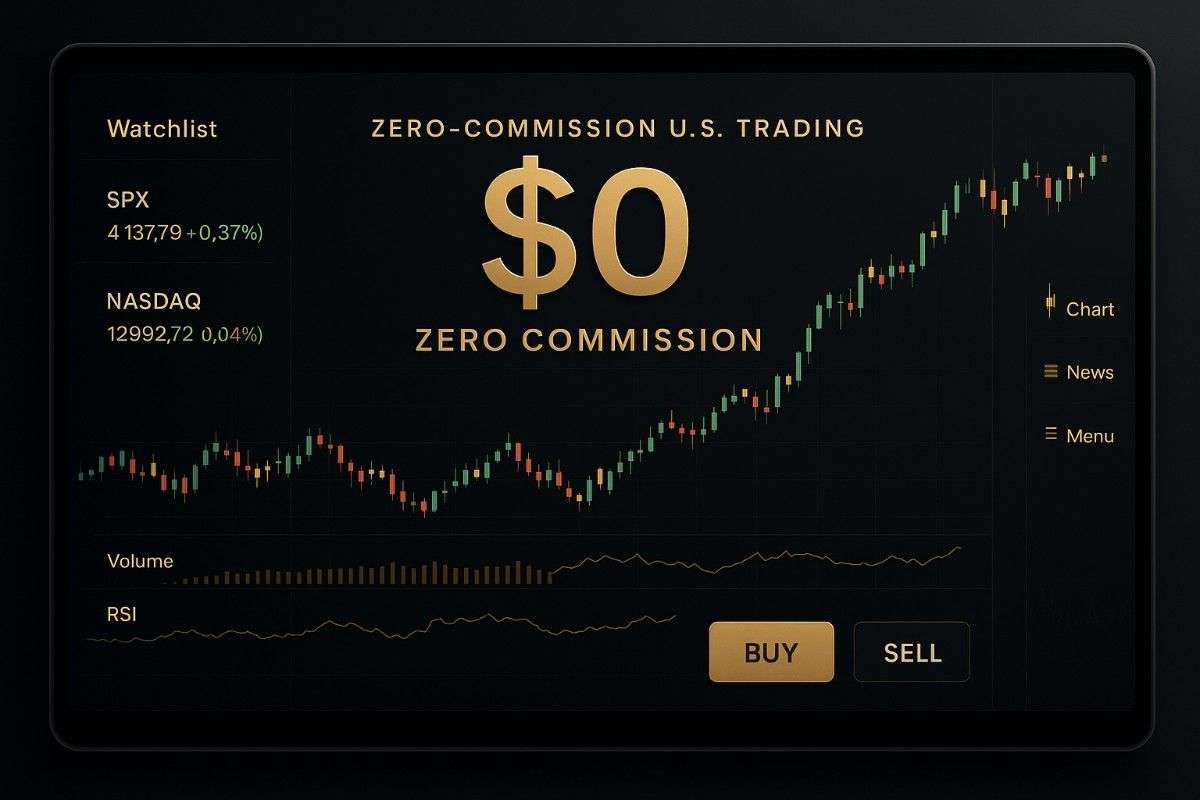
Investors in the United States today have more choice and lower costs than ever before. One of the biggest changes in the last decade has been the massive shift toward zero commission trading on stocks and exchange-traded funds. What began as a disruptive experiment by a handful of app-based brokers has now become the new normal at many major financial institutions. For traders and long-term investors, understanding how zero commission brokers work, what they offer beyond cost savings, and how they differ from each other is essential before choosing a platform.
This detailed guide explores the landscape of zero commission brokers in the USA, explains how the $0 model really works, and compares the strengths of some of the top platforms. The focus is not only on headline pricing but also on execution quality, tools, platforms, account types, safety, and the overall user experience.
Understanding Zero Commission Trading in the US
Zero commission brokers in the United States typically allow clients to trade listed US stocks and many exchange-traded funds without charging a fixed per-trade commission. In earlier years, investors routinely paid a fixed dollar amount every time they bought or sold a stock. That created friction for frequent traders and made smaller trades relatively expensive. With the rise of digital platforms and intense competition, this commission has largely been eliminated on many core products.
However, zero commission does not mean that the broker is a charity. Brokers still generate revenue in several ways. They can earn interest on uninvested cash balances in client accounts. They may charge margin interest when clients borrow funds to trade. They can collect fees for options contracts, futures, professional data, premium tools, or advisory services. Some brokers also receive payments for order flow, meaning that market makers may pay the broker in exchange for routing client orders to them. For the investor, the key question is not only whether the commission is zero but also whether trade execution, spreads, platform stability, and transparency remain strong.
The Evolution from Discount Broker to Zero Commission
The traditional model in the United States featured full-service brokers that combined advisory, research, and order execution but charged higher commissions. The first wave of discount brokers reduced fees but offered a more do-it-yourself experience. Over time, online trading reduced the cost of execution so much that the commission itself became a competitive weapon. App-based brokers came in with a mobile-first experience and zero commissions on core products. In response, major established firms matched this pricing.
Today, many of the largest US brokerages offer zero commission trading on online US stock and ETF trades for retail clients. This has raised the baseline expectation for investors. When evaluating a broker, you are now free to look beyond basic commissions and instead examine platform features, research quality, account types, educational support, and long-term reliability.
Key Factors to Consider When Choosing a Zero Commission Broker
Even though multiple brokers charge zero commission on stock trades, they are not identical. Each platform is built around a specific style of investor and trader. Before looking at individual names, it is important to clarify the factors that matter most.
First, consider the breadth of tradable products. Some zero commission brokers focus mainly on US stocks and ETFs with limited access to bonds, mutual funds, international markets, or futures. Others offer a full multi-asset ecosystem, including options, fixed income, foreign markets, and professionally managed portfolios. The right choice depends on whether you are primarily a stock investor or whether you plan to build a diversified portfolio across many asset classes.
Second, examine the platform experience. Active traders may value advanced charting tools, complex order types, real-time analytics, and highly customizable workspaces. Long-term investors may prioritise a straightforward interface, intuitive mobile apps, and clear portfolio views. Many major US brokers now provide both desktop and mobile platforms, each tuned to specific use cases.
Third, focus on reliability, regulation, and investor protection. Reputable US brokers are regulated by entities such as the Securities and Exchange Commission and the Financial Industry Regulatory Authority, and client accounts are typically protected by Securities Investor Protection Corporation coverage up to specified limits for securities and cash in the event of broker failure. Evaluating a firm’s history, financial strength, and reputation can be just as important as comparing app screenshots.
Fourth, analyse the real cost of trading beyond commissions. Margin interest rates, fees on wire transfers or paper statements, premium data subscriptions, and options contract fees can all affect your total cost. In addition, look at execution quality, including how often trades are filled at or better than the quoted price, because poor execution can quietly erode the benefit of saving a few dollars on commission.
Fifth, assess the educational content and research tools. Beginners often rely heavily on articles, videos, webinars, and model portfolios. Experienced traders may depend on sophisticated screeners, technical indicators, advanced charting, and deep fundamental research. A broker that aligns with your learning style can help you grow as an investor, not just place orders.
Major Zero Commission Brokers in the USA
In the current market, there are several high-profile zero commission brokers that stand out. While all of them offer $0 commissions on online US stock trades for retail investors, each has its own emphasis and ideal audience.
One of the most widely recognised names is the mobile-first app that popularised free stock trading for younger investors. It built its brand on a very simple user interface, instant account opening, and fractional share investing. For many first-time investors, this type of broker offers an easy on-ramp into markets. Over time, such platforms have added options trading, cryptocurrency, and cash management features. They are attractive for users who prioritise simplicity and social-style interfaces. At the same time, some of these early disruptors have faced criticism for outages during volatile periods and for gamified design that may encourage excessive risk-taking, so it is important to use them thoughtfully.
Alongside the app-based pioneers, large established brokers have embraced zero commissions while maintaining robust platforms and research offerings. Firms with long histories in asset management and brokerage now allow zero commission trades on US stocks and ETFs yet supplement that with in-depth fundamental research, retirement planning tools, and access to human advisors for an additional fee. These platforms are particularly strong for investors building long-term portfolios, retirement accounts, and diversified strategies beyond just trading popular names. Their mobile and web platforms have become more streamlined while still offering powerful analytics and screeners.
Some well-known US brokers focus strongly on active traders and options enthusiasts. These platforms team desktop software with advanced charting, streaming data, and complex order entry. They may charge a per-contract fee for options and occasionally additional charges for certain data feeds, yet stock and ETF commission remains zero for online trades. They are well suited for investors who want to go deeper into options strategies, short-term trading, and market analytics.
There are also zero commission brokers that position themselves as low-cost gateways for casual investors and those who want simple, automated investing. Some offer pre-built portfolios, robo-advisory services, and recurring investment features alongside commission-free stock and ETF trading. These can be especially useful for investors who prefer to set up systematic contributions rather than fine-tune every individual order.
Zero Commission and Options Trading
Although the headline is usually zero commission on stocks and ETFs, many US brokers also extend this model to options base commissions while still charging a per-contract fee. For investors interested in options strategies such as covered calls, protective puts, or spreads, this combination of zero base fee with a modest per-contract charge can still be cost-efficient.
When comparing brokers on options, it is important to go beyond pricing. Look at the options analytics provided, such as greeks, implied volatility charts, probability metrics, and strategy builders. Consider whether the platform allows multi-leg orders in a single ticket, whether there are risk analysis tools, and how clearly margin requirements and risks are displayed. Great options platforms will guide you without oversimplifying the complexity of derivatives.
Payment for Order Flow and Execution Quality
A recurring topic around zero commission brokers in the United States is payment for order flow. In this arrangement, market makers pay brokers for routing client orders to them. This payment helps to support the broker’s zero commission model. Critics sometimes argue that this may create a conflict of interest if the broker chooses routes based on payment rather than best execution, although brokers are still subject to regulatory requirements to seek best execution for clients.
As an investor, you should examine the broker’s disclosures and any public statistics on execution quality. Many brokers publish reports that show how often orders are executed at prices better than the public quotes and what the average price improvement is per share. While it is hard for an individual investor to fully audit execution, reviewing such data and independent analysis can provide reassurance that zero commission does not come at the hidden cost of consistent price slippage.
Account Types and Minimums
Zero commission brokers in the US generally support a range of account types without requiring large minimum balances. Many offer standard individual taxable accounts with no minimum deposit to open. They may also provide joint accounts, retirement accounts such as traditional and Roth individual retirement accounts, and custodial accounts for minors. In addition, some brokers cater to small businesses with certain retirement plans or taxable accounts under business entities.
For investors, low or no account minimums mean it is possible to start investing with a small initial amount and then build gradually. Because there is no commission on each trade, even a modest contribution can be deployed without worrying that charges will consume a large portion of the position. That said, responsible investing still calls for diversification and thoughtful allocations instead of frequent speculative micro-trades.
Margin, Leverage, and Risk
Many zero commission brokers offer margin accounts, enabling clients to borrow against the value of their securities to buy more assets. While this can amplify gains when markets move in your favour, it also magnifies losses and can trigger margin calls in volatile markets. Before enabling margin, it is vital to understand the broker’s interest rates, maintenance requirements, and risk warnings. Zero commission does not change the fundamental risk of leverage.
Some platforms market premium account tiers with lower margin rates, larger instant deposits, or extra features for a fixed monthly fee. For highly active traders who use margin extensively, the cost of borrowing often matters more than saving a few dollars in commission. Comparing margin schedules between brokers is therefore an important step for advanced users. For long-term investors focused on compounding, a cash account without leverage is often sufficient and less stressful.
Research, Tools, and Education
With commissions now so similar across major brokers, the quality of research and tools is increasingly a differentiator. Some platforms are deeply integrated with high-quality third-party research providers, offering detailed analyst reports, earnings estimates, and sector commentary. Others lean more heavily on proprietary screeners, social sentiment services, or community features.
Beginners benefit from comprehensive education libraries covering basics such as how stocks work, the role of dividends, risk management, and portfolio allocation. Videos, quizzes, and interactive courses can make the learning curve less intimidating. Meanwhile, experienced traders may look for sector-specific screeners, custom watchlists with advanced filters, trend analysis, and backtesting tools.
The best zero commission brokers combine accessible educational content with professional-grade analytics. They allow an investor to start from the basics and gradually advance to more complex strategies within the same ecosystem, without needing to switch platforms as their skills grow.
Mobile Trading and User Experience
In today’s environment, nearly every major US broker offers mobile apps for iOS and Android alongside web platforms. However, the character of these apps can differ significantly. Some are designed first and foremost for simplicity, giving traders an easy way to check their portfolios, place simple orders, and monitor basic charts. Others bring almost the full functionality of a desktop platform into a mobile layout, including advanced charting, complex order tickets, and real-time news streams.
When evaluating user experience, consider app stability, login security, navigation clarity, and customisation. Reliable biometric login, easy switching between accounts, fast access to open orders and watchlists, and a clean presentation of balances can make everyday investing smoother. Mobile notifications, price alerts, and news alerts are important for active traders who need real-time updates while away from their desk.
Customer Support and Service
Zero commission does not have to mean zero service. Many leading US brokers offer multiple channels of customer support, including phone, chat, and email. Some provide round-the-clock support, particularly for technical issues and trading emergencies. Others may maintain extended-hours support that aligns with pre-market and after-hours trading sessions.
For investors with more complex needs, some brokers also offer access to licensed financial professionals for one-on-one consultations, financial planning, or portfolio reviews, typically for a fee or as part of a relationship level. Evaluating real-world experiences from other clients, independent customer satisfaction studies, and regulatory complaint records can provide insight into how the firm treats its users when issues arise.
Security, Regulation, and Investor Protection
The safety of your capital is a fundamental priority. Reputable zero commission brokers in the US are regulated by federal and self-regulatory bodies. Client assets are usually held in segregated accounts and are protected up to certain limits by industry protection schemes in the event of broker failure. It is important to remember that this protection covers the custody of securities and cash at the brokerage, not market losses due to price movements.
On the technology side, brokers implement multiple layers of security, including encryption, multi-factor authentication, automatic logouts, and fraud monitoring. Some also provide additional alerts for login attempts from new devices or suspicious activity. As a client, enabling security features, choosing strong passwords, and keeping devices secure is an essential part of your own responsibility in the relationship.
Zero Commission Trading and Long-Term Investing
While zero commission trading became popular partly through short-term trading and social buzz around “meme stocks,” its long-term significance is quite different. The elimination of basic trading commissions makes it easier for regular investors to implement strategies such as dollar-cost averaging, gradual portfolio rebalancing, and diversified stock and ETF selection. Small contributions can be invested on a regular schedule without worrying that each trade will incur a fixed fee.
In addition, zero commission brokers that offer fractional shares enable investors to buy partial positions in high-priced stocks using modest amounts of capital. This democratises access to leading companies and allows for more precise portfolio allocations. The key is to approach these advantages with discipline rather than using them to chase every short-term move.
Comparing Zero Commission Brokers by Investor Type
Different investors will lean toward different types of zero commission brokers. A new trader who wants a simple, app-based experience and basic exposure to popular names may gravitate to platforms that emphasise ease of use and a modern-looking mobile interface. A long-term investor building retirement savings may prefer a broker known for robust research, retirement calculators, and a wide range of index funds and mutual funds.
Active options traders might choose a broker whose platform is built around complex derivatives strategies, with sophisticated charting and advanced order capabilities. Meanwhile, investors who value automatic investing and low-cost, diversified portfolios may choose a zero commission broker that integrates robo-advisory portfolios and recurring investment tools directly into the account.
When you align your broker choice with your investing style, you make the most of the zero commission environment. Instead of using price alone as the deciding factor, you match the platform’s strengths to your own goals, time horizon, and risk tolerance.
Hidden Costs to Watch For
Even in a world of zero commission trading, certain costs can still reduce your net returns. Margin interest is a prime example. If you frequently trade on margin, differences in interest rates between brokers can have a meaningful impact over time. Additionally, some brokers may charge higher fees for international trades, mutual fund transactions, or access to live professional market data feeds.
Other charges might include fees for outgoing wire transfers, account transfers to another broker, paper statements, or inactivity. None of these negate the benefits of zero commission, but being aware of them helps you avoid surprises. Carefully reading the broker’s fee schedule before opening an account is a wise habit.
Building a Personal Checklist
Before committing to a specific zero commission broker, constructing a personal checklist can be helpful. Start with your primary objective, whether it is retirement investing, active trading, or a blend of both. Then, list the features that support that objective. If you are a long-term investor, this may include strong retirement accounts, automatic investment plans, extensive research, and intuitive portfolio dashboards. If you are an active trader, your checklist may focus on advanced charts, customisable layouts, hotkeys, and real-time news.
Next, confirm that the broker offers zero commissions on the types of trades you plan to make most frequently. Verify options pricing, margin rates, and any other relevant cost items. Evaluate account protection, regulatory standing, and the reputation of the broker. Finally, test-drive the platform if possible by exploring demo accounts or starting with a small deposit to experience the interface, order flow, and customer support in practice.
The Future of Zero Commission Brokers in the USA
The zero commission model is likely to remain a permanent part of the US brokerage landscape. Competition is now shifting from headline pricing to depth of services, technology innovation, and personalised experiences. Firms will continue investing in artificial intelligence–driven tools, personalised education journeys, improved mobile experiences, and highly tailored portfolio analysis.
For investors, this creates a favourable environment. It becomes possible to access powerful tools and low-cost execution previously associated only with institutional platforms. At the same time, the responsibility for informed decision-making remains firmly with the individual. The ease and low cost of trading should not encourage reckless speculation. Instead, they can empower disciplined, research-backed strategies that build wealth over time.
Conclusion
Zero commission brokers in the USA have reshaped how both new and experienced investors approach markets. The disappearance of traditional stock trading commissions at many major firms has shifted the focus toward platform quality, education, tools, and long-term value. When choosing a broker, it is important to look beyond the $0 commission headline and to consider execution quality, product range, research, security, and how well the platform fits your own investing style.
By carefully analysing your needs, comparing the strengths of different zero commission brokers, and staying alert to hidden costs, you can take full advantage of this modern era of low-cost investing. The goal is not just to trade for free, but to build a robust, well-informed, and sustainable approach to the US stock market that supports your financial goals over many years.