
The Shift From Revenue Multiples to Economic Reality
One of the most visible changes in technology valuations in 2026 is the declining relevance of simplistic revenue multiples. During periods of low risk and easy capital, revenue growth alone was often enough to justify premium valuations. Markets assumed that scale would eventually translate into profitability, regardless of interim losses.
In a higher-risk environment, this assumption weakens. Investors increasingly ask harder questions about unit economics, customer lifetime value, and the cost required to sustain growth. Revenue that does not convert into durable cash flow is discounted more heavily. As a result, two companies with similar top-line growth can trade at vastly different valuations based on their economic quality.
This shift does not penalize growth. It penalizes growth without discipline.
Technology Valuations and the Cost of Uncertainty
Uncertainty carries a measurable cost in valuation. In 2026, technology companies operate amid uncertainty on multiple fronts, regulation, supply chains, geopolitics, data governance, and macro policy. Even if none of these risks materialize negatively, their presence increases the required return demanded by investors.
This higher risk premium compresses valuations, especially for businesses whose future outcomes are difficult to model. The more assumptions required to justify a valuation, the more fragile that valuation becomes under scrutiny.
Technology firms that simplify their narratives and demonstrate control over key variables reduce uncertainty and protect valuation integrity.
The Changing Role of AI and Automation in Valuation
Artificial intelligence and automation remain central to the technology story in 2026, but their role in valuation evolves. Markets become less impressed by abstract AI exposure and more focused on monetization, integration, and defensibility.
AI investments that enhance productivity, reduce costs, or deepen customer dependency support valuation by improving margins and cash flow visibility. AI initiatives that increase costs without near-term economic benefit are treated with skepticism.
This differentiation contributes to valuation dispersion within the sector. The presence of advanced technology alone is no longer sufficient. Economic impact matters.
Customer Concentration and Revenue Quality
Revenue concentration risk becomes more visible in a higher-risk environment. Technology companies reliant on a small number of large customers face valuation pressure if those relationships appear fragile or cyclical.
In 2026, investors assess not only how much revenue a company generates, but how diversified and resilient that revenue is. Broad customer bases with sticky usage patterns support higher valuations. Concentrated revenue streams increase vulnerability to demand shifts and contract renegotiation.
Revenue quality, not just quantity, becomes a key valuation input.
Valuation Sensitivity to Capital Expenditure Cycles
Many technology businesses require significant capital expenditure to sustain competitiveness, whether in data centers, infrastructure, or research and development. In a higher-risk environment, these expenditures carry greater weight in valuation analysis.
In 2026, investors pay closer attention to the return on invested capital from these expenditures. Heavy spending that fails to generate commensurate returns raises concerns about capital efficiency. Companies that demonstrate disciplined investment cycles and improving returns maintain stronger valuation support.
This focus reinforces the broader shift toward capital discipline across the sector.
The Decline of Valuation Support From Financial Engineering
Financial engineering once provided meaningful valuation support for technology companies. Share buybacks, stock-based compensation structures, and balance-sheet optimization helped enhance per-share metrics.
In 2026, these tools lose some effectiveness. Buybacks funded by debt face skepticism. Stock-based compensation dilutes shareholder value more visibly when growth slows. Markets become less tolerant of accounting-driven optics.
Valuations increasingly reflect operational strength rather than financial presentation.
The Impact of Talent Costs on Long-Term Valuation
Technology companies compete intensely for skilled talent. While talent remains a strategic asset, rising compensation expectations increase fixed costs. In a higher-risk environment, these costs influence valuation more directly.
In 2026, investors examine whether talent spending translates into sustainable advantage or simply higher expense bases. Companies that align talent investment with clear productivity gains defend valuation better than those with bloated cost structures.
Talent quality remains important, but cost efficiency matters more.
Valuation Resets as a Source of Opportunity
Valuation compression is often perceived as negative, but it can create opportunity. In 2026, some technology companies may experience valuation resets despite maintaining strong fundamentals. These resets reflect changing risk premiums rather than structural decline.
For long-term investors, distinguishing between repricing and impairment is critical. Businesses with durable competitive advantages, strong cash flows, and strategic relevance may emerge undervalued during periods of broad sector caution.
This selective opportunity reinforces the need for granular analysis rather than sector-wide assumptions.
Technology Valuations in a Higher-Risk 2026 Environment
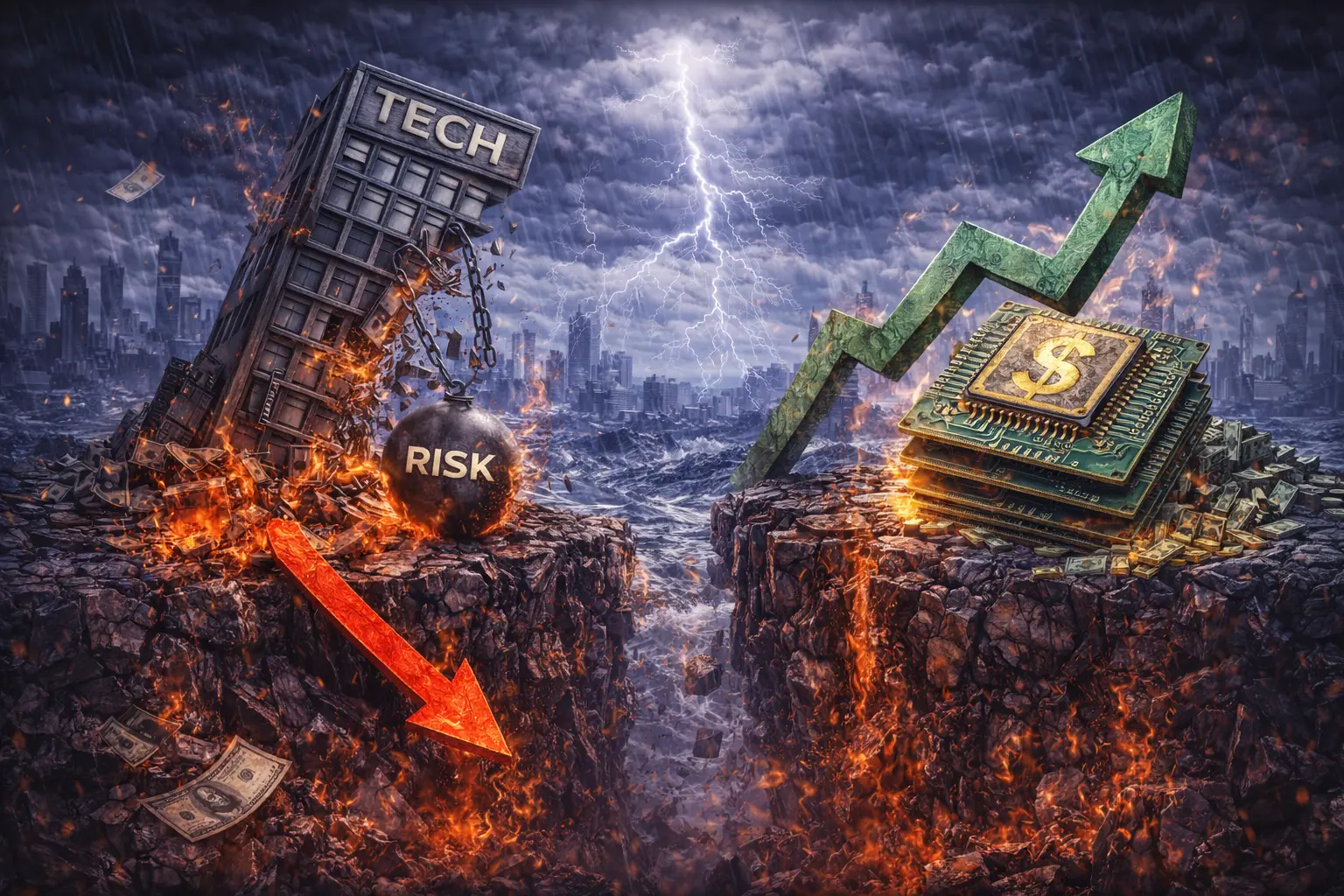
Technology valuations have always been sensitive to the mood of capital markets, but in 2026 that sensitivity becomes structural rather than cyclical. The sector enters this phase after years of extraordinary expansion driven by low interest rates, abundant liquidity, and optimistic assumptions about long-term growth. As financial conditions tighten and risk tolerance becomes more selective, technology valuations are forced to adjust to a world where capital is priced more realistically and uncertainty is persistent.
This adjustment does not imply the end of innovation or the collapse of technology businesses. Instead, it marks a transition in how value is assessed. In a higher-risk 2026 environment, technology companies are judged less on potential and more on durability, cash generation, and strategic relevance. Understanding this shift is essential for investors seeking to navigate the sector without being misled by outdated valuation frameworks.
Why Risk Perception Matters More Than Growth Narratives
Technology valuations are uniquely exposed to changes in risk perception because a significant portion of their value lies in expectations about the future. When risk tolerance is high, markets are willing to discount earnings far into the future. When risk tolerance declines, those distant earnings are discounted more aggressively.
In 2026, risk perception is shaped by interest rate volatility, geopolitical uncertainty, regulatory scrutiny, and capital discipline. Even strong growth projections may no longer justify elevated multiples if investors demand higher certainty and faster paths to profitability.
This shift explains why valuation compression can occur even when revenue growth remains healthy. The issue is not growth itself, but the confidence with which that growth can be converted into durable cash flows.
Annual Letter 2026 by Rajeev Prakash Agarwal
Markets are entering a phase where easy assumptions no longer work. Liquidity is selective, volatility is structural, and capital is rewarded only when it is positioned with clarity and discipline. In such an environment, reacting to headlines is not enough. What matters is having a forward-looking framework that helps you anticipate change rather than chase it.
The Annual Letter 2026 by Rajeev Prakash Agarwal offers a comprehensive investment outlook designed for this new market regime. It blends long-term macro analysis, market psychology, and planetary cycles that have historically aligned with major shifts in global capital flows. The focus is on understanding cycles, identifying high-probability phases, and protecting capital during periods of uncertainty.

The Repricing of Long-Duration Assets
Technology stocks are often described as long-duration assets because much of their expected value lies years ahead. In a higher-risk environment, long-duration assets suffer disproportionately because they are more sensitive to changes in discount rates and risk premiums.
In 2026, this sensitivity becomes more pronounced. Small increases in perceived risk or required return can lead to significant valuation adjustments. Companies with distant profitability or heavy reinvestment needs face greater scrutiny than those already generating stable cash flows.
This dynamic favors technology businesses that have moved beyond experimentation into scalable, monetizable operations.
Cash Flow Quality as the New Valuation Anchor
As risk tolerance declines, cash flow quality becomes the primary anchor for valuation. Markets distinguish between reported profits and free cash flow that can be reinvested or returned to shareholders.
In 2026, technology companies that consistently generate free cash flow gain a valuation advantage. Their ability to self-fund growth reduces dependence on capital markets and lowers perceived risk. Conversely, firms that rely on continuous funding to sustain operations face higher discount rates.
This emphasis on cash flow does not diminish innovation. It rewards innovation that is economically grounded rather than speculative.
Margin Stability and Operating Leverage Under Scrutiny
Operating leverage amplifies both upside and downside. In favorable conditions, technology companies can scale rapidly with limited incremental cost. In a higher-risk environment, that leverage exposes fragility if revenue growth slows.
In 2026, investors pay closer attention to margin stability. Technology models with volatile margins or heavy fixed costs face valuation pressure when growth assumptions are questioned. Companies that demonstrate disciplined cost control and resilient margins command greater confidence.
This scrutiny reshapes how markets reward scale. Size alone is insufficient. Stability matters.
The Role of Balance-Sheet Strength in Valuation
Balance-sheet strength influences technology valuations more directly in 2026. Cash reserves provide optionality and reduce risk, while debt increases sensitivity to rate volatility and refinancing conditions.
Technology companies with strong balance sheets can invest through uncertainty, pursue acquisitions opportunistically, and withstand demand fluctuations. Their valuations reflect this resilience. Firms with leveraged structures or limited liquidity face higher risk premiums, even if growth prospects appear attractive.
The market increasingly views balance sheets as strategic assets rather than accounting details.
Regulation, Data, and the Valuation Risk Premium
Regulatory risk adds another layer to technology valuation in 2026. Data privacy, competition policy, and platform oversight influence how investors assess long-term profitability.
Uncertainty around regulatory outcomes increases risk premiums, particularly for dominant platforms or data-intensive models. Valuations incorporate not only expected earnings but also the probability of structural changes imposed by policy.
Companies that proactively adapt to regulatory expectations and diversify revenue streams reduce this valuation drag.
Valuation Dispersion Within the Technology Sector
One of the defining features of 2026 is increased dispersion within technology valuations. The sector no longer trades as a single narrative. Differences in business models, cash flow profiles, and risk exposure lead to wide valuation gaps.
This dispersion creates both risk and opportunity. Broad technology exposure may underperform selective strategies that emphasize quality and resilience. Investors who analyze technology through a uniform lens risk mispricing both strength and weakness.
Understanding dispersion is critical for navigating a higher-risk environment.
The Psychological Shift From Momentum to Discipline
Valuations are influenced by psychology as much as fundamentals. In prior cycles, momentum and narrative drove technology valuations higher. In 2026, psychology shifts toward discipline and accountability.
Investors question assumptions, demand evidence, and reduce tolerance for prolonged losses. This shift does not eliminate optimism about technology’s role in the economy, but it channels that optimism into more rigorous evaluation.
Companies that embrace transparency and realistic guidance benefit from this change in sentiment.
The Astrological Context of Valuation Reassessment
From a financial astrology perspective, periods associated with Saturn often coincide with reassessment, discipline, and the exposure of excess. These phases favor substance over speculation and reward structures that can endure constraint.
In 2026, this context aligns with observable valuation behavior. Technology companies grounded in real economic contribution fare better than those dependent on perpetual optimism.
Astrology complements financial analysis by highlighting timing and regime change rather than specific price targets.
Long-Term Value Creation Beyond Valuation Compression
Valuation compression does not imply destruction of long-term value. It reflects a recalibration of expectations. Technology companies that adapt to this environment by strengthening cash flows, improving margins, and managing risk can emerge stronger.
In 2026, the reset in valuations may create opportunities for patient investors who focus on fundamentals rather than short-term sentiment. Understanding the difference between cyclical compression and structural impairment is essential.
Conclusion: Valuing Technology With Realism in 2026
Technology valuations in a higher-risk 2026 environment demand realism. Growth remains important, but it must be credible, financed sustainably, and aligned with long-term demand. Cash flow, balance-sheet strength, and margin resilience become the core drivers of value.
Investors who recognize this shift avoid the extremes of fear and enthusiasm. They approach technology not as a monolithic trade, but as a diverse set of businesses facing different risk profiles.
This perspective aligns with the broader philosophy of rajeevprakash.com and the Annual Letter 2026, where the emphasis is on understanding structural change, managing risk thoughtfully, and identifying durable value in an uncertain world.