
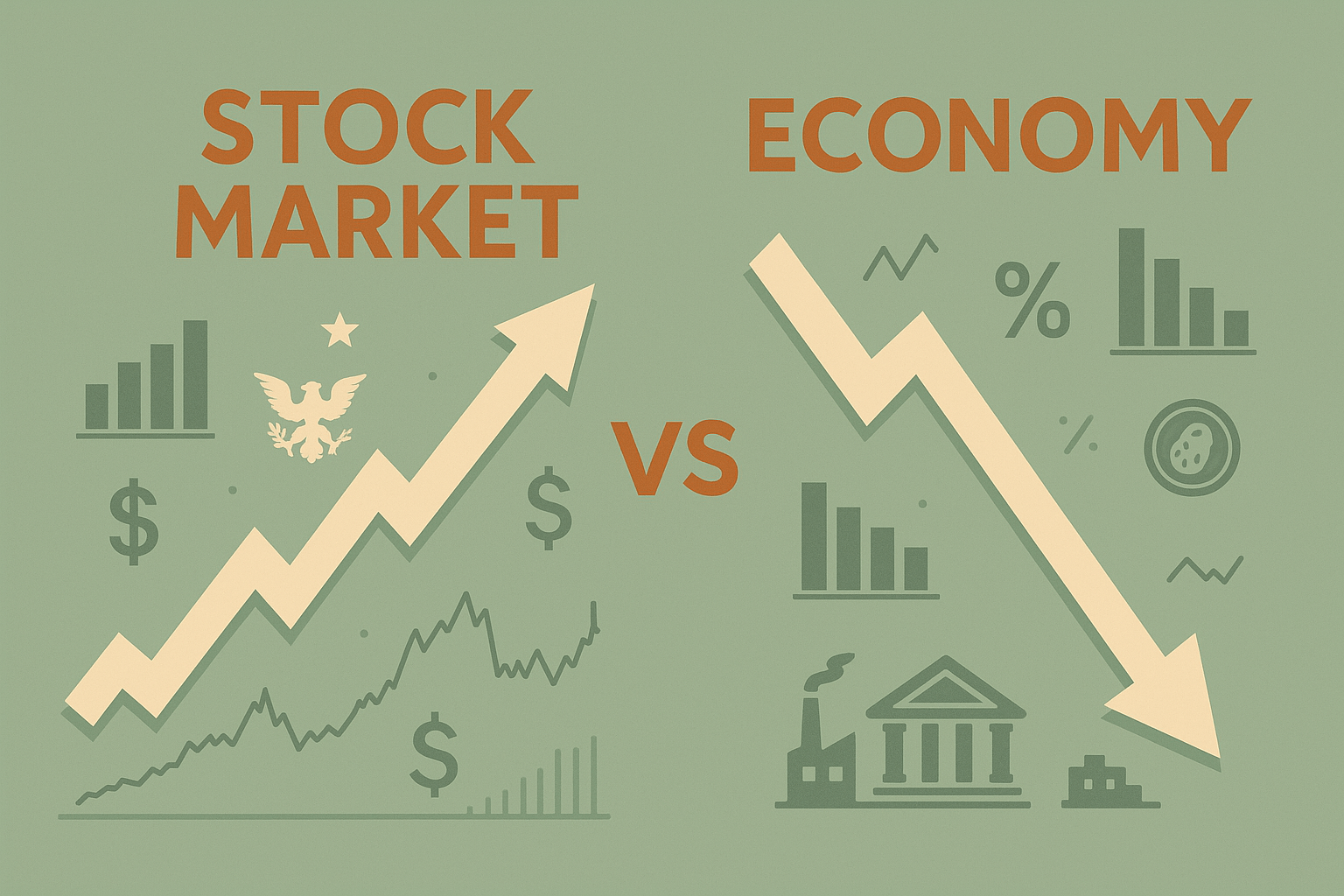
Many people assume that when the stock market is up, the economy must be doing well—and vice versa. While there is often some correlation between the two, they are not the same. In fact, it’s common to see the stock market soaring even while the economy is struggling, or the economy expanding while the markets remain flat.
Understanding the differences and dynamics between the stock market and the economy is essential for investors, policy makers, and everyday citizens trying to make sense of the financial world.
What Is the Stock Market?
The stock market refers to public exchanges where shares of companies are bought and sold. It represents investor sentiment and expectations about corporate profitability, interest rates, inflation, global events, and future growth.
Major stock indices like the S&P 500, Dow Jones, Nifty 50, or Sensex are often used as benchmarks to reflect market trends. However, they primarily track the performance of large-cap, publicly traded companies, not the broader economy.
What Is the Economy?
The economy encompasses the entire system of production, consumption, employment, income, trade, and investment within a country. Economic health is measured using indicators like:
- Gross Domestic Product (GDP)
- Unemployment rate
- Consumer Price Index (CPI)
- Retail sales
- Industrial production
These metrics provide a broader and more holistic view of the financial well-being of households, businesses, and governments.
Key Differences: Stock Market vs Economy
| Aspect | Stock Market | Economy |
|---|---|---|
| Definition | Marketplace for buying/selling public company shares | National financial activity across sectors |
| Focus | Corporate earnings, investor sentiment | Jobs, wages, production, inflation, GDP |
| Measurement | Index performance (Nifty, Sensex, S&P 500) | Economic indicators (GDP, CPI, Unemployment) |
| Volatility | High – reacts instantly to news | Slower – measured quarterly or yearly |
| Influence Factors | Earnings, interest rates, policy, liquidity | Policy, consumption, industrial output, inflation |
| Represents | A segment of the economy (mainly large corporations) | Entire nation including SMEs, agriculture, services |
| Time Horizon | Forward-looking (future expectations) | Backward or real-time looking |
Why the Stock Market and Economy Often Diverge
In recent years, especially during events like the COVID-19 pandemic, investors have noticed a strange disconnect: while millions lost jobs, stock prices reached all-time highs. How is that possible?
Here’s why they often move independently:
1. Stock Market is Forward-Looking
Markets are driven by future expectations. Investors make decisions based on what they believe will happen 6–12 months ahead. If there’s optimism about recovery—even in a recession—markets can rally in advance.
2. Central Bank Influence
In response to economic crises, central banks often inject liquidity by lowering interest rates and launching asset purchase programs. This easy money fuels stock prices, even when the real economy is weak.
3. Market Skew Toward Tech & Large Firms
Major indices are dominated by large-cap, tech-driven companies (e.g., Apple, Google, Reliance, Infosys). These companies may thrive even when small businesses or local economies suffer.
4. Corporate Profits vs Worker Wages
Stock prices reflect profits—not wages, job creation, or inequality. Companies may boost share prices by cutting costs, laying off workers, or automating operations, which helps markets but hurts the labor market.
Does a Booming Market Mean a Booming Economy?
Not necessarily. Here’s why:
- Stock ownership is limited: Only a fraction of the population owns stocks, especially in developing countries.
- Market gains are uneven: Gains may concentrate in sectors like tech or pharma, not across all industries.
- Speculative bubbles can drive markets higher without real economic backing.
The market may be booming, but wages may be stagnant, unemployment may be high, and inequality may worsen.
When the Economy Improves Before Markets Do
There are also times when economic growth outpaces market gains, such as:
- Post-crisis periods, where investors are cautious
- Tight monetary policy, which restricts liquidity
- Corporate underperformance, even when demand returns
In these cases, the economy may heal, but market sentiment takes time to catch up.
What This Means for Investors
- Don’t equate market rallies with economic recovery. Assess the fundamentals.
- Diversify investments based on sector performance, not just index trends.
- Use macro indicators (like inflation and employment) alongside market data to guide decisions.
- Beware of overreactions – the market may be irrational in the short term.
Can the Stock Market Predict the Economy?
The stock market is often referred to as a leading economic indicator, meaning it tends to move ahead of the actual economy. Investors price stocks based on what they expect to happen, not necessarily on current economic conditions. That’s why you might see markets rebounding even while GDP is shrinking or unemployment is rising.
Historically, markets begin to recover months before an economic recession ends. For example:
- During the 2008 financial crisis, markets bottomed out in March 2009, months before GDP growth resumed.
- In the COVID-19 pandemic, stocks recovered sharply by mid-2020, even though the global economy was still reeling.
This illustrates how markets are forward-looking, trying to anticipate the next phase, not reacting solely to the present.
Stock Market Is a Partial View of the Economy
While the stock market is influential, it represents only a slice of the full economy—mainly large, publicly traded companies. It excludes:
- Small businesses
- Informal sectors
- Agricultural labor
- Rural employment
- Unlisted or private companies
For example, a booming stock market may reflect strong tech sector profits, but millions of small retailers or service workers may still be struggling. This disconnect leads to an “uneven recovery” narrative, where Wall Street thrives while Main Street lags.
Market Sentiment vs. Economic Reality
A powerful force in the stock market is sentiment—how investors feel about the future. Optimism about new technology, political stability, or central bank actions can drive a rally even when the economy is stagnant. Conversely, fear and uncertainty can cause a sell-off, even during strong economic growth.
Some of the emotional drivers include:
- Fear of missing out (FOMO)
- Panic selling
- Herd mentality
- Speculation based on headlines, not data
That’s why financial markets sometimes overreact or underreact, creating a gap between valuation and real economic fundamentals.
Globalization Makes the Gap Wider
In today’s interconnected world, large companies listed on stock exchanges don’t rely solely on their domestic economy. A company listed in India may earn a significant portion of its revenue from the U.S., Europe, or Asia.
So even if India’s GDP slows, its stock market may remain buoyant if:
- Exports are strong
- Global demand is high
- Foreign institutional investors are active
This further decouples stock market trends from the local economy, making it even more important to analyze both separately.
Final Thoughts: Seeing the Full Picture
The stock market and the economy are two different lenses through which we view financial health. While they influence each other, they don’t always move in sync. The stock market is a barometer of sentiment and expectations, whereas the economy is the foundation of real-life financial activity.
Understanding both gives you a deeper, more strategic view of where opportunities and risks lie.
At RajeevPrakash.com, we help you decode not just market trends—but their relationship with macroeconomic shifts, astrology, and financial timing. If you’re looking to align your investment journey with deeper insights, you’re in the right place.