

Markets do not move on astrology alone. Earnings, liquidity, geopolitics, and positioning remain the primary drivers. Still, many investors track astrology because it often highlights the same thing market veterans obsess over: timing, sentiment shifts, and volatility clusters. In that sense, planetary alignments work best as a “risk calendar” that helps you anticipate when trend changes are more likely, so you can manage exposure, tighten stops, avoid emotional overtrading, and watch for reversals.
In 2026, the reason this approach becomes especially interesting is that the year contains a clean set of “macro timing triggers” that traders already associate with unstable price action: eclipse season in February–March and again in August, a rare Venus retrograde tied directly to money and valuation psychology in October–November, and major sign shifts that can coincide with sector rotation and leadership changes. Time those with known market rhythms like quarterly results, central-bank windows, and option expiry behavior, and you get a practical framework for identifying possible turning points.
What follows is a detailed, WordPress-ready guide that stays grounded in probability, not certainty. Use it to plan watchlists, reduce surprises, and treat the most intense windows as “decision zones” where markets are more likely to shift direction or accelerate.
How to Use Planetary Alignments as a Market-Timing Tool
Astrology becomes useful for markets when it is treated as a volatility lens rather than a prediction machine. The aim is not “the market will crash on this date.” The aim is “this is a high-energy window where reversals, breakouts, policy surprises, or sentiment swings become more likely.”
The simplest trading application is to mark the calendar for dates that historically correlate with emotional extremes: eclipses, retrogrades, and major sign ingresses of slow-moving planets. Then, you compare those windows against technical structure. If the market is already stretched, overbought, and complacent, the same timing trigger can produce a fast pullback. If the market is depressed and fear-heavy, the same trigger can produce a violent relief rally. The alignment does not decide the direction, it amplifies the probability of a turning point when conditions are ripe.
In 2026, four event families matter most.
Eclipses often align with narrative resets, because eclipses symbolically “switch off and switch on” an old storyline. In real markets, that can look like abrupt repricing after a new policy signal, a shock headline, or a sudden change in liquidity conditions. Timeanddate lists four eclipses in 2026: an annular solar eclipse on February 17, a total lunar eclipse on March 2–3, a total solar eclipse on August 12, and a partial lunar eclipse on August 27–28.
Venus retrograde is traditionally tied to reassessing value, price, desire, and financial comfort. Whether you read that symbolically or psychologically, it often maps well to periods where markets debate “what is this really worth?” and where sentiment around consumer demand, luxury, fintech, and risk appetite can flip. For New Delhi timing, Drik Panchang places Venus retrograde from October 3 to November 13, 2026.
Saturn and Jupiter sign ingresses can correspond to leadership changes across asset classes. Saturn tends to emphasize discipline, friction, and the cost of capital. Jupiter tends to expand optimism and risk-taking. In 2026, Saturn is shown entering Aries on February 13 (after its 2025 preview), and remaining there into 2028. Jupiter enters Leo on June 30, 2026, and remains there into mid-2027.
Finally, Uranus sign changes are often linked with technology themes, disruption narratives, and sudden rotation. Several astrology outlets describe Uranus transitioning into Gemini in 2026, framing it as a long-cycle shift that can reprice the “communications and information” theme. Even if you do not treat that as causal, it is a helpful calendar marker for the kinds of years where tech, AI, telecom, and “new infrastructure” storylines can rotate into or out of leadership.
The Core 2026 Turning-Point Calendar for Investors
Before we go quarter by quarter, anchor the year around the highest-impact dates. The eclipses create two volatility seasons, one in late winter and one in late summer. The Venus retrograde creates a valuation debate season in autumn. The Jupiter and Saturn sign shifts create a mid-year “leadership change” theme.
The 2026 eclipse set is especially clean. Timeanddate confirms the February 17 annular solar eclipse and the March 2–3 total lunar eclipse, followed by the August 12 total solar eclipse and the August 27–28 partial lunar eclipse. Space.com also highlights the February 17 annular eclipse as a significant astronomical event.
The main idea for traders is simple. Treat the two to three weeks around these eclipse clusters as higher probability “trend change” zones. If the market enters that window with extreme positioning, it becomes a candidate for a sharp reversal. If it enters with consolidation, it becomes a candidate for breakout and trend acceleration.
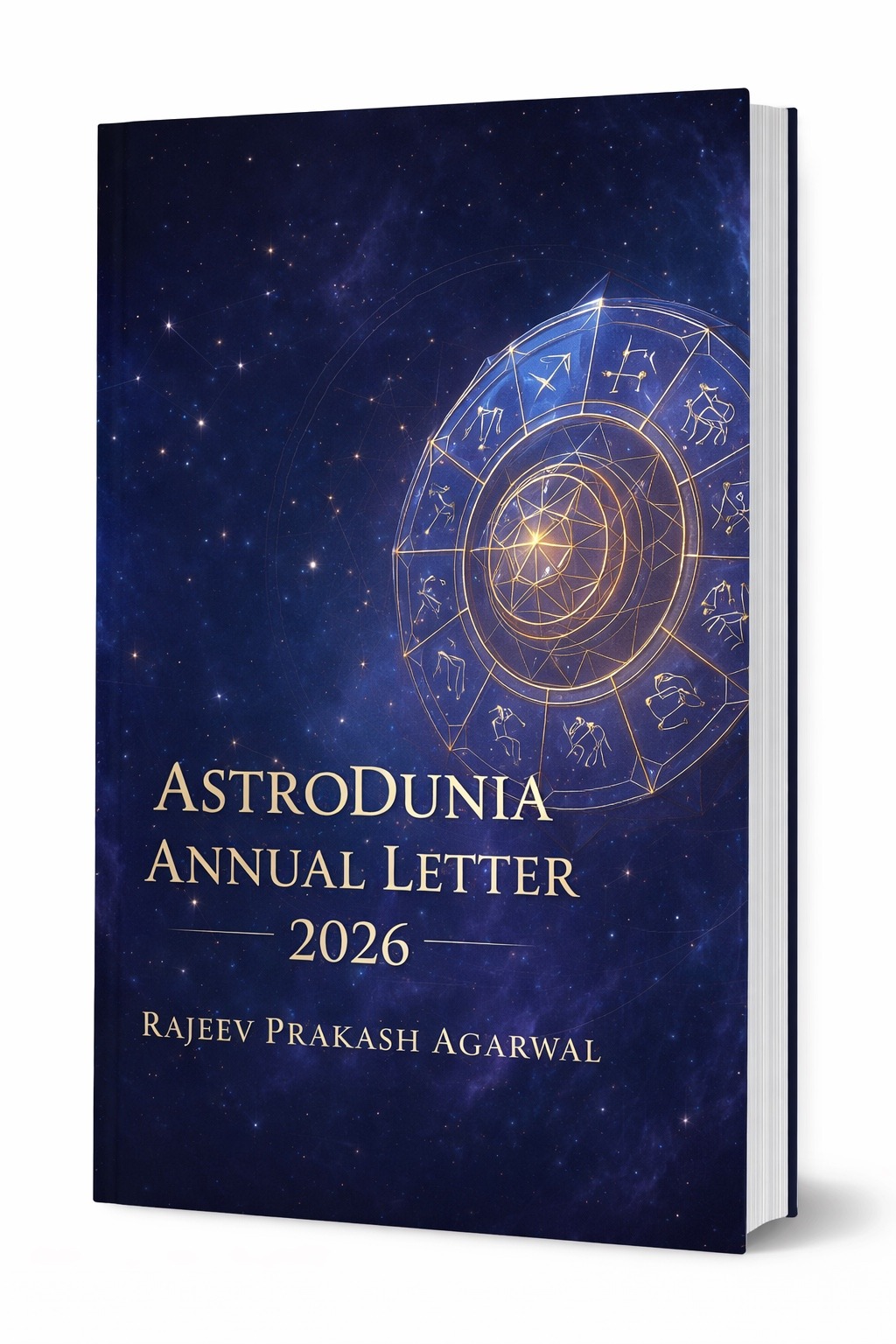
Annual Letter 2026 by Rajeev Prakash Agarwal
The Annual Letter 2026 presents a deep, forward-looking perspective created for committed investors, active market participants, and strategic thinkers operating in an era of accelerating global change. It interprets the year ahead by integrating planetary cycles with macroeconomic trends, investor psychology, and long-term structural shifts shaping equities, commodities, currencies, digital assets, and international capital movements.
Rather than offering short-term trade ideas or headline-driven forecasts, this letter provides a strategic lens for understanding how 2026 is likely to redefine risk management, opportunity cycles, regulatory dynamics, and sustainable wealth creation.
Turning Points in Q1 2026: February–March Volatility Cluster
Why Q1 Can Feel Like a Regime Reset
The year begins with markets still digesting whatever 2025 delivered: inflation progress, growth stability, geopolitics, and liquidity expectations. Q1 often carries the first major repricing of the year because positioning is rebuilt, fiscal narratives restart, and central banks set the tone early.
In 2026, Q1 is also anchored by Saturn re-entering Aries on February 13, 2026. Saturn symbolism tends to correlate with “reality checks,” cost discipline, and the consequences of leverage. Aries is associated with initiative, aggression, and leadership. When you blend those ideas, the market translation is a period where leaders are forced to prove strength, weaker business models face harsher scrutiny, and risk management becomes more important than storytelling.
The February 17 Solar Eclipse as a Shock Window
Timeanddate lists an annular solar eclipse on February 17, 2026. In market practice, solar eclipse windows are often watched for sudden narrative shifts. The practical use is to treat mid-February as a possible “headline shock” period. If equities have run hot into that window, you watch for reversal patterns, volatility expansion, or a spike in defensive flows. If equities are weak into that window, you watch for capitulation and a sharp rebound.
The March 2–3 Total Lunar Eclipse and Emotional Extremes
Timeanddate lists a total lunar eclipse on March 2–3, 2026. Lunar eclipses are often associated with emotional clarity, endings, and exposure. Translating that into markets, this is a classic period where hidden stress can surface: funding conditions, credit spreads, earnings warnings, or geopolitical risk. It is also a period where late shorts can get trapped if the market refuses to break lower and suddenly rallies.
Q1 Market Playbook
The Q1 alignment suggests this kind of rhythm. February into early March carries elevated turning-point probability. If the market is trending strongly, the odds of a pullback or at least a volatility burst increase. If the market is range-bound, the odds of a decisive breakout increase. Saturn’s Aries entry can also favor themes like defense, industrial discipline, infrastructure, and “real economy” businesses that benefit from seriousness rather than hype, while punishing overpromised growth narratives if rates or credit conditions tighten.
Turning Points in Q2 2026: Innovation Rotation and Repricing of Risk
Mercury Retrograde as a Market “Noise Amplifier”
Many traders track Mercury retrograde because it maps well to periods of mixed signals, revisions, miscommunication, and headline whiplash. In practical trading terms, these windows can produce false breakouts and sudden reversals, especially in high-beta stories that rely on perfect narrative clarity.
Multiple mainstream astrology outlets discuss 2026 Mercury retrograde periods, with coverage indicating three main retrograde windows during the year. Even if you do not trade the exact dates, the key takeaway is that Q2 can contain a “signal versus noise” problem where markets overreact to partial data.
Uranus Themes and the Tech Narrative
Several sources discuss Uranus moving into Gemini as a multi-year theme beginning in 2026. Uranus is traditionally tied to disruption and sudden change. Gemini is associated with communication, networks, data, and speed. The market translation is straightforward: technology, AI, cybersecurity, telecom infrastructure, platforms, and information-driven business models can see sudden leadership shifts.
That does not guarantee a tech bull market. It can also mark the start of aggressive dispersion inside tech, where winners and losers diverge sharply. In real-world terms, that is the kind of environment where megacaps may pause while niche enablers or infrastructure plays lead, or where speculative pockets surge and then collapse quickly.
Q2 Market Playbook
Treat Q2 as a rotation quarter. If Q1 was a “reality check,” Q2 can become the “rebuild and reprice” phase. If the market embraced defense and value earlier, it may selectively return to growth narratives, especially if rates stabilize. If the market was already in a growth-led rally, Q2 can expose weak balance sheets and force a reset. Align your approach with strict risk control and look for leadership changes rather than expecting the same stocks to dominate all year.
Turning Points in Q3 2026: Jupiter Enters Leo and the August Eclipse Season
June 30: Jupiter Enters Leo and the Mood Shift Toward Risk
Cafe Astrology lists Jupiter in Leo from June 30, 2026 to July 26, 2027. Jupiter is associated with expansion, optimism, and growth. Leo is associated with confidence, visibility, and leadership. In market psychology, this combination can coincide with a more confident bid for risk assets, a stronger appetite for themes that feel exciting or “front page,” and a preference for companies with brand power, pricing narratives, and growth charisma.
This can show up as renewed strength in consumer discretionary, entertainment, luxury, media, and even high-profile AI or tech names that capture public imagination. It can also lift IPO sentiment and speculative appetite, although the exact outcome depends on liquidity and rates.
August 12 Total Solar Eclipse: Major Trend Change Potential
Timeanddate lists a total solar eclipse on August 12, 2026. Solar eclipses are the classic “reset switch” in astrology-based market timing. In practice, mid-August is already seasonally sensitive in many markets because liquidity can be thinner and news shocks travel faster through price. That makes this one of the most important turning-point candidates of the year.
If markets are euphoric into early August, this window can align with a sharp correction, a volatility event, or a sudden rotation out of the hottest leadership. If markets are weak into early August, it can align with a bottoming process and a strong rebound. The key is to watch what price is doing before the eclipse, not to assume the direction.
August 27–28 Partial Lunar Eclipse: Confirmation or Reversal
Timeanddate lists a partial lunar eclipse on August 27–28, 2026. If August 12 created the initial shock, late August can often act like a confirmation point. Markets sometimes “show their true hand” around the second eclipse, revealing whether the earlier move was real trend change or simply a temporary spike.
Q3 Market Playbook
The Jupiter-in-Leo shift suggests that late June and July can feel more optimistic, but the August eclipse season warns that optimism can be tested. This is a classic setup for a mid-year rally that meets an August reality check. It is also a classic setup for “fast rotations,” where the index may not move dramatically but leadership inside the index changes quickly. If you manage a portfolio, this is the quarter where rebalancing discipline matters because chasing performance can become expensive.
Turning Points in Q4 2026: Venus Retrograde and the Valuation Debate
October 3 to November 13: Venus Retrograde as a Repricing Window
Drik Panchang lists Venus retrograde for New Delhi from October 3, 2026 to November 13, 2026. Vogue’s 2026 astrology dates coverage also highlights Venus retrograde from early October to mid-November.
Venus is the clearest “money and value” planet in classical astrology. When Venus goes retrograde, the symbolism is about reconsidering what is desirable and what is overpriced. In markets, this period often corresponds well to valuation arguments, style factor flips, and shifts in consumer sentiment. Sometimes it manifests as weakness in luxury, high-multiple growth, and momentum. Sometimes it manifests as a rotation back into quality, dividends, cash flow, and profitability.
This is also a period where relationship dynamics matter in markets: mergers, partnerships, pricing power, and brand trust. In practical terms, companies with fragile customer loyalty or questionable unit economics can face sharper scrutiny, while companies with genuine pricing power and strong balance sheets may outperform.
How Venus Retrograde Can Show Up by Asset Class
In equities, Venus retrograde can coincide with multiple compression, especially if investors start prioritizing certainty over excitement. In commodities like gold, this period can sometimes align with renewed focus on “real value” and safety, especially if there is macro stress, although the direction depends on real yields and the dollar. In crypto and speculative assets, it can align with a “value reckoning,” where narratives are tested and weaker tokens or themes underperform.
Q4 Market Playbook
Treat October and early November as a “review season.” It is a time to audit portfolio quality, reduce weak positions you are holding out of hope, and focus on what is actually working. If you are a trader, this can be a strong period for mean reversion strategies because valuations and sentiment often swing more violently. If you are a long-term investor, it can be a constructive period to accumulate quality when the market overreacts, provided the macro backdrop supports it.
Sector-Level Outlook Through an Astrology Lens
Technology, AI, Telecom, and Data Infrastructure
With Uranus-to-Gemini narratives emphasized for 2026 by several sources, expect sharper dispersion and faster rotations inside tech. Watch for turning points in Q2 and again around August. Instead of assuming “tech up” or “tech down,” think in terms of shifting subthemes: chips, cloud, cybersecurity, telecom infrastructure, and software pricing power.
Consumer Discretionary, Media, and Brand Power
Jupiter entering Leo on June 30, 2026 can support confidence-driven spending narratives and high-visibility companies. If the macro data cooperates, late June through July can favor these themes. The August eclipses then act as a stress test: if the consumer is weaker than headlines suggest, the rotation can reverse fast.
Defense, Industrials, and “Serious Capital”
Saturn in Aries from February 13, 2026 has a disciplined, action-oriented tone. That can align with themes like defense, infrastructure, industrial productivity, and energy security, particularly if geopolitics or policy spending remains elevated. The key risk is that Saturn can also tighten financial conditions psychologically, making markets less forgiving of leverage.
Gold, Bonds, and Risk-Off Hedges
Eclipse seasons can increase demand for hedges because traders react to uncertainty and narrative shocks. If you use gold or duration as portfolio stabilizers, the best timing often appears when complacency is highest. The February–March and August windows are candidates for that, especially if volatility has been suppressed.
A Practical “Turning Point” Framework You Can Apply All Year
A simple way to use this content operationally is to treat each major alignment as a three-layer checklist.
The first layer is the calendar trigger itself, such as February 17, March 2–3, August 12, August 27–28, June 30, and October 3 to November 13.
The second layer is market condition. You check whether the market is extended, crowded, complacent, or fearful. Turning points happen more easily when positioning is one-sided.
The third layer is technical structure. You look for break of trendline, volatility expansion, failed breakouts, or reversal candles around those dates. That is where astrology becomes practical: it tells you when to watch more closely, not what to believe blindly.
Closing Perspective: Forecasts as Probabilities, Not Promises
If you want one clean message for 2026, it is this. Expect the strongest turning-point probability around late winter and late summer due to the eclipse clusters, expect a mid-year leadership shift as Jupiter enters Leo, and expect an autumn valuation debate during Venus retrograde.
Use these windows as decision points. Tighten risk before them if you are overexposed, and stay flexible if the market breaks structure. If nothing happens, you lose nothing by being prepared. If something happens, you gain the one advantage that matters most in markets: readiness.