
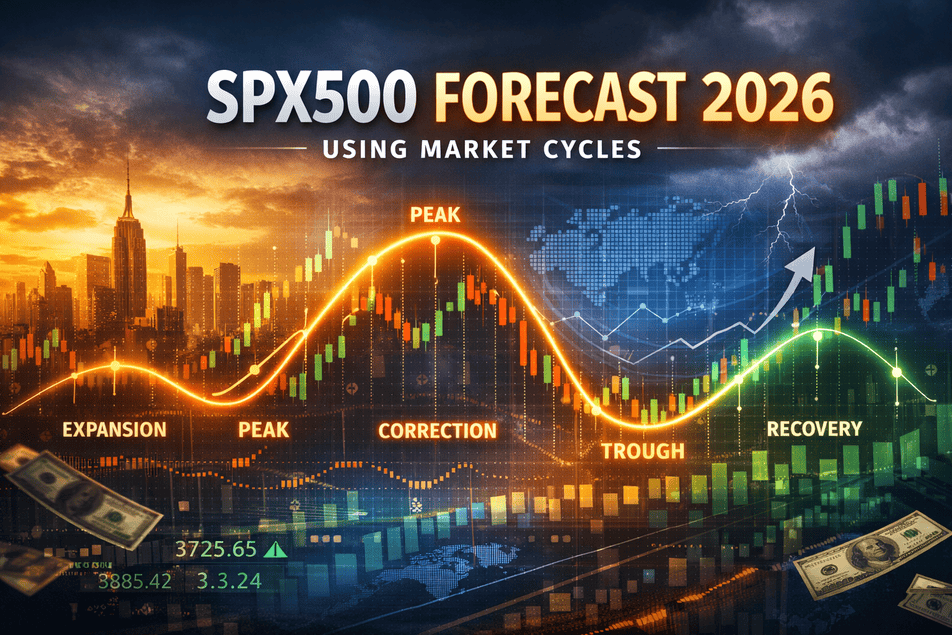
The SPX500 remains one of the most closely watched equity benchmarks in the world because it reflects the direction of major American companies, investor confidence, monetary expectations, and the broader rhythm of global capital flows. For traders, investors, and market observers, forecasting the SPX500 in 2026 is not only about studying earnings, inflation, or interest rates. It is also about understanding market cycles. Market cycles shape trends, reversals, breakouts, consolidations, and long-term investor psychology. When these cycles are studied carefully, they offer a structured way to interpret where the market may be heading next.
A market cycle approach does not claim that price will move in a straight line or that every phase will unfold exactly as expected. Instead, it helps identify where the market stands within a broader sequence of expansion, exhaustion, correction, accumulation, and renewed momentum. This is especially useful for a major index like the SPX500, where sentiment often shifts before headline narratives fully catch up. By using market cycles, traders can build a clearer framework for the SPX500 forecast 2026 and avoid relying only on emotional or short-term reactions.
The year 2026 is likely to be an important phase for the SPX500 because markets may be moving from one established macro environment into another. After periods of tightening, easing, optimism, valuation stress, and sector rotation, the index may enter a stage where cycle analysis becomes even more valuable. Instead of asking only whether the SPX500 will rise or fall, a more useful question is this: where is the market in its broader cycle, and what does that imply for the likely path in 2026?
This article explores the SPX500 forecast 2026 using market cycles in a practical and detailed way. It explains how market cycles work, what they reveal about price behavior, how macro and sector patterns influence the index, and how traders can use cyclical thinking to prepare for a volatile but opportunity-rich year.
Understanding the Meaning of Market Cycles in the SPX500
Market cycles represent recurring phases that appear in financial markets over time. These phases are not identical in every period, but they often follow recognizable patterns. In the SPX500, market cycles can be seen in the way major trends build, peak, correct, and recover. They are influenced by liquidity conditions, earnings trends, investor psychology, interest rate expectations, and institutional capital movement.
A bullish cycle often begins quietly. Valuations may not look especially exciting, sentiment is usually mixed, and only a few sectors begin to outperform. Over time, confidence expands, more stocks participate, and momentum improves. This early stage is followed by a mature uptrend where optimism becomes widespread and prices often move faster than underlying fundamentals. Eventually, the cycle becomes stretched. Volatility rises, leadership narrows, and the market becomes vulnerable to deeper pullbacks or a broader corrective phase.
A bearish or corrective cycle works in the opposite direction. Weakness may begin in a few sectors, then expand into the wider index. Investors shift from enthusiasm to caution. During this period, even good news may fail to push prices much higher. The market then enters a reset phase where excess valuation, overcrowded trades, or unrealistic expectations are gradually washed out. Once this process matures, accumulation begins again and a new positive cycle can form.
In the SPX500, these cycles matter because the index includes businesses from multiple sectors, including technology, healthcare, financials, industrials, consumer discretionary, energy, and communication services. That makes the index a broad reflection of the US economic and financial cycle. When traders study SPX500 market cycles, they are really studying the changing balance between growth expectations, liquidity, risk appetite, and institutional positioning.
SPX500 Market Cycle Forecast Tool
Explore how different market cycle phases can shape the SPX500 outlook for 2026.
Forecast Insight
Choose your market conditions and generate a forecast.
Why Market Cycles Matter More Than One-Day Narratives
Short-term news can move the SPX500 sharply, but one-day or one-week headlines rarely explain the full direction of the market. A strong inflation number, a Federal Reserve statement, a geopolitical shock, or an earnings surprise can trigger immediate price reactions. However, the larger trend often depends on where the index sits within a broader cycle.
If the SPX500 is in a strong expansion cycle, negative news may cause only temporary dips because market participants still expect higher prices over time. On the other hand, if the market is already in a late-stage cycle with stretched valuations and weakening breadth, even mildly disappointing data can trigger a more lasting correction. This is why market cycles offer deeper insight than headline-driven analysis.
For a 2026 forecast, this point becomes especially important. Many investors will focus on current earnings expectations, interest rate direction, and political developments. Those factors matter. But the bigger edge often comes from recognizing whether the market is entering 2026 with strong internal momentum, fading momentum, or a reset structure. That cyclical position will heavily influence how news is interpreted by traders and institutions.
The Probable Cyclical Structure for SPX500 in 2026
The SPX500 forecast 2026 using market cycles suggests that the year could be shaped by alternating phases rather than a single uninterrupted trend. This means 2026 may not be a simple bullish or bearish year. Instead, it may include a sequence of expansion, hesitation, corrective rebalancing, and selective recovery.
The first major possibility is that the index enters 2026 carrying momentum from a prior bullish phase. In this situation, the early part of the year may still benefit from trend continuation. Investors often extend existing trends until clear signs of exhaustion appear. If corporate earnings remain stable and liquidity conditions are supportive, the SPX500 could continue its upward bias during the opening phase of 2026.
However, a mature cycle rarely stays smooth for long. Mid-cycle volatility could become a defining feature. When an index spends a long period rising, market participation often narrows. A handful of heavyweight stocks may continue lifting the benchmark, while a broader group of companies begins to lag. This divergence often signals that the cycle is aging. If such conditions develop in 2026, the SPX500 may become increasingly vulnerable to pullbacks, rotation, and failed breakouts.
The second major possibility is that 2026 becomes a transition year. In a transition phase, the index may not collapse, but it may struggle to deliver easy trend gains. Instead, traders may see repeated swings between optimism and caution. The market might rally on growth expectations, then pull back on valuation concerns, then recover again on improving policy sentiment. This kind of cyclical environment often produces a choppy but tradable market.
The third scenario is that a broader corrective cycle emerges if the market begins 2026 in an overextended state. In that case, the SPX500 may face a more meaningful reset. Such corrections are not necessarily bearish in a long-term sense. They often serve to remove excess speculation, restore healthier valuations, and prepare the ground for the next major accumulation phase. From a cycle perspective, a correction is not simply negative. It is part of the market’s longer-term renewal process.
Early 2026: Momentum, Positioning, and Investor Confidence
The opening months of 2026 may provide important clues about the dominant cycle of the year. Early-year trading often reflects institutional asset allocation decisions, fund positioning, expectations for policy direction, and investor conviction about earnings strength. If the SPX500 begins the year with strong breadth and multiple sectors participating, that would support the idea of a still-active expansion cycle.
In this phase, price action may remain constructive, especially if support zones hold during pullbacks. A healthy bullish cycle does not move vertically forever. It usually pauses, retraces modestly, and then finds buyers again. If the SPX500 shows this pattern in early 2026, traders may interpret it as confirmation that the broader cycle remains upward, even if momentum has slowed compared with earlier periods.
On the other hand, if early rallies begin to fail and defensive sectors start outperforming while growth sectors lose strength, that could suggest that the cycle is maturing. This does not automatically mean a crash is coming. It simply indicates that upside may become harder to sustain and that market behavior is shifting from broad enthusiasm to selective caution.
Investor confidence is especially important during this phase. The SPX500 often performs best when confidence is rising from moderate levels. It becomes more fragile when confidence is already extremely high, because expectations leave less room for positive surprise. If optimism is excessive heading into 2026, the market cycle may be closer to exhaustion than many realize.
Mid-2026: The Most Important Turning Window
In many cyclical market structures, the middle part of the year becomes the testing ground for the broader trend. By then, the initial momentum of the year has already played out, earnings narratives are more developed, and institutional investors begin reassessing risk. This makes mid-2026 especially important for the SPX500 forecast.
If the index remains resilient during this period, holds key support areas, and shows rotation into fresh leadership groups, that would be a positive sign. It would suggest that the cycle is not ending but evolving. In such a case, the market may experience consolidation followed by renewed strength later in the year. Sector rotation often helps extend bull cycles because leadership passes from overheated groups to areas with better valuation support.
If mid-2026 brings higher volatility, repeated rejection near resistance, and weaker participation beneath the surface, the cycle may be entering a late-stage distribution phase. Distribution does not always look dramatic at first. The index may still hover near highs while the internal condition of the market worsens. Eventually, this hidden weakness can turn into sharper corrective action.
The SPX500 often sends these signals through breadth, volatility, and leadership behavior. A healthy market cycle usually shows participation from many industries. A tired cycle often depends too heavily on a small cluster of large-cap names. When leadership narrows too much, the index becomes more fragile.
Sector Rotation and Its Role in the SPX500 Forecast 2026
No SPX500 forecast is complete without understanding sector rotation. Because the index includes different industries, the behavior of key sectors can reveal where the market stands in its cycle. In 2026, sector rotation may play a major role in determining whether the SPX500 remains strong, turns sideways, or enters correction.
Technology often leads during expansion phases because investors reward growth, innovation, and future earnings potential. Financials can perform well when economic activity is stable and credit conditions are supportive. Industrials may gain strength when capital expenditure and infrastructure themes improve. Energy can lead when inflationary or commodity-driven conditions dominate. Healthcare and consumer staples often attract flows when investors become more defensive.
If 2026 shows healthy rotation from one strong sector to another, the SPX500 could remain supported even if some previously leading stocks cool down. That would be a constructive cyclical sign. It means the market is adapting rather than collapsing. However, if most cyclical sectors weaken together and defensive sectors dominate too early or too aggressively, the index may be entering a slower or corrective phase.
This is why sector analysis fits naturally into market cycle forecasting. It shows whether money is still moving confidently within the equity market or whether capital is preparing for a lower-risk environment. For traders watching the SPX500 in 2026, this distinction could be decisive.
Valuation Pressure and the Risk of Cycle Exhaustion
One of the biggest risks in any mature market cycle is valuation pressure. When prices rise for an extended period, valuations can stretch beyond what earnings growth alone can justify. This does not always stop the rally immediately. Markets can stay expensive for a long time. Still, elevated valuation increases sensitivity to disappointment.
In the SPX500 forecast 2026 using market cycles, valuation acts like a pressure point. It does not guarantee reversal, but it raises the probability that the market reacts more sharply to weak data, earnings misses, or tighter financial conditions. When a cycle becomes overextended, even a modest catalyst can trigger a disproportionate correction.
Cycle exhaustion also shows up in price structure. Breakouts may fail more often. Rallies may become shorter. The index may make new highs, but with lower momentum. These are not random technical details. They are signs that the cycle is becoming less efficient and more fragile.
In 2026, traders should watch whether gains are supported by real earnings expansion and broad participation or whether the market is relying mainly on momentum and multiple expansion. A cycle built too heavily on optimism eventually needs a reset.
Volatility as a Cycle Signal
Volatility is not just noise. It often reveals the health of the underlying cycle. Low and stable volatility usually appears in confident trend phases. Rising and unstable volatility often signals transition or conflict between opposing market views. In a mature SPX500 cycle, volatility tends to increase before a larger directional move becomes obvious.
For 2026, volatility may become one of the clearest tools for interpreting the SPX500. If the market experiences shallow pullbacks and volatility quickly fades, the cycle may still be constructive. If swings become larger, recoveries slower, and downside reactions more violent, that could indicate that the market is entering a different phase.
Importantly, high volatility does not always mean a bear market. Sometimes it reflects a transition from one leadership structure to another. But it does mean traders need stronger discipline. In cyclical forecasting, volatility is often the bridge between trend analysis and risk management. It shows how stable or unstable the current phase has become.
Long-Term Investors vs Short-Term Traders in 2026
Market cycles affect different participants in different ways. Long-term investors usually care more about whether the SPX500 is in a structural expansion, structural correction, or long-term accumulation phase. Short-term traders focus more on where the market sits within shorter oscillations inside that broader cycle.
For long-term investors, 2026 may require patience and flexibility. If the index remains within a broader bullish structure but experiences larger swings, investors may need to tolerate volatility without overreacting. If a deeper correction occurs, they may view it as a normal cyclical reset rather than a reason to abandon the market completely.
For short-term traders, 2026 could offer strong opportunity if cycles become more active. Transition years often create tradable moves in both directions. However, they also punish emotional decision-making. Traders who understand cycle context may perform better because they know whether they are trading with the dominant phase or fighting against it.
The key advantage of cycle analysis is that it helps both investors and traders interpret price behavior more clearly. Instead of reacting to every move in isolation, they can place each move inside a larger framework.
SPX500 Forecast 2026: Bullish, Neutral, and Corrective Possibilities
A bullish outcome for the SPX500 in 2026 would involve continued earnings resilience, supportive policy expectations, healthy sector rotation, and broad market participation. In this scenario, the index may still face pullbacks, but those declines would likely be temporary pauses inside a larger upward cycle. The year would then be remembered as one where the market extended its trend through adaptation rather than pure momentum.
A neutral or range-bound outcome would likely involve mixed macro signals, valuation tension, and repeated shifts in leadership. The index might spend much of 2026 moving between support and resistance zones rather than producing a clean directional trend. This kind of environment often frustrates passive trend followers but creates opportunities for active traders who understand cyclical turning points.
A corrective outcome would become more likely if 2026 begins with stretched valuations, narrow leadership, weakening breadth, and rising volatility. In that case, the SPX500 could go through a larger rebalancing phase. Even then, cycle analysis would not treat the correction as a disaster by default. It could simply be the market’s way of preparing for the next stronger long-term opportunity.
Among these possibilities, the most realistic cyclical expectation may be a year that combines periods of strength with meaningful resets. That makes 2026 potentially more complex than a one-direction market, but also more interesting for disciplined participants.
How Traders Can Use Market Cycles for SPX500 Decisions in 2026
Using market cycles effectively means blending long-term structure with short-term confirmation. Traders should avoid assuming that every rally signals a new expansion phase or that every dip marks the start of a crash. Instead, they should observe how price behaves around major support and resistance zones, whether sector leadership is broadening or narrowing, and whether volatility is expanding or contracting.
The best use of cycle analysis is not prediction in isolation. It is preparation. A trader who believes the SPX500 is in a mature bullish cycle may still take long positions, but with more caution and tighter risk control. A trader who sees signs of a corrective cycle may wait for stronger confirmation before becoming aggressive. This approach is more realistic than trying to guess exact tops and bottoms.
In 2026, discipline may matter more than conviction. Markets that move through cyclical transitions often punish overconfidence. Traders who stay patient, observe structure, and respect cycle signals usually perform better than those who chase every headline.
Conclusion
The SPX500 forecast 2026 using market cycles points toward a year where understanding structure may be more important than simply following sentiment. Market cycles reveal how trends build, how they weaken, and how they renew themselves. For the SPX500, that means 2026 could be shaped by the interaction between momentum, valuation, sector rotation, volatility, and investor psychology.
Rather than expecting a perfectly smooth bullish year or an obvious bearish collapse, traders should prepare for a more layered market environment. Early strength may give way to mid-year testing. Sector leadership may rotate. Volatility may rise. Corrections may appear not as failure, but as part of the natural rhythm of the index. This is the real value of market cycle analysis. It helps transform uncertainty into a framework.
For investors using WordPress content to reach a wider audience, this topic is powerful because it combines macro thinking with practical market insight. The SPX500 forecast 2026 is not just about where the index may go. It is about understanding why markets move in phases and how those phases can improve decision-making. In a world full of short-term noise, market cycles offer a more disciplined and more meaningful lens through which to interpret the future of the SPX500.