
South African gold fever is one of those rare historical events that never really ended. It began as a nineteenth-century stampede toward the Witwatersrand, turned into an industrial machine that reshaped labour, cities, and politics, and then reappeared in modern form as informal rushes and illegal mining networks whenever hardship meets a rumour of gold. If you want to understand why Johannesburg exists, why the South African economy industrialised so quickly, and why the country’s mining story remains emotionally charged, you start with the gold fever that erupted in the 1880s.
At the heart of the story is a moment that looks small on paper but enormous in consequence: the discovery of a major gold-bearing reef on the Witwatersrand in 1886. Encyclopaedia Britannica describes how the Main Reef eluded searchers until that year, when an Australian prospector, George Harrison, found an outcropping on the farm Langlaagte. That find triggered a rush that led to the establishment of Johannesburg and became the largest gold rush in South African history.
The Discovery That Turned Dust Into Destiny
Gold existed in southern Africa before 1886, and there were modest alluvial discoveries. What changed with the Witwatersrand was scale and geology. The “Rand” was not a riverbed lottery where a lucky pan could make a man rich by afternoon. It was a deep, extensive reef system that demanded machinery, engineering, and financing. The rush still involved human drama and speculation, but very quickly it evolved into something different from the classic gold-rush mythology of lone diggers. It became corporate. It became infrastructural. It became political.
This is why South African gold fever became a nation-making event rather than a short-lived boom. It created a durable industrial frontier. The Witwatersrand gold rush is widely described as beginning in 1886 and leading directly to the establishment of Johannesburg.
There is even debate about “who” discovered the reef, a sign of how symbolically important the origin story became. Modern scholarship and summaries note that while George Harrison is traditionally credited, earlier prospecting and alternative claims exist, and the politics of attribution have been argued over in later historiography. The deeper truth is that the Rand’s potential was bigger than any single person’s claim. Once the reef was recognised, capital and labour moved as if pulled by gravity.
Johannesburg: A City Invented by Gold Fever
Johannesburg’s early history is inseparable from gold. Britannica puts it bluntly: “Johannesburg’s early history is the story of gold,” then traces the lead-up through smaller strikes before the 1886 Langlaagte discovery.
Gold fever did something that few forces can do: it created a major city almost from scratch. In a short span, a mining camp turned into a commercial centre that became the largest town in South Africa and the economic heart of the region. It attracted merchants, engineers, lawyers, speculators, skilled workers, and tens of thousands of labourers. It also attracted people who wanted to control the gold, because controlling gold in an era of empire meant controlling power.
Johannesburg grew with the confidence of a boomtown and the tension of a contested frontier. It was modern and improvised at once. It had grand ambitions and harsh living conditions, glittering wealth and desperate poverty. The physical city, the social order, and the politics around it all formed in the heat of the fever.
The Mineral Revolution: Gold as an Industrial Engine
Historians often place the gold rush within a broader transformation sometimes referred to as the Mineral Revolution, where diamonds and then gold accelerated industrial development, transport infrastructure, and state capacity.
Britannica’s broader history of South Africa describes how the rapid growth of the gold-mining industry intensified processes that began with diamonds, including immigration, urbanisation, capital investment, and labour migration. In other words, gold fever did not only create a new commodity stream. It created a new economic model, one that demanded railways, power, explosives, engineering, and a reliable workforce.
This is one reason the Rand became globally important. Industrial gold mining on that scale plugged South Africa into world finance. It also made the region strategically valuable in a way that local politics could not ignore.
The Hidden Core of the Fever: Labour Control and the Migrant System
Every gold rush has winners and losers, but South African gold fever created a distinctive labour structure that would shape society for generations. As mining became deep and industrial, companies required a large, stable supply of low-cost labour. To create that supply, a system of recruitment, restriction, and accommodation expanded rapidly.
South African History Online’s overview of the Mineral Revolution emphasises that migrant labour ensured a supply of cheap wage labour to mining and industry, and that a distinctive feature was disallowing many internal migrants from settling permanently at their workplaces. This was not a small administrative rule. It influenced how families were formed, how rural economies survived, and how urban areas were designed.
A major academic review published by the South African Institute of Mining and Metallurgy describes how labour practices followed migratory patterns and how gold miners, like diamond miners, were accommodated in compounds. The compound system, which became emblematic of mining control, limited movement and reinforced surveillance. The gold economy needed bodies underground, but it also sought to prevent those bodies from becoming a settled political presence in the city.
This is one of the most important lessons of South African gold fever: the extraction of gold required the organisation of people. The fever created labour systems that were not incidental, but central to profitability and control.
Randlords and the Concentration of Wealth
If labour was the hidden foundation, capital was the visible crown. Deep-level mining required vast investment in equipment, shafts, and processing. That investment created powerful mining houses and a class of exceptionally wealthy industrialists often associated with the Rand. Popular accounts describe how the rush produced a class of magnates known as Randlords and tied them to the shaping of Johannesburg’s built environment and social hierarchy.
This matters because gold fever did not create a widely shared frontier prosperity. It created concentrated wealth with enormous influence over policy, infrastructure priorities, and the direction of the economy. When wealth concentrates around a single strategic industry, the industry’s needs tend to become the state’s priorities. That dynamic appears again and again in resource-driven economies, and South Africa’s gold era became one of the world’s defining examples.
Gold Fever and the Road to War
Gold fever did not only reshape economics. It raised political stakes so sharply that war became more likely. The Witwatersrand rush drew a large influx of “Uitlanders,” many of them English-speaking migrants, into the South African Republic (Transvaal). Disputes over rights, taxation, and political control of a suddenly priceless region hardened tensions.
Some historical explanations explicitly link the discovery of gold with the escalation that culminated in the Second Boer War. A geology-focused history piece notes that gold discovered at Langlaagte in 1886 helped set the stage for the war that began in 1899. The war was never only about gold, but gold changed the incentives, the ambitions, and the perceived threats on all sides.
Gold fever made sovereignty expensive. It made political compromise harder. It made the region too valuable to be left alone.
Infrastructure Follows Fever: Rail, Power, and the Industrial City
Industrial mining is a hungry machine. It consumes energy, water, steel, chemicals, and transport capacity. The gold rush accelerated railway development and industrial linkages in ways that permanently altered South Africa’s geography of power. The economic centre of gravity shifted inland toward the Rand. Johannesburg became a hub not merely for mining but for finance, trade, and administration connected to mining.
This infrastructural build-out is part of why gold fever’s legacy is complex. Railways and industrial capability can be engines of growth, but they also embed an extraction-first pattern that can crowd out more diversified development. They tie regions to global commodity cycles. They place enormous influence in the hands of those who control the commodity flow.
The Long Shadow: From Twentieth-Century Mining to Modern South Africa
Over time, South Africa’s gold industry faced deeper shafts, rising costs, labour conflict, safety risks, and changing global competitive dynamics. Yet the psychological power of gold remained. In the public imagination, gold remained a symbol of both promise and exploitation.
Even as South Africa’s global ranking in production declined over the decades, gold continued to shape the economy and the country’s social landscape. The reason is straightforward: the systems and settlements created in the gold era did not disappear when output fell. Johannesburg did not shrink back into a quiet ridge town. The migrant labour architecture did not vanish overnight. The inequalities and spatial patterns formed during the mineral revolution remained embedded.
The New Gold Fever: Illegal Mining and the Zama Zama Economy
One of the most striking modern echoes of gold fever is the growth of illegal mining, often associated with “zama zamas,” miners who enter abandoned or active mine networks to extract remaining ore under extreme risk. Long-form reporting has described this world as a dangerous underworld shaped by criminal syndicates, violence, and desperate survival economics, emerging as formal mining contracted in some regions.
This modern gold fever is not driven by dreams of becoming a Randlord. It is driven by the search for food, rent money, and survival. Yet it uses the same emotional fuel as historic gold rushes: the belief that the ground contains a way out. The difference is that today’s “rush” often unfolds in a landscape of unemployment, inequality, and abandoned industrial infrastructure.
February 2026: Desperation Rushes Back to the Surface
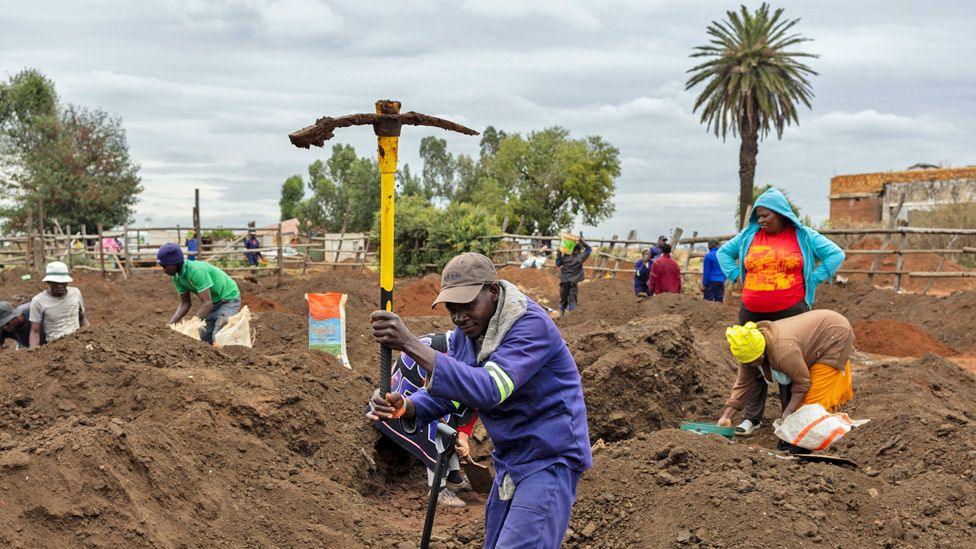
In February 2026, news reporting captured a modern “gold rush” scene that shows how quickly fever spreads when communities believe gold is present. A Guardian report described a short, sharp rush in Gugulethu, tied to severe unemployment and poverty, with residents digging and hauling soil in the hope of finding gold.
This kind of episode is not the Witwatersrand boom of 1886, but it reflects a similar social mechanism: rumour, hope, collective effort, and the thin line between opportunity and illusion. It also highlights that gold fever today is often less about organised industrial extraction and more about informal survival behaviour in a stressed economy.
The Global Gold Boom and a New Wave of Mining Interest
Gold fever is not only a social story. It is also a market story. When gold prices rise and geopolitical anxiety intensifies, capital returns to the idea of mining expansion and redevelopment. A January 2026 Wall Street Journal report described how a global gold price surge has revived mining investment and highlighted the opening of what it described as South Africa’s first new underground gold mine in over 15 years, the Qala Shallows project near Johannesburg, backed by significant investment and modernisation.
The significance here is not that South Africa suddenly returns to its old production dominance. The significance is that gold’s economics can flip quickly. When the price environment strengthens enough, projects that were previously marginal become investable again, and the idea of “another gold boom” returns to headlines. This is gold fever in financial form: capital chasing perceived scarcity and safety.
Why “Gold Fever” Is the Right Phrase for South Africa
Gold fever captures the emotional logic that repeats across eras. In the 1880s, the fever pulled in prospectors and capital, created Johannesburg, and reshaped southern Africa’s politics and labour systems. In the modern era, the fever resurfaces when poverty and unemployment make even small hopes worth chasing, and when global gold cycles reignite investment in long-dormant projects.
The fever also explains why gold in South Africa is never just about geology. It is about who controls the ground, who profits from extraction, who risks their life underground, and how the state responds. When gold is present, power tends to gather around it, and society reorganises in response.
What South African Gold Fever Changed, Permanently
South African gold fever moved the country’s economic centre of gravity toward the Rand and made Johannesburg a major global city. It accelerated industrialisation through the mineral revolution and intensified migration, investment, and labour control systems. It raised political stakes in ways that fed into regional conflict culminating in the Second Boer War.
At the same time, it left legacies of inequality, coercive labour arrangements, and a deep association between wealth and extraction that shaped South Africa’s twentieth century. And because gold remains in the ground, and because gold remains a global “fear asset” in markets, the fever still returns, in different costumes, whenever conditions align.
Conclusion
South African gold fever is best understood as a repeating force rather than a finished event. It began with the 1886 Witwatersrand discovery that led to Johannesburg’s creation and transformed southern Africa’s economy and politics. It matured into an industrial system built on capital concentration and labour control that left long-term social footprints. And in the present, it reappears through informal rushes driven by desperation, illegal mining networks, and renewed investment attention when global gold cycles surge.
Gold fever built a city, but it also built a complicated inheritance. That inheritance still shapes how South Africa works, how it struggles, and how it dreams when someone whispers that the ground might pay.