
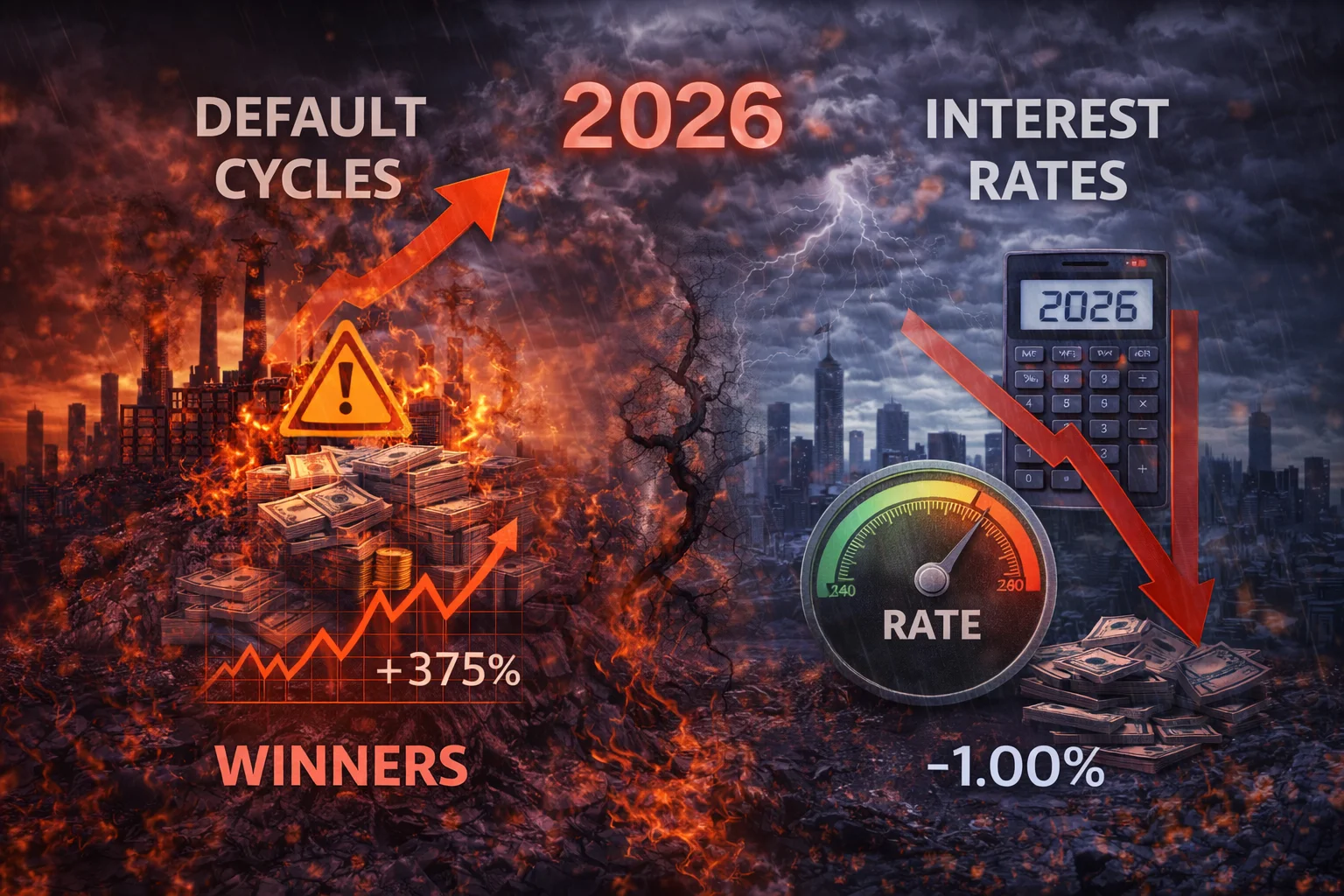
As global investors enter 2026, much of the public conversation remains narrowly focused on interest rates. Central bank decisions, inflation prints, and forward guidance continue to dominate headlines. However, beneath this surface-level narrative, a far more consequential shift is unfolding across global financial systems. Rising default cycles are quietly becoming the dominant force shaping market outcomes, capital preservation, and long-term wealth strategies. In 2026, defaults matter more than interest rates because they represent structural stress rather than policy intent, and they expose weaknesses that rate adjustments alone can no longer conceal.
This page explores why default cycles deserve primary attention in 2026, how they differ fundamentally from interest rate regimes, and what this shift means for investors, institutions, and long-term capital allocators seeking stability in an increasingly fragile financial environment.
The Changing Nature of Financial Risk in 2026
Interest rates function as a policy lever. They are visible, deliberate, and reactive. Default cycles, by contrast, are systemic. They emerge when accumulated leverage, declining cash flows, and deteriorating balance sheets collide with economic reality. In 2026, markets are transitioning from a phase dominated by monetary tightening narratives into a phase where credit stress, solvency risk, and repayment capacity define outcomes.
Over the past decade, prolonged low interest rates encouraged aggressive borrowing across sovereigns, corporations, and households. This leverage did not disappear when rates rose. Instead, it became dormant pressure. As refinancing windows narrow and growth slows, defaults begin to surface not because rates are high, but because debt structures are no longer sustainable.
This distinction is critical. Interest rates influence behavior at the margin. Default cycles reshape the entire landscape.
Why Interest Rates Lose Predictive Power in Late-Cycle Markets
By 2026, most major economies are operating in a late-cycle or post-peak environment. In such phases, interest rates stop acting as leading indicators and become lagging signals. Central banks may pause, cut, or adjust policy, but the damage embedded in credit systems continues to unfold independently.
When default risk rises, markets stop responding to rate optimism. Equity valuations compress despite easing policy. Credit spreads widen even as benchmark rates fall. Liquidity retreats not because money is expensive, but because trust is scarce.
This is why focusing exclusively on interest rates in 2026 creates a false sense of security. Lower rates do not revive insolvent borrowers. They do not repair broken cash flows. They do not reverse structural misallocation of capital. Default cycles, once initiated, follow their own internal logic driven by balance sheet stress rather than central bank signaling.
Understanding Default Cycles as Structural Events
Default cycles are not random shocks. They develop slowly and then accelerate. They are marked by rising delinquencies, covenant breaches, refinancing failures, and cascading credit events across sectors. In 2026, these cycles are expected to emerge most clearly in highly leveraged industries, speculative growth sectors, overextended real estate markets, and sovereign balance sheets burdened by fiscal imbalances.
Unlike rate cycles, default cycles are asymmetric. Their downside impact is far greater than their upside relief. When defaults rise, capital is destroyed, not merely repriced. Equity holders face permanent loss. Credit holders face restructuring or impairment. Confidence erodes across markets, leading to second-order effects that amplify volatility.
This is why default cycles matter more than rate decisions. They define who survives, not just who outperforms.
The Psychological Shift from Yield to Safety
Another reason default cycles dominate in 2026 is the psychological transition underway among investors. During rate-driven markets, participants chase yield, growth, and momentum. During default-driven markets, behavior shifts toward safety, resilience, and capital preservation.
As defaults rise, investors stop asking how much return an asset can generate and start asking whether it will survive intact. This shift changes asset allocation patterns, sector leadership, and valuation frameworks. Companies with strong balance sheets, stable cash flows, and conservative capital structures gain relative strength. Highly leveraged models lose investor sponsorship regardless of interest rate relief.
This behavioral transition reinforces the power of default cycles. Markets begin to self-select defensiveness even before defaults peak.
Credit Stress as the Real Transmission Mechanism
Interest rates influence markets through expectations. Default cycles influence markets through reality. In 2026, the transmission mechanism shaping asset prices is increasingly credit stress rather than monetary policy.
When defaults rise, banks tighten lending standards. Private credit becomes selective. Liquidity fragments. Even solvent borrowers face higher scrutiny. This restricts capital flow across the economy, slowing growth and reinforcing financial stress. These effects persist even if rates fall, because lenders prioritize survival over expansion.
This dynamic explains why markets can remain weak despite accommodative policy. It also explains why recoveries after default cycles tend to be slow but durable, built on repaired balance sheets rather than cheap money.
Sectoral Impact of Rising Default Cycles
Default cycles do not affect all sectors equally. In 2026, their impact is expected to be uneven but decisive. Capital-intensive industries with volatile earnings face higher risk. Sectors dependent on refinancing rather than organic cash flow become vulnerable. Speculative ventures that thrived on abundant liquidity struggle to adapt.
Conversely, sectors aligned with essential services, pricing power, and low leverage demonstrate relative stability. This divergence creates a market environment where broad indices may stagnate while select assets quietly compound.
Understanding this dispersion is far more valuable than predicting interest rate paths. Rate forecasts influence sentiment. Default analysis influences survival.
Global Implications and Sovereign Stress
Rising default cycles in 2026 are not confined to corporations. Sovereign stress is becoming a critical component of the global outlook. High debt-to-GDP ratios, rising social spending, and geopolitical pressures strain fiscal sustainability. While sovereign defaults may be avoided through restructuring or inflationary policies, the risk premium attached to sovereign debt increases.
This impacts currencies, capital flows, and geopolitical stability. Investors who focus solely on interest rate differentials miss these deeper fault lines. Default risk, even when managed quietly, reshapes global capital allocation.
Why Long-Term Investors Must Reframe Risk Assessment
For long-term investors, the lesson of 2026 is clear. Risk is no longer defined primarily by volatility or rate sensitivity. It is defined by durability. The ability of an asset, company, or system to endure financial stress without permanent impairment becomes the core metric.
Default cycles force this reassessment. They reward patience, discipline, and selectivity. They penalize complacency and excessive optimism. In this environment, capital preservation becomes a prerequisite for future growth, not a defensive afterthought.
This reframing aligns with the broader philosophy behind the Annual Letter 2026, which emphasizes structural awareness over short-term predictions and resilience over speculation.
The Astrological Perspective on Default Cycles
From a financial astrology perspective, default cycles often coincide with planetary patterns associated with contraction, reckoning, and restructuring. Saturn-dominant phases historically correlate with debt discipline, credit stress, and the exposure of weak financial foundations. In 2026, these cycles reinforce the macroeconomic reality that excess must be resolved before sustainable expansion resumes.
Astrology does not replace financial analysis, but it provides timing context for when latent risks surface. In 2026, this convergence between planetary cycles and economic stress underscores why defaults rise even when policy appears supportive.
Preparing for a Default-Driven Market Environment
Preparation in 2026 does not mean predicting specific failures. It means aligning portfolios and expectations with a world where defaults shape opportunity sets. This involves prioritizing quality over growth narratives, understanding credit exposure across asset classes, and resisting the temptation to equate lower rates with lower risk.
Markets that emerge from default cycles tend to be healthier, but the transition period is unforgiving. Those who recognize the shift early protect capital and position themselves for the next durable cycle of wealth creation.
Why Liquidity Crises Follow Default Cycles, Not Rate Cuts
One of the most misunderstood dynamics in financial markets is the belief that liquidity returns automatically when interest rates fall. In reality, liquidity follows confidence, not policy. In 2026, rising default cycles directly impair liquidity because they damage the willingness of lenders and investors to deploy capital, even when borrowing costs decline.
When defaults accelerate, capital becomes defensive. Banks reduce exposure. Institutional investors shorten duration. Private capital shifts toward collateralized and senior structures. This contraction happens regardless of rate levels because default risk introduces uncertainty that pricing alone cannot resolve. As a result, markets experience liquidity fragmentation, where capital exists but refuses to flow freely.
This phenomenon explains why market recoveries feel weak and uneven during default-driven phases. Liquidity does not disappear entirely, but it becomes selective. Assets perceived as fragile face capital starvation, while resilient structures attract disproportionate flows. Understanding this behavior is critical for navigating 2026 effectively.
Refinancing Risk as the Hidden Catalyst of Defaults
In 2026, refinancing risk plays a larger role in defaults than headline interest rates. Many borrowers accumulated long-term obligations during periods of easy money, assuming continuous access to refinancing. As credit conditions tighten and lenders become more cautious, refinancing windows narrow, even if nominal rates stabilize or decline.
This creates a silent pressure point. Businesses and governments that appear solvent on paper struggle when maturities approach. Defaults often emerge not from immediate cash flow collapse but from the inability to roll over existing obligations. This dynamic is especially dangerous because it unfolds quietly before surfacing abruptly.
Refinancing stress reinforces why default cycles must be analyzed independently of rate cycles. Interest rates may signal relief, but refinancing access determines survival.
Equity Markets in a Default-Centric Regime
Equity markets behave very differently when defaults dominate the narrative. In interest rate-driven regimes, equities respond positively to easing signals, often front-running policy changes. In default-driven regimes, equities become valuation-sensitive and balance-sheet focused.
In 2026, investors increasingly differentiate between earnings quality and financial structure. Growth projections lose credibility when accompanied by leverage. Buybacks lose appeal when funded through debt. Equity premiums compress as investors price in dilution risk, restructuring risk, or permanent capital loss.
This environment favors companies with conservative financing, strong operating cash flows, and limited dependency on capital markets. Equity selection becomes more important than market exposure, and passive strategies face structural headwinds.
The Feedback Loop Between Defaults and Economic Slowdown
Rising default cycles do not merely reflect economic weakness; they actively contribute to it. As defaults rise, lending standards tighten, reducing investment and consumption. This slowdown further weakens cash flows, creating a feedback loop that sustains the default cycle.
Interest rate adjustments struggle to interrupt this loop because the core issue is not borrowing cost but trust. Once lenders doubt repayment capacity, they prioritize risk control over growth stimulation. This is why default cycles often persist longer than anticipated and why premature optimism can be costly.
In 2026, recognizing this feedback loop helps investors avoid misinterpreting short-term rallies as structural recovery.
Annual Letter 2026 by Rajeev Prakash Agarwal
Markets are entering a phase where easy assumptions no longer work. Liquidity is selective, volatility is structural, and capital is rewarded only when it is positioned with clarity and discipline. In such an environment, reacting to headlines is not enough. What matters is having a forward-looking framework that helps you anticipate change rather than chase it.
The Annual Letter 2026 by Rajeev Prakash Agarwal offers a comprehensive investment outlook designed for this new market regime. It blends long-term macro analysis, market psychology, and planetary cycles that have historically aligned with major shifts in global capital flows. The focus is on understanding cycles, identifying high-probability phases, and protecting capital during periods of uncertainty.

Why Credit Markets Lead, Not Equity Markets
In default-driven environments, credit markets lead equities, not the other way around. Widening credit spreads, deteriorating covenant quality, and rising restructuring activity often appear months before equity markets fully reflect stress.
Monitoring credit behavior provides clearer insight into systemic health than watching policy statements or equity indices. In 2026, investors who focus on credit signals gain an informational edge, allowing them to adjust risk exposure ahead of broader market recognition.
This shift underscores why default analysis belongs at the center of market strategy rather than at the periphery.
Asset Allocation Under Default Pressure
Traditional asset allocation models assume diversification benefits based on correlations driven by growth and rates. Default cycles disrupt these assumptions. Correlations change when credit stress becomes systemic. Assets once considered defensive may underperform if tied to leveraged structures or credit-sensitive revenue streams.
In 2026, resilient asset allocation emphasizes balance sheet strength, real asset backing, and predictable cash generation. Flexibility becomes as important as diversification. Holding optionality and avoiding forced sellers matter more than maximizing exposure.
This approach aligns with a capital preservation mindset, where survival precedes growth.
Behavioral Errors Investors Make During Default Cycles
Default cycles expose behavioral weaknesses. Investors tend to anchor on past recoveries, assuming policy intervention will prevent deep damage. Others chase yield precisely when credit quality deteriorates. Some mistake volatility reduction for risk reduction.
In 2026, these errors are amplified by narrative fatigue. After years of policy-driven recoveries, many investors underestimate the persistence of credit stress. Recognizing this bias helps maintain discipline when markets tempt participants with premature optimism.
Default cycles reward those who respect fragility rather than dismiss it.
Conclusion: The Real Signal Investors Cannot Ignore
In 2026, interest rates are noise compared to the signal emitted by rising default cycles. Rates tell you what policymakers intend. Defaults tell you what the system can endure. Ignoring this distinction leads to mispricing risk and misunderstanding market behavior.
Rising default cycles matter more because they reveal structural truth. They strip away illusions created by liquidity and force markets to confront sustainability. Investors who grasp this reality move beyond reactive strategies and adopt a framework rooted in resilience, discipline, and long-term clarity.
This perspective lies at the heart of rajeevprakash.com’s approach to market analysis and forms a foundational theme within the Annual Letter 2026. Understanding default cycles is not about fear. It is about seeing markets as they truly are in times of transition and preparing intelligently for what comes next.