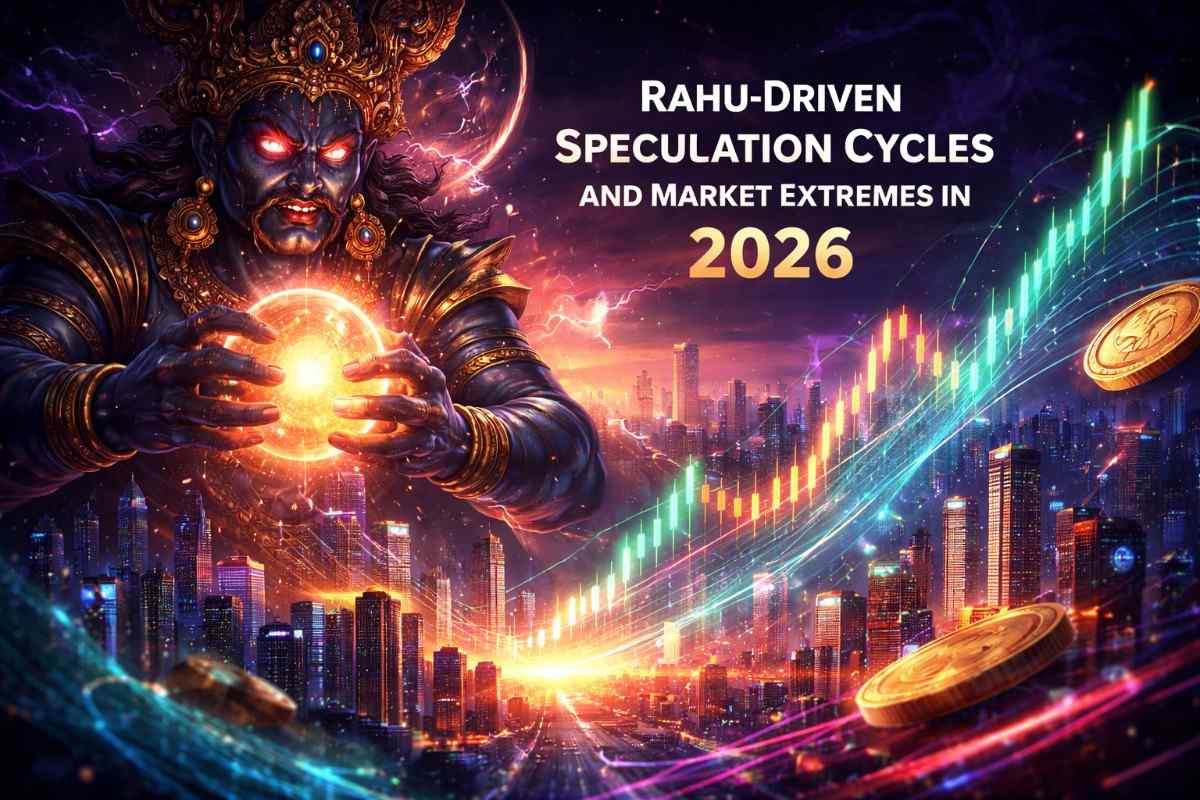
Speculation is not random. It comes in waves, and those waves tend to peak when collective attention becomes stronger than fundamentals. In financial astrology, Rahu is one of the cleanest symbols for that kind of behavior. Rahu amplifies desire, imitation, obsession, and the urge to get rich faster than the usual rules allow. When Rahu is strongly activated, markets often reward stories more than spreadsheets, speed more than patience, and leverage more than discipline. That is why “Rahu-driven speculation” is not just a poetic phrase. It describes a repeatable market mood where price discovery becomes attention discovery.
In 2026, the speculative theme stays active because the lunar nodes remain a central background influence. In Western astrology, the North Node shifts into Aquarius and the South Node into Leo on July 26, 2026, which is widely noted as a major collective pivot point. In Vedic astrology, Rahu’s sidereal placement is also linked with Aquarius through much of 2026, based on commonly published Rahu-Ketu transit timelines that run into late 2026. The signs differ in timing across systems because Western uses the tropical zodiac and Vedic uses the sidereal zodiac, but the core message converges: 2026 continues to favor “future stories” and high-voltage narratives, and it also increases the probability of sharp reversals when belief gets ahead of liquidity.
Why Rahu Is the Planet of Market Hype
Rahu is not a physical planet, but in both Vedic and Western frameworks it represents the Moon’s North Node, a mathematical point associated with appetite and escalation. That symbolism matters in markets because speculation is essentially appetite looking for an object. When Rahu dominates a cycle, you see three patterns repeat.
First, the market falls in love with a theme. It could be a technology revolution, a new financial product, a “this time is different” macro story, or a charismatic founder narrative. Second, leverage grows because participants start believing volatility is opportunity rather than risk. Third, the exit door narrows, because the same crowd that chased the rise tries to leave at the same time once the story breaks.
This does not mean markets crash every time Rahu is emphasized. It means markets become more sensitive to perception shocks. Small catalysts can trigger large moves because positioning is crowded, confidence is fragile, and liquidity is selective. That is the Rahu signature: magnification.
Rahu in Aquarius and the Speculation Style of 2026
Aquarius is the sign of networks, technology, systems, mass participation, and the future. When Rahu is tied to Aquarius themes, speculation often migrates toward “new-world” assets and platforms. The crowd wants exposure to innovation, disruption, and anything that looks like the next infrastructure layer. This is why 2026 can keep producing intense bursts of momentum around tech narratives, AI-adjacent ecosystems, digital infrastructure, defense-tech, alternative energy transitions, and network-driven consumer platforms.
Western sources flag July 26, 2026 as the node shift into Aquarius-Leo, framing it as a collective push toward Aquarian priorities. Vedic transit write-ups also place Rahu in Aquarius across much of 2026, reinforcing a similar psychological environment, even though the calculation approach differs.
In practical market terms, this points to a year where narratives can travel faster than fundamentals. The winners in such a regime are not always the best businesses. Often, they are the best stories that can absorb capital at scale. The losers are not always bad businesses either. They are often the assets that fail to maintain attention, fail to show “forward guidance,” or fail to match the crowd’s preferred identity.
The Leo Shadow: Ego Trades, Celebrity Stocks, and Overconfidence
Whenever Aquarius is emphasized, Leo becomes the axis partner. In Western astrology, the South Node moving through Leo points to release, distortion, or burnout around Leo themes such as ego, celebrity, personal brand, and dramatic leadership. In markets, Leo-shadow behavior often looks like “hero worship trades,” where a single personality becomes the proxy for an entire sector, and where investors stop analyzing and start cheering.
This matters in 2026 because speculative peaks often form when the market attaches to a face. Traders begin to treat leadership charisma as a substitute for cash flow. The risk is not that charismatic leaders disappear. The risk is that valuation becomes a form of fandom. When reality interrupts fandom, repricing becomes violent.
So, one of the cleanest Rahu-Leo warnings for 2026 is this: be careful when the market is pricing identity rather than execution. When investors start saying “you don’t understand the vision” as an answer to basic financial questions, Rahu is doing what Rahu does best.
What Market Extremes Look Like in a Rahu Cycle
Market extremes do not always appear as a single crash. In Rahu periods, extremes can look like repeated spikes and air-pockets. Price can gap up, gap down, and then recover again, because the underlying driver is not stable investment demand. It is reflexive demand driven by attention, flows, and options exposure.
In 2026, you should think of extremes in three forms.
One form is vertical rallies in crowded themes, where a handful of assets absorb disproportionate capital and appear “unbreakable” for a period. The second form is sudden liquidity withdrawals, where a small negative event creates a rapid multi-day drop because the market is over-positioned. The third form is rotation shocks, where leadership changes quickly and investors realize too late that they were holding the wrong version of the story.
Rahu cycles can produce profits, but they demand humility. The market can stay irrational longer than a leveraged trader can stay solvent. That old lesson becomes more relevant, not less, in a year where narratives remain fuel.
Sectors and Themes Most Likely to Reflect Rahu Behavior in 2026
The most Rahu-sensitive sectors are those where valuation is driven by “what could be,” not “what is.” That does not mean these sectors are bad. It means they attract more speculative heat, and heat eventually demands cooling.
Technology and AI narratives tend to stay in the spotlight because Aquarius is naturally aligned with innovation and networks. When the crowd feels the future is arriving faster, it pays up for exposure. The risk is that the crowd also punishes any company that cannot prove adoption, pricing power, and defensibility.
Crypto and tokenized finance themes also align with Rahu-Aquarius psychology because they thrive on network belief. In a Rahu cycle, the market can treat adoption metrics like destiny. If adoption slows, the belief premium can evaporate quickly.
Small caps and “story stocks” can become especially extreme, because they are easier to move and easier to hype. In Rahu periods, micro-narratives can outperform the macro for short windows. That is how late-cycle speculation often looks.
Even beyond equities, Rahu can show up in options-driven volatility, meme-like crowd behavior, and the rise of new “hot” structures that promise yield without pain. When a product is marketed as a way to get returns without risk, you should assume Rahu is somewhere nearby.
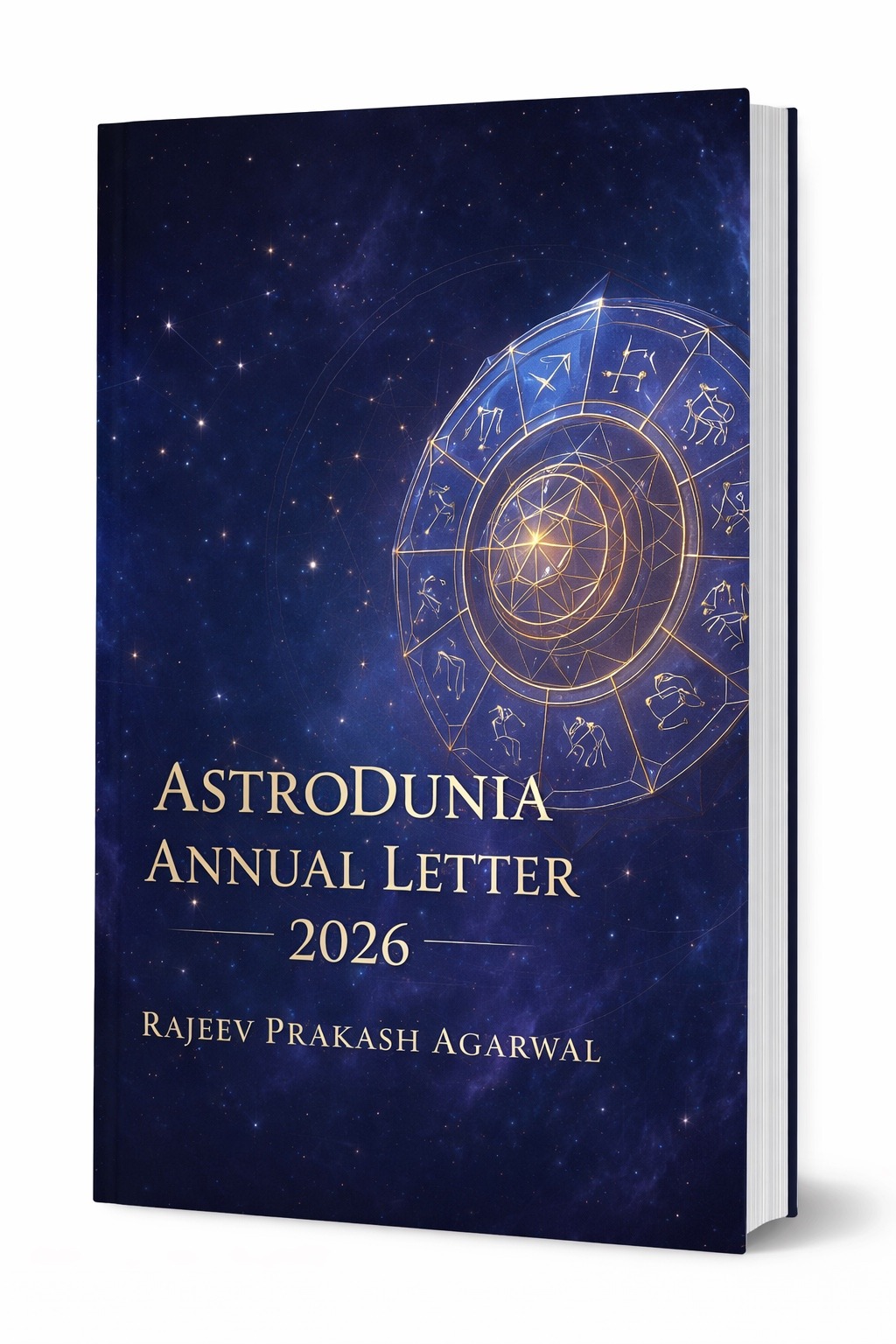
Annual Letter 2026 by Rajeev Prakash Agarwal
Markets are moving into a regime where old shortcuts no longer deliver results. Liquidity is no longer uniform, volatility is embedded into the system, and capital is rewarded only when it is deployed with precision and intent. In this environment, responding to news flow after it breaks often leads to late decisions.
The Annual Letter 2026 by Rajeev Prakash Agarwal is built for this evolving market landscape. It presents a forward-looking investment framework that integrates macroeconomic forces, market psychology, and planetary cycles that have historically coincided with major reallocations of global capital. Instead of chasing short-term narratives, the emphasis is on cycle awareness, timing high-probability phases, and preserving capital when uncertainty rises.
A 2026 Timing Map: How to Think About the Year Without Predicting a Single Date
You do not need one magic date to trade Rahu cycles well. What you need is a framework.
Early 2026 can feel like continuation energy if the market enters the year with strong narratives already established. In that case, the first phase is often “extension,” where the crowd pushes leaders further than rational models would.
Mid-2026 becomes more sensitive to regime shifts because the lunar nodes change signs in the tropical system on July 26, 2026, which many astrologers consider a major collective pivot. Even if you do not trade astrology, this period can be treated as a psychological inflection zone: flows can rotate, leadership can change, and markets can punish complacency.
Late 2026 can bring “consequence energy,” where the market starts asking whether the year’s narratives delivered real cash flows, real productivity, or real earnings durability. In Vedic transit discussions, Rahu’s Aquarius phase is commonly described as running into late 2026, which supports the idea that the speculation tone can remain present, but also that fatigue can build if expectations are too high.
The smartest way to use this is not to predict a crash. It is to recognize that 2026 favors faster cycles of crowd belief, and that profits will likely come from disciplined entries, disciplined exits, and refusing to confuse momentum with safety.
How Smart Money Navigates Rahu Extremes
When Rahu dominates, the edge goes to investors who can separate “trend” from “truth.” Smart money often does three things in these conditions.
First, it uses position sizing as a moral philosophy. That means it accepts that no story is certain, and it expresses conviction only through controlled risk.
Second, it respects liquidity. In Rahu markets, liquidity can look abundant on the way up and vanish on the way down. Smart money trades instruments it can exit, not just instruments it can buy.
Third, it keeps time horizons clean. A Rahu rally can be an excellent trade and a terrible investment if you confuse the two. The goal is to label positions honestly: is this a long-term compounder, or a cycle trade riding attention?
This is also where hedging becomes psychologically valuable. Hedging is not only about protection. It is about staying rational while everyone else is becoming emotional.
Rahu and the Psychology of Retail Crowds
Rahu’s most visible footprint in markets is crowd psychology. In 2026, speculation can be amplified by social platforms, influencer finance, and community-based trading identity. When people trade to belong, not to build wealth, the crowd becomes a volatility engine.
That environment creates a common trap: traders confuse being early with being right. Being early is not the same as being correct, especially when timing is the entire game. Another trap is moral licensing: after a few quick wins, people assume they have mastered the cycle. That is often the exact moment Rahu flips the script.
So, if you want a practical Rahu rule for 2026, it is this: the easier it feels, the closer you are to risk.
Investment Outlook for 2026 Under a Rahu Lens
A Rahu year rewards flexibility. It does not reward stubbornness. The highest-probability approach is to expect fast rotation, accept that tops and bottoms will be emotionally confusing, and treat narrative spikes as tradable events rather than permanent realities.
For investors, this can still be a great year if you focus on quality businesses that benefit from innovation trends but can survive when attention moves on. For traders, this can be a strong year if you treat volatility as a product and manage risk like a professional, not like a gambler.
Rahu does not “cause” markets to move by itself. It describes the psychological weather that makes markets more prone to extremes. In 2026, that weather favors the future, but it also tests discipline.
Closing Perspective: Turning Rahu From a Risk Into an Edge
Rahu-driven speculation cycles are not something to fear. They are something to understand. When you understand them, you stop chasing every rally and start selecting your battles. You learn to buy when the crowd is skeptical and reduce risk remember when the crowd is euphoric. You stop trading headlines and start trading behavior.
If 2026 is a year of market extremes, it will not be because investors forgot how to value assets. It will be because too many investors decide valuation no longer matters. That is the precise moment Rahu becomes loud. And that is also the moment disciplined capital quietly prepares for the next wave.