
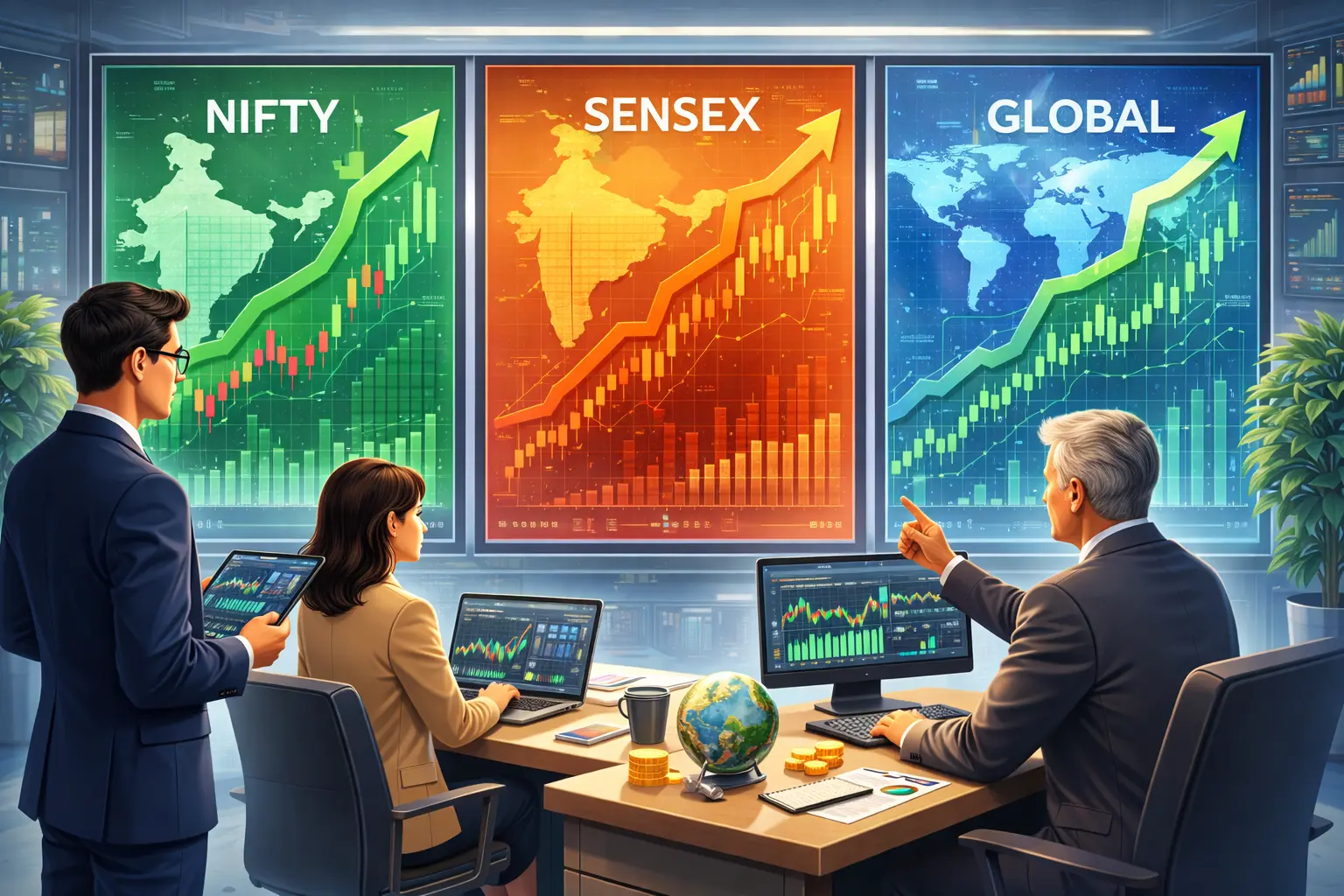
As financial markets approach 2026, investors are increasingly focused on how major equity indices such as the Nifty, Sensex, and key global benchmarks may evolve in a changing economic environment. After a decade marked by extraordinary policy measures, global disruptions, and rapid technological change, markets are entering a phase where fundamentals, earnings quality, and capital discipline are expected to play a larger role in shaping index performance.
The outlook for 2026 across Indian and global indices is best understood through a combination of macroeconomic trends, corporate profitability, valuation dynamics, and investor behavior rather than short-term predictions.
Indian Equity Markets in a Structural Growth Phase
India’s equity markets enter 2026 from a position of relative strength compared to many global peers. Structural growth drivers such as domestic consumption, infrastructure development, digital adoption, and financial inclusion continue to support long-term economic expansion. This foundation has allowed Indian indices like the Nifty and Sensex to demonstrate resilience even during periods of global volatility.
By 2026, Indian markets are expected to reflect a more mature phase of growth. Returns may be less driven by valuation expansion and more by earnings delivery. Companies that benefit from scale, strong governance, and pricing power are likely to contribute disproportionately to index performance. This shift supports a steadier, more sustainable trajectory rather than speculative acceleration.
Nifty 50 Outlook for 2026
The Nifty 50 represents a broad cross-section of India’s corporate landscape, encompassing sectors such as banking, technology, manufacturing, and consumer goods. Heading into 2026, the index is likely to be influenced heavily by financial sector performance, given its weight and role in economic transmission.
Credit growth, asset quality stability, and capital adequacy will remain central to banking-led momentum. At the same time, technology and export-oriented segments may experience periodic volatility depending on global demand cycles. Overall, the Nifty’s outlook for 2026 suggests moderate but resilient growth, supported by domestic demand and improving corporate balance sheets.
Sensex Performance Drivers in 2026
The Sensex, as a concentrated index of large-cap leaders, often reflects institutional investor confidence. Its trajectory toward 2026 is expected to mirror broader economic stability and corporate profitability trends. Companies with strong brand equity, diversified revenue streams, and disciplined capital allocation are likely to anchor index performance.
Rather than sharp directional moves, the Sensex in 2026 may exhibit phases of consolidation interspersed with earnings-driven advances. This pattern is typical of markets transitioning from rapid expansion to more sustainable growth phases.
Valuations and Expectations in Indian Indices
Valuations play a critical role in shaping future index returns. Indian equity valuations entering 2026 are likely to remain premium relative to some global markets, reflecting higher growth expectations and domestic investor participation. However, premium valuations also imply greater sensitivity to earnings delivery.
This dynamic reinforces the importance of selectivity within indices. While headline index levels may rise over time, underlying performance could vary significantly across sectors and constituents. For long-term investors, this environment favors patience and a focus on earnings consistency rather than short-term index targets.
Global Indices and the 2026 Landscape
Global equity indices such as the S&P 500, Nasdaq, FTSE, DAX, and Nikkei are expected to navigate 2026 under different economic and policy conditions. Developed markets may experience slower growth compared to emerging economies, but they benefit from deep capital markets, technological leadership, and institutional stability.
In the United States, global indices are likely to remain influenced by corporate innovation, productivity gains, and capital markets depth. However, higher interest rates compared to the previous decade may temper valuation expansion. Europe’s indices may reflect gradual recovery supported by industrial adaptation and energy transition initiatives, while Japan’s market dynamics may continue to evolve alongside corporate governance reforms.
Synchronization and Divergence Across Global Markets
One of the defining features of the 2026 outlook is the balance between synchronization and divergence across global indices. While global markets remain interconnected, regional fundamentals are increasingly driving performance differences. This creates an environment where some indices outperform while others consolidate.
For investors, this divergence underscores the importance of global perspective rather than reliance on a single market. Index performance in 2026 is likely to be influenced as much by local policy and economic conditions as by global liquidity trends.
Annual Letter 2026 by Rajeev Prakash Agarwal
The Annual Letter 2026 is a long-term strategic outlook designed for serious investors, traders, and decision-makers navigating a rapidly shifting global economy. It decodes the year ahead through planetary cycles, macroeconomic forces, market psychology, and structural turning points across equities, commodities, currencies, digital assets, and global capital flows.
This letter is not a short-term trading guide or a collection of predictions. It is a framework for understanding how 2026 reshapes risk, opportunity, regulation, and wealth creation across financial markets. Every section focuses on timing, probability, and capital protection, helping readers prepare for regime shifts rather than react to headlines.

Currency, Capital Flows, and Index Returns
Currency movements and cross-border capital flows continue to shape index performance, particularly for global investors. In 2026, currency volatility may remain present but more orderly compared to crisis periods. Indian indices may benefit from relatively stable capital inflows supported by domestic participation and long-term foreign interest.
Global indices, meanwhile, will reflect shifts in capital allocation as investors rebalance exposure based on growth prospects, risk premiums, and policy clarity. These flows contribute to relative performance differences across markets rather than uniform global trends.
Volatility Expectations for Indices in 2026
Volatility is expected to remain a feature of both Indian and global indices in 2026. Periodic corrections are likely as markets respond to economic data, policy signals, and geopolitical developments. However, volatility does not necessarily indicate bearish conditions. In many cases, it represents adjustment within broader upward or sideways trends.
Investors who view volatility as part of the investment process rather than a signal to exit may find opportunities to build positions during periods of market weakness.
Long-Term Perspective on Index Investing in 2026
From a long-term perspective, the outlook for Nifty, Sensex, and global indices in 2026 appears constructive but disciplined. Returns are likely to be driven by earnings growth, productivity improvements, and structural economic trends rather than excess liquidity or speculative enthusiasm.
This environment rewards investors who align expectations with reality and maintain a long-term horizon. Rather than focusing on precise index targets, understanding the direction and quality of growth becomes more valuable.
Earnings Composition and Index Quality in 2026
One of the most important factors influencing index performance in 2026 is the composition and quality of earnings within major benchmarks. Indices such as the Nifty and Sensex are increasingly dominated by companies with diversified revenue streams, strong domestic demand exposure, and improving operational efficiency. This shift enhances index stability, as earnings growth becomes less dependent on a narrow set of cyclical drivers.
For global indices, earnings quality varies by region. Markets with higher exposure to technology, healthcare, and consumer services may experience more consistent profit generation, while those reliant on commodities or exports may see greater cyclicality. Understanding these internal dynamics helps investors interpret index movements beyond headline levels.
Market Breadth and Participation Trends
Market breadth offers valuable insight into the health of equity indices. When a broad range of stocks participates in upward movement, index gains are generally more sustainable. Data leading into 2026 suggests that market breadth in Indian indices is improving gradually, supported by participation from multiple sectors rather than a small group of heavyweights.
Global indices may display varied breadth profiles depending on regional economic conditions. In markets where leadership is narrow, index-level gains may mask underlying weakness. In contrast, broader participation often reflects healthier underlying market conditions.
Role of Domestic Investors in Indian Indices
Domestic investor participation has become a defining feature of Indian equity markets. Systematic investment flows and long-term household participation provide a stabilizing influence on indices such as the Nifty and Sensex. As this trend continues into 2026, it may reduce reliance on volatile foreign flows and enhance market resilience.
This domestic base also influences how Indian indices respond to global shocks. While international events can still affect sentiment, sustained local participation helps absorb volatility and supports longer-term trends.
Global Policy Environment and Index Sensitivity
The policy environment remains a key driver of index behavior worldwide. In 2026, monetary and fiscal policies are expected to be more predictable compared to crisis-driven periods. This predictability reduces uncertainty and allows markets to focus more on fundamentals.
However, differences in policy approaches across regions may lead to divergent index performance. Markets that achieve a balance between growth support and fiscal discipline may attract stronger investor confidence, influencing relative returns among global indices.
Technology and Structural Change Impact on Indices
Technological advancement continues to reshape index composition and performance. As new business models emerge and traditional industries adapt, indices evolve to reflect these changes. In India, technology-enabled financial services, digital platforms, and manufacturing modernization contribute to structural growth within indices.
Global indices reflect similar transformations, though at different paces. Markets with higher exposure to innovation-driven sectors may experience higher volatility but also greater long-term growth potential. These structural shifts reinforce the importance of viewing indices as dynamic representations of economic change rather than static benchmarks.
Risk Factors That Could Influence Index Forecasts
While the overall outlook for 2026 remains constructive, certain risk factors could influence index trajectories. Changes in global liquidity conditions, unexpected policy shifts, or geopolitical developments may introduce short-term volatility. However, the presence of diversified earnings and stronger balance sheets reduces the likelihood of prolonged index-level downturns.
Investors who recognize the difference between temporary disruption and structural deterioration are better positioned to interpret index movements rationally.
Comparing Index Performance Across Regions
Comparative analysis of index performance highlights the importance of regional context. Indian indices may benefit from higher growth rates and domestic demand, while developed market indices may offer stability and innovation-driven returns. Emerging market indices beyond India present a mixed picture, influenced by policy consistency and economic reform progress.
In 2026, no single region is likely to dominate across all metrics. Instead, relative performance is expected to shift over time, creating opportunities for diversified global exposure.
Final Outlook for Nifty, Sensex and Global Indices in 2026
The forecast for Nifty, Sensex, and major global indices in 2026 points toward a year of measured progress rather than dramatic extremes. Indian markets are supported by strong domestic fundamentals, while global indices reflect a mix of innovation, policy normalization, and regional divergence.
For investors, 2026 is best approached as a year of strategic positioning. Index performance is likely to reward discipline, patience, and alignment with long-term economic trends rather than short-term speculation. In this context, both Indian and global indices remain relevant components of a diversified investment approach as markets move deeper into the decade ahead.