
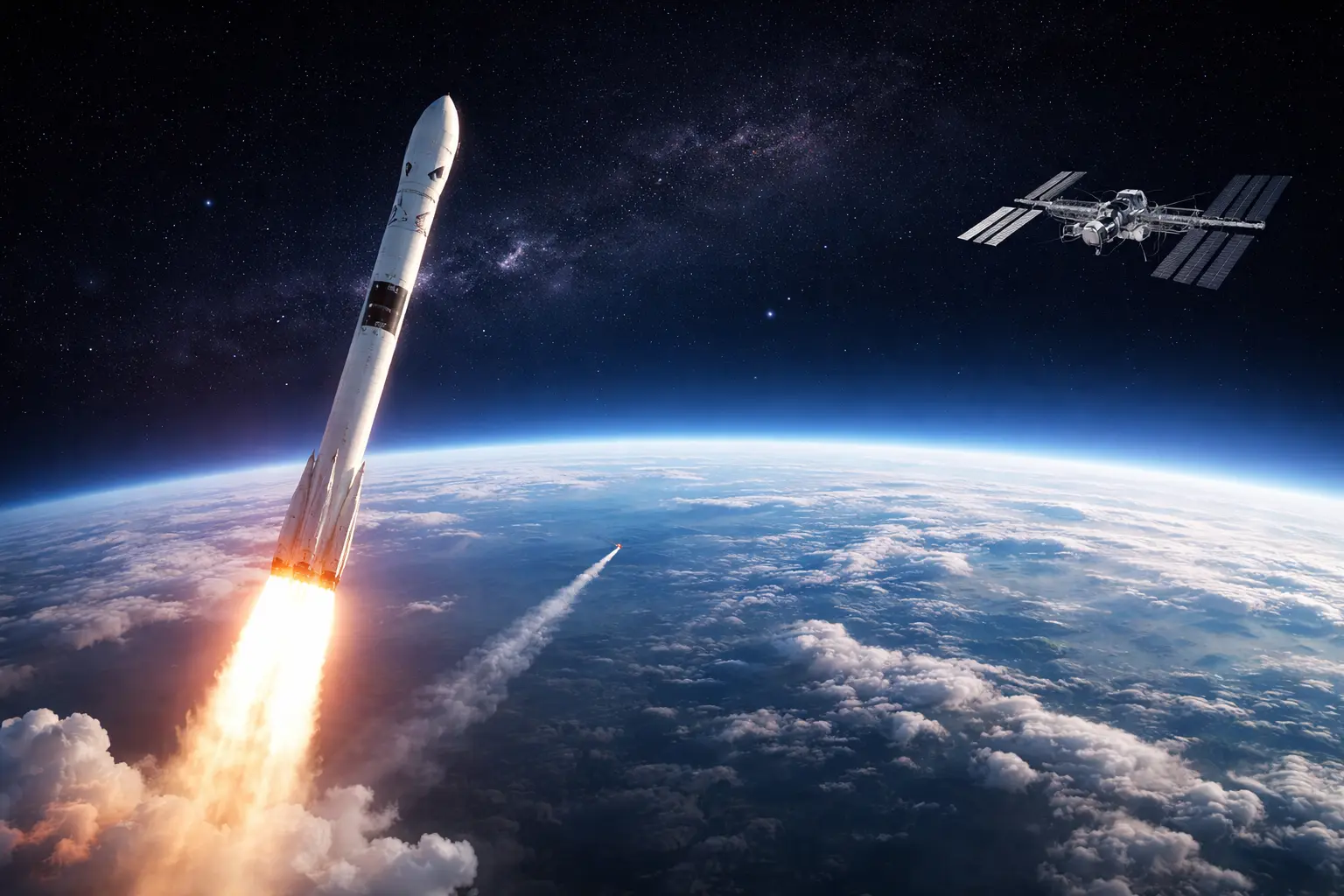
The phrase “NASA Artemis rocket launch” usually refers to NASA’s Space Launch System (SLS) lifting the Orion spacecraft off Launch Complex 39B at Kennedy Space Center, beginning a lunar mission designed to return humans to deep space and ultimately to the Moon’s surface. Artemis is not one single launch. It is an architecture of missions, hardware, ground systems, and operational lessons that build toward repeatable lunar flights. That is why every Artemis launch is treated as both a spectacle and a systems test, because what NASA proves on one flight becomes the baseline for the next.
The Artemis Program in Plain English
Artemis is NASA’s Moon-to-Mars exploration program. In practical terms, it uses Orion as the crew vehicle, SLS as the heavy-lift launcher for Orion missions, and a growing set of lunar systems intended to enable sustained operations near and on the Moon. The public shorthand is “back to the Moon,” but the operational goal is deeper: proving the life-support, navigation, communications, re-entry, and mission operations required for repeated deep-space human flights.
Artemis I: The Launch That Re-Opened the Moon Road
Artemis I was the first integrated flight of SLS and Orion. NASA lists its launch date as Nov. 16, 2022, and describes a mission that covered about 1.4 million miles and lasted just over 25 days, ending with Orion’s splashdown on Dec. 11, 2022. The Artemis I launch mattered because it validated key elements of the system as a whole: the rocket, the spacecraft, and the ground operations that support a super heavy-lift departure from Florida into deep space.
Artemis II: The Next Big Launch, and Why It’s Different
Artemis II is planned as the first crewed flight of NASA’s deep-space system, sending four astronauts on a roughly 10-day mission around the Moon without landing. NASA’s Artemis II mission page positions it as a critical systems test to validate deep-space human spaceflight capabilities before future surface missions. News coverage in February 2026 has emphasized the importance of ground test milestones, including wet dress rehearsals and propellant-loading confidence, because Artemis II’s launch readiness depends heavily on how reliably the vehicle can be fueled and counted down.
What “Rocket Launch” Means for Artemis: SLS, Orion, and the Stack
The Artemis launch vehicle is SLS, a super heavy-lift rocket designed to send Orion toward the Moon. Public technical summaries describe SLS Block 1 launching from Kennedy Space Center’s LC-39B, with solid rocket boosters and RS-25 engines providing the thrust to lift the stack off the pad. Orion sits at the top, built to carry crew in later missions and to survive high-energy lunar return re-entry. This integrated “stack” is why an Artemis launch is treated as a single high-stakes event: it is not just a rocket launch, it is the ignition of a full deep-space transportation system.
Launch Complex 39B: Why This Pad Matters
LC-39B is one of NASA’s historic pads, used for Saturn V and the Space Shuttle era, and now configured for SLS. It last hosted an SLS launch for Artemis I in November 2022, and it remains the pad planned for Artemis II operations. The pad’s importance is operational as much as historical: it supports the mobile launcher approach NASA uses for stacking, rolling out, and servicing the rocket prior to launch.
The Countdown Reality: Why Artemis Launch Dates Move
For Artemis, launch dates often shift because the countdown is a test in itself. The rocket must be loaded with large quantities of cryogenic propellants, and the system must maintain tight control over temperatures, pressures, and seals while also meeting safety thresholds. Recent reporting highlighted that NASA has dealt with hydrogen leak concerns during Artemis II preparations, prompting additional countdown tests and hardware changes. NASA’s own mission blog posts in February 2026 described troubleshooting and rollback planning tied to technical findings, illustrating how the schedule is shaped by engineering reality rather than calendar intent.
What We Know About Artemis II Launch Windows in Early 2026
Launch opportunities for lunar missions occur in windows, and NASA sometimes publishes window availability documents rather than a single fixed date far in advance. NASA released an “Artemis II Mission Availability – Early 2026” document showing multiple potential launch window openings in April 2026, including dates and local/UTC times. Separately, February 2026 news coverage reported NASA had discussed March 6, 2026 as an earliest target date contingent on readiness reviews, while NASA’s mission blog updates then emphasized actions intended to preserve April windows pending outcomes of data reviews and repairs. The practical takeaway is that Artemis launch planning is window-based and readiness-gated.
What Happens During an Artemis Rocket Launch, Step by Step
At a high level, the launch day story begins hours before liftoff as teams load cryogenic propellants and run through terminal countdown procedures. At ignition, SLS lights its core stage engines and solid rocket boosters, producing the thrust needed to clear the tower and begin ascent. Shortly after launch, stages separate as planned, and Orion is inserted on a trajectory that can be shaped for the mission profile, eventually setting up lunar operations and, later, Earth return. Artemis I demonstrated this end-to-end flight profile at full scale, and Artemis II aims to repeat the critical parts of that performance with a crew aboard.
Why Artemis Launches Matter Beyond Space Enthusiasm
Artemis launches influence far more than public excitement. They affect the direction of human spaceflight, drive industrial supply chains across aerospace, and shape international partnerships. They also act as major “proof points” in a long program where each milestone can unlock or constrain what comes next. That is why Artemis II is framed as a systems-validation mission and why NASA communicates cautiously about firm dates until key tests and readiness reviews confirm that the integrated system is stable.
How to Follow an Artemis Rocket Launch Like a Pro
The most reliable way to track Artemis readiness is to follow NASA’s official Artemis mission pages and NASA mission blog updates, which are designed to reflect real-time operational decisions such as test outcomes, rollback plans, and window preservation efforts. For historical context and mission facts, NASA’s Artemis I mission page provides clear benchmark metrics such as launch date, mission duration, and total distance traveled, which helps you understand what Artemis II is building upon.