
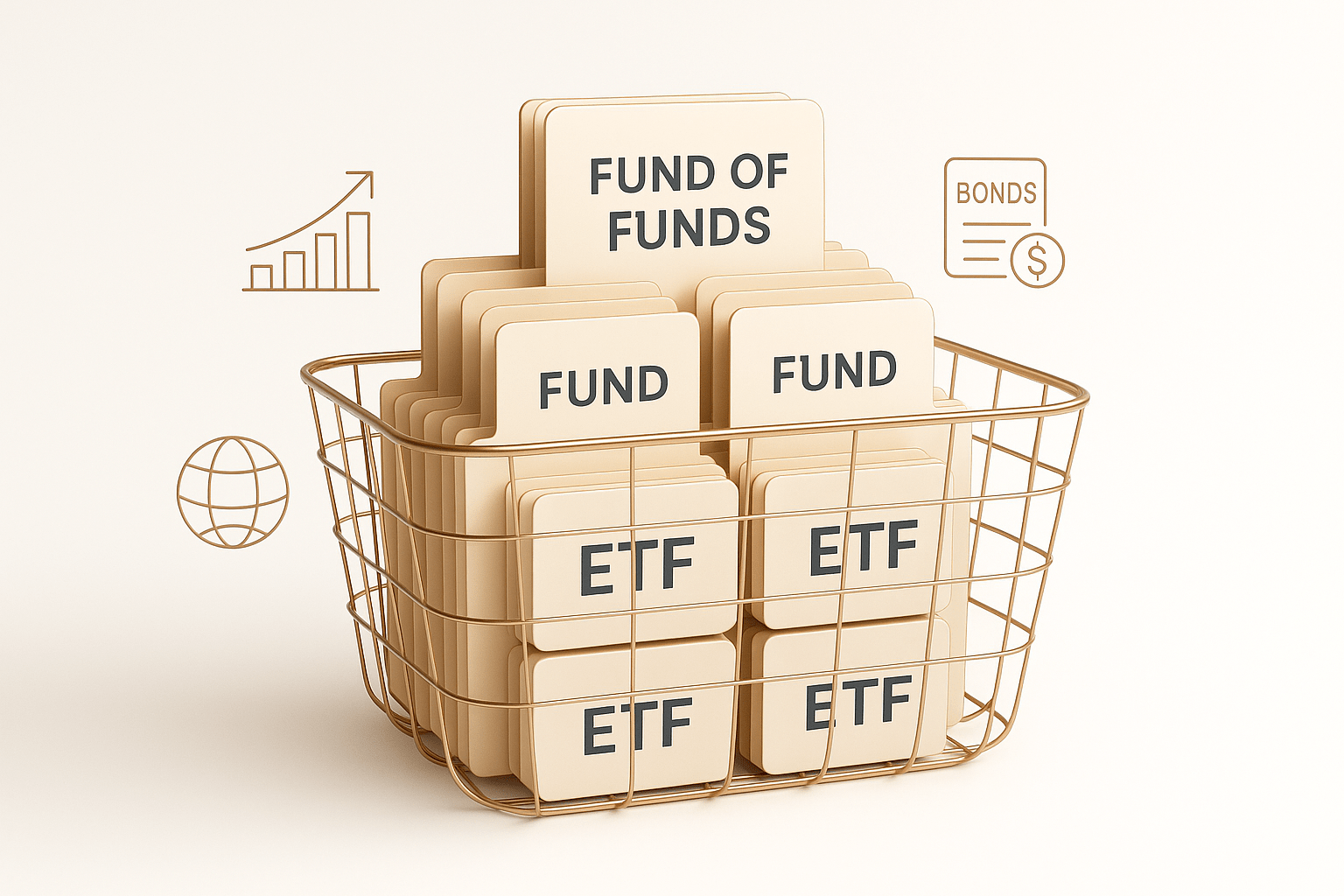
Mutual funds of mutual funds, often called FoFs, package diversification into a single, easy-to-maintain investment. Instead of buying individual funds yourself and rebalancing them, you buy one fund that invests in a curated set of underlying funds. This approach can save time, reduce decision fatigue, and provide broader market access in a single line item on your portfolio statement. In this guide, you will learn exactly how FoFs work, where they shine, where they fall short, and how to select one with confidence in 2025.
What Is a Mutual Fund of Mutual Funds
A mutual fund of mutual funds is an investment scheme that allocates investor money across multiple underlying mutual funds or exchange-traded funds. The FoF manager sets the allocation policy, performs due diligence on the underlying funds, and rebalances the mix to maintain the intended risk profile.
- What you hold: One FoF unit that represents many funds.
- Manager’s role: Select, monitor, and rebalance underlying funds.
- Your benefit: Broad exposure, single NAV, simpler upkeep.
How FoFs Work Behind the Scenes
- Define objective: Global diversification, conservative income, or growth with risk control.
- Select building blocks: Screen and pick underlying mutual funds/ETFs.
- Allocate & deploy: Invest to a target mix that fits the objective.
- Monitor overlap: Track common holdings to avoid hidden concentration.
- Rebalance & replace: Adjust weights and switch laggards when needed.
- Report a single NAV: You see one line-item; the FoF handles the rest.
Where FoFs Invest
- Domestic core: Blends equity and debt funds for an all-weather base.
- International access: Overseas funds for sector/currency diversification.
- Passive-only: Index funds and ETFs for low-cost market exposure.
- Risk-targeted blends: Equity, bonds, gold, and cash with rules-based rebalancing.
- Lifecycle/target-date: Gradual shift from growth to income as a target year nears.
Why Investors Consider FoFs
- Instant diversification across styles and geographies.
- Automatic rebalancing keeps risk aligned with goals.
- Lower maintenance and decision fatigue for busy investors.
- Clear core holding for experienced investors’ satellite ideas.
- Single SIP track simplifies contributions and tracking.
The Real Cost of Simplicity
FoFs charge their own expense ratio, and the underlying funds also have costs. You don’t pay two separate bills—the effect shows up in net returns. Passive FoFs tend to be cheaper; specialized or tactical blends cost more. Over long horizons, small cost differences can compound.
| Cost Layer | What It Pays For | Notes |
|---|---|---|
| FoF expense ratio | Selection, monitoring, rebalancing | Higher for active/tactical mandates |
| Underlying fund costs | Operating costs of constituent funds | Lower with index funds/ETFs |
| All-in impact | Shows up in net performance | Compare FoF to an appropriate blended benchmark |
Key Risks You Should Weigh
- Duplication: Multiple constituents holding the same names reduce true diversification.
- Tracking/implementation: ETF use, currency moves, or timing effects can widen deviations vs. a simple benchmark.
- Policy drift: Inconsistent allocation process may change behavior in volatile markets.
Who FoFs Suit Best
Good Fit
- Long-term savers using SIPs who want disciplined rebalancing.
- Families/small offices needing a defined core risk budget.
- Investors preferring simplicity and one line-item exposure.
Better to Avoid
- Hands-on allocators already managing multiple funds confidently.
- Tactical traders wanting direct control over each sleeve.
How to Evaluate a FoF
- Mandate clarity: Does the objective match your horizon and risk?
- Building blocks: Quality, track record, and cost of constituents.
- Overlap check: Scan top holdings of largest constituents.
- Rebalancing policy: Rules-based cadence beats ad-hoc decisions.
- Scale & liquidity: Enough AUM to execute changes efficiently.
- Benchmark match: Compare against a blended benchmark reflecting allocations.
Performance: What to Expect and How to Judge It
A balanced FoF generally draws down less than pure equity and grows more than pure bonds over multi-year periods. Judge through full cycles, not single years, and value a smoother journey if you are contributing via SIPs.
- Track risk-adjusted metrics alongside CAGR.
- Compare the path of returns, not just the endpoint.
- Expect short-term deviation when one asset class dominates.
Asset Allocation Examples You May Encounter
| Profile | Typical Tilt | Notes |
|---|---|---|
| Conservative Income | Lower equity, higher quality debt | Targets stability; offsets inflation with a measured equity slice |
| Balanced Growth | Moderate equity + bonds; small gold/cash | Rules-based rebalancing at set intervals |
| Aggressive Growth | Higher equity, small short-term debt | Accepts higher volatility for long-term growth |
| International Diversifier | Overseas equity/bonds | Adds sector and currency diversity to domestic-heavy portfolios |
Costs in Context: When Paying Extra Makes Sense
Justified
- Access to hard-to-reach markets or specialist strategies.
- Strict, rules-based rebalancing you won’t do yourself.
- Low-cost passive blends that approximate DIY costs.
Harder to Justify
- Ordinary constituents with high overlap.
- Inconsistent allocation discipline.
- Fees out of line with peers and mandate.
Taxes and Operational Details You Should Not Ignore
Tax treatment depends on jurisdiction and structure of the underlying funds. Overseas allocations may have different cut-off times, settlement, and currency effects. Read the scheme documents and consult a professional for tax clarity in your country.
SIPs, Lumpsums, and Rebalancing
FoFs pair naturally with SIPs because the manager rebalances the mix. Lumpsums also work if your horizon is long. Focus on alignment with your plan rather than perfect timing.
Due Diligence Checklist You Can Apply Today
Open checklist
- Objective & risk level match.
- List of constituents with track record & costs.
- Overlap, sector, and currency exposure.
- Stated rebalancing cadence; past changes consistent?
- Total expense ratio and exit load.
- Compare to a blended benchmark, not a single index.
Common Myths and Clear Answers
“FoFs are always expensive.”
Passive FoFs can be competitively priced; specialized or tactical blends cost more. Compare like-for-like.
“Diversification guarantees safety.”
Diversification reduces single-name risk, but market risk remains. Expect portfolio-level volatility.
“FoFs are only for beginners.”
Many experienced investors use FoFs as a disciplined core while running satellite ideas separately.
Practical Use Cases
- Global allocation core: Adds currency/sector diversity to domestic-heavy portfolios.
- Passive retirement anchor: Focus on contributions; let rebalancing work.
- Liquidity-aware treasury: Large, transparent index constituents for clarity and execution.
Disclaimer
This article is for education and general information. It is not investment, tax, or legal advice. Consider your circumstances and consult a qualified professional before investing.