
Mega-Cap Tech or Equal Weight?
The modern S&P 500 often behaves like two separate markets operating inside the same index. One side is dominated by the mega-cap technology companies that drive a disproportionate share of returns. The other side consists of the rest of the index, hundreds of mid and large cap stocks whose collective performance can diverge significantly from the giants that sit at the top. When an investor buys a market-cap-weighted product, they are choosing a structure where influence is concentrated intensely among a small group of names such as NVDA, AAPL, and MSFT. When an investor chooses an equal-weight product like RSP, they select a broader representation of market health.
The central question Mega-Cap Tech or Equal Weight refers to whether leadership should be expected from the largest companies or from the broader market. This question becomes especially important during turning points in liquidity cycles, earnings seasons, and macro transitions where leadership can rotate quickly. Understanding this rotation helps frame allocation decisions, manage risk, and detect whether the next phase of the market will be narrow or broad.
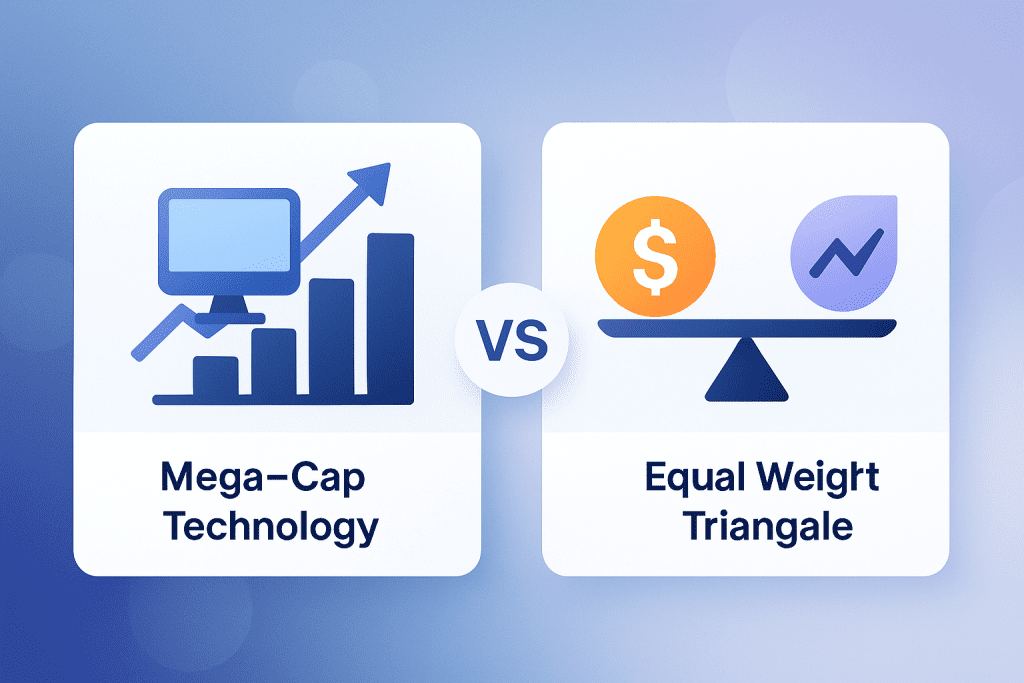
Understanding How Mega-Cap Weighting Shapes the Index
Market-cap weighting magnifies the influence of the largest companies. When mega-cap tech stocks trend strongly, they can pull the entire index higher even when a majority of components are not participating. This creates an illusion of strength. The index looks healthy, but the underlying participation can be weak. When this narrow leadership persists for long periods, it often pushes valuation dispersion to extremes between the leaders and the laggards.
Equal weight challenges this concentration. In an equal-weight structure, no single company can dominate the index’s movement. As a result, the performance of the equal-weight index provides a more accurate reflection of broad-market health. When equal weight performs in line with or stronger than the mega-cap-weighted S&P 500, it usually signals that the bull phase has broadened. When equal weight weakens significantly, it often indicates fragility beneath the surface of the headline index.
Breadth as the Primary Filter for Allocation Choices
Market breadth is the most important lens through which the mega-cap versus equal-weight debate can be understood. Breadth refers to how many stocks participate meaningfully in a move. Strong breadth means many components of the index are advancing. Weak breadth means only a handful of names are carrying performance.
A Breadth Monitor can track metrics such as the percentage of S&P 500 stocks trading above their 50-day moving average. When this percentage rises, it reflects a broadening market that supports equal weight. When it falls while the index still rises, it often reveals a narrow advance driven mostly by mega-cap names. Breadth helps identify whether the structure of the market is stable or relying on a fragile top-heavy foundation.
When breadth turns lower but mega-cap stocks continue to hit new highs, it indicates that most stocks are not confirming the rally. These divergences rarely persist indefinitely. Either the mega-caps eventually correct to realign with the broader market or the broader market improves to confirm the trend. Breadth therefore becomes a leading indicator of rotation between mega-cap and equal-weight regimes.
How Factor Rotation Guides the Decision
The Factor Rotation Matrix helps traders and investors understand which style factors are in charge. Growth, Value, Momentum, Defensive, Quality, and Cyclicals rotate under different macro conditions. Mega-cap tech stocks tend to sit at the intersection of Growth and Quality. Equal-weight portfolios often express Value, Cyclicals, and broad Momentum when breadth improves.
During periods of falling yields and expanding liquidity, growth and mega-cap tech tend to outperform. When inflation expectations rise, financial conditions tighten, or the business cycle transitions into a more mature stage, equal-weight and value-oriented components often take the lead. The Factor Rotation Matrix provides a visual framework for understanding these rotations in real time.
The market rarely stays in one quadrant for long. Shifts from Growth to Cyclicals, from Momentum to Defensive, or from Quality to Value reflect structural changes that affect which version of the S&P 500 an investor benefits from. Tracking these shifts helps avoid being caught in a phase where leadership is weakening without warning.
Putting It All Together: A Dynamic View Of Leadership And Weighting
The choice between Mega-Cap Tech or Equal Weight is not a binary label fixed in time. It is a dynamic decision that should evolve as the underlying reality of the market changes. Breadth tells you how many stocks are participating. Factor rotation reveals which styles the market is rewarding. Leadership comparisons between mega-cap names and RSP show where relative strength truly resides. Macro developments and earnings trends colour the backdrop through which these signals should be interpreted.

The Leadership Question: Who Is Actually Driving the Market?
Leadership is one of the cleanest ways to determine whether mega-cap tech or equal weight deserves a heavier allocation. Leadership is visible in relative strength, price behaviour, earnings momentum, volume patterns, and response to macro events. When NVDA, AAPL, and MSFT outperform the equal-weight index consistently, it indicates a mega-cap driven regime. When RSP begins to outperform these top names, it signals a broadening market.
A Who’s Leading carousel can compare charts of mega-cap leaders against RSP in a rotating visual format. This allows traders to see whether the giants are pulling ahead, falling behind, or trading in line with the rest of the index. The carousel turns leadership into a real-time observable behaviour rather than a theoretical concept.
Leadership typically shifts at inflection points such as Federal Reserve policy changes, major earnings releases, geopolitical shocks, or liquidity expansions or contractions. Monitoring leadership at these moments helps traders anticipate whether a rotation is taking shape before it becomes obvious in performance figures.
Why Equal Weight Matters During Transition Periods
Equal weight becomes especially important when the market transitions from one dominant regime to another. During the early stages of broad bull markets, equal weight often outperforms because rally participation expands across multiple sectors simultaneously. Investor confidence broadens, liquidity strengthens, and risk appetite improves. Under these conditions, the benefits of diversification become more pronounced.
Equal weight also acts as a protective measure when mega-cap valuations become extended. When price-to-earnings ratios in the largest tech names reach extremes, even small disappointments can trigger outsized declines. Equal-weight portfolios avoid overexposure to these concentrated risks. During periods of volatility, the reduced concentration can help stabilise returns.
However, in early liquidity tightening cycles or when growth slows, mega-cap names often act as defensive shelters. Their strong cash flows, wide moats, and earnings visibility can attract capital even when broader participation weakens. This creates cycles where equal weight lags, sometimes dramatically, despite a stable index surface.
Using Breadth To Separate Signal From Noise
Breadth is the quiet force underneath every major market move. While price grabs the headlines, breadth tells you whether the move is being carried by a strong supporting cast or by a handful of stars. For anyone asking whether mega-cap tech or equal weight is the better expression of the S&P 500 at a given moment, breadth is often the deciding factor.
How Macro Conditions Influence the Mega-Cap vs Equal Weight Divide
Macro forces create the foundation for leadership rotation. Falling interest rates typically benefit growth-heavy mega-cap stocks because lower discount rates lift the value of future earnings. Rising rates often favour equal weight because value and cyclical components respond more directly to economic activity.
Economic acceleration strengthens industrials, materials, energy, and financials. These sectors have more representation in equal-weight indices than in the market-cap-weighted S&P 500. Economic slowing or tightening liquidity narrows leadership back to the dependable mega-cap giants. Inflation, labour market conditions, productivity cycles, and fiscal policy all feed into the rotation.
Understanding these macro drivers helps traders position ahead of major turns in relative performance instead of reacting after the fact.
When Mega-Cap Tech Signals Exhaustion
No leadership lasts forever. Even the strongest mega-cap stocks experience phases of exhaustion where price momentum slows, earnings growth decelerates, or valuation becomes too stretched to sustain. These periods often present early warning signs that a rotation could be coming.
Exhaustion signals appear as negative divergences where mega-cap prices continue making new highs but relative strength begins to weaken. Another sign is when earnings beats fail to produce strong follow-through. When buyers stop rewarding strong results, it indicates a potential shift in sentiment. In these situations, equal-weight indices often begin to stabilise or quietly outperform, providing early clues about future leadership.

If you are a long term investor
Use the Annual Letter 2026 to navigate macro cycles, sector rotation and multi-month themes across global assets, without reacting to every intraday swing.
Recognising When Equal Weight Regains Control
Equal weight regains control when the market shifts from narrow to broad participation. This typically happens when economic conditions improve, when liquidity expands, or when valuation gaps between mega-cap leaders and the rest of the index compress back toward normal levels.
Price behaviour becomes more balanced. Breakouts appear in financials, industrials, materials, energy, and mid-cap technology at the same time. Volume patterns strengthen across sectors. Breadth indicators rise meaningfully, confirming that the market’s foundation is solid.
When equal weight takes leadership, the S&P 500 often enters a healthier and more sustainable advance. Returns become less dependent on the performance of a few names, and sector rotation becomes more dynamic.
Choosing Between Mega-Cap Tech and Equal Weight in Practice
There is no universal rule for choosing between mega-cap tech and equal weight. Instead, the decision depends on which regime the market is currently in. When growth leadership and liquidity support are strong, mega-cap tech often delivers superior risk-adjusted returns. When breadth expands and valuations reset, equal-weight strategies usually take the lead.
The optimal approach is dynamic allocation that adapts as market structure changes. Breadth, factor rotation, leadership behaviour, macro shifts, and earnings trends all provide signals that help identify which side of the divide is strengthening.
By combining these observations with clear frameworks, traders and investors can navigate the Mega-Cap Tech or Equal Weight question with confidence rather than guesswork.
How Breadth Regimes Evolve Over A Cycle
Breadth does not remain static. It evolves through phases that usually line up with stages of the economic and liquidity cycle. Early in a recovery, breadth often improves sharply as previously oversold names rally together. Equal weight responds strongly in this environment. As the cycle matures, leadership narrows to quality and growth. Breadth can remain positive but begins to depend more heavily on a smaller set of sectors and styles.
Understanding this evolution makes it easier to position ahead of breadth transitions. When breadth has been weak for an extended period and begins to recover, it can mark the moment when equal weight is about to reclaim leadership. When breadth has been strong but starts to roll over while mega-caps continue higher, it often signals that the regime is shifting back toward concentration and that risk around those leaders is increasing.
The Hidden Split Inside The S&P 500
The S&P 500 is often treated as a single, unified measure of the US equity market, yet beneath that simple label sits a structural split. On one side are the mega-cap technology and platform companies that dominate index weightings and media coverage. On the other side are the hundreds of smaller, but still significant, companies whose behaviour reflects the real breadth of economic and sector activity. When an investor looks only at the headline S&P 500, they see the combined result of these two groups without realising which side is doing the heavy lifting.
This structural split matters because it determines how sensitive your portfolio is to the fortunes of a handful of names. When mega-cap tech is in a powerful uptrend, a market-cap-weighted index can surge even if many other companies are flat or declining. The reverse can also occur during corrections, where weakness in a few giants drags the entire index lower despite pockets of resilience beneath the surface. Understanding Mega-Cap Tech or Equal Weight is therefore about understanding how concentrated or diversified your exposure truly is, even when you think you are simply “buying the market.”
Understanding Breadth: How Many Stocks Are Really Participating?
Breadth is a simple idea with profound implications. It answers a basic question: how many stocks are actually participating in the current direction of the market. A strong advance with healthy breadth means a large share of the index components are trading above key trend markers such as the 50-day moving average. A narrow advance with poor breadth means that only a small number of heavyweights are pulling the index higher while many stocks lag.
When breadth is strong, equal-weight strategies tend to benefit because gains are spread across a wider set of names. Sector rotation becomes more dynamic, and leadership broadens beyond the usual suspects in mega-cap tech. When breadth is weak, market-cap-weighted indices often outperform because performance is concentrated in a limited set of giants. The Breadth Monitor concept is about turning this invisible participation into a visible gauge that guides allocation decisions.
Breadth also tends to lead turning points. Before major corrections, it is common to see fewer and fewer stocks participating in the rally while the index continues to make new highs. This creates a divergence where price and participation disagree. In contrast, before durable recoveries, breadth often improves even while the index level appears to move sideways. In both cases, the breadth profile can reveal whether mega-cap strength is being supported or undermined by the rest of the market.
Mega-Cap Tech Regimes: When Concentration Is A Feature, Not A Bug
There are phases in the market where mega-cap technology leadership is not only normal but rational. In environments where earnings growth is scarce, interest rates are stable or falling, and technological disruption is the primary driver of productivity, investors gravitate toward companies with dominant business models and robust cash flows. Under such conditions, names like NVDA, AAPL, and MSFT often compress capital into a narrow set of stocks, producing powerful market-cap-weighted performance.
In these regimes, the traditional S&P 500 can appear unstoppable, but the underlying driver is the outsized performance of a few leaders. Equal-weight strategies may lag because the broader market contains more cyclical, value-oriented, or lower-growth names that do not benefit as strongly from the prevailing macro backdrop. In this phase, betting against mega-cap concentration can be costly. Instead, traders focus on monitoring when this concentration becomes extreme enough to be vulnerable.
Recognising a mega-cap regime involves observing relative strength between top-weighted tech stocks and the equal-weight index. When mega-cap charts are steadily climbing relative to equal weight, the message is clear: the market is rewarding scale, growth and balance sheet strength above all else. The challenge is not to resist this regime out of principle, but to be ready for the moment when the crowding and valuations that support it begin to reverse.
Equal Weight Regimes: When The Market Opens Up
Equal-weight outperformance is most powerful when the market shifts from narrow to broad participation. This typically occurs when economic growth begins to broaden, earnings improvements spread across sectors, or valuations become attractive in lagging areas such as financials, industrials, materials, smaller technology names and consumer cyclicals. In such environments, the majority of the index components can rise together, and an equal-weight portfolio benefits from owning more of these improving names.
When equal weight leads, the nature of risk changes. The market becomes less dependent on a handful of companies and more driven by the collective health of corporate earnings and economic momentum. Corrections within any single mega-cap name are less dangerous for the overall index, and sector rotation becomes a feature rather than a threat. This type of regime often feels healthier and more sustainable because it represents a truly broad bull phase rather than a top-heavy rally.
Recognising an equal-weight regime means watching for consistent periods where RSP and similar equal-weight products outperform the standard S&P 500. It means noticing that breakouts and constructive patterns are appearing in sectors that previously lagged. It also means accepting that the leadership narrative has changed. Instead of asking what NVDA or AAPL are doing every day, the more important question becomes how many sectors are participating in the move and whether that participation is strengthening or weakening.
Why Choose Us ?
Astrodunia guides you through the market’s ups and downs with the help of planetary science. Our team of experts in financial astrology provide valuable insights and predictions to assist you in market wise investment decisions and navigate the global market with ease.

Market Forecasting
Experience the advantage of enhanced market predictions. Our unique approach combines traditional analysis with astrological insights for more accurate predictions and better investment opportunities.

Decades of Market Timing Expertise
For over 20 years, we’ve honed our skills in market timing within the stock market. Our extensive experience allows us to navigate market trends with precision and confidence.

Trusted by Discerning Investors
Our clients choose us for our proven track record of success and our commitment to providing them with the most reliable market insights. Join the ranks of satisfied investors who trust our expertise
Factor Rotation: Growth, Value, Momentum And Defensive Styles
Behind the mega-cap versus equal-weight debate lies a more granular story about factor rotation. Factors such as Growth, Value, Momentum, Quality and Defensive behave differently at various points in the cycle. Mega-cap technology tends to embody Growth and Quality. Equal-weight portfolios often express Value, Cyclicals and broad Momentum when the bull market progresses into more mature and widespread phases.
In early recovery environments, Growth and Quality can dominate as investors seek companies that can perform regardless of uneven macro conditions. As the recovery solidifies, Cyclicals and Value begin to catch up or even take the lead, driving equal-weight outperformance. During defensive phases, investors often retreat into low-volatility or defensive sectors such as utilities, healthcare or consumer staples, sometimes favouring large caps but not always favouring concentration.
The Factor Rotation Matrix is a conceptual way to keep this dynamic visible. By mapping which factors are leading and which are lagging, traders can infer whether the current environment favours concentrated mega-cap exposure or diversified equal-weight exposure. The key is to remember that factor leadership usually does not change overnight; it transitions through periods of overlap where both mega-caps and equal weight may perform similarly before a clear winner emerges.
Who’s Leading: Reading The Tape Through Key Names And RSP
Leadership is often easier to see in individual charts than in aggregated indices. Watching NVDA, AAPL and MSFT alongside an equal-weight benchmark such as RSP provides a direct view of who is truly driving returns. If mega-cap charts consistently show clean trends, strong breakouts, constructive pullbacks and higher highs relative to RSP, the conclusion is straightforward: mega-cap tech is leading.
If, however, RSP begins to show stronger trend behaviour, tighter consolidations, and more decisive breakouts than the mega-caps, the balance of power may be shifting. At that point, the question Mega-Cap Tech or Equal Weight becomes more than a theoretical exercise; it becomes an actionable allocation decision. In practice, this often means weighing whether to tilt portfolios more towards diversified exposure or maintain concentrated positions in the giants.
The Who’s Leading carousel as a conceptual tool helps maintain this comparative view in a simple, repeatable way. Instead of checking hundreds of charts, traders focus on a small group of representative leaders and the equal-weight index. Over time, this creates a rhythm where shifts in leadership are recognised early rather than after they have fully played out.
Testimonials
Discover what our satisfied customers have to say about their experience with us. Read our testimonials from people just like who have benefited from our services.
Market singals have helped me to make quick and informed decisions for trades in stock market. resulting in significant profits for my portfolio. The team is highly professsional and always available to answer your questions and provide the best customer service.
SK Jhunjhunwala
Investor based in Mumbai
I have been using the astrodunia’s services for over 4+ years now and have been extremely impressed with level of experties and precions they bring to the table. Their live market signals have helped me make quick and informed decisions.
N. Patel
Pennsylvania , US
Excellent service. This is undoubtedly the best market forecast newsletter that i have ever subscribed. None of the other newsletter are anywhere close to this terms of accuracy. Please continue with the good work !
Withheld
Fixed income trader with a required foreign bank in asia
i am an entrepreneur based in Australia and have been subscriber of astrodunia services from the past two years.i have found their NewsLetter , Live Signals and Annual Letter to be incredibly valueable.
Z. Irani
Australia
Scenarios Where Mega-Cap Outperforms Equal Weight
There are several recurring scenarios in which mega-cap tech tends to outperform equal weight. One scenario is a period of macro uncertainty where investors seek the perceived safety of dominant franchises with fortress balance sheets. Another scenario involves technological acceleration phases, such as large shifts in artificial intelligence, cloud computing, or platform ecosystems, where the largest players capture outsized economic and market share benefits.
A third scenario occurs in the early aftermath of liquidity injections or policy easing, where investors rush into the most liquid and well-known names as a first response. The strongest liquidity flows often find their way into mega-cap indices and exchange-traded funds, amplifying their performance relative to the broader market. During these phases, equal-weight products can appear sluggish, not because the market is unhealthy, but because capital is clustering temporarily in the giants.
Understanding these scenarios allows traders to interpret mega-cap outperformance more accurately. Instead of seeing it as an automatic signal of an unhealthy market, they can distinguish between constructive phases, where mega-cap leadership is a rational response to conditions, and late-stage excess, where concentration has reached levels that may not be sustainable.
Scenarios Where Equal Weight Overtakes Mega-Cap Tech
Equal weight tends to shine when the market transitions from narrow leadership into a broad-based expansion. This often occurs after a period of consolidation or a correction that resets valuations across the board. Once investors become confident that the worst downside risk has passed, they begin to search for opportunities beyond the obvious leaders. Money rotates into sectors and stocks that had previously lagged but now look attractive relative to both earnings and price.
Another scenario where equal weight outperforms arises during cycles of robust economic growth where gains are distributed across multiple sectors. Industrials, financials, consumer discretionary, materials and mid-cap technology can all advance together, creating a market where breadth is strong and equal weighting becomes a more efficient way to harness that broad improvement.
Equal-weight leadership can also appear during phases where mega-cap valuations have become stretched relative to their own history or to the rest of the index. In such cases, even modest disappointments in mega-cap earnings can trigger underperformance, while stocks with lower expectations and cheaper valuations move higher as investors rotate into names with better risk-reward profiles.
Meet Our Team
Get to know our dedicated team of experts. With a diverse range of skills and years of experience, we’re committed to providing you with the best market analysis and investment guidance.

Mr. Rajeev Prakash Agarwal
Founder
Expert in financial & personal astrology for 20 years+. Rajeev is a well-known astrologer based in central India who has a deep understanding of both personal and mundane astrology.

Mr. Shashi Prakash Agarwal
Technical Head
Shashi is a technology leader with a strong background in global business.He holds a B. Tech in Computer Science & MBA in Finance from Narsee Monjee Institute of Management Studies, one of the top B-Schools in India.
Risk Management Across Concentrated And Broad Regimes
Risk behaves differently in concentrated and broad regimes. In a concentrated regime dominated by mega-cap tech, single-name risk becomes more important for index investors. Negative surprises in one or two giants can move the entire index sharply. In such a regime, risk management may involve understanding exposure at the top of the index and monitoring those names more closely than the long tail of smaller components.
In a broad regime led by equal weight, risk becomes more diversified but also more complex. Sector rotation can be faster, and leadership can shift more frequently between groups such as cyclicals and defensives. Risk management then involves paying attention to cross-sector relationships, factor exposures, and the overall breadth profile rather than a handful of dominant stocks.
For both regimes, the central risk question is whether the current leadership is supported by breadth, macro conditions, earnings and valuation, or whether it has become an unbalanced extension of prior trends. Mega-cap or equal-weight decisions are not about dogma. They are about aligning risk exposure with the actual structure of the market at any given moment.
Whether you’re a seasoned investor or just starting out, our financial astrology tools can be tailored to your specific investment goals. Gain valuable insights to achieve your financial aspirations.
Address
1301, 13th Floor, Skye Corporate Park, Near Satya Sai Square, AB Road, Indore 452010
+91 9669919000
© All Rights Reserved by RajeevPrakash.com (Managed by AstroQ AI Private Limited) – 2025