
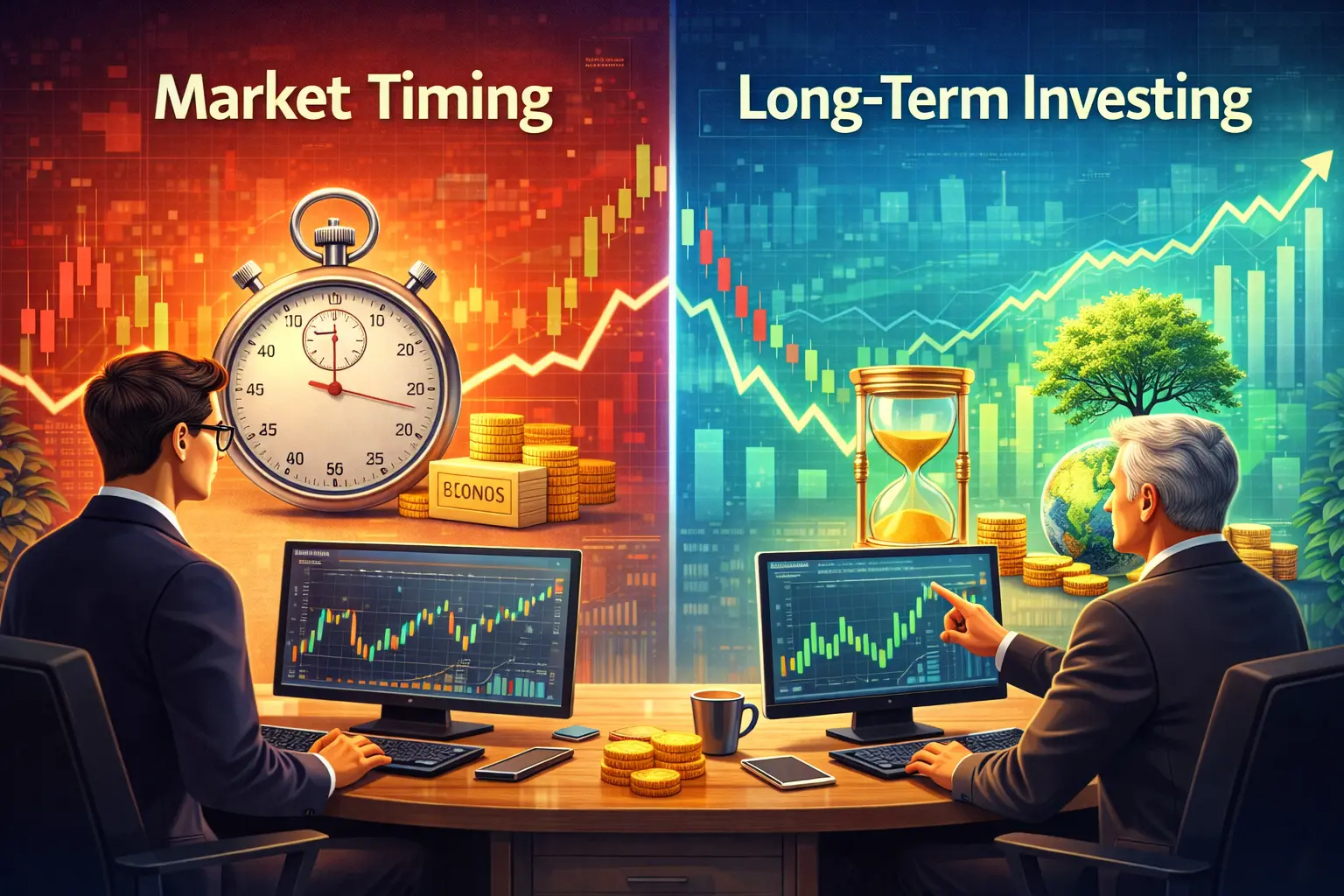
As financial markets move toward 2026, investors are once again debating a familiar question: is it better to time the market or commit to long-term investing? While this debate has existed for decades, the market environment shaping 2026 adds new complexity. Rapid information flow, evolving monetary policy, and structurally higher volatility have changed how both approaches perform.
Rather than presenting a simple winner, the answer in 2026 depends on understanding market behavior, personal objectives, and the trade-offs inherent in each strategy.
The Case for Market Timing in a Volatile Environment
Market timing aims to enhance returns or reduce risk by entering and exiting positions based on expected price movement. In 2026, frequent volatility and rapid reaction to economic data may appear to favor timing-based strategies. Short-term price swings can create opportunities for skilled participants who understand market structure and risk management.
However, market timing requires precision, discipline, and consistent execution. The challenge lies not only in predicting market direction, but also in managing emotions and transaction costs. In an environment where markets can reverse quickly, even well-timed decisions can be undermined by sudden changes in sentiment or liquidity.
Structural Challenges of Timing the Market
Despite its appeal, market timing faces structural limitations. Data shows that missing a small number of strong market days can significantly reduce long-term returns. In 2026, where volatility may produce sharp but short-lived rallies, the risk of being out of the market during critical periods increases.
Timing also assumes the ability to re-enter positions effectively after exiting. This re-entry is often more difficult than expected, as fear during downturns and hesitation during recoveries can delay action. These behavioral challenges persist regardless of market sophistication.
Long-Term Investing and the Power of Compounding
Long-term investing focuses on remaining invested through market cycles, allowing compounding to work over time. In 2026, this approach remains supported by historical evidence. Despite periods of volatility, markets have demonstrated an ability to recover and grow alongside economic progress.
Compounding does not require constant decision-making. Instead, it benefits from consistency and patience. Investors who maintain exposure to productive assets over long horizons often achieve outcomes that timing strategies struggle to replicate after costs and errors are considered.
The Role of Market Structure in 2026 Decision-Making
Market structure in 2026 plays a meaningful role in determining whether timing or long-term investing proves more effective. The growing influence of passive investing, algorithmic execution, and rapid information dissemination has changed how prices move. Markets can react swiftly to data and then stabilize just as quickly, creating conditions where short-term timing becomes more difficult to execute consistently.
For long-term investors, this structure reinforces the advantage of staying invested. Short-lived price dislocations often resolve before most participants can act decisively. Timing strategies must therefore operate with greater precision to avoid being whipsawed by rapid reversals.
Liquidity Cycles and Their Impact on Strategy Choice
Liquidity cycles influence both timing and long-term outcomes. Periods of abundant liquidity tend to smooth market behavior, while tighter conditions amplify volatility. In 2026, liquidity is expected to be uneven rather than uniformly abundant, increasing the frequency of abrupt market moves.
This environment challenges timing strategies that rely on predictable follow-through. Long-term investors, however, can use liquidity-driven volatility to add exposure gradually rather than attempting to identify precise turning points. Understanding liquidity conditions helps investors choose how actively they should engage with markets.
Valuation Awareness and Entry Discipline
Valuation plays a central role in bridging the gap between timing and long-term investing. In 2026, valuations across markets are likely to vary widely by sector and region. Investors who incorporate valuation awareness into long-term strategies can improve outcomes without resorting to frequent timing.
Rather than exiting markets entirely, valuation discipline encourages selective accumulation during periods of weakness and restraint during exuberance. This approach preserves the benefits of compounding while reducing exposure to overvaluation risk.
Drawdowns, Recovery Speed, and Psychological Pressure
Drawdowns are an inevitable part of investing, and their psychological impact often shapes strategy decisions. In 2026, recoveries may occur faster than in past cycles due to rapid information flow and institutional participation. This speed increases the cost of being out of the market during rebounds.
Timing strategies must not only anticipate drawdowns but also re-enter effectively during recovery. Long-term investing avoids this challenge by remaining exposed throughout cycles. For many investors, the reduced psychological pressure of not having to time re-entry is a significant advantage.
Time Horizon as the Defining Variable
Time horizon ultimately determines which approach works best. Short horizons magnify the appeal of timing, while longer horizons favor continuous participation. In 2026, aligning strategy with time horizon is especially important, as markets may deliver returns unevenly over time.
Investors with long-term objectives benefit from accepting interim volatility as part of the process. Those with shorter-term needs may require more active risk management. Misalignment between horizon and strategy often leads to frustration and suboptimal decisions.
Annual Letter 2026 by Rajeev Prakash Agarwal
The Annual Letter 2026 is a long-term strategic outlook designed for serious investors, traders, and decision-makers navigating a rapidly shifting global economy. It decodes the year ahead through planetary cycles, macroeconomic forces, market psychology, and structural turning points across equities, commodities, currencies, digital assets, and global capital flows.
This letter is not a short-term trading guide or a collection of predictions. It is a framework for understanding how 2026 reshapes risk, opportunity, regulation, and wealth creation across financial markets. Every section focuses on timing, probability, and capital protection, helping readers prepare for regime shifts rather than react to headlines.

The Impact of Volatility on Long-Term Strategies
Volatility often tests the resolve of long-term investors. In 2026, frequent price swings may challenge confidence even among disciplined participants. However, volatility alone does not negate the effectiveness of long-term investing. In fact, it can enhance long-term returns by providing opportunities to invest at favorable valuations.
The key lies in behavior. Investors who remain committed to long-term strategy during volatile periods are more likely to benefit from eventual recovery. Those who abandon strategy in response to short-term fear undermine the advantages of compounding.
Opportunity Cost and Strategic Trade-Offs
Choosing between market timing and long-term investing involves opportunity cost. Timing strategies may reduce drawdowns, but they also risk missing periods of recovery. Long-term investing accepts interim volatility in exchange for participation in long-term growth.
In 2026, these trade-offs are particularly relevant. Markets may not trend smoothly, and periods of sideways movement could frustrate both approaches. Understanding these dynamics helps investors set realistic expectations and choose strategies aligned with their tolerance for uncertainty.
Hybrid Approaches and Strategic Flexibility
Many investors in 2026 are exploring hybrid approaches that combine elements of both timing and long-term investing. While core holdings remain invested to capture long-term growth, tactical adjustments may be used to manage risk during extreme conditions.
This flexibility acknowledges that markets are neither perfectly predictable nor entirely random. However, successful hybrid strategies require clear rules to prevent emotional decision-making. Without discipline, flexibility can quickly devolve into inconsistent timing.
Behavioral Discipline as a Deciding Factor
Behavior often determines success more than strategy choice. Market timing demands rapid, confident decisions under pressure, while long-term investing requires patience and emotional resilience. In 2026, where information is constant and opinions are abundant, behavioral discipline becomes even more critical.
Investors who understand their psychological strengths and limitations are better positioned to select an approach they can execute consistently. A strategy that cannot be followed reliably is unlikely to succeed, regardless of theoretical merit.
The Role of Market Structure in 2026 Decision-Making
Market structure in 2026 plays a meaningful role in determining whether timing or long-term investing proves more effective. The growing influence of passive investing, algorithmic execution, and rapid information dissemination has changed how prices move. Markets can react swiftly to data and then stabilize just as quickly, creating conditions where short-term timing becomes more difficult to execute consistently.
For long-term investors, this structure reinforces the advantage of staying invested. Short-lived price dislocations often resolve before most participants can act decisively. Timing strategies must therefore operate with greater precision to avoid being whipsawed by rapid reversals.
Liquidity Cycles and Their Impact on Strategy Choice
Liquidity cycles influence both timing and long-term outcomes. Periods of abundant liquidity tend to smooth market behavior, while tighter conditions amplify volatility. In 2026, liquidity is expected to be uneven rather than uniformly abundant, increasing the frequency of abrupt market moves.
This environment challenges timing strategies that rely on predictable follow-through. Long-term investors, however, can use liquidity-driven volatility to add exposure gradually rather than attempting to identify precise turning points. Understanding liquidity conditions helps investors choose how actively they should engage with markets.
Valuation Awareness and Entry Discipline
Valuation plays a central role in bridging the gap between timing and long-term investing. In 2026, valuations across markets are likely to vary widely by sector and region. Investors who incorporate valuation awareness into long-term strategies can improve outcomes without resorting to frequent timing.
Rather than exiting markets entirely, valuation discipline encourages selective accumulation during periods of weakness and restraint during exuberance. This approach preserves the benefits of compounding while reducing exposure to overvaluation risk.
Drawdowns, Recovery Speed, and Psychological Pressure
Drawdowns are an inevitable part of investing, and their psychological impact often shapes strategy decisions. In 2026, recoveries may occur faster than in past cycles due to rapid information flow and institutional participation. This speed increases the cost of being out of the market during rebounds.
Timing strategies must not only anticipate drawdowns but also re-enter effectively during recovery. Long-term investing avoids this challenge by remaining exposed throughout cycles. For many investors, the reduced psychological pressure of not having to time re-entry is a significant advantage.
Time Horizon as the Defining Variable
Time horizon ultimately determines which approach works best. Short horizons magnify the appeal of timing, while longer horizons favor continuous participation. In 2026, aligning strategy with time horizon is especially important, as markets may deliver returns unevenly over time.
Investors with long-term objectives benefit from accepting interim volatility as part of the process. Those with shorter-term needs may require more active risk management. Misalignment between horizon and strategy often leads to frustration and suboptimal decisions.
The Cost of Overtrading in a High-Information Era
The abundance of information in 2026 can encourage overtrading. Constant exposure to opinions, forecasts, and real-time data increases the temptation to act frequently. For timing strategies, this environment raises transaction costs and increases the likelihood of error.
Long-term investing counters this tendency by emphasizing simplicity and restraint. By reducing decision frequency, investors lower costs and minimize the impact of noise-driven actions.
Data-Driven Perspective on What Works Best
From a data-driven perspective, long-term investing continues to outperform market timing for the majority of participants. While skilled traders can succeed at timing, the consistency required places it beyond the reach of most investors. Long-term strategies benefit from simplicity, lower costs, and reduced behavioral error.
This does not mean market timing has no place in 2026. It means that its effectiveness depends heavily on skill, experience, and risk management. For most investors, long-term participation remains the more reliable path.
Aligning Strategy With Goals in 2026
The question of what works best ultimately depends on individual goals. Investors focused on wealth accumulation over decades may favor long-term investing. Those with shorter horizons or specific risk management objectives may find selective timing appropriate.
In 2026, clarity of purpose is essential. Aligning strategy with goals, time horizon, and temperament reduces the likelihood of abandoning plans during challenging periods.
Final Thoughts on Market Timing vs Long-Term Investing in 2026
Market timing and long-term investing each offer distinct advantages and challenges. In the context of 2026, where volatility and uncertainty are likely to persist, long-term investing remains the more robust approach for most participants. It harnesses the power of compounding while minimizing the impact of behavioral mistakes.
Market timing, while potentially rewarding, demands exceptional discipline and skill. For those who possess these qualities, it may complement long-term strategies rather than replace them.
Ultimately, what works best in 2026 is not choosing the perfect strategy, but choosing a strategy that can be executed consistently with confidence and discipline through the inevitable ups and downs of the market.