
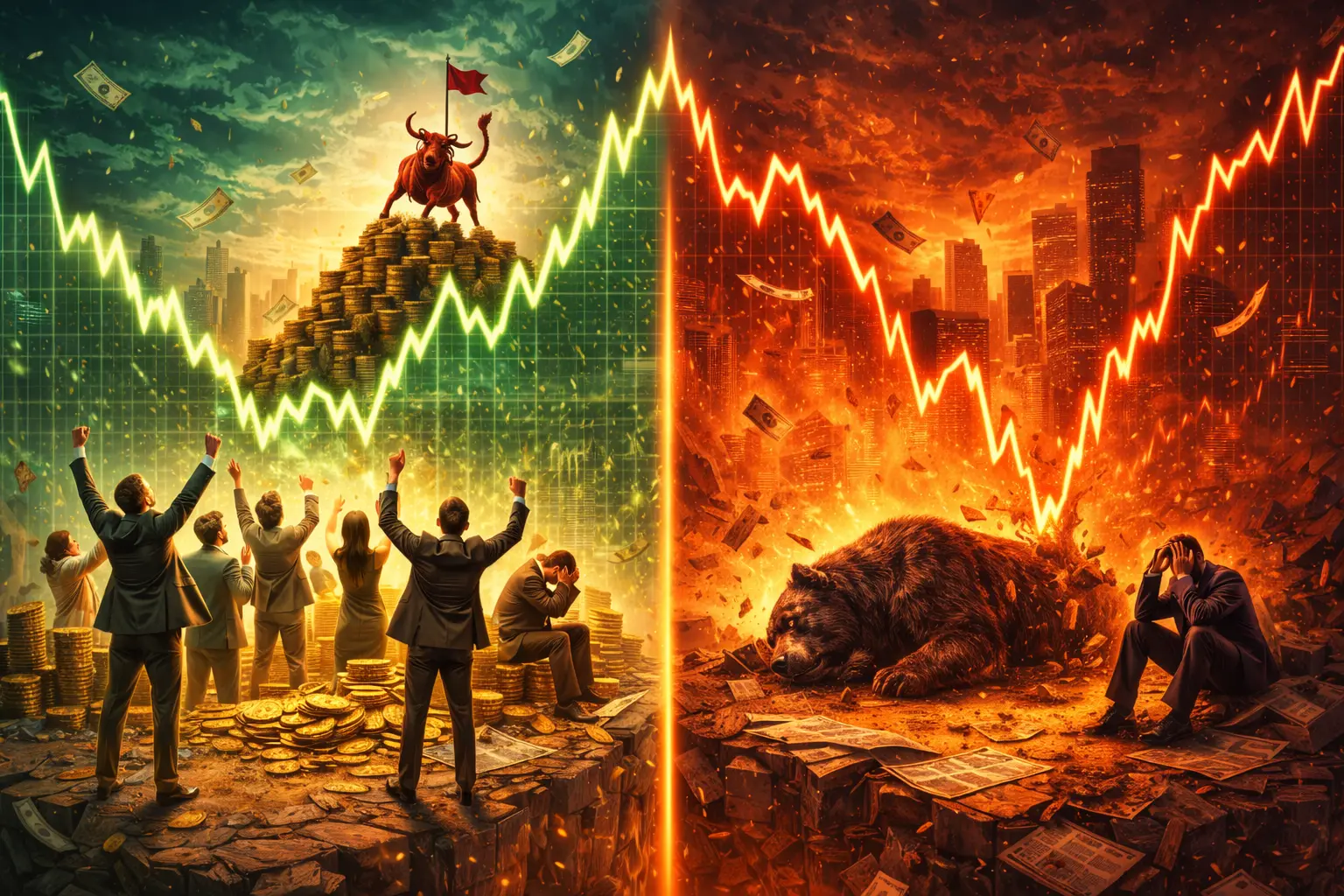
Financial markets move in emotional waves long before they move in logical conclusions. Prices rise and fall not only because of earnings, interest rates, or economic data, but because of how investors collectively interpret uncertainty and opportunity. In 2026, the contrast between market euphoria and capitulation becomes sharper than in previous cycles, largely because liquidity is constrained, narratives are unstable, and positioning adjusts faster than fundamentals.
Understanding these emotional cycles is essential for navigating markets that no longer follow smooth, policy-supported trends. Euphoria and capitulation are not anomalies. They are recurring phases that reveal where markets are most vulnerable and where opportunity quietly begins to form.
The Psychology Behind Market Euphoria
Market euphoria emerges when confidence overwhelms caution. In 2026, euphoria does not necessarily look like reckless speculation across all assets. Instead, it often appears as calm certainty. Investors believe risks are known, manageable, and already priced in. Price strength is interpreted as validation rather than warning, and setbacks are quickly reframed as temporary pauses.
This confidence is frequently reinforced by selective evidence. Positive data points receive disproportionate attention, while contradictory signals are discounted. Expectations of policy support, technological breakthroughs, or rapid economic normalization resurface even when structural constraints suggest otherwise.
What makes euphoria dangerous in 2026 is that it often builds on fragile foundations. Higher interest rates, tighter financial conditions, and geopolitical uncertainty reduce the margin for error. When optimism assumes conditions will improve quickly, markets become vulnerable to disappointment.
How Euphoria Manifests in a Post-Easy-Money Environment
Unlike previous cycles, euphoria in 2026 tends to be concentrated rather than broad-based. Certain sectors, themes, or assets attract intense enthusiasm, while others remain neglected. This concentration reflects selective liquidity and targeted capital flows rather than universal optimism.
Rallies driven by hope of renewed growth or easing financial conditions can be powerful but short-lived. As prices rise, participation increases, leverage builds subtly, and downside protection fades. The belief that markets will continue higher becomes self-reinforcing, even as underlying risks remain unresolved.
Euphoria at this stage feels rational. It is justified by forward-looking arguments and reinforced by recent performance. That is precisely why it is difficult to recognize in real time.
Capitulation as the Emotional Opposite
Capitulation represents the emotional low point of a market cycle. It occurs when fear replaces hope and investors abandon positions not because valuations are unattractive, but because uncertainty feels unbearable. In 2026, capitulation is shaped by the same forces that intensify euphoria, including rapid information flow, leverage, and tight liquidity.
When sentiment turns, declines can be abrupt. Positions are reduced quickly, correlations rise, and even high-quality assets are sold indiscriminately. Capitulation is often accompanied by pessimistic narratives that assume conditions will continue to deteriorate indefinitely.
Importantly, capitulation does not require a catastrophic event. It can be triggered by cumulative disappointment, failed expectations, or the realization that relief will not arrive as quickly as hoped.
The Role of Liquidity in Emotional Extremes
Liquidity plays a central role in both euphoria and capitulation. In 2026, liquidity is episodic rather than constant. Short-term easing, fiscal measures, or shifts in global capital flows can ignite optimism. When these supports fade, markets adjust rapidly.
Because liquidity is thinner, emotional extremes develop faster and resolve more violently. Euphoria can form over weeks rather than years, and capitulation can unfold in days. This compression of emotional cycles increases volatility and challenges traditional timing approaches.
Understanding liquidity conditions helps explain why markets swing between confidence and despair without clear changes in long-term fundamentals.
Capitulation as a Source of Opportunity
While capitulation is painful, it often marks the point where risk-reward dynamics improve. In 2026, periods of capitulation tend to occur when sentiment becomes universally negative and expectations are reset lower. Prices reflect fear rather than balanced assessment.
These moments are uncomfortable because uncertainty remains high. However, they often coincide with forced selling, reduced leverage, and the clearing of weak hands. As emotional pressure subsides, markets stabilize even if news remains negative.
Recognizing capitulation requires emotional discipline. It involves acting when conviction is low and narratives are bleak, which runs counter to natural human behavior.
The Cycle Between Euphoria and Capitulation
Markets rarely move directly from euphoria to recovery or from capitulation to sustained rallies. Instead, they oscillate between these emotional states as participants adjust expectations. In 2026, these oscillations are more frequent due to unstable narratives and reactive positioning.
Euphoria gives way to correction when expectations exceed reality. Capitulation gives way to stabilization when fear overshoots risk. Understanding this cycle allows investors to contextualize volatility rather than be overwhelmed by it.
These emotional phases are not signals to trade aggressively, but frameworks for understanding where markets stand within a broader psychological cycle.
Investor Behavior During Emotional Extremes
Investor behavior at emotional extremes tends to be reactive rather than strategic. During euphoria, risk is underestimated and diversification is reduced. During capitulation, risk is overestimated and long-term plans are abandoned.
In 2026, maintaining discipline during these phases is particularly challenging because price movements are faster and narratives shift abruptly. Those who rely on emotional cues often enter markets late and exit at the worst possible moments.
A structured approach that acknowledges emotional cycles helps mitigate these behavioral pitfalls.
From Emotional Awareness to Risk Management
The practical value of understanding euphoria and capitulation lies in risk management rather than prediction. In 2026, recognizing when markets are emotionally stretched helps investors adjust exposure, reassess assumptions, and protect capital without trying to call exact tops or bottoms.
This awareness encourages patience during euphoric phases and courage during capitulative ones. It supports gradual, thoughtful decisions rather than impulsive reactions.
Emotional Compression and Faster Market Cycles
One of the defining characteristics of 2026 is emotional compression. In earlier market cycles, euphoria and capitulation unfolded over extended periods, allowing time for reflection and adjustment. In the current environment, emotional phases are compressed into shorter timeframes. Advances and declines happen faster, and sentiment shifts with greater intensity.
This compression is driven by tighter liquidity, real-time information flow, and widespread use of leverage and derivatives. When expectations shift, markets reprice almost immediately. As a result, investors experience more frequent emotional extremes even when long-term fundamentals change slowly. Recognizing this compression helps explain why markets can feel exhausting and unpredictable despite relatively stable macro conditions.
The Illusion of Control During Euphoric Phases
Euphoric phases often create an illusion of control. Investors feel confident in their understanding of the market, believing that risks are known and manageable. In 2026, this illusion is reinforced by sophisticated tools, abundant data, and constant commentary that frames outcomes as predictable.
This sense of control leads to overconfidence. Exposure increases, hedging decreases, and assumptions harden. The belief that markets will respond rationally to new information becomes widespread. However, this confidence rests on fragile assumptions about liquidity, policy flexibility, and economic resilience.
When these assumptions are challenged, the illusion of control dissolves quickly, contributing to sharp transitions from euphoria to fear.
Capitulation Without Catharsis
Capitulation is often imagined as a dramatic event that clears the market and resets expectations. In 2026, capitulation can be more fragmented. Instead of a single, definitive washout, markets may experience a series of smaller capitulative episodes across different assets and regions.
This lack of catharsis makes recovery feel uncertain. Investors hesitate to re-engage because fear lingers even as prices stabilize. Volatility remains elevated, and confidence rebuilds slowly. This environment rewards patience and selectivity rather than aggressive positioning.
Understanding that capitulation does not always feel complete helps investors avoid waiting for a perfect signal that may never arrive.
Narrative Reversal at Emotional Extremes
Narratives tend to reverse at emotional extremes. During euphoria, stories emphasize inevitability and progress. During capitulation, they emphasize failure and permanence. In 2026, these narrative shifts happen rapidly, often without meaningful changes in underlying conditions.
The speed of narrative reversal amplifies emotional stress. Investors struggle to reconcile conflicting messages and may abandon well-considered strategies in response. Recognizing that narratives are reflections of sentiment rather than drivers of value helps maintain perspective during these transitions.
Cross-Market Feedback Loops
Emotional extremes are reinforced by feedback loops across markets. In euphoric phases, strength in one asset class spills into others, creating the impression of broad-based opportunity. In capitulation, weakness spreads quickly as correlations rise and diversification benefits diminish.
In 2026, these feedback loops are intensified by global interconnectedness and synchronized positioning. A shift in one market can trigger reactions elsewhere, even in the absence of direct fundamental links. This interconnectedness accelerates emotional cycles and increases the difficulty of isolating risk.
Understanding these feedback loops highlights why emotional discipline is critical in managing portfolios across cycles.
Annual Letter 2026 by Rajeev Prakash Agarwal
Markets are entering a phase where easy assumptions no longer work. Liquidity is selective, volatility is structural, and capital is rewarded only when it is positioned with clarity and discipline. In such an environment, reacting to headlines is not enough. What matters is having a forward-looking framework that helps you anticipate change rather than chase it.
The Annual Letter 2026 by Rajeev Prakash Agarwal offers a comprehensive investment outlook designed for this new market regime. It blends long-term macro analysis, market psychology, and planetary cycles that have historically aligned with major shifts in global capital flows. The focus is on understanding cycles, identifying high-probability phases, and protecting capital during periods of uncertainty.

The Role of Time Horizons in Emotional Decision-Making
Time horizons strongly influence how investors experience euphoria and capitulation. Short-term participants are more sensitive to emotional extremes, as their outcomes depend on immediate price movements. Long-term investors may feel pressure to react, even when their objectives remain unchanged.
In 2026, blurred time horizons contribute to emotional stress. Long-term investors are exposed to short-term volatility through constant monitoring and media exposure. This can lead to unnecessary action during periods of emotional intensity.
Reaffirming time horizons helps counteract this pressure. It allows investors to distinguish between temporary emotional cycles and meaningful changes in long-term prospects.
Learning to Sit With Discomfort
Both euphoria and capitulation challenge emotional resilience. Euphoria tempts investors to abandon discipline in pursuit of additional gains. Capitulation tests patience and conviction by presenting uncomfortable uncertainty.
In 2026, success increasingly depends on the ability to sit with discomfort. This does not mean ignoring risk, but resisting the urge to react impulsively. Discomfort often signals that markets are transitioning between emotional states, not that immediate action is required.
Developing this tolerance is a competitive advantage in an environment defined by emotional extremes.
Navigating 2026 Through Emotional Cycles
Market euphoria and capitulation are defining features of the 2026 investment landscape. They reflect deeper tensions between hope and constraint, confidence and uncertainty. For investors, these cycles offer insight into where risk is being ignored and where opportunity is quietly forming.
By understanding emotional extremes and their relationship to liquidity, positioning, and expectations, investors can navigate volatile markets with greater clarity. In an environment where traditional narratives are fragile and liquidity is selective, emotional intelligence becomes as important as financial analysis in determining long-term success.