
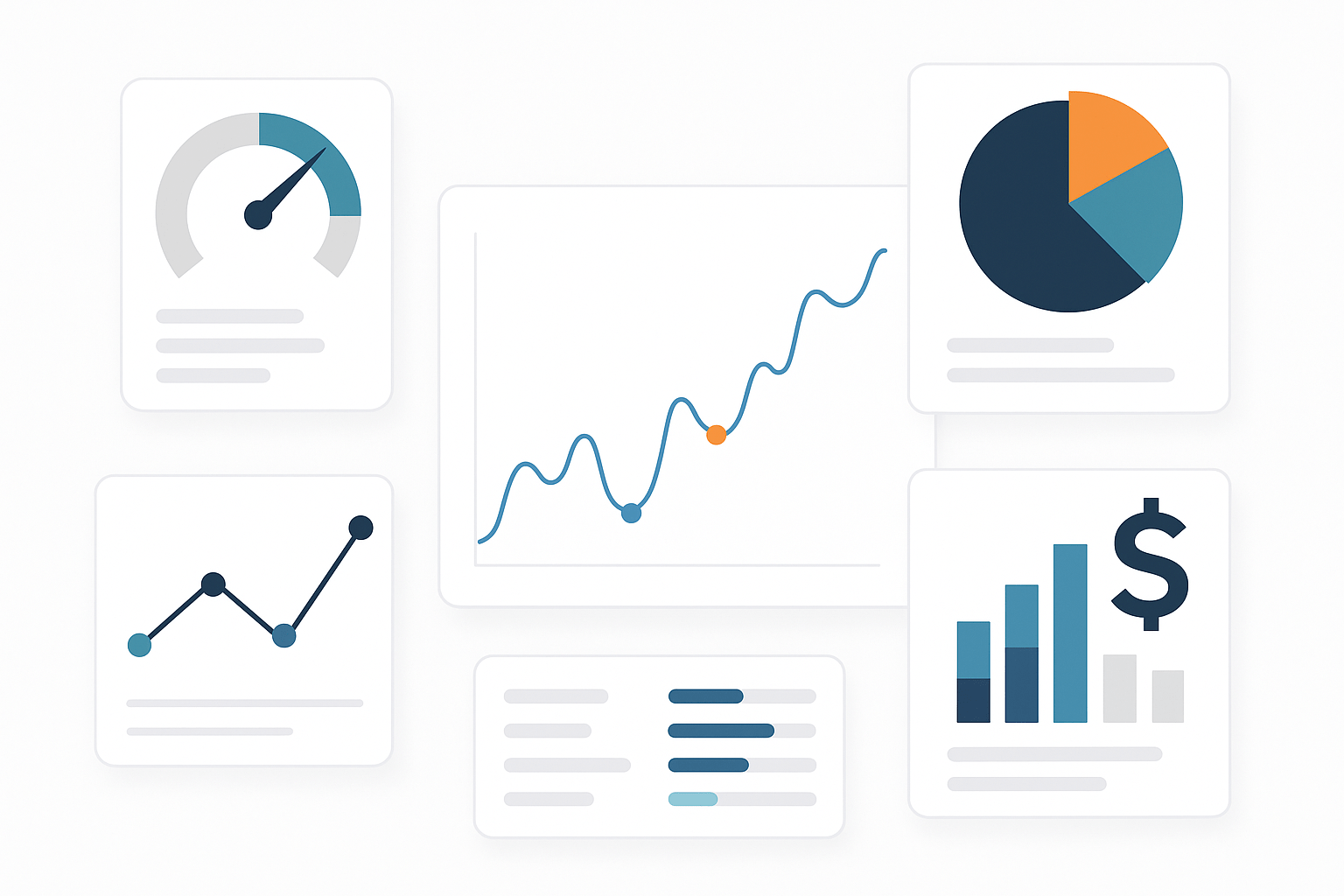
Financial markets can feel unpredictable when you watch them day to day. One week the market rallies on optimism, the next week it sells off on fear, and headlines appear to change direction every few hours. However, beneath this noise, markets often move in broader patterns that repeat in a familiar way. These patterns are known as market cycles. They are not perfectly timed, and they do not follow calendars, but they tend to reflect the same forces again and again: economic growth and slowdown, changes in interest rates and liquidity, corporate profitability, and investor psychology.
Market cycles matter because they provide context. When you understand what phase a market may be in, you stop overreacting to short-term volatility. Instead, you can interpret price action as part of a larger process. The cycle framework is not meant to predict exact tops or bottoms. Its value is that it helps you think clearly about risk, expectations, and opportunity as conditions evolve.
What a Market Cycle Really Is
A market cycle is the progression of financial prices through repeating phases over time. Most cycles include a rising phase when confidence builds, a topping phase when enthusiasm peaks and momentum slows, and a falling phase when risk appetite collapses and pessimism dominates. Each stage has its own “feel” because it is driven by different combinations of fundamentals, policy conditions, and crowd behavior.
Importantly, market cycles do not only apply to the overall stock market. They also occur in sectors, themes, and individual stocks. Technology can be peaking while energy is expanding. Small caps can be declining while mega caps remain resilient. This is why investors sometimes feel confused by mixed signals. Cycles can overlap and coexist across different segments of the market.
A cycle is also not the same as a single price move. A rally within a downtrend does not automatically mean a new expansion phase has begun. Likewise, a pullback within an uptrend does not automatically mean a decline phase is starting. The cycle framework becomes most useful when you combine price behavior with broader conditions such as earnings trends, interest rates, and liquidity.
Expansion Phase: Growth, Liquidity, and Rising Confidence
The expansion phase is the period most investors enjoy. Prices trend higher, pullbacks often feel manageable, and confidence steadily increases. This phase is usually supported by improving economic activity, rising corporate earnings, and supportive financial conditions. Investors are more willing to take risk because uncertainty feels lower and positive outcomes appear more likely.
During expansion, money tends to flow into equities and growth assets. Credit conditions often improve, meaning borrowing becomes easier and cheaper for businesses and consumers. This supports spending, investment, and profit growth. At the market level, valuations often rise because investors are willing to pay more for future earnings when the environment feels stable.
Expansion markets often produce leadership in cyclical and growth-oriented sectors. Companies that benefit from rising demand, strong consumer spending, or accelerating business investment tend to outperform. This is not a guarantee, but it is a common pattern because the economy and market psychology are aligned toward optimism.
What Expansion Looks Like on Price Charts
On charts, expansion typically shows up as an uptrend. Prices make higher highs and higher lows. Dips are often bought quickly, and breakouts above previous resistance levels tend to hold. Volatility may decline because confidence increases and market participants become comfortable holding risk.
However, expansion is not always smooth. Even strong expansion phases include corrections. Those pullbacks are important because they reset sentiment, shake out weak hands, and allow the next leg higher. When the cycle is healthy, corrections tend to be orderly and followed by renewed demand.
One of the most common mistakes beginners make is assuming that expansion means “no risk.” Expansion only means the trend is favorable. Risk still exists, but the market environment often rewards patience, diversification, and staying aligned with the broader trend.
The Psychology of Expansion: From Skepticism to Optimism
Most expansions begin when confidence is still fragile. After a decline phase, investors remain cautious. Early gains are often doubted. Many participants wait for confirmation, which is why the early part of an expansion can feel surprisingly quiet. Over time, as the market continues to rise, skepticism fades and optimism grows.
As prices rise, a reinforcement loop develops. Strong performance attracts attention, attention attracts capital, and capital pushes prices higher. This process continues until the market becomes crowded with optimism.
In a healthy expansion phase, confidence grows alongside fundamentals. Earnings improve, margins stabilize, and economic data supports the narrative. In a late expansion phase, confidence can grow faster than fundamentals, and that imbalance becomes one of the seeds of the peak phase.
Peak Phase: When Good News Stops Pushing Prices Higher
The peak phase is often misunderstood because it does not always look dramatic. Many people assume the market peak is a moment when everything suddenly collapses. In reality, peaks are often processes. Momentum slows, leadership narrows, volatility increases, and the market becomes more sensitive to disappointment.
At a peak, expectations are usually very high. Valuations may be elevated because investors have already priced in a strong future. Economic growth may still exist, but it often becomes less evenly distributed. Some sectors continue to perform well while others start weakening.
In this phase, markets may still make new highs, but the gains become harder. Good news produces smaller reactions, while bad news produces larger reactions. This is a critical shift because it suggests that buyers are no longer as eager to chase higher prices.
What Peak Conditions Often Look Like in the Real World
Peaks often coincide with some combination of stretched valuations, tightening financial conditions, or slowing growth. Sometimes central banks begin raising interest rates to control inflation. Sometimes profit margins stop expanding. Sometimes credit conditions tighten. These changes do not immediately crash the market, but they gradually erode the foundation that supported the expansion.
Another classic sign of the peak phase is narrowing participation. Early in an expansion, many stocks rise together. Near peaks, fewer stocks carry the index higher. A small group of large companies may keep the overall market afloat while the average stock weakens. This divergence often signals that risk appetite is becoming selective rather than broad.
Peaks also tend to bring a stronger narrative. Confidence becomes persuasive. People begin to believe the market has entered a “new era” where old valuation rules do not apply. This can happen in technology cycles, commodity booms, or new financial innovation cycles. The narrative itself is not the problem. The problem is when narrative replaces discipline.
The Psychology of the Peak: Complacency and Overconfidence
The peak phase is where psychology becomes dangerous. By the time the market approaches a peak, many participants have experienced months or years of success. That success creates overconfidence. Risk feels lower than it actually is because recent experience has been positive.
At peaks, investors often focus on upside stories and minimize downside risks. They may increase leverage, concentrate positions, or chase momentum. This behavior makes markets vulnerable because it reduces the margin of safety. When disappointment arrives, the same crowded positioning can unwind quickly.
A key insight is that peaks are not defined by maximum optimism. They are defined by the moment the market stops responding to optimism. That is why peaks can occur even when the news still looks good.
Decline Phase: The Shift From Risk Taking to Risk Avoidance
The decline phase begins when expectations fall and investors reduce risk. This can happen because earnings weaken, economic data deteriorates, credit conditions tighten, or interest rates rise. Sometimes a shock triggers the decline, but often the decline begins because the foundation becomes fragile.
Declines tend to move faster than expansions. Selling is more urgent than buying. Fear spreads quickly, and market participants rush to protect capital. As prices fall, forced selling can occur through margin calls, risk-parity rebalancing, or institutional drawdown controls. This can amplify declines beyond what fundamentals alone would justify.
During declines, volatility usually increases. The market becomes more reactive to headlines and more sensitive to liquidity conditions. Big intraday swings become more common, and sentiment becomes unstable.
What Decline Looks Like on Price Charts
On charts, decline usually appears as a downtrend. Prices make lower highs and lower lows. Rallies fail at resistance zones. Support breaks become more frequent.
A common feature of decline phases is sharp rallies that fail. These are often called bear market rallies. They can be powerful and convincing, which is why they trap investors who believe a new expansion has begun. Bear market rallies often occur because markets become oversold, short sellers cover positions, or policy makers hint at support. But if fundamentals and confidence remain weak, those rallies fade.
Decline phases also include periods of sideways movement. Markets may stabilize temporarily, forming ranges, before continuing lower. This is not a contradiction. It reflects the tug-of-war between bargain hunters and sellers who want out.
The Psychology of Decline: Fear, Regret, and Capitulation
Decline phases trigger strong emotions. Investors who bought near peaks experience regret. Those who held through early declines begin to question their strategy. News turns negative. Social sentiment becomes pessimistic.
Over time, fear can intensify into capitulation. Capitulation is a period when selling becomes emotional and widespread. Investors sell not because of careful analysis, but because they want the discomfort to end. Capitulation often happens near lows, but it is difficult to identify in real time.
Eventually, selling pressure exhausts itself. Once most investors who wanted to sell have already sold, the market becomes capable of stabilizing. That stabilization is the beginning of the transition toward recovery.
The Recovery Transition: When the Market Starts to Heal
Markets often begin recovering before the economy looks healthy. This surprises beginners. The reason is that markets are forward-looking. Prices begin to rise when the rate of bad news slows, when policy becomes supportive, or when investors believe the worst outcomes are less likely.
Recovery often begins quietly. Volume may be low. Sentiment remains skeptical. Many investors refuse to believe the market is turning. This skepticism is actually healthy because it prevents the market from becoming overcrowded too quickly.
As recovery develops, the market starts forming higher lows. Volatility often remains elevated at first, but it gradually declines as confidence rebuilds. Over time, the recovery becomes a new expansion.
Why Market Cycles Do Not Repeat Exactly
No two cycles are identical because the world changes. Technology evolves, global trade shifts, demographics change, and policy frameworks differ. Still, cycles follow similar emotional patterns because human behavior remains consistent.
One cycle may be driven by inflation and interest rate tightening. Another may be driven by a credit shock. Another may be driven by rapid technological adoption. The triggers differ, but the phases of expansion, peak, decline, and recovery tend to remain recognizable.
Also, cycles can vary across assets. Bonds can behave differently from stocks. Commodities can follow their own cycle based on supply constraints and demand shocks. Understanding cycles means accepting complexity rather than forcing every asset into the same pattern.
How Interest Rates Shape Market Cycles
Interest rates are one of the strongest influences on cycles because they affect the cost of capital and the valuation of future earnings. When rates are low, investors can justify paying more for growth because the discount rate is lower. When rates rise, valuations often compress, especially for growth stocks whose profits lie far into the future.
Rising rates can also tighten financial conditions. Borrowing becomes more expensive, credit availability can shrink, and corporate investment can slow. This pressure can accelerate the transition from late expansion to peak and decline.
On the other hand, when rates fall after a tightening period, financial conditions can improve, supporting recovery and expansion. This is why many major market turns are closely linked to shifts in central bank policy expectations.
Liquidity and Credit: The Fuel of Risk Taking
Liquidity is the ease with which money flows through the system and how easily assets can be bought and sold. Credit is the ability to borrow. Together, liquidity and credit act like fuel for market risk-taking.
In expansion, liquidity is often healthy and credit spreads tend to be stable or tightening. In peak phases, liquidity can become uneven and credit spreads may begin widening subtly. In declines, liquidity often dries up and credit spreads widen sharply as risk aversion rises.
For beginners, this is a powerful insight: markets can fall not only because earnings decline, but because liquidity and credit conditions tighten, making investors demand a higher premium for risk.
Sector Rotation Across the Cycle
Different sectors often lead in different phases. During early expansion, more economically sensitive sectors may perform well because growth rebounds. During late expansion and peak, leadership can narrow, and defensive sectors sometimes begin to outperform as investors seek stability. During decline, capital often moves toward defensive assets or companies with stable cash flows. During recovery, riskier assets often rebound strongly.
This rotation is not automatic, and it depends on the unique conditions of each cycle. Still, the concept is useful because it explains why “the market” can feel inconsistent. The index may rise while many stocks struggle because leadership is concentrated in a few areas.
Why the Cycle Framework Helps Investors Avoid Common Mistakes
Most investor mistakes come from misreading the phase. People chase risk late in expansions when optimism is already priced in. They panic in declines when prices already reflect fear. They stay overly cautious during recoveries because the economy still looks weak.
The cycle framework improves decision-making by encouraging you to ask better questions. Are valuations stretched or reasonable. Are earnings accelerating or slowing. Are financial conditions supportive or tightening. Is sentiment euphoric or fearful.
When you combine these questions with trend awareness, you reduce the risk of emotional buying at peaks and emotional selling at lows.
Using Market Cycles as a Framework, Not a Crystal Ball
Market cycles do not provide perfect timing. They provide context. Trying to call exact tops and bottoms is extremely difficult and often harmful.
Instead, cycle awareness can guide risk management. In expansion, investors often focus on participation and long-term growth while managing downside risk. Near peaks, investors may become more selective and emphasize discipline. In declines, capital preservation and patience become priorities. In recovery, gradually rebuilding exposure can matter more than waiting for perfect certainty.
This approach respects uncertainty while still making decisions based on probability.
A Simple Mental Model: Belief, Price, and Risk
A useful way to understand market cycles is to think in terms of belief. Expansion reflects rising belief in growth. Peaks reflect overconfidence and crowded belief. Declines reflect a collapse in belief. Recovery reflects cautious rebuilding.
Price follows belief because belief influences capital flows. Risk perception changes because belief changes. When belief is strong, investors accept more risk. When belief weakens, investors demand safety.
This model helps explain why markets often turn before the news turns. Belief shifts first, news catches up later.
Conclusion: Seeing Markets as a Process Instead of a Mood
Markets move in cycles because economies evolve, policies shift, and human psychology repeats. Expansion brings growth and rising confidence. Peaks bring high expectations and vulnerability. Declines bring fear and repricing. Recovery begins when pessimism fades and belief rebuilds.
The goal is not to perfectly predict each phase. The goal is to recognize the environment so you can set realistic expectations, avoid emotional decisions, and manage risk more effectively.