
Financial astrology is one of the most debated subjects in market forecasting. Some traders see it as a powerful timing tool, while others dismiss it as belief-based speculation. The truth sits somewhere between blind faith and complete rejection. Financial astrology does not replace research, technical analysis, fundamental analysis, or risk management. However, many traders use it as an additional lens to study market psychology, timing cycles, sentiment shifts, and periods of higher volatility.
At its core, financial astrology studies the relationship between planetary cycles and financial markets. It looks at how major planetary movements, retrogrades, eclipses, lunar phases, and long-term cycles may coincide with changes in investor behavior. The idea is not that planets “force” a stock or index to move in a certain direction. Instead, financial astrology suggests that markets, like nature, may move through cycles of expansion, contraction, fear, confidence, speculation, and correction.
What Is Financial Astrology?
Financial astrology is the application of astrological principles to markets, trading, investing, and economic cycles. It studies planetary positions and their possible connection with stock markets, commodities, currencies, bonds, and broader economic trends.
Traditional astrology studies human life, personality, timing, and events. Financial astrology applies similar timing principles to collective behavior. Since markets are driven by human decisions, fear, greed, hope, uncertainty, and confidence, financial astrologers believe planetary cycles can help identify periods when market psychology may become more aggressive, cautious, emotional, or unstable.
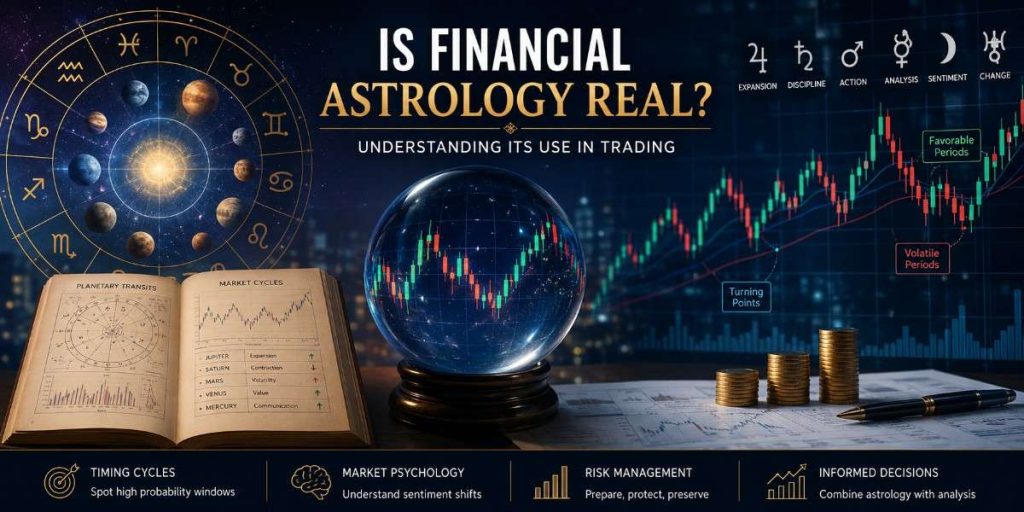
For example, Mercury is often linked with communication, data, contracts, and trading decisions. Venus is connected with value, luxury, balance, and money flow. Mars is linked with aggression, speed, conflict, and sharp action. Jupiter often represents expansion, optimism, growth, and excess. Saturn is associated with discipline, restriction, debt, pressure, and correction. Uranus is linked with sudden shocks, disruption, technology, and unexpected changes. Neptune may reflect confusion, speculation, illusion, and unclear sentiment. Pluto often connects with deep transformation, crisis, power, and structural change.
In trading, these planetary meanings are not used in isolation. A serious financial astrology approach studies cycles, aspects, historical market behavior, and confirmation from price action.
Is Financial Astrology Real?
The answer depends on what one means by “real.” If financial astrology is presented as a guaranteed prediction system, then it becomes misleading. No method can predict the market with certainty. Even the best analysts, economists, hedge funds, and algorithmic models fail at times. Markets are complex systems affected by interest rates, earnings, inflation, liquidity, geopolitics, central banks, investor psychology, and unexpected events.
However, if financial astrology is understood as a timing and sentiment framework, then it can be useful for traders who respect probability and risk. Many market participants already use cycles. They study seasonal trends, election cycles, business cycles, commodity cycles, credit cycles, and liquidity cycles. Financial astrology adds another cycle-based perspective.
The real value of financial astrology lies in identifying possible turning points, emotional extremes, volatility windows, and periods when markets may behave differently from normal expectations. It does not tell a trader to buy or sell blindly. Instead, it highlights dates and periods where extra attention may be needed.
Frequently Asked Questions
Is Financial Astrology Real? FAQs for Traders
Explore common questions about financial astrology, market timing, planetary cycles, and how traders use astrology with technical and fundamental analysis.
Financial astrology is real as a cycle-based market timing approach used by some traders and investors. It does not guarantee market predictions, but it can help identify possible sentiment shifts, volatility windows, and important timing zones when combined with price action and risk management.
Financial astrology cannot predict the stock market with certainty. It is better used as a probability tool. Traders may use planetary cycles, retrogrades, eclipses, and lunar phases to prepare for possible turning points or volatility, but price confirmation is always necessary.
Traders use financial astrology to study market timing, investor psychology, and risk windows. They may compare planetary transits with stock charts, index movements, commodity prices, or currency trends. Most serious traders combine it with technical analysis, fundamentals, and strict stop-loss rules.
Financial astrology is not better or worse than technical analysis. Both serve different purposes. Technical analysis studies price behavior, while financial astrology studies timing cycles. When used together, they may help traders identify stronger decision zones.
Jupiter, Saturn, Mars, Mercury, Venus, Uranus, Neptune, and Pluto are commonly studied in financial astrology. Jupiter may relate to expansion, Saturn to restriction, Mars to volatility, Mercury to trading and communication, and Uranus to sudden market surprises.
Beginners should not rely only on financial astrology. It should be treated as an additional timing layer. A beginner must first understand market basics, risk management, chart analysis, position sizing, and emotional discipline before using astrology in trading decisions.
Why Traders Use Financial Astrology
Traders use financial astrology because markets are not purely mathematical. If markets were fully rational, prices would always reflect fair value. In reality, markets often overshoot on both sides. Stocks become overvalued during optimism and undervalued during panic. Commodities can rise sharply when fear increases. Currencies can weaken when confidence drops. Indices can rally even when news looks bad, and they can fall even when fundamentals appear strong.
This emotional behavior makes timing difficult. Financial astrology attempts to study the rhythm of market emotions. Traders who use it often combine it with charts, support and resistance, trend lines, moving averages, volume, options data, macroeconomic indicators, and fundamental research.
For example, a trader may notice that a stock is near a major resistance level. Technical analysis says the price is stretched. Financial astrology may show a strong Mars, Saturn, Uranus, or eclipse-related period approaching. This does not guarantee a fall. But it may suggest that the trader should reduce leverage, tighten stop-loss levels, or wait for confirmation before entering.
Financial Astrology and Market Psychology
Market psychology is one of the strongest arguments for financial astrology. Prices move because people act. People buy, sell, hold, panic, chase, average down, and take profits based on perception. When millions of investors respond to uncertainty, the market becomes a reflection of collective emotion.
Financial astrology studies these collective emotional patterns through planetary symbolism. Jupiter periods may reflect optimism and expansion. Saturn periods may bring fear, discipline, or pressure. Mars periods may create aggressive trading, volatility, or conflict-driven movement. Uranus periods may trigger sudden surprises, especially in technology, innovation, and speculative assets. Neptune periods may create confusion, bubbles, unrealistic expectations, or unclear price behavior.
This does not mean every Jupiter transit creates a bull market or every Saturn transit creates a crash. The market must always be judged through context. A planetary signal becomes more meaningful when it appears near important technical levels, major economic events, central bank decisions, earnings seasons, or historical cycle points.
How Financial Astrology Works in Trading
Financial astrology works by mapping planetary movements against market charts. A financial astrologer may study the birth chart of a stock exchange, a company’s listing date, an index launch date, or the incorporation chart of a business. They may also study transits, progressions, retrogrades, eclipses, lunar phases, and planetary aspects.
The goal is to identify sensitive periods when price may react strongly. For example, if a major planet makes a strong aspect to the chart of a stock index, a financial astrologer may watch for increased volatility. If Mercury turns retrograde during a sensitive market period, traders may become cautious about false breakouts, data confusion, communication issues, or sudden revisions. If Mars forms a hard aspect with Uranus, the market may face sudden, sharp, or unexpected movement.
In practical trading, this information is most useful when used as a timing filter. It can help traders decide when to be more alert, when to avoid overexposure, when to wait for confirmation, and when to prepare for a possible trend change.
Financial Astrology Is Not a Standalone Trading System
A major mistake is treating financial astrology as a standalone buy-sell signal. Serious traders should not enter a trade only because of a planetary transit. A responsible trading decision must include price action, volume, trend, risk-reward ratio, market structure, liquidity, news flow, and position sizing.
Financial astrology can improve awareness, but it cannot remove uncertainty. The market can ignore a cycle for days or weeks. A forecast can be early. A planetary signal may produce volatility rather than direction. A bearish signal may create a temporary dip instead of a major crash. A bullish signal may produce a short bounce instead of a lasting rally.
This is why the best use of financial astrology is not prediction with certainty. It is preparation. It helps traders ask better questions. Is the market entering a high-risk window? Is sentiment too optimistic? Is a reversal more likely near this date? Should traders avoid fresh leverage? Should investors wait for a better entry?
Historical Interest in Financial Astrology
Financial astrology is not a new idea. Traders and market researchers have explored cycles for decades. W.D. Gann is often associated with market geometry, time cycles, and astrology-based timing concepts. While his methods remain controversial, his influence on cycle-based trading is undeniable.
Many traders also study lunar cycles, seasonal cycles, planetary retrogrades, and long-term outer planet movements. Some believe that major financial events often occur near powerful planetary configurations. Others argue that these are coincidences or examples of selective interpretation.
The debate continues because financial astrology is difficult to test in a simple way. Markets are influenced by many variables at the same time. A planetary alignment may coincide with a market move, but proving direct causation is extremely difficult. Therefore, the practical approach is to treat financial astrology as a probability tool rather than a scientific certainty.

Is Financial Astrology Real?
Understand how planetary cycles, market psychology, and trading timing come together in financial astrology.
Financial Astrology vs Technical Analysis
Technical analysis studies price, volume, trends, patterns, support, resistance, indicators, and market structure. Financial astrology studies time, cycles, planetary movement, and sentiment windows. Both methods focus on market behavior, but they approach it differently.
Technical analysis answers the question: What is price doing now?
Financial astrology asks: When is the market more likely to change behavior?
When combined, they can create a stronger framework. For example, technical analysis may show that the market is near support. Financial astrology may show that an important cycle date is approaching. If price confirms a reversal near that date, the trader may gain more confidence. If price breaks support instead, the trader avoids forcing a prediction.
The key is confirmation. Astrology may identify a timing window, but price must confirm the trade.
Financial Astrology vs Fundamental Analysis
Fundamental analysis studies business value, earnings, revenue, debt, cash flow, management quality, interest rates, inflation, and economic data. It helps investors understand what an asset may be worth.
Financial astrology does not replace this. Instead, it can help with timing. A company may have strong fundamentals, but buying at the wrong time can still lead to losses. A stock may be excellent for the long term, yet short-term planetary or market cycles may suggest patience before entry.
For investors, financial astrology may help identify better accumulation periods, caution windows, or emotionally extreme phases. For traders, it may help detect when volatility could increase. In both cases, fundamentals remain important.
Can Financial Astrology Predict Market Crashes?
Financial astrology cannot guarantee a market crash. However, it may help identify periods of increased stress. Market crashes usually occur when several forces combine: excessive leverage, weak liquidity, fear, unexpected news, high valuations, policy shocks, or economic pressure.
Astrological risk windows may become more meaningful when they align with these real-world weaknesses. For example, if markets are overvalued, investor sentiment is extremely bullish, central banks are tightening policy, and a difficult planetary period is approaching, traders may prepare for higher downside risk.
Still, preparation is not prediction. A risk window may produce sideways movement, a correction, or only short-term volatility. This is why traders should avoid dramatic claims and focus on disciplined risk management.
The Role of Planetary Cycles in Trading
Planetary cycles are central to financial astrology. The Moon moves quickly and is often used for short-term sentiment. Mercury cycles may relate to communication, data, and trading decisions. Venus cycles may connect with value, currencies, luxury, and market balance. Mars cycles may influence aggression, volatility, and sharp price action.
Jupiter and Saturn are especially important for broader market cycles. Jupiter may reflect expansion, optimism, liquidity, and growth. Saturn may reflect contraction, discipline, regulation, debt, and correction. Uranus, Neptune, and Pluto move slowly and are often studied for long-term economic and structural changes.
When these planets form major aspects, financial astrologers watch for shifts in market tone. Again, these are not automatic signals. They are timing markers that require confirmation.
Why Skeptics Reject Financial Astrology
Skeptics reject financial astrology mainly because it lacks clear scientific proof. They argue that market movements can be explained by earnings, interest rates, liquidity, policy decisions, economic data, and investor behavior. They also warn that people may see patterns after the event and ignore failed predictions.
This criticism is valid when astrology is used carelessly. Any method can become dangerous if a trader uses it without testing, discipline, or risk control. Financial astrology becomes weak when it makes vague claims, ignores price data, or promises guaranteed outcomes.
A serious approach should welcome skepticism. It should compare forecasts with actual results, study historical data, and remain honest about uncertainty. Traders should never risk capital based only on belief.
Why Some Traders Still Find It Useful
Despite criticism, some traders find financial astrology useful because markets often move in cycles that are not fully explained by news. Sometimes prices reverse before the news changes. Sometimes markets react emotionally to events that were already known. Sometimes volatility rises around dates that cycle traders had already marked.
Financial astrology can help traders stay alert during such periods. It may also reduce impulsive decisions. Instead of reacting emotionally, traders can plan in advance. They can mark important dates, define risk levels, and wait for confirmation.
This planning mindset is valuable. Even if a trader does not believe in astrology, the discipline of studying time cycles can improve market awareness.
Practical Use of Financial Astrology in Trading
The practical use of financial astrology begins with observation. A trader may maintain a calendar of important planetary events and compare them with market behavior. Over time, patterns may become visible. Certain assets may respond more strongly to specific cycles. Gold, oil, currencies, technology stocks, banking stocks, and indices may each show different sensitivities.
A trader can use this calendar to prepare for high-volatility days, trend reversal zones, and caution periods. However, every trade still needs a clear entry, exit, stop-loss, and position size. Financial astrology should guide attention, not replace execution rules.
The best use is defensive and strategic. It can help traders avoid overconfidence, reduce exposure during uncertain windows, and look for confirmation near key dates.
The Responsible Way to Understand Financial Astrology
Financial astrology should be understood as a timing discipline, not a magic formula. It works best when used with humility. Markets are larger than any single method. A trader should never assume that one planetary event will control price direction.
Responsible financial astrology uses probability-based language. It says a market may become more volatile, a trend may weaken, or a reversal window may open. It does not promise exact outcomes. It respects the difference between possibility and certainty.
This approach protects traders from emotional decision-making. It also makes financial astrology more useful for serious investors, analysts, and institutions that value timing but require discipline.
Is Financial Astrology Suitable for Every Trader?
Financial astrology is not suitable for every trader. Some traders prefer pure price action. Others trust only fundamentals. Some rely on quantitative models. That is perfectly acceptable. Every trader needs a system that matches their mindset.
Financial astrology may suit traders who are open to cycle research, timing studies, and behavioral market analysis. It may also suit investors who want to understand emotional extremes and risk windows. However, it should not be used by anyone looking for guaranteed predictions or quick profits.
Trading requires patience, emotional control, and risk management. Financial astrology can support these qualities only when used correctly.
Final Thoughts
So, is financial astrology real? It is real as a historical, symbolic, and cycle-based approach used by some traders to study market timing and psychology. It is not real as a guaranteed prediction machine. The market does not move only because of planets. It moves because of money, liquidity, earnings, policy, fear, greed, and human behavior.
Financial astrology becomes valuable when it helps traders prepare rather than predict blindly. It can highlight important timing windows, possible volatility periods, and moments when sentiment may shift. Yet every insight must be confirmed through price action, market data, and disciplined risk management.
For traders and investors, the smartest approach is balance. Use financial astrology as one layer of analysis. Combine it with technical charts, fundamentals, macro research, and a clear trading plan. When used this way, financial astrology can become a thoughtful timing tool that helps traders observe markets with greater awareness, patience, and discipline.