
Institutional Risk Management Framework: How Large Investors Control Drawdowns, Protect Capital, and Stay Invested Through Every Cycle
Institutions do not survive for decades by guessing. They survive because they build a repeatable risk framework that works when headlines are calm and, more importantly, when markets turn violent. A pension fund, an endowment, a sovereign fund, or an insurance balance sheet cannot behave like a short-term trader. These organizations carry long-dated liabilities, public scrutiny, governance constraints, and reputational risk. They must remain invested through cycles, yet they cannot afford catastrophic drawdowns that permanently impair compounding. That tension is exactly why institutional risk management is not a single tool or a single metric. It is an operating system.
An institutional risk management framework combines philosophy, governance, measurement, portfolio construction, liquidity planning, stress testing, and disciplined execution. It defines what “risk” means in the context of the institution’s mission. It turns that definition into clear limits and decision rules. It continuously measures exposures, identifies new vulnerabilities, and responds in a controlled way. And it does all this without forcing the institution to abandon long-term return objectives.
This article lays out a complete institutional risk management framework in a practical, implementation-focused way. The goal is not to overwhelm you with jargon. The goal is to show how sophisticated allocators structure risk so that performance becomes a byproduct of process rather than luck.
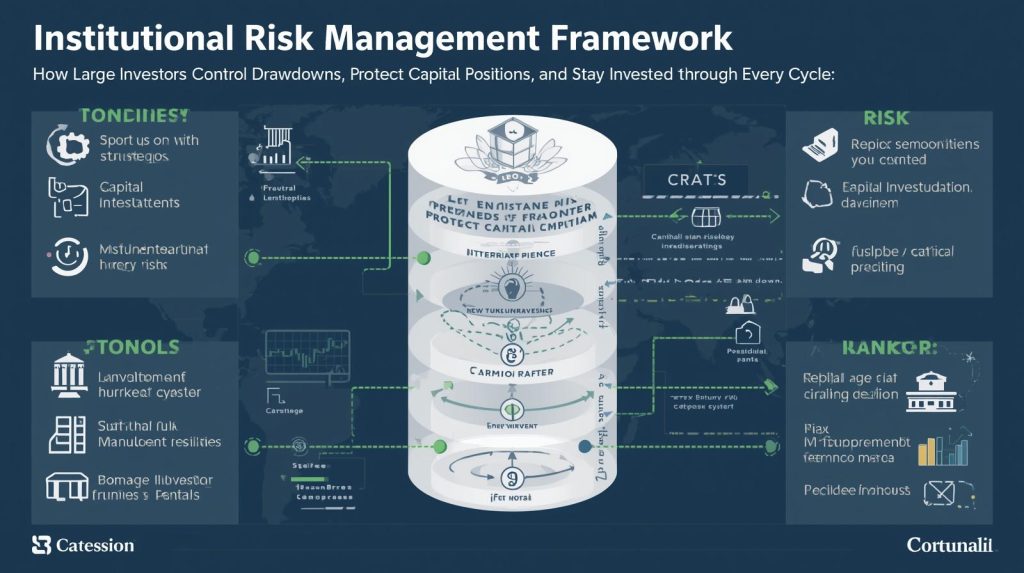
What Institutional Risk Management Really Means
Retail investing often frames risk as volatility. Institutions usually see risk as the probability of failing the mission. For a pension fund, that mission is meeting future payouts without unacceptable contribution increases. For an insurer, it is meeting claims while respecting regulatory capital requirements. For an endowment, it is funding spending needs while preserving purchasing power across generations. Each mission implies a different “risk of ruin,” and therefore a different framework.
Institutional risk management starts with acknowledging that there are many kinds of risk that do not show up in a simple volatility chart. There is liquidity risk, the risk that the institution is forced to sell at the worst time. There is leverage risk, where small market moves cascade into large losses. There is concentration risk, where a portfolio that looks diversified by name is actually dependent on one macro driver such as real rates, energy, or credit spreads. There is model risk, where assumptions work in normal times but fail under regime shifts. There is governance risk, where decision-making slows down just when speed and clarity are needed.
A true framework accepts that risk is multidimensional. It does not attempt to eliminate risk, because eliminating risk eliminates return. Instead, it seeks to decide which risks are intentional, compensated, and aligned with the mission, and which risks are accidental, uncompensated, or destabilizing.
The First Layer: Defining the Risk Objective
Before measuring risk, institutions define the objective of risk management. That sounds obvious, yet many portfolios operate with mismatched objectives. A portfolio might claim to be “long-term,” yet the governance structure panics at a 10 percent drawdown. Another might claim to be “defensive,” yet the liquidity terms lock capital for years. The framework begins by stating the truth in plain language.
A strong risk objective answers questions such as: How much loss can we tolerate over one month, one quarter, and one year without triggering mission failure or governance crisis? What is the maximum drawdown that is survivable without forced selling? What level of illiquidity is acceptable given liabilities and spending needs? What time horizon is truly investable, meaning the horizon over which the institution can stick with the plan?
This is where institutions separate aspiration from capacity. They may aspire to hold risk through volatility, but they must confirm the capacity to do so operationally, politically, and psychologically. If the board cannot handle a large drawdown, then the portfolio must be designed to avoid it, even if the expected return is lower. The job of risk management is to align the portfolio with the institution’s actual tolerance, not its wishful tolerance.
The Governance Layer: Who Owns Risk Decisions
Institutions work through committees, mandates, and delegated authority. Without clear governance, the best model fails. An institutional risk management framework therefore includes a governance map that states who can do what, when, and with which approvals.
Good governance clarifies roles. The board sets the mission, approves the risk appetite, and holds management accountable. The investment committee translates mission into policy, approves asset allocation bands, and reviews major risks. The CIO and investment team implement, rebalance, and manage manager relationships. The risk function measures exposures independently, challenges assumptions, runs stress tests, and escalates breaches. Operations and treasury manage liquidity, collateral, and cash forecasting. Compliance ensures that risk controls align with regulation and internal policy.
The framework also defines escalation and action procedures. If a risk limit is breached, what happens next? Is there an automatic de-risking rule? Is there a mandatory committee meeting? Is it a “notify and monitor” event or a “reduce now” event? The framework is strongest when it is explicit, because ambiguity tends to expand exactly when markets become uncertain.
Risk Taxonomy: Mapping the Sources of Loss
Institutions categorize risk so they can measure and manage it systematically. A practical taxonomy often includes market risk, credit risk, liquidity risk, leverage and financing risk, concentration risk, operational risk, counterparty risk, legal and regulatory risk, and reputational risk. The exact taxonomy varies by institution, but the purpose is consistent: ensure that no major risk category is ignored simply because it is inconvenient to model.
Market risk includes equity beta, duration exposure, inflation exposure, commodity sensitivity, currency risk, and volatility exposure. Credit risk includes default risk, downgrade risk, spread widening, and structural risks inside complex credit products. Liquidity risk includes mismatch between asset liquidity and liability timing, redemption terms in funds, and the ability to raise cash under stress. Leverage risk includes explicit leverage and embedded leverage, such as options, structured products, and margin requirements. Counterparty risk includes derivative counterparties, prime brokers, custodians, and clearinghouses. Operational risk includes failures in systems, processes, valuation, and reporting.
Institutions also map “hidden” risks that appear during regime shifts. A portfolio may be diversified by asset class, yet still be driven by one factor such as falling interest rates, cheap money, or global growth. When the factor reverses, correlations converge and diversification fails. The framework therefore makes factor analysis a core discipline rather than an occasional exercise.
The Measurement Layer: What Institutions Track and Why
Institutional risk measurement is not one number. It is a dashboard that captures different dimensions of vulnerability. The challenge is not to track everything, because that produces noise. The challenge is to track the small set of indicators that reliably warn about fragility.
A baseline measurement system includes exposure decomposition by asset class, by region, by sector, and by factor. It includes tracking error relative to policy benchmarks if relevant, because large tracking error can create governance risk even when returns are positive. It includes risk contribution analysis so the institution can see which allocations generate the majority of portfolio risk, not just the majority of capital allocation. It includes drawdown analysis and scenario analysis. It includes liquidity metrics such as days-to-liquidate under normal and stressed assumptions, and it includes cash flow forecasts tied to liabilities and spending.
Many institutions still use Value at Risk because it standardizes risk communication. However, Var is not a sufficient control by itself. It tends to underestimate risk when volatility is low and correlations appear stable. In other words, it can be most comforting exactly when hidden leverage and crowding are building. Institutions that use Var effectively treat it as one indicator among many, not as a final truth.
Stress testing is usually more useful than VaR, because it asks: what happens if the world changes abruptly? The framework should include historical stress tests, such as a repeat of a major equity crash, a rapid rate hike cycle, a credit event, an energy shock, or an emerging market currency devaluation. It should also include hypothetical stress tests that reflect current vulnerabilities, such as a sudden jump in inflation expectations, a disorderly bond selloff, or a liquidity freeze in private markets.
The highest quality institutions combine quantitative measures with qualitative risk reviews. They explicitly discuss what the models might miss. They ask where positioning might be crowded. They ask what the biggest consensus assumptions are, because consensus assumptions are the ones most likely to break.
Risk Appetite: Translating Mission Into Limits and Guardrails
Risk appetite is the bridge between philosophy and action. It turns the mission into measurable boundaries. Institutional risk appetite is usually expressed through a set of limits and guidelines rather than one statement.
A mature framework defines acceptable drawdown ranges, volatility ranges, and loss thresholds over multiple horizons. It defines maximum exposures to certain factors such as equity beta, duration, credit spreads, inflation, and currency. It defines concentration limits by issuer, sector, manager, and strategy. It defines liquidity limits, such as maximum allocation to illiquid assets given spending needs, and minimum cash or liquid buffer requirements. It defines leverage limits in both gross and net terms and clarifies how derivatives count toward exposure. It defines counterparty limits and collateral requirements.
The important detail is that these limits should be meaningful in practice. Limits that are too loose provide no protection. Limits that are too tight create constant breaches and governance fatigue. The right limits reflect realistic market behavior and the institution’s actual decision speed. If a limit requires same-day action but the institution cannot meet for two weeks, then the limit is poorly designed. A good framework aligns limits with operational reality.
Portfolio Construction: Building Risk Into the Architecture
Institutions manage risk most effectively at the portfolio construction level rather than through reactive hedging. Construction is where you decide what risks you want to own and how much.
The core concept is that capital allocation is not risk allocation. A portfolio can allocate a small amount of capital to something like high yield credit or emerging market equities, yet those positions can dominate downside risk in a crisis. Institutions therefore allocate based on risk contribution. They ask which exposures will drive drawdowns during stress, and they design the portfolio so that no single factor can break it.
Diversification for institutions is not simply holding many assets. It is holding exposures that respond differently across regimes. A portfolio designed for one regime, such as falling rates and rising globalization, can collapse in a regime of rising inflation and geopolitical fragmentation. Institutions that survive do not pretend they can predict every regime. They accept regime uncertainty and build resilience through balanced exposures.
This is where strategic asset allocation matters. Institutions typically set a long-term policy portfolio that reflects their mission and time horizon. They then allow tactical ranges around that policy based on valuation, macro risk, and funding status. The policy portfolio is the anchor. Tactical moves are adjustments, not reinventions.
A robust framework also considers how risk behaves when correlations change. Many assets that look diversified in calm markets become correlated in crises. Institutions therefore build explicit crisis resilience through assets or strategies that historically hold up during stress, and they test whether those protections still work under current conditions. This might include high-quality duration in some regimes, certain systematic trend approaches, option-based hedges, or alternative defensive allocations. The exact tools vary, but the principle remains: do not assume diversification will appear when it is needed most unless you have tested it.
Liquidity Risk Management: The Hidden Driver of Forced Selling
Liquidity is one of the most important differences between institutional and retail risk management. Institutions often hold illiquid assets such as private equity, private credit, infrastructure, and real assets. These exposures can improve long-term return potential, but they can also create a liquidity trap when public markets fall and capital calls arrive.
A strong framework includes liquidity mapping. It forecasts cash inflows and outflows under normal conditions and under stress. It estimates how quickly each asset can be liquidated, and at what cost, during a crisis. It evaluates the interaction between illiquid allocations and commitments. It sets limits on total illiquidity and on the pace of commitments. It requires a liquid buffer sized to survive stressed outflows without forced selling.
Liquidity management also includes collateral planning for derivatives. In stress events, margin calls can rise quickly, creating sudden cash needs. If the institution uses derivatives for hedging or overlays, it must forecast worst-case collateral needs and ensure that liquid assets are available.
One of the most painful institutional errors is building a portfolio that looks fine on paper but cannot meet cash needs during a crisis. This is why liquidity is treated as a first-class risk, not an afterthought.
Manager Risk: Controlling Delegated Exposure
Many institutions invest through external managers. That delegation creates a new set of risks: style drift, hidden leverage, crowding, and operational weaknesses. The risk framework must therefore include manager oversight as a central component.
Institutions typically define manager roles clearly. A manager is hired to deliver a specific exposure, such as value equity, quality credit, systematic trend, or market-neutral strategies. The framework then monitors whether the manager continues to provide that exposure or shifts into something else. It tracks performance in different regimes, not just overall returns. It monitors factor exposures and tail behavior. It reviews liquidity terms, gates, and redemption rights. It assesses operational robustness, valuation practices, and counterparty relationships.
Manager risk management also involves portfolio-level aggregation. Individual managers may look diversified, yet their combined exposures can create crowding. For example, multiple hedge funds might be long the same growth themes, short the same value themes, and financed through similar counterparties. The institution’s risk team must aggregate exposures and identify concentration that no single manager report will reveal.
Derivatives and Hedging: When to Hedge and How to Avoid Over-Hedging
Institutions hedge for different reasons. They hedge to protect funded status, to control drawdowns, to reduce unwanted factor exposure, to manage currency risk, and to stabilize liquidity. However, hedging is not free. It costs carry, consumes collateral, introduces counterparty exposure, and can create governance complexity.
A disciplined framework begins by stating the purpose of the hedge. If the purpose is to reduce funded-status volatility, then the hedge should be linked to liability sensitivity rather than to market narratives. If the purpose is to protect against a crash, then the hedge must be evaluated on crisis behavior rather than on day-to-day PnL. If the purpose is currency risk control, then the hedge should reflect the institution’s base currency needs and risk tolerance, not a view about FX direction.
The framework also includes hedge sizing rules. Institutions often make the mistake of implementing hedges only after volatility rises, when hedges become expensive. A well-run system uses pre-defined rules that activate hedging when conditions are favorable, rather than when fear is maximal. It also defines when hedges will be reduced, because hedges can become a drag when conditions normalize.
The most sophisticated institutions treat hedging as part of portfolio design rather than as emergency firefighting. They plan it, budget it, and test it.
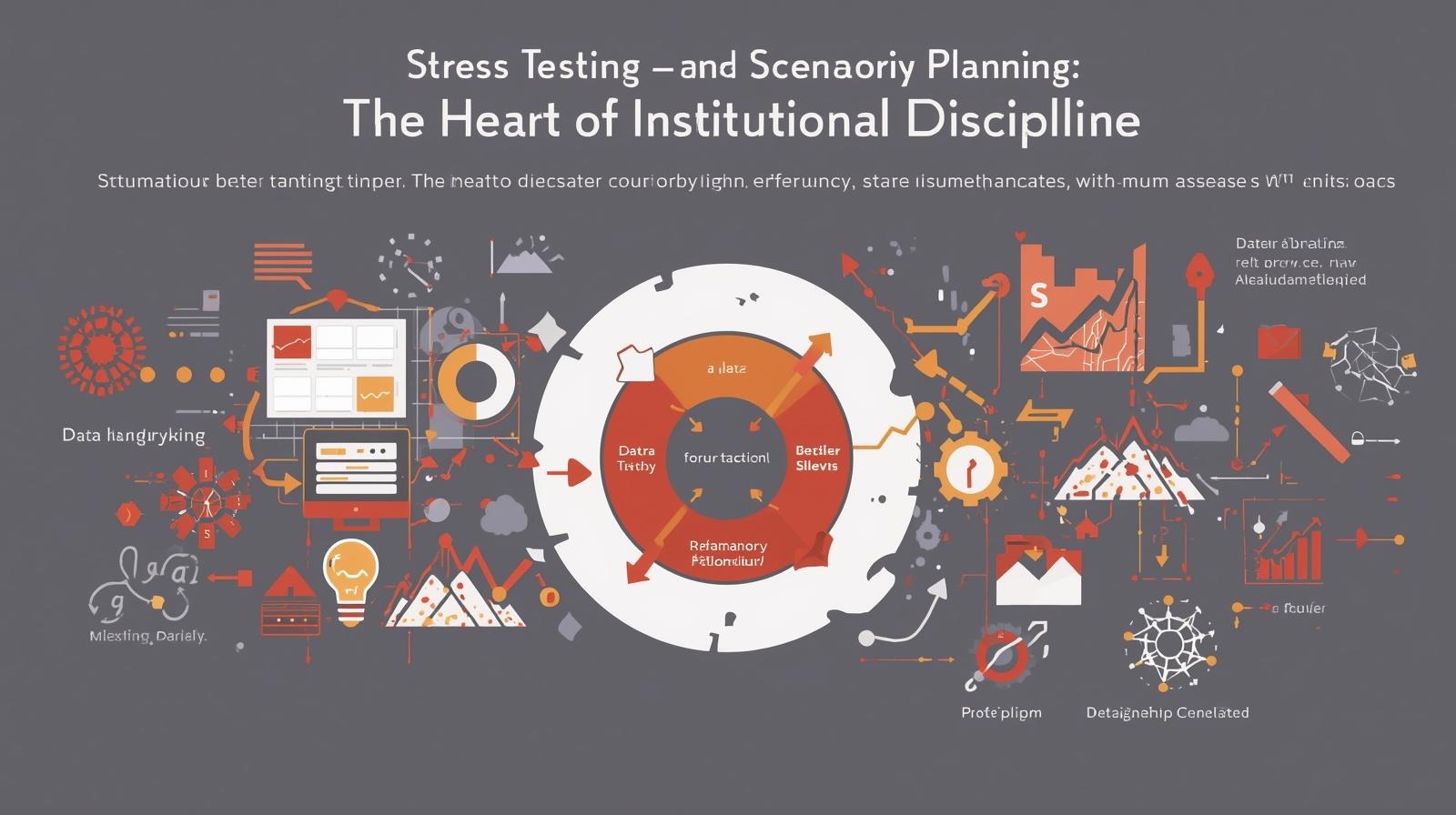
Stress Testing and Scenario Planning
Stress testing should not be a one-time report. It should be a recurring process embedded in decision-making. Institutions that do this well revisit scenarios after major allocation changes. They also track which risks are increasing because of market moves, not just because of trading activity.
Meet Our Team
Get to know our dedicated team of experts. With a diverse range of skills and years of experience, we’re committed to providing you with the best market analysis and investment guidance.

Mr. Rajeev Prakash Agarwal
Founder
Expert in financial & personal astrology for 20 years+. Rajeev is a well-known astrologer based in central India who has a deep understanding of both personal and mundane astrology.

Mr. Shashi Prakash Agarwal
Technical Head
Shashi is a technology leader with a strong background in global business.He holds a B. Tech in Computer Science & MBA in Finance from Narsee Monjee Institute of Management Studies, one of the top B-Schools in India.
Whether you’re a seasoned investor or just starting out, our financial astrology tools can be tailored to your specific investment goals. Gain valuable insights to achieve your financial aspirations.
Address
1301, 13th Floor, Skye Corporate Park, Near Satya Sai Square, AB Road, Indore 452010
+91 9669919000
© All Rights Reserved by RajeevPrakash.com (Managed by AstroQ AI Private Limited) – 2025