
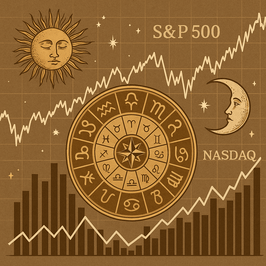
Astrology has quietly moved from late night curiosity to serious side tool for many traders in the US stock market. When markets are volatile, interest rates are uncertain, and algorithms move prices at lightning speed, investors naturally look for additional frameworks that help them time entries and exits. For a growing group of investors, financial astrology fills that space.
If you have ever wondered how to use astrology in stock market trading in a practical, structured way, especially when you focus on the S&P 500, Nasdaq, and leading US sectors, you are not alone. Many beginners search for a clear US market astrology guide that does not promise miracles, but instead shows how to blend planetary cycles with sensible technical and risk management rules.
In this long-form guide, you will explore how to use astrology in the stock market without abandoning logic or discipline. You will see how to read planetary transits, how to line them up with the behaviour of the S&P 500 and Nasdaq, how to think about sectors, and how to build a step-by-step approach that respects both charts and cycles.
Understanding The Logic Behind Financial Astrology
Before applying any astro trading ideas to real money, it helps to understand the logic that supports financial astrology trading. Astrology assumes that there is a meaningful relationship between planetary cycles and human behaviour. Markets are nothing but crowd behaviour expressed as price action. If collective mood and risk appetite move in cycles, and those cycles correlate with planetary patterns, then it becomes possible to search for repeating relationships.
Financial astrology trading does not claim that planets mechanically “cause” a stock to rise or fall. Instead, it treats planetary positions as timing signals that reflect changes in sentiment. A market, especially a huge one like the US equity market, is a living system of expectations. Shifts in optimism, fear, greed, and caution often occur in clusters, and astrologers attempt to map those clusters to specific planetary configurations.
Therefore, when you learn how to use astrology in the stock market, you are not replacing earnings reports, macro data, or technical charts. You are adding an extra timing layer that helps you decide when risks are more likely to expand or contract. The wise US investor uses astrology in stock market analysis as a filter, not as the only decision-making engine.
Key Astrological Building Blocks In A US Market Astrology Guide
To use astrology in US stock market trading, you first need a basic toolkit. Even a beginner astro trading framework can be powerful if the foundations are correct. The central elements you work with are signs, planets, houses, aspects, and cycles.
Zodiac signs describe qualities. Cardinal signs relate to beginnings and initiative. Fixed signs describe persistence and consolidation. Mutable signs reflect transition and adjustment. When major market events or important planetary alignments take place in a particular sign, financial astrologers interpret these qualities in relation to volatility, trends, and sector leadership.
Planets are viewed as forces or themes. The Sun is associated with vitality and core confidence in the system. The Moon’s rapid motion often relates to short-term mood, intraday swings, and the ebb and flow of trading sentiment. Mercury connects to information, news, and trading flow. Venus is linked to money, value, and investor comfort. Mars is associated with aggression, speculation, and sharp movements. Jupiter symbolizes expansion, optimism, and risk-on phases, whereas Saturn is tied to contraction, discipline, boundaries, and risk-off phases. Uranus is the disruptor, often associated with sudden breaks and surprises. Neptune is tied to illusions, hype, and confusion. Pluto is linked to power, leverage, extremes, and deep transformations.
Houses provide a backdrop for where the planetary action expresses itself. When traders build charts for the US national horoscope, for major stock exchanges, or for large companies, they examine which houses receive strong transits. For example, houses associated with finance, speculation, partnerships, or mass psychology will become focal points when those sectors experience intense movement.
Aspects describe relationships between planets. Harmonious aspects often correlate with smoother flows or more supportive conditions. Challenging aspects often accompany tension, turning points, or periods where markets digest shocks. When you learn how to use astrology in the US stock market, aspect patterns around key dates become crucial for identifying windows of opportunity or caution.
Cycles and retrogrades are the timing heartbeat. Jupiter and Saturn cycles are especially important when you perform financial astrology trading on indices like the S&P 500. Faster cycles, such as Moon and Mercury movements, matter for tactical traders and short-term swings. Retrogrades mark review periods, where trends slow, reverse, or become choppy while investors reassess narratives.
Mapping Planetary Cycles To The US Stock Market Structure
The US equity market is not a single monolithic entity. It is a layered system of benchmarks, growth engines, blue-chip barometers, and sector rotations. When you apply a US market astrology guide, you want to map planetary cycles to this structure.
The S&P 500 represents broad US corporate health and is a central benchmark for global investors. Many financial astrology practitioners treat the S&P 500 as a kind of “solar barometer,” where major transits to key planetary positions of the index or to the chart of the United States often line up with major highs, lows, or accelerations.
The Nasdaq, with its heavier concentration of technology, growth, and innovation names, is more sensitive to Uranian and Jupiterian themes. Disruptive technology, speculation in high-growth stories, and sudden reratings often appear stronger in the Nasdaq than in the broader market. When Uranus or Jupiter forms powerful aspects, traders sometimes see disproportionate moves in tech, semiconductor, internet, and biotech names that inhabit the Nasdaq universe.
Leading US sectors each respond differently to planetary symbolism. Financials often follow cycles linked to Venus, Jupiter, and Saturn because they represent credit, leverage, and regulatory conditions. Energy responds to Mars and Pluto themes, since conflict, resource scarcity, and transformation drive commodity prices. Healthcare and biotech often echo lunar and Neptunian motifs, as they relate to collective health, pharmaceutical narratives, and research cycles. Consumer discretionary can be tied to Venus and Jupiter, while consumer staples respond more to Saturn and the need for security.
By mapping planetary transits to these index and sector structures, you build a framework where the question “how to use astrology in stock market trading” turns into “which indices and sectors might be most sensitive to the current sky.”
Preparing Your Astro Trading Framework As A Beginner
As a beginner astro trading enthusiast, you may feel overwhelmed by all the moving parts. The simplest way forward is to construct a clear workflow. The goal is to turn a complex universe of planets, signs, and aspects into a daily, weekly, and monthly routine that supports your US stock market decisions.
You start by clarifying your trading timeframe. If you mainly swing trade the S&P 500 or Nasdaq with positions that last several days to several weeks, you will focus more on the Sun, Moon, Mercury, Venus, and Mars transits, combined with key aspects involving Jupiter, Saturn, Uranus, Neptune, and Pluto. If you are a position trader who holds for months or years, you will pay closer attention to the slower cycles, eclipses, and major planetary ingresses into new signs.
Next, you define a modest set of charts. This might include a natal chart for the United States, a foundational chart for the New York Stock Exchange or key US indices, and charts for a few primary stocks or sectors you follow. When you know exactly which charts matter to your strategy, you avoid drowning in excessive data.
Then you choose your technical tools. Astrology does not replace moving averages, volume profiles, or momentum indicators. Instead, you might decide that trend direction and major support or resistance levels will always come from technical analysis, while planetary transits will be used to refine timing and assess risk-on or risk-off bias.
You also set a risk framework that does not depend on transits alone. Position sizing rules, maximum loss per trade, and overall portfolio exposure should be defined numerically. Astrology may help you decide when to lean in or stay light, but risk control needs objective boundaries.
Finally, you develop a journal. Each time you act on an idea that uses astrology in US stock market trades, you record the chart you considered, the planetary patterns, your entry, exit, and outcome. Over time, this journal becomes your personal evidence base. Instead of blindly believing or rejecting financial astrology trading, you measure how it works with your temperament and style.
Reading The Sky Before The Opening Bell
Once your framework is in place, the daily routine begins. A practical way to use astrology in stock market analysis is to start your day by scanning planetary positions and comparing them to key charts before the US market opens.
You might first check the Moon’s sign and aspects for the day. Because the Moon moves quickly, its changes often mirror intraday mood shifts. On days where the Moon connects with challenging aspects, equity markets sometimes show choppier ranges, fake breakouts, or swift reversals. On days with more supportive patterns, trends may unfold more smoothly.
You then examine whether Mercury, Venus, or Mars are forming important connections that could trigger news events, volume surges, or directional pushes in the S&P 500 and Nasdaq. If Mercury is strong and well aspected, news-related moves can be decisive and orderly. If Mercury is under strain, miscommunication, rumours, or confusing guidance can create whipsaw patterns.
After reviewing these shorter-term indicators, you overlay them onto the current bigger picture. If Jupiter or Saturn are currently aspecting key points in the US chart or S&P 500 chart, you treat that as a background theme. Days that fall close to exact aspects can be more pivotal for trend continuation or reversal.
Finally, you compare the astro picture with futures, overnight news, and your technical levels. If the S&P 500 futures show a gap up into resistance on a day with challenging planetary patterns, you may treat that as a day to be cautious about chasing price. If the Nasdaq futures test a strong support zone on a day with supportive transits, you may prepare to look for reversal setups.
Applying Astrology To Index Trading On The S&P 500 And Nasdaq
When you focus on index trading, the question of how to use astrology in stock market trading becomes more about timing waves than picking individual stories. The S&P 500 and Nasdaq often respond clearly to shifts in collective optimism or fear, which makes them good candidates for an astrology-informed approach.
You can start by identifying windows of elevated probability for trend continuation or reversal. For example, when a major aspect involving Jupiter and Saturn is forming, you know that institutional investors might be rebalancing risk or reassessing macro narratives. Around such dates, you watch how the S&P 500 behaves near key moving averages or long-term trend lines. Astrology gives you a time window; technical analysis tells you where the market is vulnerable.
You also pay attention to Uranus aspects for the Nasdaq, because sudden breaks, gap moves, and aggressive repricing of tech names often appear during disruptive transits. If the Nasdaq is already extended and trading at rich valuations, and you see intense Uranian activity in the sky, you respect the possibility of abrupt shakeouts or sharp spikes.
Shorter-term traders may use the Moon’s interactions with index charts to choose which sessions deserve higher attention. When the Moon activates sensitive degrees linked to prior highs and lows on the S&P 500, intraday reversal candidates become more interesting. Your trading rules still depend on price action, but the astro calendar helps you prioritise which days and times to watch closely.
Using Astrology To Filter And Time US Sectors And Stocks
Beyond the broad indices, you can refine your astro trading strategy by considering sector and stock-level symbolism. This is where the combination of financial astrology trading and sector rotation becomes powerful.
Technology names and high-growth stories often resonate with Uranus, Jupiter, and Mercury. During periods when Uranus forms supportive aspects with Jupiter or Mercury, investors may reward innovation, new listings, and disruptive themes. Under difficult aspects, the same stocks can suffer sudden devaluation, especially if expectations were unrealistic.
Financial stocks, including US banks and brokers, respond more to Venus, Jupiter, and Saturn cycles. Venus relates to money and comfort, Jupiter to expansion and credit, and Saturn to regulation and discipline. When Saturn forms restrictive patterns, financials may underperform as lending standards tighten or regulatory chatter becomes louder. Supportive Venus and Jupiter activity can correlate with yield curve improvements, bullish guidance, or credit growth optimism.
Energy and commodity-related names tend to echo Mars and Pluto dynamics. When these planets engage in intense aspects, geopolitics, supply shocks, or demand surprises can hit the energy complex. Investors who use astrology in stock market trading for energy plays monitor these patterns carefully, especially when prices approach major support or resistance levels on the charts.
Healthcare and biotech often move with Moon and Neptune themes. Emotional responses to health news, trial data, or policy changes can drive these stocks to overshoot in both directions. Strong Neptunian transits can coincide with hype cycles or disillusionment, while supportive lunar patterns sometimes accompany relief rallies after fear-driven drops.
Consumer-driven sectors divide into discretionary and staples. Discretionary stocks follow Venus and Jupiter since they reflect confidence and desire. Staples respond more to Saturn and the basic need for security. When Saturn is heavy and global risk sentiment is fragile, staples may hold up better, while discretionary stocks lag. When optimism returns under supportive Jupiter patterns, discretionary again regains leadership.
Combining Astrology With Technical And Fundamental Analysis
Astrology alone is not enough to navigate the complexity of the US stock market. When you ask how to use astrology in US stock market trading responsibly, the answer always includes a synthesis with technical and fundamental inputs.
On the technical side, you can treat planetary dates as “time clusters” where you expect bigger-than-average movement. You then look for confluence with chart levels. If a major aspect falls near a long-standing horizontal support or resistance, trendline, or moving average, you pay more attention. The trade might be a breakout, a breakdown, or a reversal, but the combination of time and price confluence gives you an edge in preparation.
On the fundamental side, you continue to respect earnings, guidance, macro reports, and policy decisions. For example, if a central bank meeting or key economic release takes place under intense planetary pressure, you know that markets may react more violently than usual. If a company announces earnings under a supportive transit that fits its natal chart, positive surprises and constructive reactions may have higher probability.
This blended approach turns financial astrology trading into an additional filter rather than a replacement. Your stop losses, targets, and setups still come from chart structures and valuation logic. The astro layer helps you decide when to press and when to stay conservative.
Practical Walkthrough Of A Beginner Astro Trading Routine
To make the process easier to visualise, imagine a beginner astro trading routine for a US investor who mainly trades ETFs on the S&P 500, Nasdaq, and a few sector funds.
They start each month by marking key planetary dates on a calendar. This includes conjunctions, squares, oppositions among the outer planets, major Jupiter and Saturn transits, New Moons, Full Moons, and eclipses. These dates become the backbone of the monthly plan.
They then open weekly and daily charts of the S&P 500 and Nasdaq. They mark important support and resistance levels, trendlines, and moving averages. If a key planetary date falls close to a level that has already been tested multiple times, they treat that date as a potential turning or acceleration point.
Each week, they review the upcoming planetary patterns and look at how the indices and sectors have behaved into those windows. If the S&P 500 has rallied strongly into a challenging aspect, they become more cautious with new longs and tighten stops. If it has pulled back into support ahead of a supportive aspect, they look for signs of stabilization to initiate positions.
On a daily basis, they observe the Moon’s sign and aspects, and how these interact with intraday levels. When the Moon activates critical degrees that previously marked reversals, they pay special attention to price behaviour. If the reaction confirms the pattern, they may add to positions or scale out according to their plan.
Throughout this process, they record observations in their journal. Over several months, they begin to see which combinations of astro signals and technical structures work well for them. They gradually refine which signals to trust and which to ignore.
Risk Management, Psychology, And Ethics In Financial Astrology Trading
When investors first discover how to use astrology in stock market contexts, they sometimes become overly confident, as if they have found a secret code. This can be dangerous. The market punishes overconfidence in any form, whether it comes from indicators, models, or esoteric tools.
Sound risk management is therefore non-negotiable. Even if a transit looks powerful, you still size positions according to what you can afford to lose. You still respect stop losses and maximum portfolio drawdown thresholds. Astrology may suggest that a specific period is highly likely to produce a major move, but it cannot guarantee direction or magnitude. Probabilistic thinking remains essential.
Psychology plays a large role as well. Some traders use astrology to feel more in control, which can backfire if they ignore evidence on the chart. Others treat astrology as a gentle guide that helps them prepare without dictating every trade. The second approach is healthier. When you treat transits as weather forecasts rather than precise scripts, you stay flexible.
Ethics matter in financial astrology trading too. Responsible practitioners do not make wild promises or claim risk-free returns. They present astro trading strategies as an optional layer on top of serious analysis. They also encourage clients and readers to verify ideas, test them in paper trading, and adapt them to their own temperament.
Building Your Personal US Market Astrology Playbook
Over time, your goal is to build a personal playbook that explains exactly how you use astrology in US stock market trading. This playbook becomes a living document that evolves as you gain experience.
In this playbook, you describe which indices and sectors you focus on. You outline the specific planetary cycles that matter most to your strategy. You define the type of setups you seek, such as reversals at major support during supportive transits, or breakouts around expansive patterns. You specify how you manage risk around eclipses, retrogrades, or heavy aspects.
You also include space for research. You might conduct small studies where you examine how the S&P 500 behaved around certain recurring transits over the past several years. You might evaluate how the Nasdaq responded to Uranus-related patterns. This research does not need to be perfectly scientific, but it does need to be honest. You are trying to see whether your US market astrology guide has real-world usefulness when combined with technical and fundamental processes.
As your playbook matures, your use of astrology becomes more disciplined. Instead of reacting emotionally to every planetary event, you know exactly which ones matter to you and which ones you ignore. This is the difference between casual curiosity and a serious, organized attempt to integrate astrology into stock market trading.
Conclusion: A Balanced Way To Use Astrology In Stock Market Trading For US Investors
Astrology can be a meaningful ally for US investors who want to understand market timing beyond traditional models. When you explore how to use astrology in stock market strategies, especially for the S&P 500, Nasdaq, and leading US sectors, the real power lies in structure and balance.
A practical US market astrology guide does not tell you to abandon earnings, macro data, or technical analysis. It shows you how to place planetary cycles alongside those tools, so that you see markets through an additional lens. Financial astrology trading works best when you treat it as a timing complement, not a replacement for sound analysis and risk control.
For beginners, the path is clear. Learn the basic building blocks of signs, planets, houses, and aspects. Map them onto the structure of the US market. Create a daily and weekly routine where you review the sky and the charts together. Keep a journal to test what actually adds value. Over time, you will refine a personal approach that fits your psychology, your timeframe, and your goals.
Astrology will not eliminate risk, and it will not convert the market into a predictable machine. However, when used thoughtfully, it can help you frame cycles, identify windows of opportunity, and respect periods of caution. In a world where numbers, algorithms, and narratives constantly collide, that extra layer of cyclical awareness can make your journey as a US investor more informed, more intentional, and more aligned with the rhythms that have quietly guided human behaviour for centuries.