
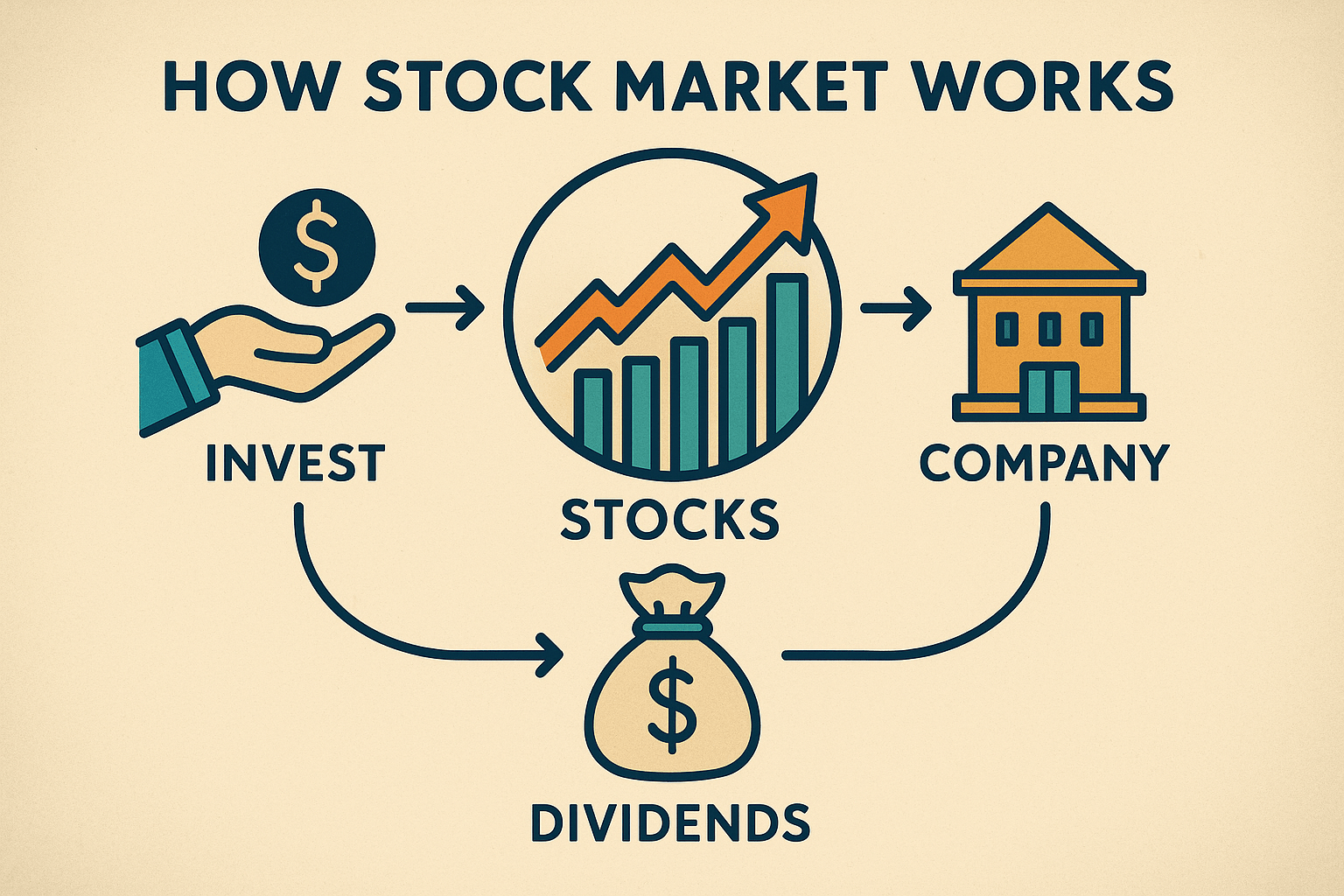
The stock market can seem intimidating at first—with charts, tickers, and financial jargon flying everywhere. But at its core, it’s simply a marketplace where ownership in companies is bought and sold. Understanding how the stock market works is your first step toward becoming an informed investor.
Whether you want to grow your wealth, beat inflation, or create passive income, the stock market offers a powerful avenue—but only if you know how it operates.
What Is the Stock Market?
The stock market is a system where investors buy and sell shares (or stocks), which represent partial ownership in companies. It facilitates this exchange through regulated platforms called stock exchanges, such as:
- NSE (National Stock Exchange) – India’s largest exchange
- BSE (Bombay Stock Exchange) – One of the oldest in Asia
- NYSE/NASDAQ – Major US stock exchanges
Companies list their shares publicly through a process called an Initial Public Offering (IPO), allowing anyone to invest in their growth.
Key Players in the Stock Market
| Participant | Role in the Market |
|---|---|
| Retail Investors | Individuals like you and me who buy/sell shares for investment |
| Institutional Investors | Mutual funds, insurance companies, and foreign investors with large capital |
| Companies (Listed) | Businesses that raise funds from the public by issuing shares |
| Stock Exchanges | Platforms that facilitate the trading of shares (e.g., NSE, BSE) |
| SEBI (India) | Regulates the stock market and protects investor interests |
| Brokers | Intermediaries through whom you place orders |
| Clearing Corporations | Ensure transactions are settled (buyer gets shares, seller gets money) |
How a Trade Happens (Step-by-Step)
Let’s say you want to buy 10 shares of Reliance:
- You place a buy order via your broker or trading app.
- The order goes to the stock exchange (NSE/BSE).
- The exchange matches your buy order with a sell order.
- Once matched, the trade is executed in real time.
- Within T+1 day, your demat account receives the shares, and the seller gets the money.
It’s all done digitally, and you can track it instantly on your trading platform.
What Drives Stock Prices?
Stock prices are not fixed—they move every second based on supply and demand. But what influences that?
- Company performance: Profits, earnings, growth potential
- Investor sentiment: Optimism, fear, speculation
- Economic indicators: Inflation, GDP, interest rates
- Global trends: War, pandemic, oil prices, U.S. Fed announcements
- News & announcements: Mergers, results, leadership changes
In short, stock prices reflect what investors expect to happen in the future—not necessarily what’s happening now.
Primary Market vs. Secondary Market
| Market Type | What Happens |
|---|---|
| Primary Market | Companies issue shares to the public for the first time (IPO) |
| Secondary Market | Investors buy and sell shares among themselves via stock exchanges |
When you buy a stock from an IPO, you’re buying directly from the company. When you trade on the NSE or BSE, you’re buying from other investors.
What Is a Stock Index?
A stock index tracks the performance of a group of selected stocks. It helps you understand the overall direction of the market.
Popular indices include:
- Nifty 50 – Top 50 companies on NSE
- Sensex – Top 30 companies on BSE
- Bank Nifty – Top banking sector stocks
- Midcap 150 / Smallcap 250 – Emerging companies
When you hear “the market is up,” it typically means that the index has gone up.
How You Make Money in the Stock Market
There are two main ways investors earn returns:
1. Capital Gains
Buy low, sell high. If you buy a stock at ₹100 and sell at ₹150, your profit is ₹50 per share.
2. Dividends
Some companies share their profits by paying dividends to shareholders. This gives you regular income even if the stock price doesn’t move much.
Bonus: Some long-term investors also benefit from stock splits, buybacks, or bonus shares.
Risks Involved in the Stock Market
Every investment has risk—and the stock market is no exception. Common risks include:
- Volatility: Prices can rise or fall unpredictably
- Market corrections: Sharp drops in value (short-term pain)
- Company-specific risk: Poor earnings or fraud can hurt stock value
- Emotional trading: Fear and greed lead to bad decisions
But with the right strategy, risk becomes manageable and profitable.
Tools You Need to Participate
To invest or trade in the stock market in India, you’ll need:
- A PAN card
- A demat account (to hold shares)
- A trading account (to place buy/sell orders)
- A linked bank account
- A SEBI-registered broker or app (Zerodha, Groww, Upstox, etc.)
The Role of SEBI in Regulating the Market
In India, the Securities and Exchange Board of India (SEBI) oversees all stock market activities. It:
- Regulates brokers and exchanges
- Protects investor interests
- Ensures transparency and fair trade
- Enforces insider trading and fraud laws
SEBI ensures that the stock market remains a level playing field.
Astrology and Stock Market Timing
At RajeevPrakash.com, we blend stock market logic with Vedic astrology to help investors:
- Identify favorable planetary periods for investing
- Time entries and exits with planetary support
- Understand astrological transits affecting market cycles
Combining data with intuition can give you a strategic edge in this fast-moving environment.
Final Thoughts: Simpler Than It Looks
The stock market may appear complicated—but once you understand its participants, mechanisms, and purpose, it becomes a powerful tool for long-term wealth creation.
Whether you’re an aspiring investor or a curious learner, remember:
- Start small
- Stay consistent
- Learn continuously
- Think long term
At RajeevPrakash.com, we help you decode market complexity with clarity—guided by both financial knowledge and astrological insight.