
Financial astrology is an alternative market timing approach that studies the relationship between planetary cycles, investor psychology, economic mood, and stock market behavior. While traditional market forecasting depends on price action, earnings, interest rates, liquidity, and economic data, financial astrology adds another layer by observing time cycles. It does not claim that planets directly “move” stock prices in a mechanical way. Instead, it studies how repeating celestial patterns may coincide with changes in collective sentiment, risk appetite, volatility, and turning points in financial markets.
For traders and investors, timing is often as important as direction. A fundamentally strong stock can still fall during a weak market cycle, while an overextended index can continue rising when liquidity and sentiment remain supportive. This is where financial astrology becomes useful as a timing framework. It helps traders identify sensitive dates, emotional market phases, possible reversal windows, and periods when caution may be needed.
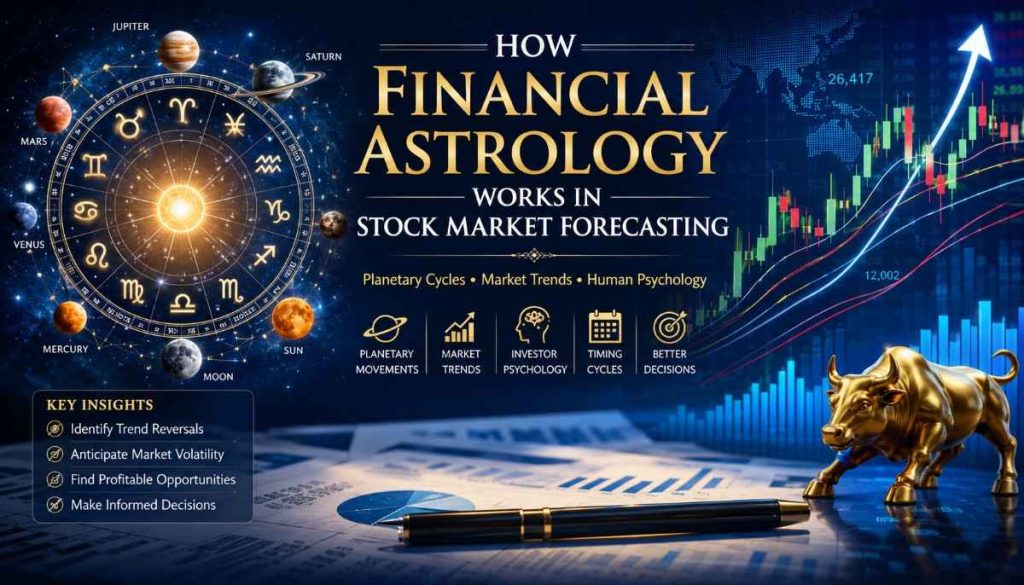
At Rajeev Prakash, financial astrology is studied as a complementary tool, not as a replacement for research, discipline, or risk management. The purpose is to combine planetary cycles with market structure, price behavior, sector rotation, and macroeconomic context. When used responsibly, financial astrology can help investors think beyond daily news and understand markets as part of larger time cycles.
What Is Financial Astrology?
Financial astrology is the study of planetary movements and their possible connection with financial markets. It looks at the motion of planets such as the Sun, Moon, Mercury, Venus, Mars, Jupiter, Saturn, Rahu, Ketu, Uranus, Neptune, and Pluto, and compares these movements with historical stock market behavior.
The basic idea is that markets are not only driven by numbers. They are also driven by human emotions such as fear, greed, confidence, panic, hope, and uncertainty. Since astrology has traditionally studied cycles of human behavior and collective mood, financial astrology applies the same principle to markets.
In stock market forecasting, financial astrology may study planetary transits, retrogrades, eclipses, lunar phases, conjunctions, oppositions, squares, and ingresses into zodiac signs. These events are then compared with market charts to identify repeating patterns. For example, some planetary combinations may historically coincide with volatility, while others may align with optimism, liquidity expansion, or speculative behavior.
However, financial astrology should not be treated as a guaranteed prediction system. It is best used as a probability-based timing method. It can highlight when markets may become sensitive, but price confirmation, volume, fundamentals, and risk management remain essential.
Financial Astrology FAQ
Frequently Asked Questions About Financial Astrology and Stock Market Forecasting
Understand how planetary cycles, investor psychology, market timing, and astrology-based forecasting methods are used in modern financial astrology.
Financial astrology studies the relationship between planetary cycles, investor psychology, market timing, and financial market behavior. It is commonly used alongside technical and fundamental analysis.
Financial astrology works by analyzing planetary transits, retrogrades, eclipses, lunar cycles, and historical market behavior to identify possible periods of volatility, reversals, and trend changes.
Financial astrology does not guarantee exact predictions, but it can identify sensitive time periods when markets may become emotionally unstable, highly volatile, or vulnerable to correction.
Financial astrology is considered an alternative market timing framework rather than a scientifically proven forecasting method. Many traders use it as a complementary tool alongside data-driven analysis.
Jupiter, Saturn, Mercury, Mars, Venus, Uranus, Neptune, Pluto, Rahu, Ketu, the Sun, and the Moon are commonly studied because they are associated with growth, fear, liquidity, speculation, volatility, and investor sentiment.
Yes. Financial astrology is often combined with technical analysis to improve market timing. Astrology highlights potential timing windows while technical analysis confirms price action and trend behavior.
Mercury retrograde is associated with communication issues, confusion, delays, revisions, and unexpected shifts in sentiment. Traders often become more cautious during these periods.
Some traders observe lunar cycles for short-term emotional shifts and volatility patterns. Full moons and new moons are often studied for possible turning points in market sentiment.
Financial astrology can help long-term investors identify broader market cycles, sentiment extremes, and timing opportunities for accumulation or risk reduction.
Timing is important because even fundamentally strong assets can underperform during weak market cycles. Financial astrology focuses heavily on identifying sensitive periods when trends may shift.
Why Timing Matters in Stock Market Forecasting
Stock market forecasting is not only about knowing whether a company is good or bad. Many investors buy strong businesses but enter at the wrong time. Others sell too early because they do not understand market cycles. Timing helps investors avoid emotional decisions and prepare for possible turning points.
Financial astrology focuses strongly on timing because planetary movements follow fixed cycles. The Moon changes signs quickly, Mercury retrogrades several times a year, Jupiter changes signs roughly once a year, and Saturn moves slowly through long-term phases. These cycles allow analysts to prepare a calendar of possible market-sensitive periods in advance.
This makes financial astrology different from news-based forecasting. News often explains market movement after it happens, while cycle analysis tries to identify important periods before the market reacts. For example, if a major planetary aspect is approaching and the market is already overbought, a financial astrologer may treat that period as a possible correction window. If the market is oversold during a supportive cycle, it may become a potential recovery zone.
The main value of financial astrology lies in preparation. It encourages traders to respect time, avoid overconfidence, and stay alert when multiple signals point toward a possible shift in trend.
How Planetary Cycles Influence Market Sentiment
Markets move because people make decisions. Every buy or sell order reflects belief, expectation, fear, confidence, or doubt. Financial astrology studies planetary cycles as indicators of changing collective sentiment.
The Moon is often associated with short-term mood and emotional reactions. In trading, lunar phases are sometimes observed for short-term volatility, especially around new moons and full moons. These phases may not always create major moves, but they can coincide with emotional intensity, sudden reactions, or temporary turning points.
Mercury is connected with communication, data, trading systems, contracts, and decision-making. Mercury retrograde periods are often watched for confusion, delays, revisions, technical errors, or unexpected changes in market narratives. In stock market forecasting, Mercury retrograde does not mean markets must fall, but it may suggest that traders should verify information carefully and avoid impulsive decisions.
Venus is linked with value, comfort, luxury, banking, consumption, and financial harmony. Venus-related cycles may be studied in relation to consumer stocks, luxury sectors, currencies, and overall market confidence.
Mars represents aggression, speed, risk-taking, conflict, and momentum. Strong Mars periods may coincide with sharp moves, speculative trading, geopolitical tension, or high-volatility phases. In bullish markets, Mars can support momentum. In weak markets, it can increase panic and selling pressure.
Jupiter is associated with expansion, optimism, liquidity, growth, and confidence. Jupiter cycles are often studied for broad market optimism, economic expansion, and risk appetite. However, excessive Jupiter influence can also create bubbles, overvaluation, and unrealistic expectations.
Saturn represents discipline, restriction, regulation, fear, debt, structure, and correction. Saturn cycles are important in long-term market forecasting because they may coincide with tighter liquidity, regulatory pressure, economic slowdown, or valuation discipline. Saturn does not always mean a crash, but it often demands realism.
Outer planets such as Uranus, Neptune, and Pluto are used in long-term financial astrology. Uranus is linked with disruption, technology, shocks, and sudden reversals. Neptune can relate to illusion, speculation, bubbles, confusion, and idealism. Pluto is connected with deep transformation, power shifts, debt cycles, crisis, and restructuring.
The Role of Retrogrades in Market Forecasting
Retrograde periods are important in financial astrology because they represent review, reversal, delay, or reassessment. When a planet appears to move backward from Earth’s perspective, astrologers interpret it as a time when the themes of that planet become internalized, delayed, or reconsidered.
Mercury retrograde is one of the most discussed cycles. In market forecasting, it may coincide with confusion in communication, changes in economic interpretation, data revisions, technical glitches, or sudden shifts in trader sentiment. It is not a simple sell signal. Instead, it suggests that traders should be careful with assumptions.
Venus retrograde may affect sectors connected with luxury goods, banking, fashion, entertainment, relationships, and consumer value. It can also bring reassessment of valuations. Mars retrograde may slow momentum and create frustration in aggressive market trends. Jupiter retrograde may reduce excessive optimism or bring a review of growth expectations. Saturn retrograde can bring delays in policy, regulation, debt restructuring, or institutional decision-making.
Retrogrades become more important when they occur near sensitive points in a market chart, company listing chart, national horoscope, or major index cycle. A retrograde alone may not change the market, but when combined with technical weakness or macro pressure, it can become a useful warning signal.
Lunar Phases and Short-Term Market Behavior
The Moon moves quickly and reflects short-term emotional cycles. In financial astrology, lunar phases are often used for shorter-term market timing. The new moon represents the beginning of a cycle, while the full moon represents culmination, visibility, and emotional intensity.
Some traders observe whether markets tend to form short-term highs or lows near new moons or full moons. The results can vary across assets, timeframes, and market conditions. Therefore, lunar cycles should not be used mechanically. Their value increases when they align with other signals such as support and resistance, volume exhaustion, overbought or oversold conditions, or major planetary aspects.
The Moon’s transit through different zodiac signs may also be studied. For example, earthy signs may reflect practical and value-based thinking, fire signs may increase risk-taking, air signs may support speculation and information flow, and water signs may heighten emotional sensitivity. These interpretations are symbolic, but they can help traders understand the mood of the market.
In stock market forecasting, lunar cycles are best used as a timing refinement tool rather than a complete strategy. They may help traders become more aware of emotional peaks and avoid entering positions during unstable sentiment.
Eclipses and Market Turning Points
Eclipses are considered powerful timing events in astrology because they involve the Sun, Moon, Rahu, and Ketu. In financial astrology, eclipse periods are often treated as high-sensitivity windows. They may coincide with sudden news, policy shifts, geopolitical events, market reversals, or emotional extremes.
An eclipse does not always produce an immediate market crash or rally. Sometimes its effect unfolds over weeks or months. Analysts often study where the eclipse falls in relation to important market charts, national charts, or company charts. If an eclipse activates sensitive degrees connected with a major index or sector, the period may become more significant.
Eclipse seasons can bring uncertainty because they often reveal hidden information or accelerate existing trends. If the market is already weak, an eclipse may intensify fear. If the market is consolidating, it may trigger a breakout. If a sector is overvalued, it may mark the beginning of reassessment.
For responsible forecasting, eclipses should be combined with market evidence. A financial astrologer may identify an eclipse window as important, but traders should still wait for confirmation through price action, volume, sector behavior, and macro news.
Planetary Aspects and Volatility
Planetary aspects occur when planets form specific angles with each other. In financial astrology, major aspects such as conjunctions, squares, oppositions, trines, and sextiles are studied for their possible influence on market behavior.
A conjunction occurs when two planets align closely. It can intensify the themes of both planets. For example, a Mars-Uranus conjunction may suggest sudden action, volatility, or surprise movements. A Jupiter-Uranus conjunction may support innovation, speculation, and strong moves in technology or growth sectors.
A square is considered tense and may indicate friction, pressure, or conflict. A Saturn-Uranus square, for example, may symbolize tension between old structures and new disruption. In markets, this could reflect pressure between regulation and innovation, value and growth, or stability and volatility.
An opposition can represent polarity, confrontation, or imbalance. It may coincide with market indecision or sharp reactions. Trines and sextiles are usually considered smoother aspects and may support flow, confidence, or constructive developments.
In stock market forecasting, aspects are most useful when they align with important price zones. If a major index is near resistance during a tense planetary aspect, traders may watch for rejection. If a stock is near support during a favorable aspect, it may become a possible recovery candidate.
Sector Forecasting Through Financial Astrology
Financial astrology can also be used to study sectors. Different planets are symbolically connected with different industries. This helps analysts create sector-specific outlooks instead of only focusing on the broad market.
Technology and innovation are often associated with Uranus, Mercury, and sometimes Rahu. Banking, wealth, luxury, and consumer comfort may connect with Venus and Jupiter. Energy, metals, defense, engineering, and high-action sectors may relate to Mars. Infrastructure, mining, debt, regulation, and heavy industries may connect with Saturn. Oil, chemicals, pharmaceuticals, and hidden-value sectors may sometimes be studied through Neptune and Pluto.
For example, when Jupiter supports growth and risk appetite, technology and high-growth stocks may perform better. When Saturn becomes dominant, investors may shift toward defensive sectors, cash flow, infrastructure, utilities, or value stocks. When Mars is active, energy, defense, metals, or momentum stocks may see sharper movement.
This approach does not replace sector fundamentals. Instead, it adds a timing layer. If a sector already has strong earnings, favorable policy, and improving price action, supportive planetary cycles may increase confidence in the timing. If a sector is fundamentally weak and faces difficult planetary cycles, caution may be useful.
Combining Financial Astrology With Technical Analysis
Financial astrology works best when combined with technical analysis. Astrology can identify possible timing windows, while technical analysis can confirm whether the market is actually responding.
For example, if planetary cycles suggest a volatile period, technical traders can watch support, resistance, trendlines, moving averages, relative strength, and volume. If the market breaks support during that period, the astrological timing gains relevance. If the market remains strong, the forecast may need adjustment.
This combination helps avoid blind prediction. A responsible analyst does not say that a market must fall because a planet is in a certain position. Instead, the analyst says that a certain time window may carry higher risk, and then waits for market confirmation.
Technical analysis also helps define risk. Astrology may suggest a reversal date, but traders still need stop-loss levels, entry zones, profit targets, and position sizing. Without risk management, even a good timing insight can lead to poor results.
The best use of financial astrology is not to replace charts but to improve the timing of chart-based decisions. It helps traders ask better questions: Is this breakout happening during a supportive cycle? Is this correction occurring near a known reversal window? Is market sentiment aligned with the planetary background?
Combining Financial Astrology With Fundamental Analysis
Fundamental analysis studies earnings, revenue, cash flow, debt, valuation, management quality, industry trends, and economic conditions. Financial astrology can support fundamental analysis by helping investors think about timing.
A company may have strong fundamentals, but the stock may remain under pressure during a difficult market cycle. Another company may be fundamentally average but rise sharply during a speculative phase. This is why timing matters.
Financial astrology can help investors identify when market mood may become favorable for growth stocks, defensive stocks, commodities, banking, technology, or consumer sectors. It can also highlight periods when investors may become more cautious about valuation, debt, or uncertainty.
For long-term investors, financial astrology may help with entry planning, accumulation phases, and risk reduction. For traders, it may help identify potential volatility windows. For portfolio managers, it may support broader asset allocation decisions when used alongside macroeconomic data.
However, fundamentals remain essential. Astrology should not be used to buy weak companies blindly or ignore financial risk. The strongest approach combines fundamental quality, technical confirmation, market cycle awareness, and astrological timing.
Financial Astrology and Market Psychology
Stock markets are emotional systems. Prices move because millions of investors interpret information differently. One investor sees opportunity, while another sees danger. One trader buys a dip, while another exits in fear.
Financial astrology is useful because it focuses on collective psychology. Planetary cycles are interpreted as symbolic reflections of changing mood. When Jupiter is strong, markets may become optimistic. When Saturn dominates, investors may become cautious. When Uranus is active, sudden disruption may enter the market. When Neptune is strong, confusion, speculation, or unrealistic narratives may rise.
This psychological lens can help traders avoid emotional traps. During euphoric cycles, investors may overpay for growth. During fearful cycles, they may sell quality assets too cheaply. Astrology does not remove uncertainty, but it encourages awareness of emotional extremes.
Market forecasting becomes more mature when it includes psychology. Charts show what investors are doing. Fundamentals show what businesses are worth. Astrology attempts to show when collective mood may shift. Together, these tools create a broader view of market behavior.
Risk Windows in Stock Market Forecasting
A risk window is a time period when markets may become more sensitive to volatility, reversals, news shocks, or emotional decisions. Financial astrology is especially useful for identifying such windows in advance.
Risk windows may occur around eclipses, major planetary aspects, retrograde stations, planetary ingresses, full moons, or combinations involving Mars, Saturn, Uranus, Neptune, Pluto, Rahu, and Ketu. These periods do not guarantee losses, but they suggest that traders should avoid complacency.
For example, a risk window may encourage investors to reduce leverage, tighten stops, avoid emotional entries, or wait for better confirmation. It may also help traders prepare for sudden breakouts or breakdowns.
The purpose of a risk window is not fear. It is preparation. Markets reward discipline more than prediction. If traders know that a sensitive period is approaching, they can manage exposure more carefully.
At Rajeev Prakash, this type of timing approach can be used to support market planning across stocks, indices, commodities, and sectors. The goal is to help investors understand when the market environment may demand patience, caution, or opportunity awareness.
Limitations of Financial Astrology
Financial astrology has limitations and should be used carefully. It is not a guaranteed forecasting system. Markets are influenced by many factors, including central bank policy, inflation, earnings, liquidity, geopolitics, technology, regulation, and investor flows.
Astrological cycles may highlight important periods, but they do not always produce clear market moves. Sometimes a predicted risk window may pass quietly. Sometimes a major move may happen outside a visible astrological setup. This is why astrology must be used with humility and discipline.
Another limitation is interpretation. Different astrologers may read the same planetary pattern differently. The quality of forecasting depends on experience, historical testing, market knowledge, and the ability to combine multiple signals.
Financial astrology should never be used as the only basis for investment decisions. It works best as a complementary timing tool. Traders should always use stop-losses, position sizing, diversification, and independent research.
The right question is not whether astrology can predict every market move. The better question is whether financial astrology can help investors prepare for possible timing shifts, understand sentiment cycles, and improve decision-making when used with other tools.
How Traders Can Use Financial Astrology Practically
Traders can use financial astrology by creating a calendar of important planetary dates and comparing them with market structure. This includes retrograde periods, full moons, new moons, eclipses, major aspects, planetary sign changes, and sensitive dates for specific sectors.
Once the calendar is ready, traders can mark possible trend-change zones and watch how the market behaves near those dates. If price action confirms the cycle, the timing becomes useful. If price action does not confirm it, traders should avoid forcing a prediction.
For example, if a major index is rising into a tense Mars-Saturn period and technical indicators show weakness, traders may become cautious. If a stock is correcting into a supportive Jupiter period and shows strong volume near support, traders may watch for recovery.
This method helps traders become proactive instead of reactive. They do not need to wait for news headlines to explain every move. They can prepare in advance and act only when the market confirms the setup.
Conclusion
Financial astrology works in stock market forecasting by studying time cycles, planetary movements, and their possible connection with investor psychology and market behavior. It does not replace technical analysis, fundamental research, or risk management. Instead, it adds a timing layer that helps traders identify sensitive periods, possible reversals, volatility windows, and sector shifts.
The strength of financial astrology lies in its ability to make investors more aware of market rhythm. Stocks do not move in straight lines. Markets rise, pause, correct, recover, and rotate. These movements often reflect changes in collective mood. By studying planetary cycles, traders can gain a broader perspective on when sentiment may change.
Used responsibly, financial astrology can support better planning, stronger discipline, and more thoughtful decision-making. It is not about blind prediction. It is about understanding timing, probability, and market psychology.
For investors who want to explore a deeper timing-based approach to markets, Rajeev Prakash offers a unique perspective on financial astrology, stock market forecasting, planetary cycles, and market timing. The goal is simple: better timing, better awareness, and better preparation in an uncertain financial world.