
Markets rarely fall only because of numbers. Earnings, inflation, interest rates, liquidity, debt, policy decisions, and geopolitical events all matter, but the real force that turns a correction into panic is human emotion. Fear spreads quickly when investors feel uncertain about the future. Panic appears when that uncertainty becomes urgent. A market correction begins when confidence weakens, but a deeper decline usually comes when belief breaks across a large group of traders at the same time.
This is where financial astrology becomes an interesting timing layer. Astrology does not replace technical analysis, fundamental research, risk management, or macroeconomic study. Instead, it studies the emotional rhythm behind market behavior. It looks at planetary cycles, lunar phases, retrogrades, eclipses, and tense aspects to understand when collective psychology may become unstable. Since markets are built on expectation, confidence, greed, fear, and reaction, astrology offers a symbolic framework for tracking the emotional temperature of investors.
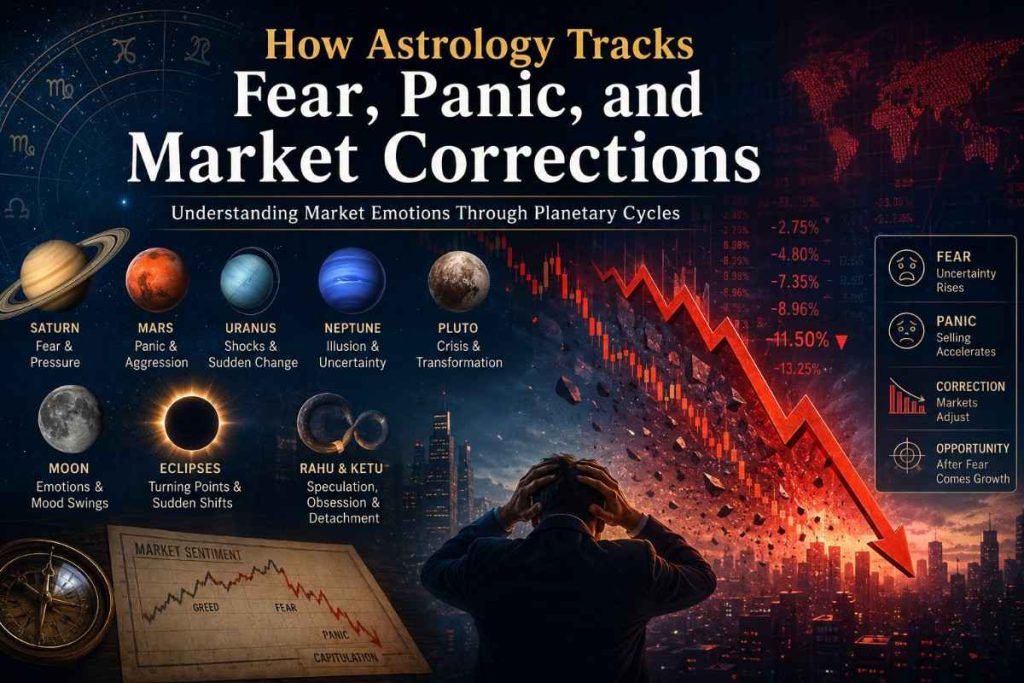
The purpose of this page is to explain how astrology tracks fear, panic, and market corrections in a practical way. It does not claim that every planetary transit will cause a crash or that astrology can predict exact prices with certainty. Rather, it shows how planetary cycles can help traders identify risk windows, emotional turning points, and periods when volatility may rise. When used responsibly, financial astrology can become a useful companion to price charts, market breadth, macro data, and sentiment indicators.
The Emotional Nature of Financial Markets
Every market cycle has an emotional story. A bull market begins when pessimism slowly turns into hope. It strengthens when confidence grows. It becomes dangerous when confidence turns into excitement. Finally, it reaches emotional excess when excitement becomes greed, overconfidence, and blind speculation. A correction often begins when reality challenges that optimism. At first, investors call the decline temporary. Then they start doubting the trend. Eventually, if selling continues, doubt becomes fear and fear becomes panic.
Astrology studies this emotional movement through planetary symbolism. Jupiter is often linked with expansion, optimism, faith, liquidity, and risk-taking. Saturn is linked with fear, discipline, pressure, restriction, debt, and reality checks. Mars represents aggression, urgency, conflict, and sudden action. Uranus represents shocks, disruption, unexpected news, and unstable market behavior. Neptune can reflect confusion, illusion, bubbles, false narratives, and unclear information. Pluto often points toward deep transformation, crisis, liquidation, and structural resets. In Vedic astrology, Rahu and Ketu add another powerful layer because they represent obsession, speculation, sudden reversals, detachment, and karmic turning points.
When these forces become active in market-related charts, they may reflect shifts in investor mood. A market does not need astrology to fall, but astrology may help identify the timing of emotional stress. This is especially useful because fear often builds before the news fully explains it. Traders who only wait for headlines may react late. A timing model that studies emotional cycles can help investors prepare before the crowd becomes visibly nervous.
Subtopic: Saturn and the Psychology of Market Fear
Saturn is one of the most important planets in financial astrology because it represents pressure, caution, contraction, responsibility, and consequence. In market psychology, Saturn often reflects the moment when optimism faces reality. When Saturn becomes strongly active, investors may focus more on risk than reward. They may worry about debt, earnings quality, regulation, recession, interest rates, or liquidity conditions. As a result, markets may become more defensive.
Saturn does not always create crashes. In fact, Saturn can also support disciplined investing, long-term planning, value investing, and serious portfolio construction. However, when Saturn forms difficult aspects with other major planets or sensitive market points, it may coincide with periods when investors reduce exposure. This can create slower rallies, weak recoveries, lower volume enthusiasm, and increased demand for safer assets.
During Saturn-heavy periods, traders often become less willing to buy every dip. They ask harder questions. They look for proof. They punish weak balance sheets. Growth stocks may face pressure if future earnings are discounted more strictly. High-debt companies may struggle. Speculative sectors may lose momentum. This is why Saturn is often seen as a correction planet. It does not always bring dramatic panic, but it can slowly drain confidence from overheated markets.
For investors, Saturn cycles are useful because they encourage discipline. If a market has already rallied aggressively and Saturn begins applying pressure, traders should avoid emotional overexposure. They should review stop-loss levels, position sizing, leverage, and concentration risk. Saturn teaches that survival matters more than excitement.
FAQs on Astrology, Fear, Panic, and Market Corrections
Understand how financial astrology studies planetary cycles, investor psychology, volatility, panic selling, and market correction risk windows.
Financial astrology studies planetary cycles and market psychology to understand when investors may become more fearful, reactive, or uncertain. In market corrections, it can help identify possible risk windows where volatility, panic selling, or emotional decision-making may increase.
Astrology should not be treated as a guaranteed prediction tool. However, it can highlight periods when collective sentiment may become unstable. Traders can use these timing signals with technical analysis, macro data, and risk management to prepare for possible panic-driven market moves.
Saturn is often linked with fear, pressure, debt, discipline, and correction phases. Mars can show urgency and sharp selling pressure. Uranus may indicate sudden shocks, while Pluto may point toward deeper structural resets. Rahu and Ketu are also important in Vedic astrology for speculative excess and sudden reversals.
Saturn represents caution, restriction, responsibility, and reality checks. When Saturn becomes strongly active, markets may become more defensive. Investors may focus on debt, valuation, regulation, interest rates, and weak earnings. This can create pressure on speculative stocks and overvalued sectors.
Mars represents speed, aggression, conflict, and impulsive action. During panic selling, markets often move quickly and emotionally. Mars-related periods may coincide with sharp intraday moves, sudden breakdowns, high volatility, and fast reactions from traders.
Uranus is connected with surprise, disruption, instability, and sudden change. In financial markets, Uranus may reflect unexpected events, policy surprises, technology shocks, flash crashes, or sudden reversals. It is often studied when markets behave unpredictably.
Eclipses are considered important timing markers in astrology because they are linked with turning points, hidden risks, and sudden changes in perception. In financial astrology, eclipse periods are often watched as possible windows of higher uncertainty, especially when they connect with sensitive market cycles.
The Moon is associated with emotions, public mood, and short-term sentiment. Financial astrologers often observe New Moon, Full Moon, and specific lunar phases to study emotional turning points. These signals are more useful when combined with price action and volatility indicators.
Financial astrology can be useful as a timing and sentiment layer. It may help traders become more aware of high-risk windows, emotional market phases, and possible volatility clusters. However, traders should always combine it with technical analysis, fundamentals, position sizing, and stop-loss discipline.
No. Astrology should not replace technical or fundamental analysis. It works best as an additional timing framework. A serious investor should confirm astrological risk windows with charts, market breadth, economic indicators, valuation data, earnings trends, and liquidity conditions.
Investors can use astrology to prepare for possible volatility rather than react emotionally. During stressful planetary periods, they may review portfolio exposure, reduce unnecessary leverage, tighten risk controls, avoid impulsive trades, and wait for technical confirmation before making major decisions.
A risk window is a period when planetary alignments suggest higher emotional, financial, or volatility pressure. It does not guarantee a market fall, but it encourages traders to become more alert. Risk windows are most valuable when they align with weak price structure or negative macro conditions.
Subtopic: Mars and Sudden Selling Pressure
Mars represents action, aggression, speed, heat, and conflict. In financial markets, Mars can reflect sharp moves, impulsive trading, sudden sell-offs, geopolitical tension, and emotional reactions. When Mars is strongly activated, price action may become more violent. Traders may react quickly rather than patiently. A small trigger can create a large move because market participants become more sensitive to immediate risk.
Mars periods can create strong upside momentum as well, especially when traders chase breakouts or risk assets move with force. However, when Mars interacts with Saturn, Uranus, Rahu, Ketu, Pluto, or eclipse points, the mood can become unstable. Panic often has a Mars quality because panic is fast. Investors do not calmly calculate every detail during a panic. They rush. They sell first and think later. They exit because they fear others will exit before them.
In technical terms, Mars-like markets often show large candles, gap openings, high intraday ranges, sudden reversals, and emotional volume spikes. These are the moments when traders may feel that price is moving faster than their decision-making ability. Astrology can help identify when this kind of aggressive market behavior may become more likely.
For practical use, Mars periods require extra attention to risk control. Traders should avoid oversized positions, especially in volatile instruments. They should be careful with leverage because Mars can magnify both gains and losses. A correction that begins under strong Mars influence may move quickly, and late reactions can become costly.
Subtopic: Uranus and Market Shock Events
Uranus is associated with surprise, rebellion, innovation, disruption, and sudden change. In market astrology, Uranus often reflects unexpected news, sharp reversals, technology shocks, policy surprises, flash crashes, and unusual volatility. While Saturn creates fear through pressure and Mars creates urgency through action, Uranus creates instability through surprise.
Markets dislike uncertainty, but they dislike unexpected uncertainty even more. A known risk can be priced slowly. An unknown shock forces investors to reprice quickly. This is the Uranian nature of market corrections. A sudden downgrade, a central bank surprise, a geopolitical event, a technology disruption, or a liquidity shock can create a fast change in sentiment.
Uranus is especially relevant in modern markets because trading has become faster, more automated, and more connected. Algorithms, derivatives, options flows, exchange-traded funds, and social media-driven speculation can amplify sudden moves. When Uranian energy is strong, the market may behave in a way that feels unusual, unstable, or disconnected from normal expectations.
For traders, Uranus cycles are not always bearish. They can also bring explosive rallies in technology, innovation, crypto, artificial intelligence, and high-growth sectors. However, they must be handled carefully. Uranus rewards flexibility and punishes rigid assumptions. During Uranus-heavy periods, investors should avoid believing that a trend must continue just because it has worked before. Sudden reversals become more possible.
Explore Rajeev Prakash Investor Tools
Choose the right financial astrology product for market timing, research, live signals, and daily investor guidance.
Annual Letter 2026
Read the yearly market timing roadmap based on financial astrology, planetary cycles, equities, precious metals, and key investment risk windows.
Explore Annual Letter
Live Signals
Get live trading and investment timing guidance using planetary cycles, technical levels, real-time price movement, and risk windows.
View Live Signals
Daily Newsletter
Start your trading day with daily market bias, financial astrology insights, risk alerts, planetary timing zones, and important levels to watch.
Subscribe Now
Financial Astrology Terminal
Use the Financial Astrology Terminal to track global assets, market cycles, planetary timing windows, watchlists, and financial astrology signals.
Open TerminalSubtopic: Neptune, Illusion, and the Breakdown of Market Narratives
Neptune represents dreams, imagination, confusion, illusion, fog, and emotional projection. In financial markets, Neptune can describe bubbles, unrealistic expectations, unclear data, false hope, and narratives that feel inspiring but lack strong foundations. During Neptune-influenced periods, investors may believe in a story more than they believe in evidence.
Market panic often follows a period of illusion. Before a correction, traders may ignore warning signs because the story sounds powerful. They may believe that a company will grow forever, that liquidity will remain easy, that debt does not matter, or that a speculative asset cannot fall. Neptune can create this fog. It does not always bring immediate decline, but it can weaken judgment.
When Neptune illusions begin to dissolve, markets may react sharply. Investors suddenly realize that expectations were too high. A company misses guidance. A sector loses momentum. A macro story changes. A popular theme becomes overcrowded. At that point, disappointment can become selling pressure.
Neptune is especially important in speculative manias because it rules emotional imagination. It can inflate dreams around new technologies, future profits, digital assets, or revolutionary business models. These stories can create powerful rallies, but they can also create painful corrections when reality returns. Financial astrology uses Neptune to identify periods when investors may not be seeing clearly.
Subtopic: Pluto and Deep Market Corrections
Pluto is connected with power, destruction, rebirth, hidden forces, debt, control, and transformation. In market astrology, Pluto often appears around deeper structural changes. While Mars may show quick panic and Saturn may show pressure, Pluto can represent liquidation, crisis, forced selling, and long-term market restructuring.
Pluto cycles are not always visible at first. They often work beneath the surface. Debt builds quietly. Leverage increases. Risk becomes concentrated. Weakness hides behind strong index performance. Then, when the pressure breaks, the market experiences a deeper reset. Pluto is not simply about fear. It is about exposure. It reveals what was hidden.
A Pluto-style correction can affect investor psychology very deeply because it changes belief systems. Traders do not merely worry about a temporary pullback. They begin questioning the structure of the market itself. They may question banks, debt markets, currencies, government policy, corporate balance sheets, or the sustainability of a major trend.
For long-term investors, Pluto periods can be difficult but also important. They may create rare opportunities after fear reaches an extreme. Pluto destroys weak structures but also opens the path for renewal. In this sense, astrology does not only track panic; it also helps identify when panic may eventually become a foundation for the next cycle.
Subtopic: Rahu, Ketu, and Speculative Panic in Vedic Astrology
In Vedic financial astrology, Rahu and Ketu are extremely important for understanding speculative trends. Rahu represents obsession, hunger, illusion, foreign influence, technology, hype, and unusual expansion. Ketu represents detachment, separation, sudden exits, cooling sentiment, and loss of interest. Together, they often describe the rise and fall of speculative enthusiasm.
Rahu can drive markets into extreme excitement. It may reflect periods when investors chase new themes without fully understanding the risk. This can appear in technology bubbles, crypto rallies, meme stocks, artificial intelligence speculation, and highly leveraged trades. Rahu wants more. It creates desire, urgency, and fascination. When Rahu dominates sentiment, the crowd may become convinced that a trend has no limit.
Ketu often appears when the crowd suddenly disconnects from that same story. Interest fades. Traders exit. A once-popular asset loses attention. The same people who chased the rally may no longer care. This emotional detachment can be dangerous because liquidity may disappear quickly. When buyers lose interest, even a small amount of selling can create a sharp correction.
Rahu and Ketu are also connected with eclipses, which are powerful timing markers in astrology. Around eclipse seasons, markets may experience emotional extremes, sudden shifts, or turning points. This does not mean every eclipse causes a market crash. However, eclipse periods deserve attention because they often coincide with heightened uncertainty and changing collective psychology.
Subtopic: Lunar Cycles and Short-Term Market Sentiment
The Moon is one of the fastest-moving bodies in astrology, and it is strongly connected with mood, emotion, instinct, and public sentiment. In market astrology, lunar cycles are useful for tracking shorter-term emotional waves. The New Moon can represent beginnings, hidden potential, and uncertain direction. The Full Moon can represent emotional visibility, culmination, tension, and release.
Many traders observe that markets often become emotionally charged around Full Moons, especially when the Moon forms difficult aspects with Mars, Saturn, Uranus, Pluto, Rahu, or Ketu. This does not mean that a Full Moon automatically causes selling. Instead, it may increase emotional sensitivity. If the market is already vulnerable, a lunar trigger can coincide with a sharper reaction.
The Moon also moves through signs and nakshatras in Vedic astrology, which can provide more detailed timing clues. Some lunar positions may support confidence and liquidity, while others may reflect hesitation, fear, or sudden emotional shifts. For short-term traders, lunar timing can be used as an additional filter, especially when combined with price action and volatility indicators.
Market corrections often unfold in emotional waves. The first decline creates concern. A bounce creates hope. A second decline creates fear. A breakdown creates panic. The Moon can help track this emotional rhythm because it moves quickly through changing sentiment states.
Subtopic: Eclipses and Market Turning Points
Eclipses are among the most watched events in financial astrology. They occur near the lunar nodes, Rahu and Ketu, and symbolize disruption, revelation, endings, beginnings, and sudden shifts in perception. In market psychology, eclipses may represent moments when hidden risks become visible or when investor attention suddenly moves from one narrative to another.
Not every eclipse produces a major market event, and responsible astrology should avoid exaggerated claims. However, eclipse seasons often deserve caution because they can coincide with emotional turning points. Markets may become more reactive, news may carry more psychological weight, and traders may reassess positions more quickly.
Eclipses are especially relevant when they activate sensitive points in the charts of major indices, countries, currencies, commodities, or financial institutions. They may also matter when they occur near important planetary aspects. In such cases, astrology may point toward a period when markets are more vulnerable to volatility.
For investors, eclipse periods are best treated as risk-awareness windows. This does not mean one should sell everything. It means one should avoid complacency. Traders should check whether their portfolios are too exposed to crowded positions, overvalued assets, or leverage. Eclipses remind investors that market perception can change suddenly.
Subtopic: Astrology and Technical Confirmation
Financial astrology works best when it is combined with technical confirmation. A planetary transit may suggest a risk window, but price action should confirm whether the market is actually weakening. Without confirmation, astrology can become too abstract. With confirmation, it can become more practical.
For example, if astrology shows a tense Saturn-Mars period and the market is already trading below key moving averages, the risk of correction may become more serious. If volatility is rising, breadth is weakening, and major support levels are breaking, the astrological warning gains more weight. On the other hand, if the same planetary transit occurs while price remains strong, volume is healthy, and leadership is broad, the correction risk may stay limited.
This is the balanced approach used by serious market timers. Astrology identifies the potential emotional climate. Technical analysis confirms whether that climate is affecting price. Fundamentals explain why investors may be reacting. Risk management protects the portfolio if the interpretation is wrong.
A trader should never use astrology as an excuse to ignore the chart. Instead, astrology should help the trader ask better questions. Is the market entering a fear cycle? Are investors becoming defensive? Is volatility rising near a known planetary stress period? Are safe-haven assets gaining strength? Are speculative sectors losing leadership? These questions make astrology more useful and more disciplined.
Subtopic: How Astrology Helps During Market Corrections
During a correction, investors often struggle emotionally. They wonder whether the decline is a buying opportunity or the beginning of a deeper fall. They may feel pressure to act quickly. Some sell too late. Others buy too early. Many become trapped between fear and hope.
Astrology can help by dividing corrections into timing phases. A Saturn influence may suggest slow pressure and disciplined caution. A Mars influence may suggest sharp selling and emotional reactions. A Uranus influence may suggest sudden shocks and unpredictable reversals. A Pluto influence may suggest deeper structural stress. A Rahu-Ketu influence may suggest speculative unwinding or sudden loss of interest.
This timing perspective can help traders avoid one of the biggest mistakes in corrections: treating every decline the same way. Some corrections are healthy pauses within a bull market. Others are emotional shakeouts. Some are liquidity events. Others are the start of a larger bear phase. Astrology cannot guarantee which one is happening, but it can provide useful context when combined with market evidence.
For example, if a correction occurs during a short lunar stress period but broader planetary conditions remain supportive, it may be a temporary emotional dip. If the correction occurs during heavy Saturn-Pluto pressure with weak market breadth and rising credit stress, the decline may deserve more caution. This is where astrology becomes a timing and risk-assessment tool.
Subtopic: Fear, Panic, and the Opportunity After Capitulation
The same astrology that tracks fear can also help identify when panic may be reaching exhaustion. Markets often bottom when the emotional pressure becomes extreme. At that stage, bad news is widely known, investors are defensive, media headlines are negative, and many traders have already sold. Panic feels dangerous in real time, but it can also create future opportunity.
Astrologically, the end of panic may appear when difficult aspects begin separating, when lunar pressure releases, when Jupiter forms supportive aspects, or when Venus and Mercury improve market tone. In Vedic astrology, a shift in nakshatra energy, lunar phase, or node-related pressure may also suggest a change in sentiment. Again, price must confirm the turn. A bullish reversal, improving breadth, falling volatility, and reclaiming of support levels can strengthen the case.
This is an important point because financial astrology should not only warn about danger. It should also help investors prepare for recovery. Fear cycles create mispricing. Panic can push quality assets below fair value. Corrections can reset sentiment and create healthier conditions for the next advance. The goal is not to fear corrections, but to understand them.
Subtopic: The Practical Value for Traders and Investors
The practical value of astrology in market corrections lies in preparation. If an investor knows that a stressful planetary period is approaching, they can review risk before emotions rise. They can reduce unnecessary leverage, avoid impulsive entries, tighten stops, hedge exposure, or wait for better confirmation. This preparation can make a major difference because the worst decisions usually happen during emotional pressure.
For active traders, astrology can help identify dates when volatility may expand. For swing traders, it can help filter entries and exits. For long-term investors, it can highlight periods when portfolio review becomes important. For family offices and institutional investors, financial astrology may serve as an additional timing layer alongside macro strategy, quantitative models, and technical research.
This does not mean astrology should dominate the investment process. It should support decision-making, not replace it. The strongest approach combines planetary timing with market structure, liquidity analysis, valuation, earnings trends, sector rotation, and risk controls. Astrology becomes more powerful when it is used with humility and discipline.
Conclusion: Astrology as a Market Psychology Timing Layer
Fear, panic, and market corrections are not random emotional accidents. They often unfold in patterns. Investors become hopeful, then greedy, then uncertain, then fearful, then panicked, and eventually exhausted. Financial astrology studies these emotional patterns through planetary cycles and symbolic timing.
Saturn shows caution and pressure. Mars shows urgency and fast reactions. Uranus shows shocks and disruption. Neptune shows illusion and confusion. Pluto shows deep transformation and crisis. Rahu and Ketu show speculative obsession and sudden detachment. The Moon and eclipses add shorter-term emotional timing. Together, these factors help create a map of market psychology.