
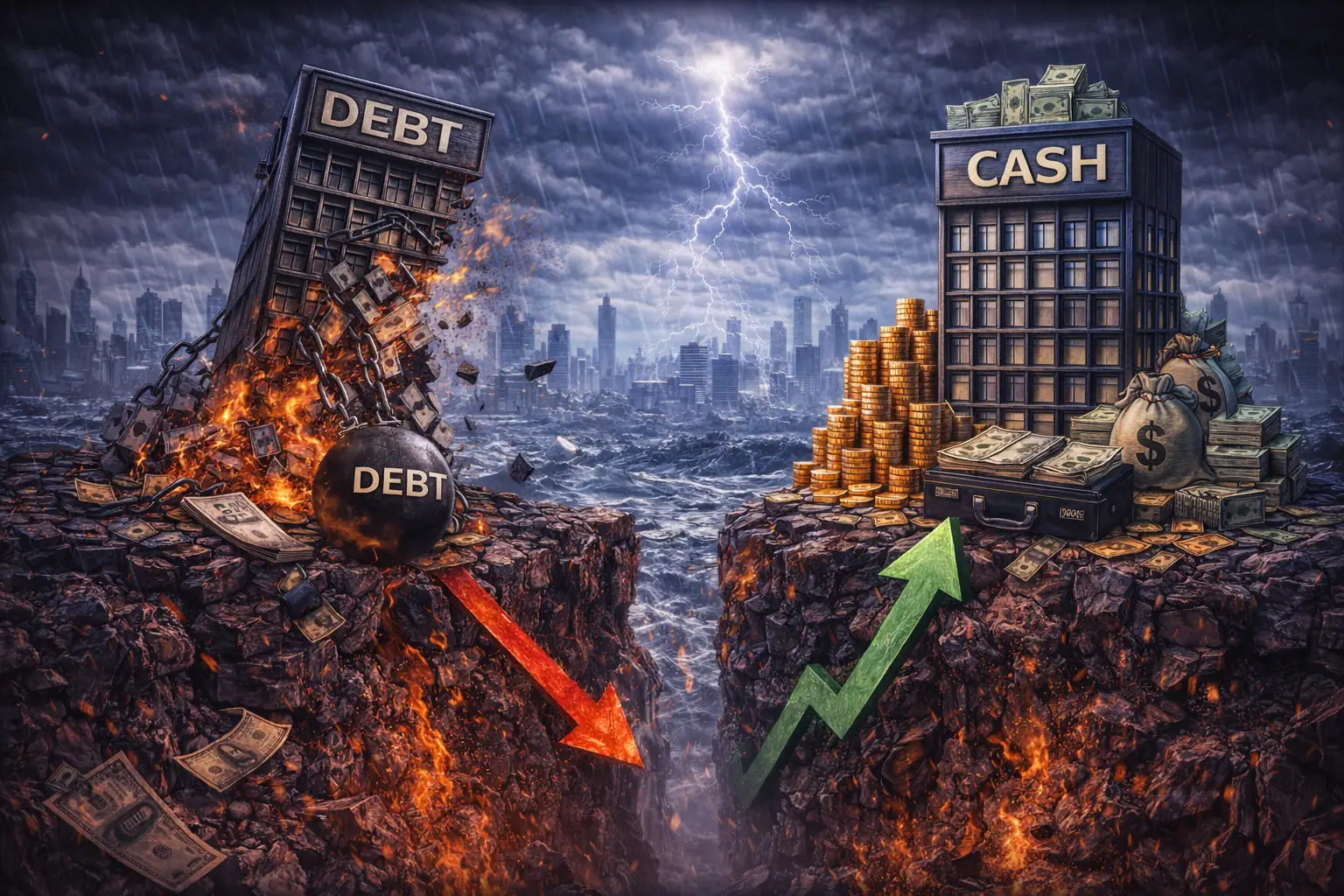
Every investment cycle eventually forces a reckoning with balance sheets. During periods of easy money, leverage is often framed as efficiency and cash is dismissed as unproductive. When conditions tighten, those narratives reverse with surprising speed. In 2026, balance-sheet strength becomes a primary determinant of survival, valuation, and strategic flexibility. The contrast between high-debt companies and cash-rich balance sheets is likely to shape corporate outcomes more than revenue growth or headline earnings.
This is not because debt is inherently bad or cash is inherently good. It is because the environment of 2026 magnifies the consequences of financial structure. Interest rate volatility, selective credit availability, refinancing risk, and uneven demand all interact to reward resilience and punish fragility. Understanding this distinction is essential for investors seeking to protect capital through transition rather than chase short-term narratives.
The End of Leverage as a Default Growth Tool
For much of the previous decade, leverage was a rational response to policy conditions. Low interest rates reduced the cost of debt, and abundant liquidity made refinancing routine. Companies borrowed to fund expansion, acquisitions, and shareholder returns with limited penalty.
In 2026, this backdrop has changed. Debt is no longer neutral. It introduces sensitivity to rate movements, credit spreads, and lender sentiment. High-debt companies find that financial decisions once taken for granted now require careful negotiation. Refinancing is no longer automatic, and covenant flexibility becomes a constraint rather than a technicality.
This shift does not create immediate failure, but it reduces room for error. High-debt models become less tolerant of operational volatility and external shocks.
Cash as Strategic Optionality Rather Than Idle Capital
Cash-rich balance sheets are often misunderstood as conservative or inefficient. In reality, cash provides optionality. It allows companies to act rather than react. In 2026, this optionality carries a premium.
Companies with strong cash positions can invest through downturns, support customers, secure supply chains, and pursue acquisitions when valuations compress. They can absorb cost increases without immediate margin erosion. They can choose when to access capital markets rather than being forced to do so under pressure.
This flexibility becomes especially valuable when uncertainty is high and opportunities emerge unevenly.
Refinancing Risk as the Hidden Divider
One of the most significant risks facing high-debt companies in 2026 is refinancing. Debt maturity schedules that once appeared manageable now represent potential stress points. Even if interest rates stabilize or decline modestly, lenders remain cautious. Credit spreads reflect not only rates but perceived risk.
Companies dependent on rolling over debt face vulnerability if market conditions tighten unexpectedly. A single adverse event, earnings miss, regulatory change, or macro shock can close refinancing windows or raise costs sharply.
Cash-rich companies avoid this trap. They are not forced into the market at inopportune moments. This difference in timing often determines long-term outcomes.
The Psychological Impact of Balance-Sheet Strength
Balance-sheet structure influences not only financial metrics but also stakeholder behavior. Investors, employees, customers, and suppliers all respond to perceived stability. In uncertain environments, confidence becomes a competitive advantage.
In 2026, companies with strong cash positions inspire greater trust. They attract talent more easily, negotiate better supplier terms, and reassure customers about continuity. High-debt companies may face subtle but compounding disadvantages as stakeholders become more cautious.
This psychological dimension accelerates divergence between resilient and fragile balance sheets.
Cost of Capital as a Competitive Weapon
The cost of capital shapes strategy. High-debt companies face higher effective costs as lenders demand compensation for risk. This raises hurdle rates for new projects and discourages long-term investment. Growth becomes constrained not by opportunity but by financing.
Cash-rich companies operate with a lower internal cost of capital. They can pursue projects with longer payback periods and invest in innovation without immediate pressure. In 2026, when many firms pull back, this ability to invest counter-cyclically can reshape competitive landscapes.
Over time, the advantage compounds.
Balance Sheets and Pricing Power Interaction
Balance-sheet strength and pricing power reinforce each other. Companies with pricing power can service debt more comfortably because margins are resilient. Conversely, companies without pricing power struggle under leverage because they cannot pass costs forward.
In 2026, this interaction becomes critical. High-debt companies with weak pricing power face a double squeeze. Costs rise, margins compress, and debt servicing becomes more burdensome. Cash-rich companies with pricing power enjoy a virtuous cycle of stability and reinvestment.
Investors who analyze balance sheets in isolation miss this dynamic. Structure and operating leverage must be viewed together.
High-Debt Models and the Illusion of Scale
Scale often masks leverage risk. Large companies can appear stable despite heavy debt because their revenue base is broad. However, scale does not eliminate refinancing or interest rate exposure. It only delays recognition.
In 2026, even large firms may face scrutiny if leverage is high and cash buffers are thin. Market perception shifts quickly when conditions tighten. What once looked like efficient capital management can be reinterpreted as vulnerability.
Cash-rich firms, regardless of size, enjoy greater resilience because they are not dependent on continuous market confidence.
Liquidity Stress Versus Solvency Risk in 2026
One of the most misunderstood aspects of balance-sheet analysis is the difference between liquidity stress and solvency risk. High-debt companies often appear solvent on paper, with assets exceeding liabilities, yet they remain vulnerable to liquidity shocks. In 2026, this distinction becomes critical.
Liquidity stress emerges when cash inflows are delayed, refinancing windows narrow, or credit markets reprice risk suddenly. Even profitable companies can face distress if they cannot meet near-term obligations. High leverage magnifies this risk because fixed financial commitments leave little room for timing mismatches.
Cash-rich balance sheets reduce this exposure. Liquidity provides time. Time allows management to respond thoughtfully rather than react defensively. In uncertain conditions, time itself becomes a strategic asset.
Balance Sheets and Strategic Negotiating Power
Balance-sheet strength directly affects negotiating power. Companies with cash and low leverage negotiate from a position of confidence. They can set terms with suppliers, lenders, and partners rather than accept imposed conditions.
In 2026, this advantage becomes visible across industries. High-debt firms may face stricter covenants, reduced flexibility, and limited strategic options. Cash-rich firms can demand better pricing, longer contracts, or exclusive arrangements because counterparties value stability.
This asymmetry compounds over time. Strong balance sheets attract favorable terms, while weak ones invite scrutiny and constraint.
Annual Letter 2026 by Rajeev Prakash Agarwal
Markets are entering a phase where easy assumptions no longer work. Liquidity is selective, volatility is structural, and capital is rewarded only when it is positioned with clarity and discipline. In such an environment, reacting to headlines is not enough. What matters is having a forward-looking framework that helps you anticipate change rather than chase it.
The Annual Letter 2026 by Rajeev Prakash Agarwal offers a comprehensive investment outlook designed for this new market regime. It blends long-term macro analysis, market psychology, and planetary cycles that have historically aligned with major shifts in global capital flows. The focus is on understanding cycles, identifying high-probability phases, and protecting capital during periods of uncertainty.

Capital Allocation Freedom During Market Stress
Market stress reveals how constrained capital allocation really is. High-debt companies must prioritize debt servicing and covenant compliance, often at the expense of long-term investment. Even attractive opportunities may be unreachable due to balance-sheet pressure.
Cash-rich companies, by contrast, retain freedom of choice. In 2026, when asset prices may fluctuate sharply and strategic assets become available, this freedom is decisive. The ability to deploy capital selectively, rather than defensively, differentiates long-term winners from survivors.
This is why many enduring companies are built not during booms, but during periods when others are forced to retreat.
Earnings Volatility and Financial Leverage Interaction
Financial leverage amplifies earnings volatility. When operating income fluctuates, debt magnifies the impact on equity value. In stable periods, this leverage can appear efficient. In volatile periods, it becomes destabilizing.
In 2026, earnings volatility is driven not only by demand cycles but also by input costs, regulatory changes, and currency movements. High-debt companies experience sharper equity swings as small changes in operating performance translate into outsized changes in financial risk perception.
Cash-rich companies absorb volatility more smoothly. Their equity value is less sensitive to short-term earnings noise, supporting valuation stability during uncertainty.
The Illusion of Financial Engineering
Share buybacks, dividend optimization, and leveraged recapitalizations are often framed as shareholder-friendly financial engineering. While these actions can enhance returns in favorable conditions, they reduce balance-sheet resilience.
In 2026, markets reassess these strategies. Investors begin to question whether past capital returns compromised future flexibility. Companies that aggressively reduced cash buffers to enhance short-term metrics may find themselves constrained at precisely the wrong time.
Cash-rich firms that resisted aggressive financial engineering appear conservative in hindsight, but they gain credibility as conditions tighten.
Balance Sheets and Corporate Culture
Balance-sheet structure influences corporate behavior and culture. High leverage creates pressure to meet short-term targets, often encouraging risk-taking or cost-cutting that may harm long-term value. Cash abundance encourages patience, experimentation, and strategic consistency.
In 2026, cultural differences matter more because decision-making occurs under stress. Organizations accustomed to operating with financial breathing room make different choices than those operating under constant pressure.
This cultural resilience often translates into better execution during difficult periods.
The Role of Cash in Innovation Cycles
Innovation requires tolerance for uncertainty. New products, processes, and business models rarely deliver immediate returns. High-debt companies struggle to sustain innovation when financial obligations dominate priorities.
Cash-rich companies can invest in innovation even when near-term payoffs are unclear. In 2026, when technological change continues alongside economic uncertainty, this ability to innovate through the cycle becomes a competitive advantage.
Over time, innovation funded by balance-sheet strength contributes to durable differentiation.
Market Valuation Shifts Toward Balance-Sheet Quality
Valuation frameworks evolve with cycles. In growth phases, markets emphasize revenue expansion and future potential. In transitional phases, they emphasize balance-sheet quality and cash generation.
In 2026, this valuation shift accelerates. Multiples increasingly reflect perceived survivability rather than projected growth. High-debt companies may face valuation compression even if revenues grow, while cash-rich companies may command premiums despite modest growth.
Understanding this shift helps investors interpret market behavior that may otherwise seem counterintuitive.
The Feedback Loop Between Debt and Market Confidence
Debt interacts with market confidence in powerful ways. As confidence weakens, financing costs rise. As financing costs rise, confidence weakens further. This feedback loop can turn manageable leverage into a serious constraint.
Cash buffers break this loop. They reassure markets that a company can weather stress without immediate external support. In 2026, breaking negative feedback loops is as important as capturing growth.
This dynamic explains why balance-sheet announcements often trigger outsized market reactions during uncertain periods.
Cash-Rich Balance Sheets and Long-Term Value Creation
Cash alone does not create value. How it is used matters. In 2026, disciplined deployment of cash becomes a differentiator. Acquiring distressed assets, investing in core capabilities, and strengthening customer relationships can create lasting advantages.
Companies that treat cash as a strategic asset rather than a passive reserve position themselves for long-term value creation. They avoid panic decisions and focus on building durable competitive moats.
This patient approach contrasts sharply with high-debt companies forced into defensive measures that may compromise future potential.
The Astrological Lens on Debt and Discipline
From a financial astrology perspective, periods dominated by Saturn often emphasize discipline, accountability, and structural strength. Excess leverage accumulated during expansion phases tends to be tested during such cycles. Rahu-driven optimism gives way to sober assessment.
In 2026, this lens aligns with observable market behavior. Leverage is scrutinized. Balance-sheet quality matters more than projections. Cash buffers are valued as protection rather than inefficiency.
Astrology does not replace analysis, but it reinforces the theme that structure matters more than speed in this phase.
The Long-Term Divergence Between Fragility and Resilience
As 2026 progresses, divergence between high-debt companies and cash-rich balance sheets is likely to widen. Fragile structures face compounding constraints, while resilient structures gain flexibility and opportunity.
This divergence influences valuations, investor preference, and strategic outcomes. It also shapes which companies emerge stronger from the cycle and which struggle to regain footing.
Understanding this divergence helps investors avoid permanent loss and focus on enduring value.
Conclusion: Balance-Sheet Strength as the Foundation of 2026 Strategy
The comparison between high-debt companies and cash-rich balance sheets in 2026 is not a moral judgment. It is a structural reality. In a constrained environment, optionality, resilience, and trust carry a premium.
Companies with heavy debt can survive if their operations are strong and their pricing power is durable. However, their margin for error is narrow. Cash-rich companies enjoy a wider path forward, greater strategic freedom, and stronger stakeholder confidence.
For investors aligned with the philosophy of rajeevprakash.com and the Annual Letter 2026, this balance-sheet perspective is central. It shifts focus from short-term performance to long-term survivability and from narratives to structure. In 2026, balance sheets are not a footnote. They are the story.