
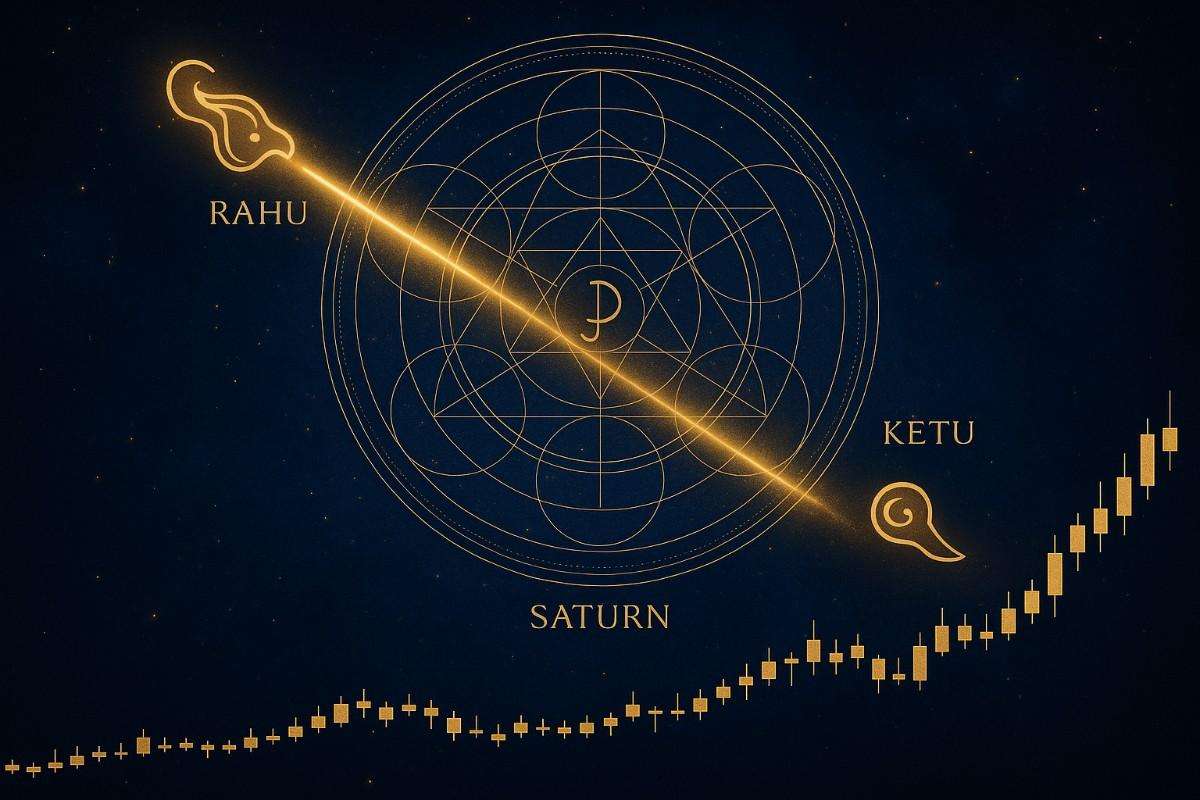
Gold Trends in Vedic Astrology: Rahu–Ketu, Jupiter–Saturn and Market Movements
Gold has always carried a special aura in human consciousness. In Vedic astrology, gold is much more than a commodity; it is a symbol of Jupiter’s wisdom, Sun’s authority and Venusian luxury. When traders and investors talk about gold astrology or search for an astrological prediction for gold price, they are really asking how cosmic cycles of Rahu–Ketu, Jupiter, Saturn and other planets can influence fear, greed and long-term value in the gold market.
In this detailed guide, we will explore how Vedic astrology looks at gold trends, what key planetary alignments matter, and how you can use these insights with discipline and risk management rather than blind speculation.
Understanding Gold in Vedic Astrology
Gold is primarily associated with the Sun and Jupiter in Vedic astrology. The Sun represents power, confidence, government authority and the soul’s radiance. Jupiter represents wealth, expansion, spiritual wisdom and long-term value. Together, Sun and Jupiter connections often show periods when gold can become a preferred store of value, especially when there is doubt or fear around fiat currencies, equities or economic stability.
At the same time, Venus brings an element of luxury, beauty and status. When Venus is strong and harmoniously connected with Jupiter or the Sun, demand for gold jewelry, ornaments and weddings can rise, particularly in cultures where gold is deeply integrated into social customs.
However, no realistic astrological prediction for gold price can ignore the shadow planets Rahu and Ketu, or the slow karmic giants Jupiter and Saturn. Rahu–Ketu drive extremes, illusions and sudden events, while Jupiter–Saturn cycles align with broader economic expansions, contractions and shifts in investor psychology.
Gold astrology therefore looks at the interplay among these energies, rather than isolating a single planet in the chart.
Rahu–Ketu and Gold Price Volatility
Rahu and Ketu, the lunar nodes, are not physical planets but mathematical points indicating where the Moon’s orbit intersects the ecliptic. Yet in Vedic astrology, they have immense power to destabilize, accelerate and transform. For gold, Rahu and Ketu are often linked with speculative excess, panic buying, fear-driven rallies, and sharp reversals.
When Rahu influences houses or signs connected to finances, commodities, or national economies, it can intensify demand for “safe haven” assets. In anxious times, investors rush towards gold to protect purchasing power. Rahu amplifies this flight to safety, often exaggerating both rallies and corrections. Ketu on the other hand can bring sudden detachment, profit-booking and unexpected trend exhaustion.
Gold astrology also pays close attention to eclipses, which are Rahu–Ketu phenomena. Solar and lunar eclipses in signs associated with wealth, banking or precious metals can coincide with turning points in sentiment. While not every eclipse will cause a price explosion, clusters of eclipses around important planetary positions may indicate phases where the astrological prediction for gold price must include higher volatility and emotionally driven swings.
In practical terms, Rahu–Ketu phases remind traders that gold is not a one-way bet. Even in strong uptrends, sudden spikes can be followed by steep corrections. Astrological analysis encourages disciplined position sizing and clear timeframes instead of emotional entries based purely on fear or greed.
Jupiter’s Role in Gold Trends
Jupiter is the natural karaka (significator) of wealth, fortune and expansion. In gold astrology, Jupiter’s sign, house position, retrograde motion and aspects can mark phases when the long-term narrative around gold shifts.
When Jupiter is strong by sign and well-supported by other benefics, confidence in the broader economy and financial systems can remain stable. In such phases, gold may still appreciate, but often behaves more as a portfolio diversifier than an urgent crisis hedge. However, when Jupiter moves through signs linked with inflation, currency weakness or debt concerns, the narrative can change. Investors may begin questioning the value of paper assets and searching for long-term stores of wealth.
Jupiter’s aspects to the Sun, Venus and Mars also matter. A supportive Jupiter-Sun configuration can strengthen both gold’s symbolic authority and the willingness of central banks or large institutions to hold reserves. When Jupiter aspects Venus, jewelry demand and festive buying may rise, especially in cultures where gold is tied to auspicious events. When Jupiter connects strongly with Mars, speculative trading energy can increase, sometimes leading to impulse rallies and active futures trading.
Astrological prediction for gold price from a Jupiter perspective is more about the long arc than the intraday noise. Jupiter indicates when multi-year themes are shifting: inflation cycles, confidence in fiat currencies, and the balance between risk assets and safe havens. Traders using gold astrology watch Jupiter transits to anticipate when the market may begin discounting a new macro story.
Saturn Cycles and Structural Gold Re-Rating
Saturn represents discipline, scarcity, responsibility, and karmic checks. In the context of gold, Saturn is closely linked with periods of austerity, financial stress, credit tightening and structural rethinking of value. When Saturn triggers sensitive points in national charts or major indices, the appetite for safety can rise, placing gold back at the center of asset allocation.
Saturn’s long transits through earthy signs like Taurus, Virgo or Capricorn can emphasize tangible value and risk control. In such phases, investors may gradually increase exposure to hard assets, including gold, as a hedge against systemic shocks. When Saturn challenges Jupiter or Venus by aspect, it can put pressure on optimism, consumer confidence and speculative froth in equity markets. Gold often benefits as capital rotates from overvalued risk assets into perceived safety.
At the same time, Saturn is not purely bullish for gold. It can enforce long consolidations, sideways ranges and tests of patience. After strong rallies, Saturn transits can force the market to digest gains and shake out weak hands. The serious student of gold astrology therefore looks at Saturn as the planet of risk management, reminding traders not to chase parabolic moves without a plan.
Saturn also rules time. Long-term holders of gold, such as central banks and conservative investors, often think in multi-year cycles rather than daily fluctuations. In periods when Saturn and Jupiter form significant conjunctions or oppositions, the entire framework of global finance can recalibrate. These turning points can mark major re-ratings of gold’s role in portfolios.
The Rahu–Ketu Axis with Jupiter–Saturn: Powerful Turning Points
The most potent phases for gold astrology often occur when Rahu–Ketu interact strongly with Jupiter and Saturn. These alignments can create powerful turning points in market sentiment and structural trends.
When Rahu aspects Jupiter or occupies Jupiter’s signs, speculative enthusiasm can explode around macro themes: inflation fears, currency wars, or sudden distrust of central bank policies. If this aligns with vulnerable equity markets, flows into gold and other precious metals can accelerate, delivering large price swings in a relatively short period.
Similarly, when Ketu interacts with Jupiter, prior narratives about “endless growth” or “permanent stability” can be suddenly questioned or dismantled. For gold, this may translate into phases where long-term skeptics return to the market, seeking to hedge what they now see as delayed risks.
Rahu or Ketu forming tight connections with Saturn can intensify the sense of systemic stress. Fears of defaults, banking crises or policy missteps can push gold to the forefront as a hedge not only against inflation but also against institutional fragility. In such periods, an astrological prediction for gold price often includes a higher probability of sharp uptrends followed by volatile consolidations.
What matters most is the layering of energies. When both Jupiter and Saturn are under nodal influence and other triggers such as eclipses, retrogrades or sign ingresses occur, the background environment becomes ripe for large gold moves. Traders practicing gold astrology look for these clusters, combining them with technical analysis and macro data to refine timing.
Houses and Signs Connected with Gold in Vedic Astrology
Beyond planetary interactions, houses and zodiac signs also play a role in gold astrology. The second house governs wealth, savings and family assets. The eighth house relates to hidden wealth, inheritances and sudden gains or losses. The eleventh house signifies profits, speculative gains and inflows from trading or investments.
When transiting planets activate these houses in the chart of a nation, a central bank, or the chart used for major gold contracts, shifts in demand and pricing can unfold. Strong benefic influence on the second and eleventh houses often correlates with phases of healthy, steady demand, while stressed combinations with malefics can lead to volatility, smuggling, policy changes or tax restructuring that affect gold flows.
Signs ruled by the Sun, Jupiter and Venus naturally carry more resonance with gold’s symbolism. Leo, as the Sun’s sign, highlights status, prestige and royal wealth. Sagittarius and Pisces, ruled by Jupiter, connect with long-term belief systems, faith in value and philosophical views on money. Taurus and Libra, ruled by Venus, emphasize jewelry, adornment and the balance between aesthetic desire and financial practicality.
When Rahu–Ketu, Jupiter or Saturn transit these signs, gold astrology expects more active participation from both retail buyers and institutional players. Certain nakshatras, especially those linked with wealth, trade and craftsmanship, can also fine-tune timing, but using them effectively requires experience and consistent observation.
Precious Metal Sentiment and Planetary Retrogrades
Planetary retrogrades often coincide with phases of reassessment, trend pauses or reversals. For gold, retrogrades of Jupiter, Saturn, Venus and Mercury can all have distinctive impacts on sentiment and trading behavior.
Jupiter retrograde tends to make investors revisit their assumptions about inflation, growth and monetary policy. During such periods, gold astrology suggests that markets may temporarily question prior narratives. If gold has rallied strongly into a Jupiter retrograde, a consolidation or corrective phase is common. If gold has been neglected, a retrograde can open the door to a quiet accumulation phase before a larger move.
Saturn retrograde encourages the market to question risk exposures and leverage. Traders and institutions may reduce high-risk positions, tighten margins and re-evaluate hedges. In this environment, astrological prediction for gold price often includes the possibility of safe-haven inflows, especially if other indicators show that credit conditions are tightening.
Venus retrograde can affect jewelry demand, luxury consumption and overall aesthetic preferences. In cultures where weddings, festivals and auspicious ceremonies drive gold buying, Venus retrograde may temporarily disrupt normal patterns, shifting the seasonal rhythm of demand.
Mercury retrograde is famous for confusion, miscommunication and technical issues. In trading, it may align with periods of erratic price action, fake breakouts, data glitches or news misinterpretations. Gold astrology treats Mercury retrograde as a time for extra discipline with order placement, position sizes and trade confirmations. While not inherently bullish or bearish for gold, it can complicate the execution of otherwise sound strategies.
Linking Gold Astrology with Practical Market Analysis
For modern traders, astrology should not replace fundamental and technical analysis. Instead, gold astrology offers an additional lens to understand market mood, timing and the underlying “why” behind major turns.
Fundamentals such as interest rates, real yields, central bank policies, geopolitical risks, currency trends and inflation data remain crucial. Technical tools like support–resistance, moving averages, trendlines and momentum indicators help identify entries, exits and risk levels.
Astrological prediction for gold price becomes powerful when it coordinates with these tools. For example, if Jupiter and Saturn align in a way that historically correlates with monetary regime shifts, and at the same time gold is approaching a major technical breakout zone supported by rising inflation expectations, the confluence strengthens the conviction behind a long-term bullish stance.
On the other hand, if Rahu drives a speculative spike far above long-term valuation bands while leading indicators cool down and Saturn prepares to impose discipline, gold astrology may warn that chasing the move without a plan could be dangerous. In this way, astrology acts as a timing and sentiment framework that complements the logic of macro and technical analysis.
Building a Framework for Gold Trading with Vedic Astrology
To use gold astrology responsibly, traders should build a structured framework rather than reacting to every transit or headline. This framework may include a long-term view of Jupiter–Saturn cycles, a medium-term calendar of Rahu–Ketu and eclipse dates, and a short-term watchlist of retrogrades and key planetary aspects relevant to precious metals.
The long-term view helps define whether the broader environment favors higher gold allocations or a more cautious stance. The medium-term calendar highlights volatility clusters and potential turning windows where trend acceleration or reversal becomes more likely. The short-term watchlist tunes entries and exits around major events, allowing traders to reduce exposure during chaotic windows or scale in when signals strengthen.
Risk management remains central. Even the most carefully prepared astrological prediction for gold price carries uncertainty. Markets can diverge from expectations due to sudden policy decisions, wars, technological shifts or unexpected data shocks. Astrology can show the pressure zones and energetic themes, but the exact expression unfolds through free will, collective behavior and real-world events.
For this reason, gold astrology is best used as a probability enhancer rather than a certainty generator. Traders can size positions according to their risk tolerance, use stop losses or hedging instruments, and treat astrology as a strategic overlay that improves timing and emotional control.
Psychology, Karma and the Gold Trader
One of the subtle gifts of Vedic astrology is its ability to mirror the trader’s inner world. Rahu exposes greed and desperation, encouraging over-leverage and fear of missing out. Ketu exposes detachment and indifference, which can sometimes become neglect of genuine opportunity. Jupiter can create overconfidence if not balanced by Saturn’s realism. Saturn, in turn, can induce excessive fear or paralysis unless supported by Jupiter’s faith.
In gold trading, these psychological patterns are easy to see. At tops, emotional narratives dominate: “Gold can only go higher; this time is different.” At bottoms, despair appears: “Gold is dead; nothing will ever save it.” Astrology helps traders recognize when collective emotions are likely to peak and when humility, patience and balance are more valuable than any indicator.
By mapping planetary cycles, traders can better understand when their own temperament may not match the market’s requirement. For example, a highly restless trader may find it difficult to hold positions through slow Saturn-driven consolidations, even though these phases can be ideal for accumulation. Conversely, a conservative investor may miss high-Rahu windows of opportunity due to discomfort with volatility, even though those windows can deliver exceptional rewards if managed wisely.
Gold astrology therefore becomes a tool for self-awareness in addition to market analysis. The same planets that shape global cycles also reflect individual tendencies to fear, hope, doubt and overreach. Aligning personal strategy with planetary rhythms can reduce emotional friction and improve decision-making.
Ethical and Practical Limits of Gold Astrology
It is important to recognize the limits of predictive tools. No astrological system can guarantee exact price targets or perfectly timed entries and exits. Astrological prediction for gold price should be offered as guidance with probability bands, not as absolute promises.
Ethically, astrologers and traders must acknowledge that markets are influenced by countless visible and invisible factors. A planetary configuration can describe a high-risk environment, but the specific event that triggers a move may be impossible to foresee. Astrology can indicate that the collective psyche is ready for a shock, yet not specify whether it will come through monetary policy, political change, war, technological disruption or natural disasters.
Therefore, the most responsible use of gold astrology is to prepare rather than to control. When cycles suggest rising volatility, traders can reduce leverage, refine risk parameters, and remain alert for opportunity. When cycles indicate calm and stability, traders can lean into longer-term strategies while still respecting the possibility of surprise.
Practical humility is essential. Astrology offers a map, but each trader still has to walk the path, manage positions and accept outcomes. In this sense, gold astrology becomes part of a larger spiritual discipline: aligning with cycles, respecting uncertainty, and using insight to act with wisdom rather than impulsiveness.
From Cosmic Cycles to Market Strategy
Gold continues to attract investors as a hedge against uncertainty, a symbol of enduring value and a bridge between the material and the spiritual. In Vedic astrology, the dance of Rahu–Ketu with Jupiter and Saturn shapes both the emotional weather and the structural backdrop of the gold market.
When Rahu amplifies fear, gold can surge. When Ketu cuts illusions, exaggerated narratives can collapse. When Jupiter expands, long-term themes evolve and valuation frameworks shift. When Saturn tightens, risk is repriced and discipline returns. Together, these cycles create the multi-layered environment in which gold’s price moves day by day, month by month and decade by decade.
For those who study gold astrology, the goal is not to escape risk but to understand it at a deeper level. Astrological prediction for gold price, when used responsibly, can help traders and investors anticipate turning zones, respect volatility and align their strategies with broader cosmic rhythms. Combined with sound market analysis, disciplined money management and continuous learning, astrology becomes a powerful ally in navigating the ever-changing landscape of precious metals.
In the end, gold’s true value lies not only in charts and numbers, but in its capacity to reflect human hopes, fears and aspirations across time. Vedic astrology simply provides another language to read that reflection more clearly and to turn cosmic insight into thoughtful, grounded market decisions.
Gold Trends in Vedic Astrology FAQs
Explore common questions about gold astrology, Rahu-Ketu cycles, Jupiter-Saturn influence, eclipses, retrogrades, and how Vedic astrology can support precious metal market timing.
Vedic astrology studies gold trends through the influence of the Sun, Jupiter, Venus, Rahu, Ketu, Saturn, and important financial houses. Gold is seen as a symbol of wealth, authority, long-term value, security, and luxury, so planetary cycles are used to understand possible shifts in demand, sentiment, and volatility.
Gold is mainly connected with the Sun and Jupiter in Vedic astrology. The Sun represents power, authority, confidence, and royal value, while Jupiter represents wealth, wisdom, fortune, and expansion. Venus also plays a role through luxury, beauty, jewelry, comfort, and social status.
Rahu and Ketu can create extreme movements in gold by amplifying fear, speculation, panic buying, and sudden reversals. Rahu may intensify safe-haven demand or speculative rallies, while Ketu may bring profit-booking, detachment, or unexpected trend exhaustion. Eclipse periods linked with Rahu and Ketu can also increase volatility.
Jupiter shows expansion, wealth themes, confidence, inflation narratives, and long-term value, while Saturn shows discipline, scarcity, credit tightening, and structural risk. When Jupiter and Saturn form important cycles or aspects, investors may reassess the role of gold as a hedge, reserve asset, or portfolio stabilizer.
Vedic astrology should not be used to guarantee exact gold prices or perfect entry and exit points. It is better used as a probability-based timing and sentiment framework. Traders should combine gold astrology with technical analysis, macroeconomic data, interest rates, currency trends, position sizing, and disciplined risk management.