
Financial Astrology and Recession Forecasting is an emerging area of market research that studies the relationship between planetary cycles, investor psychology, economic stress, and long-term financial turning points. While traditional economists look at interest rates, inflation, employment data, credit conditions, corporate earnings, and central bank policy, financial astrology adds another timing layer. It does not replace economic analysis. Instead, it helps investors study the rhythm of collective behavior and identify periods when fear, caution, excess, or contraction may become more visible in the markets.
A recession is not only an economic event. It is also a psychological event. Before a recession becomes official, confidence often starts weakening. Businesses delay expansion. Consumers become more careful. Banks tighten lending. Investors rotate away from risky assets. Equity markets begin to price lower growth. Credit spreads widen. Commodities may react differently depending on inflation, supply shocks, and global demand. This entire process reflects a shift in mass sentiment.
Financial astrology studies such shifts through planetary movements. Saturn is often associated with restriction, discipline, debt, pressure, fear, and structural correction. Jupiter is linked with expansion, optimism, liquidity, growth, and confidence. Uranus can indicate disruption, sudden shocks, technology shifts, and unexpected volatility. Neptune may reflect confusion, bubbles, illusions, and unclear economic narratives. Pluto often represents deep transformation, destruction of old structures, power struggles, and systemic change. In Vedic astrology, Rahu and Ketu play a major role in speculative manias, sudden reversals, foreign influence, technological hype, detachment, and market corrections.
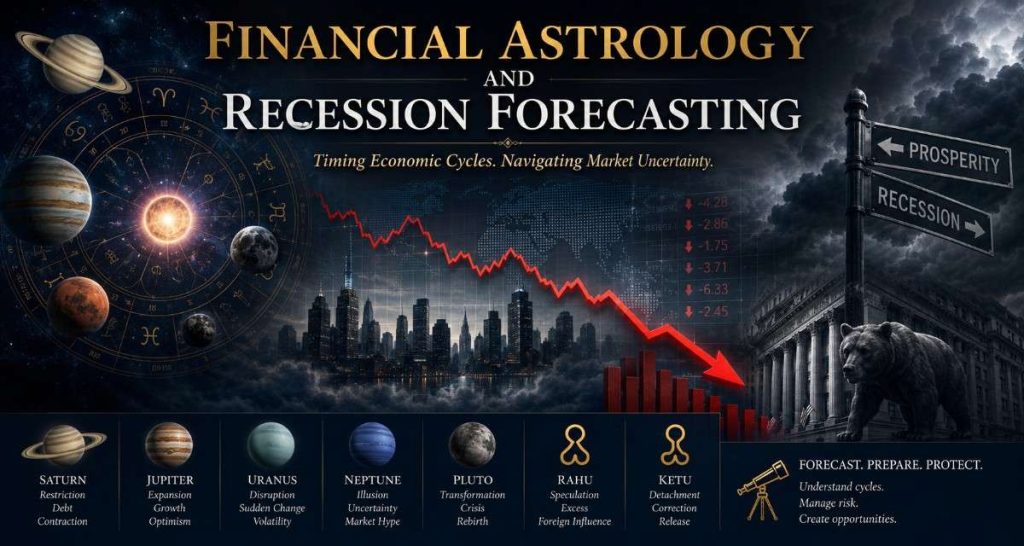
When these planetary forces align with weak economic conditions, financial astrology can help forecast risk windows. A risk window does not mean a guaranteed recession. It means the probability of economic stress, market volatility, policy uncertainty, or investor fear may rise. This is why Financial Astrology and Recession Forecasting should be used as a probability-based timing framework, not as a fixed prediction machine.
Why Recessions Are Difficult to Predict
Recessions are difficult to predict because economies move through many layers at the same time. A country may show strong employment numbers while corporate profits are already weakening. Inflation may look controlled while household debt rises. Stock markets may rally even when manufacturing activity slows. Central banks may cut rates after the damage has already started. Because of this, investors often recognize a recession only after markets have already reacted.
Traditional indicators such as yield curve inversion, unemployment claims, purchasing manager indexes, credit spreads, and corporate earnings revisions are useful. However, they often provide mixed signals. Sometimes the yield curve inverts long before a recession. Sometimes markets fall sharply without a formal recession. Sometimes governments and central banks delay the economic pain through stimulus. Therefore, investors need a broader framework that studies timing, psychology, and cycles together.
This is where financial astrology becomes useful. Planetary cycles are not used to replace hard data. They are used to understand when economic pressure may become more intense. For example, a period of strong Saturn influence may coincide with tighter credit, lower risk appetite, regulation, debt stress, or a reality check in overvalued markets. A difficult Jupiter cycle may show that optimism is fading or that growth expectations are being revised downward. A major Uranus cycle may coincide with sudden shocks in energy, technology, currency, or banking systems.
Recession forecasting becomes stronger when financial astrology is combined with macroeconomic data. If economic indicators already show weakness and planetary cycles also point toward pressure, the risk window becomes more important. If markets are overvalued, credit conditions are tight, and Saturn or Pluto cycles are active, investors may need to become more defensive. If the same period also shows volatile lunar patterns or eclipse activity near sensitive market points, short-term market swings may become sharper.
The Role of Saturn in Recession Forecasting
Saturn is one of the most important planets in Financial Astrology and Recession Forecasting. Saturn represents discipline, limits, contraction, debt, time, fear, responsibility, and structural weakness. In financial markets, Saturn often brings a reality check. It can expose overconfidence, excessive leverage, weak balance sheets, poor governance, and unsustainable growth stories.
During strong Saturn periods, markets may become less forgiving. Investors may stop rewarding promises and start demanding profits. Companies with weak cash flow may come under pressure. Highly leveraged businesses may struggle. Credit markets may tighten. Governments may face fiscal discipline. Consumers may reduce spending. This is why Saturn cycles are often watched carefully by financial astrologers during recession analysis.
Saturn does not always create a recession. In many cases, Saturn simply forces markets to become more realistic. A speculative sector may correct. A debt-heavy industry may struggle. A country with weak fiscal health may face pressure. However, when Saturn aligns with already weak economic conditions, the probability of recession risk can rise.
Saturn’s movement through important zodiac signs, its aspects to slower planets, and its relationship with market foundation charts can all provide clues. For example, when Saturn forms difficult angles with Jupiter, the market may shift from expansion to caution. When Saturn interacts strongly with Uranus, the economy may face tension between old systems and disruptive change. When Saturn connects with Pluto, markets may face deep structural transformation, debt pressure, or institutional stress.
For traders and investors, Saturn periods are not necessarily negative. They can create opportunities for disciplined buying, risk management, and long-term allocation. However, Saturn demands patience. It rewards investors who focus on quality, cash flow, valuation, and timing. It punishes emotional speculation and excessive leverage.
Financial Astrology and Recession Forecasting FAQs
Explore how planetary cycles, market psychology, macroeconomic pressure, and investor sentiment may help identify recession risk windows.
Financial astrology and recession forecasting is the study of planetary cycles, investor psychology, and economic timing patterns to understand possible market downturns. It does not replace traditional financial analysis. Instead, it adds a timing layer that may help investors identify periods of higher recession risk, market stress, and volatility.
Astrology should not be treated as a guaranteed recession prediction tool. However, financial astrology can highlight risk windows when economic pressure, investor fear, credit stress, or market corrections may become more likely. The best approach is to combine planetary cycle analysis with macroeconomic indicators such as interest rates, inflation, credit spreads, employment data, and stock market trends.
Saturn, Jupiter, Uranus, Neptune, Pluto, Rahu, and Ketu are often studied in financial astrology. Saturn is linked with contraction, debt, discipline, and economic pressure. Jupiter represents growth and liquidity. Uranus may indicate sudden shocks. Neptune can show confusion or market illusion. Pluto often represents deep structural change. Rahu and Ketu can highlight speculation, hype, detachment, and sharp reversals.
Saturn is one of the most important planets for recession forecasting because it represents restriction, fear, discipline, debt, and economic reality checks. Strong Saturn periods may coincide with tighter credit, slower growth, lower investor confidence, pressure on leveraged companies, and weakness in speculative assets.
Financial astrology can help investors prepare for periods of higher uncertainty. It may support better timing, portfolio protection, risk management, sector rotation, and emotional discipline. Investors may use it to identify when to reduce excessive risk, avoid speculation, monitor defensive assets, or prepare for long-term buying opportunities after market corrections.
Financial astrology can be useful for traders when it is used as a timing and sentiment tool. Traders may study planetary cycles, lunar phases, eclipses, and major transits to understand periods of possible volatility. However, it should be combined with technical analysis, price action, volume, risk management, and stop-loss discipline.
Economic forecasting studies data such as GDP, inflation, employment, interest rates, credit conditions, and corporate earnings. Financial astrology studies planetary cycles and market psychology to understand timing and sentiment shifts. A balanced recession forecast may use both methods together, where economic data confirms the pressure and astrology helps identify possible timing windows.
Financial astrology may help identify periods when fear is likely to peak and sentiment may begin to reverse. Market bottoms often occur when panic, liquidity stress, and negative expectations become extreme. Astrology can help study these emotional cycles, but confirmation should come from price action, volume, valuation, policy response, and improving macro signals.
Rahu and Ketu are important in Vedic financial astrology because they often represent speculative excess, sudden reversals, hype cycles, foreign influence, detachment, and unexpected market behavior. Rahu may show periods of obsession and market mania, while Ketu may indicate loss of interest, exits, corrections, and sharp changes in sentiment.
No. Investors should not rely only on astrology for recession forecasting. Financial astrology works best as an additional timing layer. It should be used with fundamental analysis, technical analysis, macroeconomic research, valuation study, liquidity analysis, and proper risk management. The goal is not blind prediction, but better preparation.
Jupiter, Growth Cycles, and Recession Risk
Jupiter is usually seen as a planet of growth, expansion, optimism, wealth, liquidity, and confidence. In market cycles, Jupiter often supports bullish sentiment, economic expansion, policy support, and investor appetite for risk. However, Jupiter can also create excess. When optimism becomes too strong, markets may enter bubble-like behavior. Investors may ignore risk. Companies may receive high valuations despite weak fundamentals. Credit may expand too quickly.
In Financial Astrology and Recession Forecasting, Jupiter is important because recessions often begin after a period of excess. When Jupiter’s positive influence weakens or forms difficult connections with Saturn, Neptune, Uranus, or Pluto, the market may start questioning previous growth assumptions. Investors may realize that earnings estimates were too optimistic. Consumers may pull back. Businesses may stop expanding aggressively. Capital may shift from growth assets to defensive assets.
A weak Jupiter cycle does not automatically mean recession. However, if Jupiter’s expansion is blocked by Saturn’s restriction, the economy may face slower growth. If Jupiter connects with Neptune in an unstable way, markets may struggle with unrealistic expectations, bubbles, or confusion. If Jupiter interacts with Uranus, investors may experience sudden optimism followed by sharp reversals. If Jupiter is under pressure during a period of high debt, inflation, or global uncertainty, recession risks can increase.
Jupiter also plays a key role in recovery. After a recession or market crash, Jupiter cycles may help restore confidence. Liquidity may return. Investors may become more willing to take risk. Governments may announce support. Businesses may begin planning expansion again. Therefore, Jupiter is useful not only for forecasting downturns but also for identifying recovery windows.
For institutional investors, Jupiter analysis can help understand whether markets are entering a phase of sustainable expansion or speculative overreach. If Jupiter supports broad growth and macro data confirms it, risk assets may perform well. If Jupiter shows excess while Saturn or Pluto warns of pressure, investors may need to prepare for a shift from optimism to caution.
Explore Rajeev Prakash Investor Tools
Use financial astrology, market timing insights, planetary cycle analysis, and recession risk windows to understand market sentiment with a deeper timing perspective.
Uranus and Sudden Economic Shocks
Uranus is linked with disruption, innovation, rebellion, shocks, technology, electricity, sudden change, and unexpected market movements. In recession forecasting, Uranus is important because many downturns are not smooth. They often involve sudden events that change investor perception quickly. Banking stress, currency shocks, energy price moves, geopolitical surprises, technology disruptions, and policy errors can all carry a Uranian signature.
When Uranus is active, markets may behave unpredictably. Traditional models may fail for a time. Investors may experience sharp rallies and sudden declines. Sectors connected to technology, electricity, artificial intelligence, digital assets, aerospace, defense, and innovation may become more volatile. At the same time, older industries may face disruption.
Uranus does not always indicate recession. In fact, Uranus can create powerful growth in innovative sectors. However, when Uranus interacts with Saturn, the conflict between old systems and new forces becomes stronger. This can create economic instability. Established business models may weaken. Regulations may lag behind innovation. Markets may struggle to price disruption correctly.
During recession risk periods, Uranus can act as a trigger. The economic system may already be fragile, but a sudden event can reveal the weakness. For example, a banking system may appear stable until liquidity dries up quickly. A currency may appear controlled until investors suddenly lose confidence. A technology stock may look unstoppable until valuation concerns create a sharp reversal.
For traders, Uranus periods require flexibility. Stop-loss discipline, position sizing, and diversified exposure become important. For long-term investors, Uranus can create both risk and opportunity. Recession periods linked with Uranus may damage old sectors but accelerate innovation in new sectors. This is why financial astrology should not only focus on fear. It should also identify where capital may rotate next.
Neptune, Market Illusion, and Economic Confusion
Neptune represents dreams, illusions, uncertainty, liquidity, imagination, deception, faith, and confusion. In financial markets, Neptune often appears during periods when investors struggle to separate reality from narrative. Bubbles, unclear accounting, unrealistic growth stories, excessive speculation, and policy confusion may carry a Neptunian quality.
In recession forecasting, Neptune is important because economic downturns often follow periods of illusion. Investors may believe that asset prices can rise forever. Consumers may assume credit will remain easy. Companies may project future growth that does not arrive. Governments may underestimate inflation or debt pressure. Markets may ignore risk because the story feels attractive.
When Neptune becomes difficult in a market cycle, clarity may disappear. Economic data may send mixed signals. Central banks may communicate uncertainty. Investors may debate whether inflation, recession, or stagflation is the greater risk. This confusion can create volatility because markets dislike uncertainty.
Neptune can also influence commodities, oil, gas, chemicals, shipping, pharmaceuticals, entertainment, and spiritual or imagination-led industries. During recession periods, Neptune may show where expectations were unrealistic. It may also indicate where investors seek safety through gold, defensive assets, or long-duration themes.
A strong Neptune influence in Financial Astrology and Recession Forecasting warns investors to question narratives. If a market rally depends only on hope and not on earnings, cash flow, or macro strength, Neptune may be active. If investors ignore risk because liquidity feels endless, Neptune may be creating illusion. If policy signals are unclear, Neptune may increase confusion.
The practical takeaway is simple. During Neptune-heavy periods, investors should verify everything. They should avoid blind belief in market stories. They should study balance sheets, cash flow, debt, and valuation. Financial astrology can help identify when illusion is high, but traditional analysis helps confirm what is real.
Pluto and Structural Economic Transformation
Pluto represents deep transformation, crisis, power, destruction, rebirth, hidden forces, debt, control, and systemic change. In financial astrology, Pluto is often linked with major shifts that reshape economies, industries, and institutions. Pluto cycles are slow and powerful. They may not create immediate market moves every day, but they can define the deeper background of an era.
In recession forecasting, Pluto becomes important when the economy faces structural problems. These may include excessive debt, banking weakness, geopolitical tension, energy transition, currency pressure, technological displacement, or institutional distrust. Pluto does not usually describe a small correction. It points to deeper transformation.
When Pluto is active, weak systems may break down. Old leaders may lose power. New industries may rise. Regulation may become stronger. Capital may move from one global center to another. Investors may become aware of risks that were hidden for years. This is why Pluto cycles are important for family offices, hedge funds, and long-term asset allocators.
A Pluto recession is not only about falling GDP. It is about the transformation of the financial system itself. The market may reprice debt, currencies, commodities, defense, technology, energy, and financial institutions. In such periods, investors should not only ask whether markets will fall. They should ask which structures will survive and which structures will change.
Pluto also teaches that crisis can create opportunity. After deep corrections, strong assets may become available at better prices. New leadership may emerge. Capital may flow into sectors that benefit from restructuring. Investors who understand Pluto cycles may prepare for both defense and future accumulation.
Rahu, Ketu, and Speculative Recession Signals
In Vedic financial astrology, Rahu and Ketu are extremely important for understanding speculation, sudden reversals, and market psychology. Rahu represents hunger, obsession, foreign influence, technology, illusion, ambition, and unusual growth. Ketu represents detachment, separation, exits, correction, and loss of interest.
Rahu periods may create speculative manias. Investors may chase artificial intelligence themes, crypto assets, meme stocks, foreign capital flows, high-growth technology, or unusual market stories. Rahu does not care about moderation. It amplifies desire. In markets, this can create rallies that feel unstoppable. However, Rahu-driven rallies may become unstable when fundamentals do not support prices.
Ketu often appears when the crowd loses interest. A sector that was loved may suddenly feel empty. Capital may leave quickly. Investors may detach from the same story they once believed deeply. This can create sharp corrections, especially after Rahu has pushed prices too far.
In Financial Astrology and Recession Forecasting, Rahu and Ketu can help identify speculative excess before economic weakness becomes visible. If markets are highly speculative while credit conditions are tightening, recession risk may be rising below the surface. If Rahu amplifies technology or foreign capital inflows while Saturn shows restriction, the market may experience a painful adjustment later.
Rahu and Ketu are also important in global markets because they often connect with sudden changes in sentiment. They can influence currency flows, emerging markets, commodities, crypto assets, and high-beta stocks. For investors, their message is clear. When speculation becomes extreme, do not assume the trend will last forever. When detachment begins, respect the possibility of a faster correction.
Lunar Cycles, Eclipses, and Short-Term Volatility
While slow-moving planets help identify long-term recession risk, lunar cycles can help track short-term sentiment. The Moon reflects emotion, liquidity, public mood, and immediate market response. New Moons, Full Moons, and eclipses can coincide with emotional turning points, volatility spikes, or changes in investor behavior.
Eclipses are especially important because they often intensify uncertainty. They may not cause recessions by themselves, but they can activate existing stress. If an eclipse occurs during a fragile macro period, markets may react sharply to news. Investors may become more emotional. Political, financial, or geopolitical events may gain greater importance.
In recession forecasting, lunar cycles are useful for timing rather than diagnosis. They help identify when market fear or hope may become more visible. For example, if a long-term Saturn or Pluto cycle suggests economic pressure, lunar triggers may show when volatility could accelerate. Traders may use this information to manage entries, exits, hedges, and exposure.
The Moon also matters because recessions are deeply emotional. People reduce spending because they feel uncertain. Investors sell because they fear losses. Businesses pause hiring because they sense risk. The Moon helps financial astrologers study this emotional rhythm.
Combining Financial Astrology with Economic Indicators
Financial Astrology and Recession Forecasting works best when it is combined with traditional financial analysis. Astrology can identify timing windows, but economic data confirms whether the risk is real. A responsible forecasting model should study both.
Yield curves can show whether bond markets expect slower growth. Credit spreads can show whether lenders demand higher compensation for risk. Unemployment trends can reveal pressure in the labor market. Consumer confidence can show whether households are becoming cautious. Corporate earnings can reveal whether profit margins are shrinking. Manufacturing and services data can show whether business activity is weakening.
When these indicators weaken during difficult planetary cycles, recession probability rises. For example, if Saturn indicates restriction and credit spreads widen, the signal becomes stronger. If Pluto suggests structural stress and banks reduce lending, the risk becomes more serious. If Neptune shows confusion and policy communication becomes unclear, market volatility may increase. If Rahu has created speculative excess and Ketu begins to show detachment, high-risk assets may correct faster.
This combined approach helps investors avoid blind prediction. It also protects them from overreacting to astrology alone. A difficult planetary cycle may simply create volatility without recession if economic conditions remain strong. Similarly, weak economic data may recover if Jupiter cycles and policy support improve sentiment. The strongest forecasts come when astrology and data point in the same direction.
How Investors Can Use Recession Forecasting
Investors can use recession forecasting to improve timing, risk management, and portfolio strategy. The goal is not to predict every market movement. The goal is to prepare for periods when risk may rise and opportunity may follow.
During high-risk recession windows, investors may reduce exposure to overvalued or highly leveraged assets. They may review cash levels, hedge portfolios, rotate toward defensive sectors, and avoid emotional buying during speculative rallies. They may focus on balance sheet strength, dividend quality, pricing power, and essential industries.
Recession forecasting can also help investors avoid panic. If a downturn has been anticipated through cycle analysis, investors can respond calmly. They can distinguish between temporary volatility and deeper structural stress. They can also prepare a buying plan for strong assets that may become attractive during market corrections.
For family offices and institutional funds, Financial Astrology and Recession Forecasting can become a market timing layer. It can support macro allocation, risk windows, sector rotation, and capital preservation. It does not replace investment committees, research teams, or risk models. Instead, it adds a time-cycle perspective that many traditional models ignore.
This is especially useful in a world where markets react quickly to central bank policy, inflation data, geopolitical risk, technology disruption, and liquidity changes. A timing framework helps investors ask better questions before the crowd reacts.
Sector Behavior During Recession Risk Windows
Different sectors respond differently during recession risk windows. Financial astrology can help study which sectors may face pressure and which may show relative strength.
During Saturn-heavy periods, debt-sensitive sectors may struggle. Real estate, highly leveraged companies, speculative technology, and weak consumer businesses may face pressure. Investors may prefer quality, cash flow, and defensive assets. During Uranus-heavy periods, technology, electricity, innovation, and digital infrastructure may become volatile but also offer long-term opportunity. During Neptune-heavy periods, oil, gas, shipping, pharmaceuticals, and liquidity-sensitive assets may experience confusion or narrative-driven moves. During Pluto-heavy periods, defense, energy, banking, commodities, and strategic industries may go through deep repricing.
Gold and precious metals often become important during recession fear, currency uncertainty, or declining trust in policy. However, gold also depends on real interest rates, the dollar, central bank demand, and liquidity conditions. Financial astrology can help time sentiment shifts, but investors must still study macro drivers.
Crypto assets may behave differently. In some periods, Bitcoin may act like a speculative risk asset. In other periods, it may attract investors looking for alternatives to traditional finance. Rahu, Uranus, and lunar cycles may be especially important for crypto volatility. However, crypto remains highly sensitive to liquidity, regulation, and investor risk appetite.
Why Timing Matters More Than Prediction
The biggest value of Financial Astrology and Recession Forecasting is timing. Many investors know that markets move in cycles, but they struggle to know when risk is likely to rise. They may understand that debt is high or valuations are stretched, but the market can continue rising for months or years. Timing helps bridge the gap between awareness and action.
Financial astrology does not need to claim perfect prediction to be useful. Even traditional economists cannot forecast recessions with perfect accuracy. What matters is whether the framework helps investors prepare earlier, manage exposure better, and avoid emotional decisions.
A timing model can identify periods when investors should become more alert. It can highlight when speculative markets may be vulnerable. It can show when fear may peak and when recovery may begin. It can help traders plan around volatility rather than react after the move.
This is why RajeevPrakash.com focuses on financial astrology as a practical market timing discipline. The purpose is not sensational prediction. The purpose is better preparation, better risk control, and better understanding of market psychology.
The Rajeev Prakash Approach to Recession Forecasting
Rajeev Prakash’s approach to financial astrology focuses on the connection between planetary cycles, financial history, investor sentiment, and market timing. The method studies broad market cycles first, then moves toward asset classes, sectors, and specific timing windows. This approach is useful because recessions are rarely caused by one factor. They emerge from the interaction of credit, confidence, policy, liquidity, valuation, and psychology.
A strong recession forecasting model should study planetary transits, historical market behavior, macroeconomic indicators, sector rotation, and risk appetite together. It should avoid fear-based claims. It should focus on probabilities. It should clearly separate long-term cycle pressure from short-term trading signals.
For investors, this creates a more disciplined way to think about uncertainty. Instead of asking whether a recession will happen tomorrow, they can ask whether the next few months show rising pressure. Instead of reacting to headlines, they can study whether market behavior confirms the cycle. Instead of chasing every rally, they can check whether the rally has support from both astrology and economic data.
This is where financial astrology becomes a professional tool. It helps investors watch time, sentiment, and risk together.
Practical Takeaways for Traders and Investors
Financial Astrology and Recession Forecasting can help traders and investors in several important ways. It can highlight periods of rising caution before market stress becomes obvious. It can support risk management during uncertain macro phases. It can help identify when speculative optimism may be turning into fear. It can also help investors prepare for recovery after a difficult period.
However, the method should always remain balanced. Astrology should not be used as a standalone reason to buy or sell. It should work with technical analysis, macro data, valuation, liquidity conditions, and portfolio strategy. The strongest insights come when multiple signals agree.
Investors should also remember that recession forecasting is not about fear. It is about preparation. Recessions create pain, but they also create opportunity. High-quality assets often become available at better valuations. Weak businesses get exposed, while strong businesses gain market share. Capital moves from overhyped sectors to durable themes. Investors who prepare in advance can act with more confidence.
Conclusion: Using Financial Astrology to Read Recession Risk
Financial Astrology and Recession Forecasting offers a unique way to understand economic cycles, investor psychology, and market timing. It studies the deeper rhythm behind fear, greed, expansion, contraction, speculation, and correction. Saturn shows restriction and discipline. Jupiter shows growth and confidence. Uranus brings disruption. Neptune creates illusion and uncertainty. Pluto reveals structural transformation. Rahu and Ketu explain speculative manias and sudden detachment. Lunar cycles help track short-term emotion and volatility.
When these astrological signals align with weak economic data, recession risk becomes more meaningful. When they conflict, investors should remain patient and study confirmation. This balanced approach makes financial astrology more practical, more responsible, and more useful for modern investors.