

Financial astrology does not replace earnings, rates, liquidity, and geopolitics. What it does well is highlight timing windows when crowd psychology tends to swing harder than usual. In market language, that means volatility clusters, narrative pivots, sudden rotations, and those moments when “the same news” starts producing a totally different price reaction.
The backbone of 2026 is a rare combination: structural planets changing signs, a tight eclipse calendar, and money-planets shifting into more sentiment-driven territory. When outer planets shift, the market often re-prices the future, not the present. When eclipses land, markets tend to react to what was hidden, delayed, or underestimated. Put them together and you get a year where trend-following can work beautifully in certain quarters and then suddenly whipsaw when the story flips.
A practical way to use this is to treat 2026 as a year of phases. Each phase has its own “market personality,” and your job as an investor is to align position sizing, holding period, and sector focus with the phase you’re in, rather than forcing one style all year.
The 2026 Astro Map Investors Should Keep in Mind
The Eclipse Spine of 2026: Four High-Impact Windows
Eclipses are classic market “timers” because they correlate with visibility events. In trading terms, eclipses often behave like catalysts: information surfaces, leadership changes, policy statements land, or risk appetite shifts.
2026 has four eclipses, and they form a clean rhythm for major inflection points: an annular solar eclipse on February 17, a total lunar eclipse on March 2–3, a total solar eclipse on August 12, and a partial lunar eclipse on August 27–28.
You don’t need to believe eclipses “cause” anything to use them. Instead, treat them as historically useful “attention magnets,” where markets are more likely to reprice narratives quickly. This is especially relevant for indices, high-beta tech, momentum baskets, and anything driven by flows and sentiment.
Saturn Enters Aries: The Discipline Cycle Becomes More Direct
Saturn’s move into Aries is one of the big structural signals of 2026. Western astrology sources commonly place Saturn in Aries from mid-February 2026 through April 2028 (with retrograde periods inside).
In market terms, Saturn in Aries frequently coincides with “hard choices” and leadership tests: stronger emphasis on defense budgets, infrastructure discipline, industrial reshoring narratives, and a market preference for companies that can execute in tough conditions. Aries is initiation energy, so Saturn here tends to reward focused action and punish sloppy risk-taking. This can show up as stricter regulation, higher standards from investors, and more unforgiving price action around guidance.
If 2025 was about optimism and broad narratives, Saturn-in-Aries years often ask, “Show me the numbers, show me execution, show me cash flows.”
Uranus Enters Gemini: Tech, Media, AI, and Markets Move Faster Than Comfort
Uranus’ entry into Gemini (late April 2026 for the longer stretch) is another major signature of 2026. Multiple astrology calendars place Uranus’ main Gemini transit beginning around April 25–26, 2026.
Gemini rules information, trading, networks, messaging, and distribution. Uranus rules disruption, shocks, breakthroughs, and sudden reversals. Put them together and you get a market environment where information cycles accelerate, narratives flip faster, and “communication infrastructure” becomes a battlefield. This is a classic signature for explosive innovation in AI tooling, chips, cloud, cybersecurity, telecom, satellite networks, and also the financial plumbing behind markets such as exchanges, market data, payment rails, and broker tech.
It can also correlate with higher frequency of rumor-driven volatility, sharper reactions to central bank messaging, and more dramatic sector rotations. Investors can benefit here by shortening feedback loops: tighter risk controls, clearer invalidation levels, and a greater willingness to rebalance rather than marry a thesis.
Jupiter Shifts Into Cancer, Then Leo: From Safety-Seeking to Risk-On Theater
In Vedic (Jyotish) tradition, Jupiter (Guru) is the planet of expansion, liquidity sentiment, and “growth narratives.” Jupiter’s sign changes matter for the emotional tone of markets.
Jupiter is commonly listed as entering Cancer on June 2, 2026, then moving into Leo around October 31, 2026.
Cancer is protective, domestic, and security-driven. In market language, Jupiter in Cancer can boost themes tied to households and stability: housing-linked ecosystems, consumer staples, food and agriculture narratives, utilities, water, and “safe” cashflow stories. It can also lift gold sentiment when combined with risk-off macro, because Cancer energy often increases the desire to preserve wealth rather than chase it.
Leo, by contrast, is more speculative, leadership-driven, and performative. Jupiter in Leo can coincide with stronger momentum phases, bigger story-stocks, more appetite for mega-cap leadership, and bolder risk-taking. If the macro backdrop permits, late 2026 can feel more “risk-on,” but with Uranus in Gemini, it can be a faster, more selective risk-on rather than a calm, broad rally.
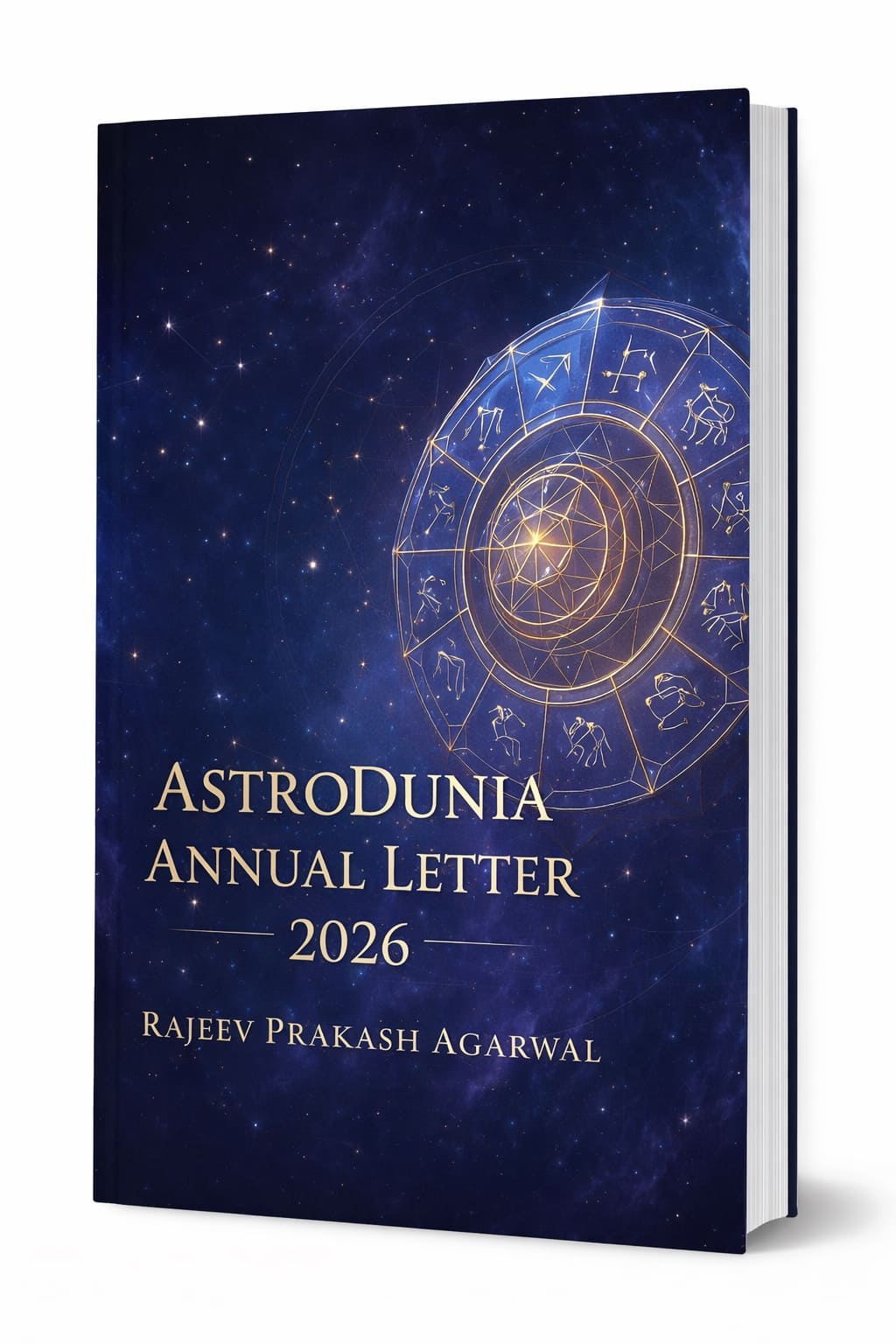
Annual Letter 2026 by Rajeev Prakash Agarwal
The Annual Letter 2026 presents a forward-looking strategic perspective crafted for investors, market professionals, and decision-makers who must operate within an increasingly complex and evolving global financial system.
Rather than offering short-term trade ideas or headline-driven forecasts, this letter serves as a long-horizon roadmap. Its purpose is to clarify how 2026 is likely to redefine risk management, opportunity identification, regulatory dynamics, and long-term wealth formation.Each section emphasizes timing, probability, and downside protection, enabling readers to anticipate major transitions in market behavior and positioning well before they become obvious to the broader crowd.
Timing Major Market Moves in 2026: The Phase-by-Phase Outlook
Phase 1: Late January to Mid-March 2026
Volatility Builds Into the February 17 Solar Eclipse and the March 2–3 Total Lunar Eclipse
The first major timing cluster is the February 17 annular solar eclipse and the March 2–3 total lunar eclipse.
This window often correlates with sentiment re-pricing. Solar eclipses tend to feel like “new storyline” events, while lunar eclipses can feel like “results, revelations, or consequences.” When they arrive back-to-back, markets can move from speculation to confirmation quickly. If investors entered the year with strong expectations, this period can expose which narratives are actually delivering.
From a portfolio standpoint, this is a phase where it’s wise to respect gap risk and headline risk. If you are holding high-beta positions, consider whether your thesis is time-sensitive. If it depends on “perfect conditions,” this is the kind of window where the market stress-tests that assumption.
This is also a period where macro messaging matters more than usual. Watch for central bank tone shifts, inflation surprises, energy price moves, and geopolitical developments. Uranus is still close enough to its sign transition buildup that markets can overreact to “future tech” headlines even before the big Gemini entry later.
Phase 2: Mid-February through May 2026
Saturn in Aries Settles In, Then Uranus Moves Into Gemini
With Saturn entering Aries in mid-February 2026, the market’s tolerance for low-quality growth and weak execution can diminish. This is a constructive backdrop for disciplined capital allocation stories and a tougher environment for companies that rely on endless funding or optimistic forward promises.
Then, in late April, Uranus’ entry into Gemini can flip the “speed” of markets. Expect a more news-reactive environment and stronger differentiation within sectors. For example, “AI” as a broad theme may stop moving together, and the market can start paying for specific moats: proprietary distribution, defensible data, specialized hardware advantages, or unusually strong unit economics.
This phase often rewards investors who do two things well: first, they identify which stories are genuinely scaling; second, they avoid overexposure to crowded positioning. When Uranus is active, the crowd can be right about the direction and still lose money on timing because of violent pullbacks.
Phase 3: June to Early August 2026
Jupiter in Cancer: The Market Leans Toward Protection, Quality, and the “Home Economy”
Jupiter’s move into Cancer on June 2, 2026 often marks a change in tone. Cancer is a sign linked to security, shelter, and domestic stability. In markets, this can coincide with a preference for businesses that feel essential: food supply chains, consumer staples, utilities, water-related infrastructure, healthcare services, and quality dividend narratives when rates and growth uncertainty remain themes.
This can also be a phase where gold and defensive commodities behave better, especially if macro stress is present. If inflation cools but growth remains uncertain, the market may rotate toward “durable demand” rather than “dream growth.” Jupiter in Cancer is also associated with real estate cycles in some financial astrology frameworks, so housing-linked equities and rate-sensitive sectors can react strongly to policy signals.
Importantly, this phase can still produce powerful rallies, but they may be more selective. The winners can be the companies that make investors feel safe, not just excited.
Phase 4: Early August to Early September 2026
The August 12 Total Solar Eclipse and the August 27–28 Lunar Eclipse: A Second Major Repricing Window
The second big inflection cluster is the August 12 total solar eclipse, followed by the August 27–28 partial lunar eclipse. This is the kind of alignment that often corresponds with “big pivot” behavior: leadership rotation in indices, new policy direction, a change in recession expectations, or an abrupt shift in global risk sentiment.
Astronomy calendars highlight August 12, 2026 as a significant total solar eclipse visible across parts of Europe and beyond, which is one reason it draws global attention. Market-wise, attention clusters can matter because the same period often concentrates major announcements, conferences, and geopolitical decision points.
In practical trading terms, this window frequently produces breakouts or breakdowns that look obvious only in hindsight. If you want a clean “timing major market moves” approach, treat August as a month to reduce overconfidence. Let the market show its hand. If leadership changes, follow the leadership rather than arguing with it.
Phase 5: October to December 2026
Venus Retrograde, Jupiter Into Leo: Valuation Debates Return, Then Momentum Hunts for a New King
In late 2026, two dynamics matter. Venus retrograde in October–mid November is widely listed as beginning on October 3, 2026 and ending around November 13, 2026 (timings vary slightly by system, but the window is consistent). Venus rules money, valuation, comfort, and “what something is worth.” When Venus is retrograde, markets often revisit pricing assumptions. This can show up as sudden value rotations, sharp reversals in luxury and discretionary themes, or a re-rating of high-multiple growth as investors question what they’re paying for.
Then Jupiter’s move into Leo around October 31, 2026 can tilt the mood back toward boldness and leadership narratives, provided liquidity and macro conditions cooperate. Leo wants a champion. In equity markets, that often translates into leadership concentration: a handful of names or a single theme captures flows and attention. With Uranus in Gemini, this could be a new wave in AI platforms, semiconductor cycles, quantum-adjacent narratives, media distribution shifts, or financial infrastructure innovations.
Late 2026 can therefore feel like a tug-of-war. Venus retrograde questions valuations while Jupiter in Leo tries to crown a winner. If you see strong rallies that become unstable, it may be that the market wants leadership but is still negotiating price.
Sector Tendencies for 2026 Through an Astrology Lens
Technology, AI, Semiconductors, Telecom, Cybersecurity
Uranus in Gemini is the loudest signature for these sectors. Expect innovation, but also sudden shocks. Winners can change quickly. The most consistent advantage usually belongs to firms with distribution, switching costs, and balance sheet strength, because Saturn-in-Aries punishes fragility.
Energy, Industrials, Defense, Infrastructure
Saturn in Aries often supports themes linked to security and decisive action. This does not guarantee a straight-line bull run, but it can keep policy attention on strategic autonomy, supply chains, and infrastructure resilience.
Healthcare, Staples, Utilities, Water, Agriculture
Jupiter in Cancer can provide tailwinds for “protective economy” themes from June into late October. If macro uncertainty rises, these areas can act as relative shelters.
Financials, Payments, Exchanges
Uranus in Gemini can accelerate structural changes in how markets trade and settle. Watch for regulation headlines and technological breakthroughs that reshape fee pools or risk models. This can be a year where select financial infrastructure firms outperform even when traditional banks move sideways.
Gold and Defensive Alternatives
Gold tends to react to macro reality first, and astrology second. Still, the June–October Jupiter-in-Cancer window can align with stronger “wealth protection” psychology, especially if recession fears or geopolitical risks flare.
A Simple Timing Framework You Can Apply All Year
Use Eclipses as “Decision Windows,” Not Prediction Anchors
In 2026, the clearest timing windows are around February 17, March 2–3, August 12, and August 27–28. Instead of trying to predict the exact direction, use them to tighten process. Reduce leverage, respect stops, hedge if needed, and be ready to rebalance after the dust settles.
Watch for Leadership Rotation Around Late April and Early June
Uranus into Gemini (late April) and Jupiter into Cancer (June 2) are classic rotation triggers. If your portfolio depends on one theme, this is when you check whether leadership is changing under your feet.
Treat October to Mid-November as a Valuation Reality Check
Venus retrograde from early October to mid-November is a recurring “repricing” signature. In investing terms, it’s a good period to avoid overpaying, avoid impulsive entries, and reassess what you own versus why you own it.
Key 2026 Astrology Dates for Investors to Mark on a Market Calendar
If you want a clean market calendar, start with the eclipse dates because they are the highest-signal timing points. The 2026 eclipse set is February 17 (annular solar), March 2–3 (total lunar), August 12 (total solar), and August 27–28 (partial lunar).
Next, add the regime-change transits that shift the market’s personality: Saturn’s entry into Aries in mid-February 2026, Uranus’ entry into Gemini in late April 2026, and Jupiter’s entry into Cancer on June 2, 2026 followed by Jupiter’s move into Leo around October 31, 2026.
Finally, for valuation and sentiment resets, include Venus retrograde from October 3 to about November 13, 2026.
With just these dates, you already have a strong “timing map” for potential major market moves.
Investment Outlook for 2026: A Probability-Based Summary
2026 looks less like a smooth trend year and more like a rotation-and-repricing year. The probability of sharp, news-driven swings increases after late April as Uranus enters Gemini. The probability of the market rewarding discipline, execution, and strategic clarity increases with Saturn in Aries. The probability of defensive themes gaining relative strength rises from June into late October with Jupiter in Cancer, and the probability of momentum leadership returning rises after Jupiter shifts into Leo at the end of October, assuming macro conditions allow risk appetite to expand.
The two biggest timing clusters, where major moves are most likely to begin or reverse, remain the eclipse pairs in February–early March and August.
A Grounded Closing Note for Serious Investors
Financial astrology works best when it sharpens timing discipline rather than feeding certainty. If you combine these 2026 timing windows with real signals like earnings breadth, liquidity, credit spreads, inflation trend, and policy direction, you get a practical edge: you become early to risk management and faster to adapt when leadership changes.
Financial Astrology Predictions for 2026 FAQs
Explore common questions about 2026 financial astrology, eclipse timing, Saturn in Aries, Uranus in Gemini, Jupiter cycles, sector rotation, and major market move windows.
Financial astrology predictions for 2026 study planetary cycles, eclipses, and major sign changes to identify possible market timing windows, volatility clusters, sector rotation, and sentiment shifts. They do not replace earnings, interest rates, liquidity, macro data, or risk management, but they can help investors prepare for periods when crowd psychology may swing more sharply.
The key 2026 eclipse dates for investors are February 17, March 2–3, August 12, and August 27–28. These windows may act as market attention points where narratives can shift, leadership can rotate, and volatility may increase. Traders should treat them as decision and risk-control windows, not guaranteed directional signals.
Saturn in Aries can bring a stronger focus on discipline, execution, leadership tests, regulation, and hard choices. In market terms, it may reward companies with strong cash flows, clear strategy, and operational strength while punishing weak execution, excessive leverage, and low-quality growth stories.
Uranus in Gemini is important because Gemini is linked with information, trading, networks, communication, and distribution, while Uranus represents disruption, speed, shocks, and breakthroughs. This combination can increase volatility in technology, AI, chips, cybersecurity, telecom, broker technology, market data, and financial infrastructure themes.
Technology, AI, semiconductors, telecom, cybersecurity, energy, defense, infrastructure, healthcare, staples, utilities, water, agriculture, financial infrastructure, and gold may all see important phases in 2026. However, sector leadership may rotate during the year, so investors should track both planetary timing and real market signals such as earnings, liquidity, credit spreads, and price strength.