
Commodity markets move with emotion, liquidity, scarcity, geopolitics, inflation expectations, currency trends, and investor psychology. Gold rises when fear enters the market. Crude oil reacts to supply pressure, war risk, production decisions, and global demand. Silver often behaves like both a precious metal and an industrial commodity. Copper responds to growth expectations. Agricultural commodities respond to weather, seasonal cycles, trade flows, and policy changes. Yet behind all these visible factors, financial astrology studies one deeper question: is there a timing rhythm behind commodity price movement?
Financial astrology for gold, crude oil, and commodities does not replace technical analysis, macro research, or risk management. Instead, it adds a timing layer. It studies how planetary transits, lunar cycles, eclipses, retrogrades, solar activity, and long-term planetary alignments may coincide with changes in market sentiment. Commodity markets are especially suitable for this approach because they are deeply connected with natural cycles, human fear, inflation psychology, war risk, weather patterns, and global liquidity.
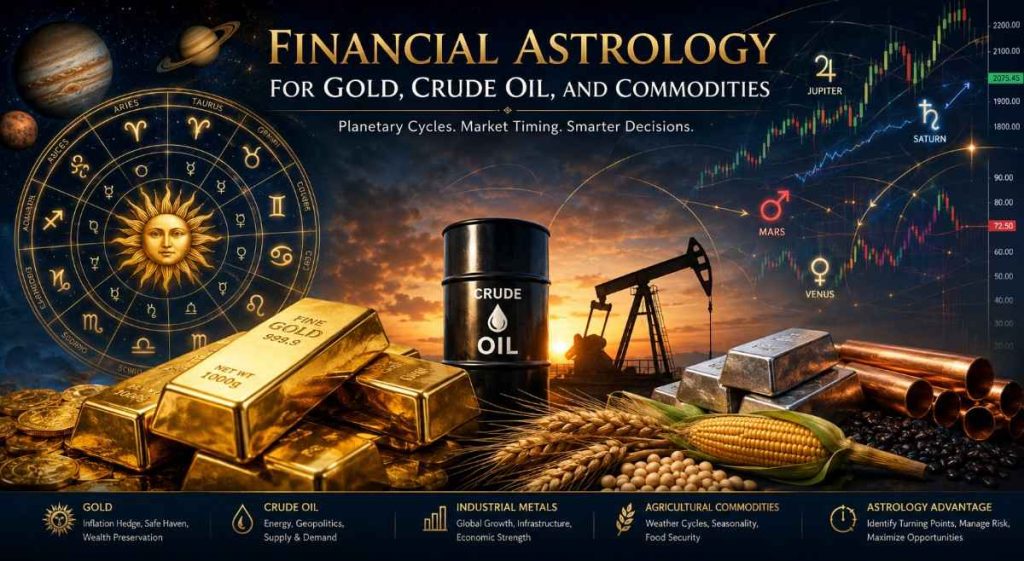
Gold, crude oil, silver, natural gas, copper, wheat, sugar, and other commodities often move sharply when sentiment changes. A trader may understand the fundamental story, but still enter too early or exit too late. This is where financial astrology becomes useful. It helps traders identify possible volatility windows, reversal periods, trend acceleration zones, and periods when risk should be reduced. It is not about making blind predictions. It is about improving timing awareness.
For traders, investors, wealth managers, and market researchers, financial astrology offers a unique way to study commodities beyond price charts. It connects market cycles with planetary timing. When used carefully, it can help create a more disciplined approach to commodity trading.
Why Commodities Respond Strongly to Cycles
Commodities are different from ordinary stocks. A company stock depends on earnings, valuation, management quality, competition, and investor confidence. Commodities depend more directly on global supply and demand. They also respond to seasonal patterns, weather cycles, shipping conditions, currency trends, interest rates, and political tension.
Gold is connected with monetary fear, central bank reserves, inflation protection, and safe-haven demand. Crude oil is connected with energy demand, transport, war risk, OPEC policy, and industrial activity. Silver connects precious metal sentiment with industrial demand. Copper is often treated as a signal of global growth. Agricultural commodities carry strong links with nature, rainfall, drought, harvest cycles, and food inflation.
Because commodities already move in cycles, financial astrology can add an interesting perspective. Astrology itself is based on cycles. The Moon completes its zodiac cycle every month. Mercury retrograde occurs several times a year. Venus and Mars influence sentiment cycles over shorter and medium-term periods. Jupiter and Saturn create larger economic and inflation cycles. Uranus, Neptune, and Pluto influence long-term structural changes in energy, currency systems, and global power.
When these planetary cycles align with strong technical levels or important macro events, commodity markets can become more sensitive. Traders who understand these timing windows can prepare better instead of reacting emotionally after the move has already started.
Gold and Financial Astrology
Gold is one of the most important assets in financial astrology. Traditionally, gold is associated with the Sun. The Sun represents authority, power, wealth, confidence, leadership, status, and central control. In financial markets, gold often becomes stronger when trust in paper assets weakens. It also becomes attractive when inflation rises, currency confidence declines, or investors seek safety.
Astrologically, gold is often studied through the position of the Sun, Jupiter, Saturn, lunar phases, eclipses, and major outer planet transits. The Sun gives gold its symbolic connection with wealth and value. Jupiter can expand demand, optimism, inflation expectations, and speculative interest. Saturn can bring fear, contraction, scarcity, and defensive positioning. Eclipses can bring sudden changes in sentiment. Lunar cycles can influence short-term volatility and emotional trading behavior.
Gold is not only a metal. It is a psychological asset. It reflects confidence in governments, currencies, banks, and global stability. When uncertainty rises, gold often attracts attention. From an astrological point of view, periods involving strong Saturn, Mars, Rahu, Ketu, or eclipse influence may increase defensive behavior in markets. During such periods, traders often watch gold closely because fear-driven buying can appear suddenly.
Financial astrology for gold price timing focuses on identifying the periods when market emotion may intensify. A gold trader may already know that inflation data, central bank policy, bond yields, and the U.S. dollar matter. Astrology adds another layer by asking when these themes may become more active in market psychology. The best results come when planetary timing, technical support or resistance, macro data, and price momentum point in the same direction.
Crude Oil and Financial Astrology
Crude oil is one of the most politically sensitive commodities in the world. It is linked with energy security, inflation, transport costs, industrial demand, war risk, and economic growth. Oil prices can move sharply because supply disruption or geopolitical tension can change the market mood almost overnight.
In astrology, crude oil is often associated with Mars, Saturn, Neptune, and Pluto. Mars represents energy, conflict, fire, aggression, machinery, and action. Saturn represents scarcity, pressure, restriction, and infrastructure. Neptune has symbolic links with liquids, oceans, oil, gas, chemicals, and invisible forces. Pluto is connected with underground resources, extraction, power, crisis, and transformation.
When Mars becomes highly active through difficult aspects, crude oil may become more volatile, especially if geopolitical news is already tense. Saturn can point toward supply constraints, production discipline, or pressure on energy systems. Neptune can reflect confusion, speculation, hidden supply issues, or uncertainty in oil markets. Pluto can bring major shifts in control, resource politics, and long-term energy transformation.
Financial astrology for crude oil does not claim that one planetary transit alone will move prices. Instead, it studies how planetary pressure may align with existing market conditions. If oil inventories are tight, geopolitical tension is high, and Mars or Pluto themes become active, traders may prepare for a higher-risk window. If demand is weakening and Saturn signals contraction, crude oil may face pressure.
For crude oil traders, timing is everything. A strong idea can fail if entered at the wrong moment. Astrology can help identify periods when crude oil may break out, reverse, or become unstable. Used together with inventory data, demand trends, OPEC decisions, moving averages, and support-resistance levels, it can become a valuable timing tool.
Silver, Copper, and Industrial Commodities
Silver has a unique nature. It behaves like a precious metal during fear cycles, but it also behaves like an industrial commodity during growth cycles. In astrology, silver is commonly linked with the Moon because the Moon represents emotion, liquidity, reflection, and changing sentiment. Silver prices often move faster than gold because the market is smaller and more volatile.
The Moon’s cycle can be useful for short-term silver timing. Full Moon and New Moon periods may coincide with emotional extremes, increased volatility, or short-term turning points. However, traders should not treat lunar phases as automatic signals. They should study them along with trend direction, volume, momentum, and macro triggers.
Copper is often tied to industrial growth and global demand. It reflects manufacturing strength, construction activity, infrastructure spending, and economic confidence. Astrologically, copper may be studied through Venus, Mars, Jupiter, and Saturn. Venus connects with metals and value. Mars connects with industrial energy and construction. Jupiter expands demand and economic optimism. Saturn can indicate slowing growth, restriction, or pressure on industrial demand.
Industrial commodities often move with the global economic cycle. When Jupiter themes are supportive and risk appetite improves, metals like copper may attract stronger demand. When Saturn pressure dominates, markets may worry about recession, weaker construction, or lower industrial consumption. Financial astrology can help investors observe when growth-sensitive commodities may be entering a favorable or difficult period.
FAQs on Financial Astrology for Gold, Crude Oil, and Commodities
Explore how planetary cycles, lunar phases, eclipses, and market psychology may help traders understand timing windows in gold, crude oil, silver, and other commodity markets.
Financial astrology for commodities is the study of how planetary cycles, lunar phases, eclipses, and astrological timing windows may coincide with price movements in gold, crude oil, silver, copper, agricultural products, and other commodities. It does not guarantee future prices. Instead, it acts as a timing layer that traders can combine with technical analysis, macroeconomic data, supply-demand trends, and risk management.
Astrology can help identify possible timing windows for gold volatility, trend changes, and sentiment shifts. However, it should not be used as a standalone prediction system. Gold prices are also influenced by inflation, central bank policy, interest rates, the U.S. dollar, geopolitical risk, and investor demand. Financial astrology works best when it supports broader market analysis.
Gold is mainly connected with the Sun in astrology. The Sun represents wealth, authority, confidence, power, and central control. Astrologers also study Jupiter for expansion and inflation, Saturn for fear and scarcity, and eclipses for sudden shifts in sentiment when analyzing gold price movements.
Crude oil is often studied through Mars, Saturn, Neptune, and Pluto. Mars represents energy, conflict, aggression, and volatility. Saturn represents scarcity, restriction, and supply pressure. Neptune is associated with oil, gas, liquids, and uncertainty. Pluto represents underground resources, extraction, power, and crisis-driven transformation.
Financial astrology helps commodity traders by highlighting possible periods of volatility, trend reversal, breakout, or emotional market behavior. A trader can use these timing windows to prepare better, reduce impulsive decisions, manage risk, and wait for price confirmation before entering or exiting a trade.
Financial astrology may be useful for crude oil trading because oil is highly sensitive to geopolitical tension, supply disruptions, inventory data, OPEC decisions, and global demand expectations. Astrological timing can help traders watch periods when energy-related volatility may increase, especially when Mars, Saturn, Neptune, or Pluto themes are active.
Silver is commonly connected with the Moon. The Moon represents emotion, liquidity, public mood, reflection, and short-term rhythm. Because silver can move quickly and react strongly to investor emotion, lunar phases are often studied by financial astrologers for short-term timing and volatility windows.
Lunar phases may coincide with short-term emotional shifts in gold and silver markets. New Moon and Full Moon periods are often watched for possible volatility, reversals, or sentiment extremes. However, lunar phases should be used with price action, technical levels, volume, and macroeconomic signals rather than as automatic buy or sell indicators.
Eclipses are considered important timing windows in financial astrology because they may coincide with sudden changes in sentiment, hidden pressure, unexpected news, or market turning points. In commodity markets, eclipse periods may be watched closely for gold volatility, crude oil uncertainty, agricultural price shocks, and broader inflation-related movement.
Yes. The best use of financial astrology is often with technical analysis. Astrology can suggest timing windows, while technical analysis confirms price levels, trend direction, support, resistance, volume, and momentum. When planetary timing aligns with strong chart signals, traders may gain better clarity and discipline.
Financial astrology can highlight periods when commodity markets may face higher risk, emotional selling, or sharp volatility. However, it cannot guarantee a crash. Commodity crashes usually happen because of a combination of macroeconomic pressure, demand weakness, supply shocks, currency moves, and market sentiment. Astrology should be treated as a risk-awareness tool, not a certain prediction method.
Financial astrology is not considered scientifically proven in the same way as traditional financial models or economic research. It is a cycle-based and interpretive method. Many traders use it as an additional timing perspective, but responsible users combine it with data, charts, fundamentals, and strict risk management.
Want deeper commodity timing insights?
Explore financial astrology research, market timing frameworks, and commodity cycle analysis designed for traders and serious investors.
Explore RajeevPrakash.comAgricultural Commodities and Natural Cycles
Agricultural commodities have a close relationship with nature. Wheat, corn, soybean, sugar, coffee, cotton, and rice depend on weather, rainfall, soil conditions, planting seasons, harvest cycles, storage, and transport. These markets are strongly seasonal. Financial astrology can be useful here because astrology itself is built on natural timing.
The Moon, Venus, Saturn, Jupiter, and Rahu-Ketu axis are often studied in relation to agricultural markets. The Moon is connected with moisture, water, growth, and public consumption. Venus represents fertility, sweetness, crops, and agricultural abundance. Saturn may represent scarcity, drought, delay, or supply pressure. Jupiter can represent abundance, expansion, and food inflation. Eclipses may mark unusual shifts in weather expectations, supply sentiment, or price volatility.
Agricultural commodity traders already follow seasonal calendars. They watch sowing progress, rainfall, drought risk, government policy, export bans, and crop reports. Financial astrology adds a timing perspective to these existing tools. It can help identify periods when weather-related anxiety, food inflation, or supply shocks may become more visible in the market.
Because agricultural commodities are affected by many practical factors, astrology should be used carefully. It should support analysis, not replace it. A trader should combine planetary timing with crop reports, demand data, technical charts, and risk controls.
Planetary Influences on Commodity Markets
Every planet carries a symbolic market influence. The Sun relates to gold, leadership, governments, central authority, confidence, and wealth. The Moon relates to silver, liquidity, emotional swings, public mood, and short-term market rhythm. Mars relates to crude oil, energy, conflict, metals, volatility, and aggressive price movement. Mercury relates to trading activity, contracts, shipping, communication, and short-term speculation. Venus relates to metals, luxury, value, sugar, cotton, beauty-linked commodities, and market harmony.
Jupiter represents expansion, inflation, optimism, abundance, and speculative appetite. Saturn represents scarcity, discipline, contraction, fear, regulation, and supply limitation. Uranus represents sudden shocks, technological change, electricity, innovation, and unexpected breakouts. Neptune represents oil, gas, chemicals, confusion, speculation, liquidity, and hidden forces. Pluto represents underground resources, mining, power struggles, crisis, and deep transformation.
In Vedic astrology, Rahu and Ketu are also important for market timing. Rahu can bring speculation, obsession, sudden rise, foreign influence, and unusual market behavior. Ketu can bring detachment, collapse of confidence, sharp reversals, and hidden corrections. Eclipses involving Rahu and Ketu may create important timing windows, especially when they align with sensitive points in commodity charts.
The key is not to isolate one planet and make a forecast from it. Real financial astrology studies combinations. For example, if gold is near a major resistance level, inflation concern is rising, the dollar is weakening, and a strong Sun-Jupiter or eclipse-related timing window appears, the probability of a major move may increase. This is how astrology can be used as a probability tool.
Lunar Cycles and Short-Term Commodity Trading
The Moon is one of the most useful timing tools for short-term traders. Since commodities are emotional markets, lunar phases can help traders observe changes in market mood. New Moon periods may mark fresh sentiment, while Full Moon periods may show emotional peaks or volatility. The Moon’s transit through different signs may also influence the tone of trading.
For gold and silver, Moon cycles can be especially important because precious metals respond to emotion, fear, liquidity, and safe-haven demand. For crude oil, lunar cycles may not be enough on their own, but they can still help identify short-term volatility windows. For agricultural commodities, the Moon carries traditional significance because of its connection with growth, moisture, and natural rhythms.
A trader can use lunar cycles as a calendar tool. Instead of blindly buying or selling on a Full Moon or New Moon, the trader can mark those dates as observation windows. If price reaches support near a lunar turning point, there may be a stronger case for a reversal watch. If price breaks resistance during a high-energy lunar period, the move may attract more attention. This method turns astrology into a structured timing discipline rather than emotional prediction.
Eclipses and Commodity Volatility
Eclipses are among the most watched events in financial astrology. They often coincide with periods of uncertainty, sudden news, emotional shifts, and market revaluation. In commodity markets, eclipses may be important because commodities react quickly when confidence changes.
Gold may become sensitive around eclipse windows if investors worry about currency stability, inflation, or geopolitical risk. Crude oil may react if eclipse periods overlap with political tension, supply concerns, or sudden changes in energy policy. Agricultural commodities may become volatile if weather patterns, food policy, or export restrictions enter the news around the same time.
An eclipse does not guarantee a market crash or rally. However, it can mark a period when hidden pressure becomes visible. That is why traders should monitor commodity charts carefully before and after eclipse windows. Often, the market begins to show signs earlier through accumulation, distribution, divergence, or false breakouts.
Eclipse-based commodity forecasting should be treated as a risk management tool. Traders can reduce excessive leverage, tighten position sizing, and avoid emotional decisions during these periods. For long-term investors, eclipses may help identify major turning zones, especially when they align with long-term planetary cycles and important price levels.
Explore Rajeev Prakash Investor Tools
Choose the right financial astrology product for market timing, research, live signals, and daily investor guidance.
Annual Letter 2026
Read the yearly market timing roadmap based on financial astrology, planetary cycles, equities, precious metals, and key investment risk windows.
Explore Annual Letter
Live Signals
Get live trading and investment timing guidance using planetary cycles, technical levels, real-time price movement, and risk windows.
View Live Signals
Daily Newsletter
Start your trading day with daily market bias, financial astrology insights, risk alerts, planetary timing zones, and important levels to watch.
Subscribe Now
Financial Astrology Terminal
Use the Financial Astrology Terminal to track global assets, market cycles, planetary timing windows, watchlists, and financial astrology signals.
Open TerminalRetrogrades and Commodity Market Sentiment
Retrogrades are another important part of financial astrology. Mercury retrograde is widely known, but Venus, Mars, Jupiter, Saturn, and outer planet retrogrades also matter. Retrograde periods often bring review, delay, confusion, reversals, or reassessment.
Mercury retrograde can affect short-term trading behavior, contracts, shipping, communication, data interpretation, and market rumors. In commodity markets, this may appear as sudden revisions, confusing inventory data, false breakouts, or news-driven reversals. Venus retrograde may influence metals, luxury demand, value perception, and soft commodities. Mars retrograde can affect energy, aggression, war themes, and crude oil volatility.
Jupiter retrograde may slow speculative expansion or cause markets to question inflation expectations. Saturn retrograde may bring delayed consequences of earlier policy or supply decisions. Outer planet retrogrades may influence long-term themes such as energy transition, resource nationalism, and currency confidence.
Traders should not stop trading during retrogrades. Instead, they should become more selective. Retrograde periods are useful for reviewing positions, testing assumptions, and avoiding overconfidence. In commodity markets, where price swings can be sharp, this discipline matters.
How Financial Astrology Helps Commodity Traders
Financial astrology helps commodity traders in three main ways: timing, emotional discipline, and risk awareness. The first benefit is timing. A trader may already know that gold is bullish or crude oil is under pressure, but the exact entry point matters. Astrology can identify periods when the probability of movement may rise.
The second benefit is emotional discipline. Commodity markets can create fear and greed quickly. Gold rallies can trigger panic buying. Crude oil crashes can create emotional selling. Silver can move so fast that traders chase entries without a plan. Astrology provides a calendar-based structure that helps traders prepare in advance instead of reacting late.
The third benefit is risk awareness. Certain planetary windows may suggest higher volatility. During these windows, traders can reduce leverage, avoid oversized trades, wait for confirmation, or book partial profits. This practical use makes financial astrology more valuable than vague prediction.
For institutional traders, family offices, and serious investors, astrology can become a complementary timing model. It does not replace research teams or quantitative systems. However, it can sit beside technical analysis, macro strategy, sentiment data, and seasonal research. When several independent methods point to the same timing window, decision-making becomes stronger.
Financial Astrology and Technical Analysis Together
The best use of financial astrology comes when it is combined with technical analysis. A planetary date by itself is not a trade. A support zone by itself may not be enough either. However, when a strong planetary timing window aligns with a major support or resistance zone, the setup becomes more interesting.
For example, a gold trader may observe that gold is approaching a long-term resistance level. At the same time, an eclipse window or Jupiter-related transit appears. If momentum confirms strength and volume expands, the trader may prepare for a breakout. If price rejects the level during the same window, the trader may prepare for a reversal.
In crude oil, a trader may track inventory data, moving averages, trendlines, and geopolitical headlines. If a Mars or Pluto-related timing period appears near a major breakout zone, the trader may prepare for higher volatility. The final decision should still come from price confirmation.
This approach keeps astrology practical. It prevents blind forecasting and builds a disciplined process. Traders can use astrology as a timing filter, technical analysis as a price confirmation tool, and risk management as the final decision gate.
Commodity Forecasting for Investors and Institutions
Commodity exposure is important for investors because commodities affect inflation, currency strength, bond yields, equity markets, and sector rotation. Gold can protect portfolios during uncertainty. Crude oil can drive inflation and influence energy stocks. Copper can signal industrial demand. Agricultural commodities can affect food inflation and emerging market economies.
Financial astrology can help investors think about commodity cycles in advance. Instead of waiting for inflation headlines or supply shocks, investors can monitor potential timing windows. This may help family offices, fund managers, and high-net-worth investors prepare for changes in market regime.
For example, if a major planetary cycle suggests rising pressure on energy or precious metals, investors may review exposure to gold, silver, oil, mining stocks, energy companies, commodity ETFs, and inflation-sensitive assets. If the timing window suggests volatility rather than direction, investors may focus on hedging and position sizing.
This is especially useful in a global market environment where sudden events can change asset prices quickly. Financial astrology gives investors a wider timing framework. It encourages preparation, not panic.
Financial Astrology for Gold, Crude Oil, and Commodities in the Modern Market
Modern commodity markets are faster than ever. Algorithmic trading, real-time news, central bank policy, geopolitical conflict, currency volatility, and global supply chains all affect prices. Some traders may think astrology belongs only to ancient traditions. However, cycle analysis remains relevant because markets are still driven by human emotion.
Fear, greed, hope, scarcity, confidence, and uncertainty have not disappeared. They have only become faster. Financial astrology studies the timing of these collective emotions. It helps traders observe when markets may become more sensitive to news, when a trend may accelerate, and when reversal risk may increase.
Gold, crude oil, and commodities are ideal markets for this study because they sit at the center of emotion and survival. Gold represents trust and safety. Oil represents energy and power. Agricultural commodities represent food and life. Metals represent industry and growth. These markets carry deep symbolic and practical meaning, which makes them highly responsive to collective mood.
Why RajeevPrakash.com Focuses on Commodity Timing
RajeevPrakash.com studies financial astrology as a market timing framework for serious traders and investors. The focus is not on sensational claims. The focus is on building a disciplined timing layer that can support better decision-making. Commodity markets require this discipline because they move fast and often react before the broader market understands the story.
Through financial astrology, traders can study planetary cycles, lunar phases, eclipse windows, retrograde periods, and long-term commodity trends. The goal is to identify high-probability timing zones for gold, crude oil, silver, metals, and other commodities. When this timing work is combined with technical levels, macro conditions, and market sentiment, it can help traders avoid emotional decisions.
For investors, the value is even broader. Commodity cycles influence inflation, currencies, equity sectors, interest rates, and global capital flows. A strong gold cycle may point to defensive positioning. A crude oil volatility cycle may warn of inflation pressure. A copper cycle may reveal growth expectations. A silver cycle may show speculative appetite. These insights can support portfolio strategy.
Practical Takeaway for Commodity Traders
Financial astrology for gold, crude oil, and commodities should be used as a timing tool, not as a standalone trading system. The right approach is simple. Study the commodity trend. Mark important support and resistance levels. Understand the macro story. Then compare these factors with planetary timing windows.
If all signals align, the trade setup becomes stronger. If signals conflict, patience is better. This is how professional traders use additional research layers. They do not depend on one indicator. They build confluence.
Gold traders can use financial astrology to study safe-haven demand, inflation psychology, and emotional reversal points. Crude oil traders can use it to monitor energy volatility, geopolitical pressure, and supply-demand turning windows. Silver traders can use it to study lunar sensitivity and speculative momentum. Copper and industrial metal traders can use it to understand growth cycles. Agricultural traders can use it with seasonal and weather-based analysis.
The real value lies in preparation. Markets reward traders who prepare before volatility arrives. Financial astrology helps create that preparation.
Conclusion: A Smarter Timing Layer for Commodity Markets
Financial astrology for gold, crude oil, and commodities offers a unique way to study market timing. It connects planetary cycles with commodity behavior, investor psychology, inflation themes, geopolitical pressure, and natural rhythms. While it should never replace technical analysis, macro research, or risk management, it can improve timing awareness.
Gold, crude oil, silver, copper, and agricultural commodities all move through cycles. Some cycles are economic. Some are seasonal. Some are emotional. Financial astrology studies another layer of these cycles through planetary movement. When used responsibly, it can help traders prepare for volatility, identify potential turning points, and improve decision-making.