
Financial astrology for crypto market timing is an advanced approach that studies planetary cycles, lunar movements, eclipses, retrogrades, and cosmic timing patterns to understand possible shifts in cryptocurrency market sentiment. Crypto markets are open twenty-four hours a day, seven days a week, and this makes timing one of the most important challenges for traders. Unlike traditional stock markets, there is no closing bell, no weekend break, and no fixed pause in emotional activity. Because of this, crypto price action often reacts quickly to fear, greed, liquidity changes, regulatory news, global risk appetite, and sudden speculative momentum.
Financial astrology does not claim to replace technical analysis, blockchain research, macroeconomic study, or risk management. Instead, it works as an additional timing layer. It helps traders observe when market psychology may become more sensitive, volatile, impulsive, or cautious. In crypto trading, where crowd behavior can change within hours, understanding timing cycles can be valuable. The goal is not to predict every candle or every price move. The goal is to identify windows where probability may shift and where traders should become more alert.
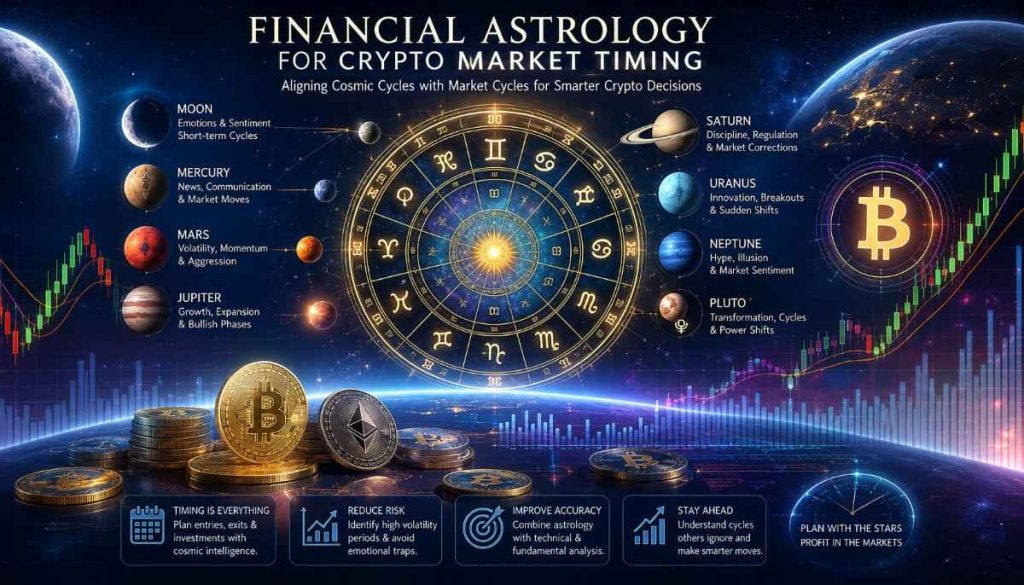
Cryptocurrency markets are deeply psychological. Bitcoin, Ethereum, Solana, XRP, meme coins, DeFi tokens, and AI crypto assets often move because of collective belief. When confidence expands, traders chase breakouts. When fear rises, liquidity disappears quickly. Financial astrology studies this emotional rhythm through planetary symbolism. The Moon, Mercury, Mars, Jupiter, Saturn, Uranus, Neptune, and Pluto are all studied for different market themes. Each planet reflects a type of energy that may influence collective sentiment. When these cycles align with technical levels, volume patterns, funding rates, and macro signals, traders can build a more complete timing framework.
Why Crypto Markets Need a Timing-Based Approach
Crypto trading is different from traditional investing because the market moves with extreme speed. A strong bullish move can develop in one session, and a sharp correction can erase gains just as quickly. Traders often enter too late because they follow hype. They exit too early because they fear volatility. They hold weak positions because they believe every correction is temporary. This is why timing matters.
Financial astrology for crypto market timing focuses on the rhythm behind price movement. It studies whether the market is entering a risk-on phase, a speculative phase, a correction phase, a consolidation phase, or a panic phase. Crypto markets are heavily influenced by liquidity cycles, Bitcoin dominance, stablecoin flows, institutional participation, interest rate expectations, ETF demand, and regulatory developments. However, even when the news is clear, traders still struggle with timing. A bullish story can remain inactive for weeks before price reacts. A bearish risk can be ignored until the market suddenly breaks down. Astrology helps traders study these transition windows.
The crypto market often behaves like a living emotional system. Bitcoin may act as the central confidence indicator. Ethereum may reflect risk appetite in smart contract ecosystems. Altcoins may show speculative expansion. Meme coins may indicate emotional excess. Stablecoin dominance may reveal caution. A timing-based approach helps traders ask the right questions. Is the market ready for expansion? Is the rally becoming overextended? Is volatility likely to rise? Is the market entering a period of confusion? Is it better to trade aggressively or protect capital?
The Role of the Moon in Crypto Market Timing
The Moon is one of the most important factors in financial astrology because it moves quickly and reflects emotional changes. In crypto markets, the Moon can be useful for short-term timing because traders react emotionally to price movement. The Moon’s movement through zodiac signs, lunar phases, full moons, new moons, and eclipses may coincide with changes in volatility and sentiment.
New moons often represent fresh emotional cycles. In crypto trading, a new moon period can sometimes reflect a reset in sentiment. It may appear near accumulation zones, early breakouts, or the beginning of a new narrative. However, traders should not treat every new moon as bullish. The surrounding planetary conditions matter. If the new moon forms difficult aspects with Saturn, Mars, Uranus, or Pluto, the period may bring uncertainty, pressure, or sudden volatility.
Full moons often bring emotional intensity. In crypto markets, full moon periods can coincide with sharp moves, trend exhaustion, panic reactions, or strong breakout attempts. Because crypto traders are highly responsive to price and social media narratives, full moon windows may increase emotional decision-making. A trader using financial astrology may watch full moon periods carefully, especially when Bitcoin is near a major support or resistance zone.
Eclipses are stronger lunar events. Solar and lunar eclipses may act as turning points or acceleration windows. In market timing, eclipses are not always immediate signals. Sometimes their influence builds before the event and unfolds afterward. For crypto, eclipse periods may bring regulatory news, exchange-related developments, sudden liquidations, or major narrative shifts. Traders should be cautious during eclipse windows because volatility can increase and price action can become less predictable.
Mercury and Crypto Market Communication
Mercury rules communication, data, transactions, analysis, networks, and information flow. This makes Mercury very important in crypto markets because crypto depends on digital networks, exchanges, trading platforms, blockchain data, social media, and rapid news cycles. Mercury’s condition can influence how information spreads and how traders interpret it.
Mercury retrograde is one of the most discussed cycles in astrology. In crypto trading, Mercury retrograde may coincide with confusion, technical issues, exchange delays, wallet mistakes, rumor-driven moves, misinformation, or sudden reversals after exaggerated news. This does not mean traders should stop trading during Mercury retrograde. It means they should become more careful. Orders should be checked twice. Leverage should be controlled. News should be verified. Technical breakouts should be confirmed before aggressive entries.
Mercury also matters during major aspects with Uranus, Neptune, Saturn, or Mars. Mercury-Uranus aspects can bring sudden news, hacking concerns, technology breakthroughs, or unexpected market reactions. Mercury-Neptune aspects may create confusion, unrealistic narratives, scams, or misleading information. Mercury-Saturn aspects may bring regulatory discussions, serious market analysis, or restrictive sentiment. Mercury-Mars aspects may trigger aggressive debate, fast trading, and emotional decision-making.
For crypto market timing, Mercury cycles can help traders understand information risk. Since digital assets often move on narratives, communication cycles can become powerful. A good trader does not rely only on the headline. A good trader asks whether the market is in a clear information cycle or a noisy information cycle.
Mars and High-Volatility Crypto Moves
Mars represents action, aggression, speed, conflict, speculation, and risk-taking. In crypto markets, Mars can reflect sudden momentum, sharp breakouts, liquidations, and emotional trading. When Mars is active, traders may become impatient. They may chase price. They may enter high-leverage positions. They may react quickly to small signals. This can create strong price movement, but it can also increase risk.
Mars transits can be especially important when Bitcoin or major altcoins are already near breakout levels. If technical structure is strong and Mars supports momentum, the market may move quickly. However, if the market is overleveraged, Mars energy may also trigger a liquidation event. This is why Mars should be interpreted with technical and liquidity data.
Mars-Uranus aspects are often associated with sudden shocks, breakouts, accidents, and extreme volatility. In crypto, this may appear as fast price spikes, exchange incidents, unexpected news, or sudden rotation into high-beta altcoins. Mars-Saturn aspects may create resistance, pressure, or failed breakout attempts. Mars-Pluto aspects may bring intense market moves, power struggles, or deep liquidation events.
For traders, Mars periods require discipline. They are not always bad. In fact, strong Mars periods can create excellent trading opportunities. However, they demand quick risk control. Stop-loss levels, position sizing, and exit plans become more important when Mars energy is active.
Jupiter and Crypto Bull Market Sentiment
Jupiter represents expansion, optimism, growth, speculation, wealth, belief, and confidence. In crypto markets, Jupiter cycles can support bullish sentiment when they align with favorable liquidity and strong narratives. Jupiter may amplify risk appetite. It can make traders more willing to invest in Bitcoin, Ethereum, altcoins, DeFi projects, AI tokens, gaming tokens, and early-stage crypto themes.
When Jupiter is strong, the market may become more hopeful. Institutional adoption stories may gain attention. ETF flows may become important. Long-term holders may feel more confident. Altcoin narratives may expand. However, Jupiter can also create overconfidence. It may inflate unrealistic expectations. During extreme Jupiter-driven phases, traders may believe prices can only go higher. This is when risk management becomes essential.
Jupiter aspects with Uranus can be especially powerful for technology-driven markets. These periods may support innovation, sudden adoption, breakthrough narratives, or speculative rallies in emerging sectors. Jupiter-Neptune aspects may create idealism and dream-driven speculation, but they can also increase bubble risk. Jupiter-Saturn aspects may bring a balance between growth and structure, which can support more mature institutional participation.
For crypto market timing, Jupiter is useful for identifying broader sentiment phases. A Jupiter-supported market may reward patience and trend following. However, traders must avoid blind optimism. The best use of Jupiter is to understand when expansion is possible, not to assume every asset will rise.
Financial Astrology for Crypto Market Timing
Explore common questions about using planetary cycles, lunar phases, retrogrades, and market psychology to understand Bitcoin, Ethereum, altcoins, volatility, and crypto timing windows.
Saturn and Crypto Market Corrections
Saturn represents discipline, restriction, regulation, structure, fear, patience, and reality checks. In crypto markets, Saturn cycles may coincide with corrections, regulatory pressure, institutional caution, liquidity tightening, or a shift from speculation to survival. Saturn does not always mean collapse. It often means the market must prove its strength.
When Saturn is active, weak projects may suffer. Overhyped tokens may lose attention. Traders may become more selective. Bitcoin may outperform smaller altcoins as capital moves toward safer crypto assets. Regulators may become more visible. Exchanges may face compliance pressure. Investors may focus more on balance sheets, token unlocks, revenue models, and real adoption.
Saturn periods are important because they separate strong market structures from weak ones. In a Saturn phase, narratives without substance may fade. Projects with real utility, strong liquidity, and institutional relevance may survive and eventually benefit. For traders, Saturn can be a warning against excessive leverage and emotional buying.
Saturn aspects with Mercury may bring regulatory announcements, serious market commentary, or cautious communication. Saturn-Mars aspects may slow momentum and create frustration. Saturn-Uranus aspects may create tension between innovation and regulation. This is especially relevant for crypto because digital assets operate at the intersection of technology, finance, freedom, and government oversight.
Uranus and the Digital Asset Revolution
Uranus is strongly connected with innovation, disruption, technology, decentralization, rebellion, and sudden change. Because crypto itself is a Uranian asset class, Uranus plays a major role in financial astrology for crypto market timing. Bitcoin was born from a desire to create a decentralized financial system outside traditional control. This theme fits Uranus very well.
Uranus cycles may coincide with sudden technological developments, blockchain innovation, unexpected regulation, exchange disruptions, security events, or rapid changes in market structure. Uranus can create both opportunity and risk. It may support explosive rallies, but it can also trigger sudden breakdowns.
When Uranus forms strong aspects with Jupiter, Mars, Mercury, or the Sun, crypto markets may become more active. Traders may see sudden news, rapid breakouts, or unexpected reversals. Uranus periods are difficult to manage with slow thinking. They require preparation before the move happens. A trader who waits for full confirmation may enter late. A trader who acts without risk control may get trapped.
Uranus is also connected with decentralization and alternative systems. Therefore, it may be important for Bitcoin, Web3, DeFi, tokenization, AI crypto, and emerging blockchain technologies. In long-term analysis, Uranus cycles can help investors understand when the crypto sector may enter a new innovation wave.
Explore Rajeev Prakash Investor Tools
Choose the right financial astrology product for market timing, research, live signals, and daily investor guidance.
Annual Letter 2026
Read the yearly market timing roadmap based on financial astrology, planetary cycles, equities, precious metals, and key investment risk windows.
Explore Annual Letter
Live Signals
Get live trading and investment timing guidance using planetary cycles, technical levels, real-time price movement, and risk windows.
View Live Signals
Daily Newsletter
Start your trading day with daily market bias, financial astrology insights, risk alerts, planetary timing zones, and important levels to watch.
Subscribe Now
Financial Astrology Terminal
Use the Financial Astrology Terminal to track global assets, market cycles, planetary timing windows, watchlists, and financial astrology signals.
Open TerminalNeptune, Hype, and Crypto Illusion
Neptune represents dreams, imagination, mass belief, illusion, confusion, spirituality, and idealism. In crypto markets, Neptune can be both inspiring and dangerous. Many crypto projects begin with a vision of a better financial future. They promise decentralization, freedom, transparency, and innovation. These ideals are powerful. However, Neptune can also create hype, scams, unrealistic expectations, and emotional blindness.
When Neptune is active, traders should be careful with narratives that sound too perfect. A token may promise revolutionary utility but lack real adoption. A project may build a strong online community but have weak fundamentals. A market rally may feel spiritual or unstoppable, but liquidity may not support it.
Neptune-Mercury aspects may increase misinformation. Neptune-Jupiter aspects may create speculative bubbles. Neptune-Mars aspects may lead to confused action and poor risk decisions. Neptune-Saturn aspects may force dreams to meet reality.
For crypto market timing, Neptune helps traders identify periods when market stories may become exaggerated. This does not mean every Neptune period is bearish. Sometimes Neptune supports strong collective belief, which can drive crypto prices higher. However, traders should verify data, avoid emotional attachment, and separate vision from valuation.
Pluto and Deep Crypto Market Transformation
Pluto represents power, destruction, rebirth, hidden forces, wealth concentration, crisis, and transformation. In crypto markets, Pluto may reflect deep structural shifts. These can include major collapses, exchange failures, institutional accumulation, government pressure, mining changes, or a complete change in market leadership.
Pluto cycles are not always short-term trading signals. They often work in the background. However, when Pluto forms strong aspects with faster planets, the market may experience intense movement. Pluto can expose hidden weakness. It can reveal leverage, fraud, liquidity stress, or concentration risk. At the same time, Pluto can support powerful recoveries after destruction.
Crypto has already shown many Pluto-like themes. The industry has gone through boom, collapse, scandal, regulation, rebuilding, and institutional entry. Every major cycle removes weak hands and creates stronger structures. Pluto teaches that crypto market timing should not only focus on price. It should also study power. Who controls liquidity? Who owns supply? Where is leverage concentrated? Which institutions are entering? Which exchanges are gaining trust? Which narratives are dying?
A trader using Pluto cycles should respect deep turning points. These periods may not feel comfortable, but they can create long-term opportunities after fear reaches an extreme.
Bitcoin as the Timing Anchor of Crypto Astrology
Bitcoin remains the most important asset in crypto market timing because it acts as the confidence anchor for the entire digital asset market. When Bitcoin is strong, the broader crypto market usually gains confidence. When Bitcoin weakens sharply, altcoins often suffer more. Therefore, any financial astrology model for crypto should begin with Bitcoin.
Bitcoin’s price action should be studied with planetary cycles, lunar phases, major aspects, halving cycles, liquidity trends, ETF flows, macroeconomic data, and technical chart structure. Astrology can help identify possible timing windows, but Bitcoin’s market structure confirms whether the signal is active.
For example, a bullish Jupiter period near a strong support zone may suggest that traders should watch for accumulation. A Mars-Uranus period near resistance may suggest possible breakout volatility. A Saturn period after an extended rally may suggest caution. An eclipse near a major trendline may suggest a possible shift in direction. These signals become more useful when they match price behavior.
Bitcoin also influences altcoin timing. During early bull phases, Bitcoin often leads. Later, capital may rotate into Ethereum and then into altcoins. Financial astrology can help study when this rotation may become more likely. However, traders must also track Bitcoin dominance, volume, liquidity, and market breadth.
Ethereum, Altcoins, and Sector Rotation
Ethereum often represents broader blockchain utility. It connects to smart contracts, DeFi, tokenization, NFTs, stablecoins, and layer-two ecosystems. In financial astrology, Ethereum may respond strongly to technology-driven cycles, especially those linked with Uranus, Mercury, and Jupiter. When the market believes in innovation, Ethereum and related ecosystems may perform well.
Altcoins are more speculative. They respond to risk appetite, liquidity, community hype, exchange listings, token unlocks, and narrative cycles. Financial astrology can help traders understand when speculative energy may increase. Jupiter and Uranus may support altcoin expansion. Mars may trigger fast momentum. Neptune may create hype. Saturn may punish weak projects. Pluto may expose hidden risks.
Sector rotation in crypto can be studied through both market data and astrology. AI tokens, gaming tokens, real-world asset tokens, DeFi tokens, privacy coins, meme coins, and layer-one blockchains may perform differently depending on the broader cycle. When risk appetite rises, traders may move into high-beta sectors. When caution returns, they may move back to Bitcoin, Ethereum, stablecoins, or cash.
Financial astrology for crypto market timing should not treat all tokens equally. Each crypto asset has its own launch chart, exchange listing history, market structure, and community psychology. A more advanced approach studies the birth chart of Bitcoin, Ethereum, or a specific token and compares current transits with historical turning points.
Combining Financial Astrology with Technical Analysis
The most practical way to use financial astrology in crypto trading is to combine it with technical analysis. Astrology provides timing windows. Technical analysis provides price confirmation. A trader may watch planetary cycles to identify high-risk or high-opportunity periods, but entries and exits should still be based on chart structure.
Support and resistance levels are essential. If a planetary timing window arrives when Bitcoin is near a major support zone, traders may watch for reversal signals. If the same window arrives near resistance, they may watch for breakout or rejection. Moving averages, trendlines, volume, RSI, MACD, Fibonacci levels, and market structure can help confirm whether the timing window is active.
Volume is especially important. A planetary signal without volume may fail. A breakout during a strong timing window with rising volume may carry more weight. Similarly, a bearish timing window with heavy selling volume may indicate a more serious correction.
Financial astrology should not create blind trades. It should create awareness. A trader can mark important dates, observe price behavior around those windows, and wait for confirmation. This method reduces emotional decision-making and creates a disciplined process.
Combining Astrology with Macro and Liquidity Data
Crypto markets are deeply connected to global liquidity. Interest rates, central bank policy, inflation expectations, dollar strength, bond yields, risk appetite, ETF flows, and stablecoin supply can all influence crypto price action. Financial astrology becomes stronger when it is used with these macro signals.
For example, Jupiter may suggest expansion, but if liquidity is tightening and the dollar is strengthening, the bullish effect may be limited. Saturn may suggest caution, and if macro conditions are also restrictive, the correction risk may increase. Uranus may suggest sudden movement, and if the market is already overleveraged, volatility may become extreme.
Crypto traders should watch Federal Reserve policy, global liquidity cycles, institutional flows, regulatory announcements, stablecoin market capitalization, and on-chain activity. Astrology can then help identify when these forces may express themselves through price.
A serious crypto timing model should not depend on astrology alone. It should integrate planetary timing, macro data, technical levels, on-chain metrics, sentiment indicators, and risk management. This balanced approach makes financial astrology more practical and credible.
Risk Management in Crypto Astrology
Risk management is the foundation of successful crypto trading. Financial astrology can help identify timing windows, but it cannot remove uncertainty. No timing system is perfect. Markets can move against any forecast. This is why every trade needs clear risk control.
Traders should avoid excessive leverage during high-volatility planetary windows. Mars-Uranus periods, eclipse windows, Mercury retrograde phases, and intense Pluto periods can create unexpected moves. These periods may offer opportunities, but they also punish careless trading.
Position sizing should match volatility. A trader should not use the same risk level in a calm market and a chaotic market. Stop-loss planning is also important. Crypto markets can wick sharply, so stops should be placed with care. Traders should avoid emotional revenge trading, especially during Mars-driven periods.
Financial astrology is most useful when it makes traders more disciplined, not more reckless. The purpose of timing is to improve decision-making. It should help traders know when to be aggressive, when to wait, when to reduce exposure, and when to protect capital.
How Financial Astrology Terminal Helps Crypto Traders
A professional financial astrology platform can help crypto traders by organizing planetary data, timing windows, market cycles, and asset behavior in one place. Instead of manually checking transits, lunar phases, retrogrades, and market charts, traders can use a structured system to identify important dates and risk periods.
Financial Astrology Terminal can act as a market timing layer for crypto traders, investors, family offices, and institutional funds that want to study time cycles in a disciplined way. It can help users track planetary influences, observe volatility windows, compare past market behavior, and combine astrological timing with price analysis.
For crypto traders, this type of tool is valuable because the market never sleeps. A trader cannot manually monitor every planetary change, every market narrative, and every technical setup at all times. A terminal-based system can help convert complex time-cycle information into practical insights. It can highlight when Bitcoin, Ethereum, or the broader crypto market may enter important timing zones.
The best use of such a terminal is not blind prediction. The best use is preparation. Traders can prepare for volatility, review positions before key dates, avoid emotional entries during confusing windows, and become more aware of market rhythm. For serious investors, this can become a unique edge because most market participants focus only on price and news. Time-cycle intelligence adds another dimension.
Crypto Market Timing for Long-Term Investors
Financial astrology is not only useful for short-term traders. Long-term crypto investors can also use it to understand accumulation and distribution phases. Bitcoin and major crypto assets often move in large cycles. These cycles are influenced by halving events, liquidity conditions, institutional adoption, regulatory clarity, and collective belief.
Astrology can help long-term investors identify periods when the market may be emotionally depressed, overextended, confused, or ready for a new phase. During Saturn or Pluto-heavy periods, fear may dominate. These periods may be uncomfortable, but they can also create long-term accumulation opportunities if fundamentals remain strong. During Jupiter or Uranus-supported periods, expansion may become more visible. However, investors should avoid buying blindly during euphoric peaks.
Long-term investors should use astrology as a timing guide, not as a replacement for research. They should study asset quality, adoption, liquidity, security, regulation, tokenomics, and long-term market structure. Astrology can then help improve entry timing, rebalancing decisions, and risk awareness.
The Future of Financial Astrology in Crypto
As crypto markets mature, traders and institutions will search for new tools that help them understand volatility, liquidity, and sentiment. Traditional analysis will remain important, but alternative timing models may gain more attention. Financial astrology has the potential to become one of these timing tools because it studies cycles, psychology, and market rhythm.
The future of crypto market timing may include a blend of artificial intelligence, on-chain analytics, technical analysis, macro data, sentiment tracking, and financial astrology. This combination can help traders see the market from multiple angles. Crypto is not only a financial asset class. It is also a technological movement, a social belief system, and a speculative market. This makes it highly suitable for cycle-based study.
Financial astrology will become more useful when it is tested, tracked, and compared with actual market outcomes. Traders should record timing windows, review forecasts, compare results, and refine their models. Over time, this creates a more serious and evidence-aware approach.
Conclusion: Using Astrology as a Crypto Timing Edge
Financial astrology for crypto market timing offers a unique way to study digital asset markets. It focuses on timing, sentiment, volatility, and collective behavior. Crypto markets are emotional, fast-moving, and deeply influenced by narratives. Because of this, traders need more than price charts and news headlines. They need a framework that helps them prepare for shifts before they become obvious.
The Moon can help identify emotional cycles. Mercury can highlight information risk. Mars can signal volatility and fast action. Jupiter can show expansion and optimism. Saturn can warn of correction and regulation. Uranus can reflect disruption and technological breakthroughs. Neptune can reveal hype and illusion. Pluto can mark deep transformation. When these planetary signals are combined with technical analysis, macro data, liquidity indicators, and disciplined risk management, financial astrology becomes a practical timing layer.