
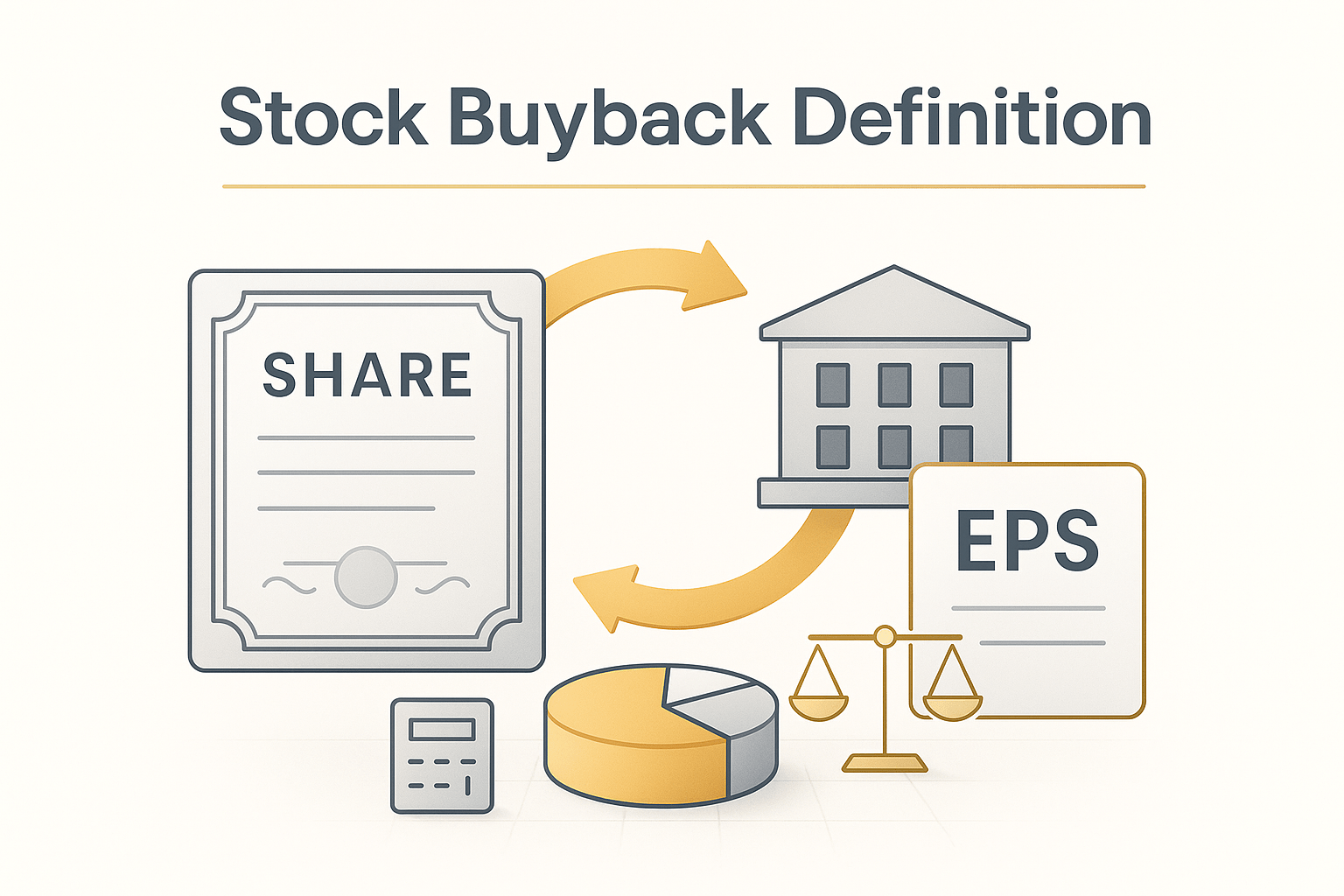
Definition: A stock buyback (share repurchase) is when a company buys its own outstanding shares from the market or shareholders, reducing the public float. Fewer shares can lift earnings-per-share (EPS), alter ownership mix, and signal management’s view on valuation. Below is a clear, investor-first guide to why companies repurchase, how it affects value, and what to check before you cheer—or worry.
What a Buyback Does (Mechanics)
- The company uses cash (or debt) to purchase its shares in the open market or via tender offer.
- Repurchased shares are usually retired or held as treasury stock, reducing shares outstanding.
- With fewer shares, EPS may rise; ownership percentage of remaining holders increases.
- Capital allocation trade-off: money spent on buybacks is not available for growth capex, R&D, or dividends.
Why Companies Repurchase Shares
| Motive | Intended Benefit | Investor Watch-outs |
|---|---|---|
| Undervaluation | Buy $1 for $0.70; accretive to intrinsic value | Needs honest assessment & steady cash flows |
| EPS Accretion | Boost per-share metrics | Can be cosmetic if profits aren’t growing |
| Offset Dilution | Neutralize stock-based compensation | Net share count may still creep up—check! |
| Flexible Payout | More optional than dividends | Procyclical timing—often buy high, pause low |
| Signal | Confidence in prospects | Signals can be wrong; compare to insider actions |
| Leverage Optimization | Adjust capital structure | Debt-funded buybacks add risk when rates rise |
How Buybacks Affect Value
- If undervalued: Repurchasing can increase per-share intrinsic value.
- At fair value: Roughly neutral vs a cash dividend (tax/jurisdiction dependent).
- Overvalued: Destroys value—shareholders pay too much for their own stock.
- EPS vs Cash: EPS can rise while free cash flow falls—track both.
- Leverage: Debt-funded programs raise financial risk in downturns.
- Timing Quality: Best programs are price-sensitive and patient.
How to Evaluate a Buyback (Investor Checklist)
Open checklist
Common Repurchase Methods
| Method | How It Works | Notes |
|---|---|---|
| Open-Market | Broker buys shares over time | Flexible; watch price discipline |
| Tender Offer | Company offers to buy at fixed price | Faster; premium paid to sellers |
| Accelerated Buyback (ASR) | Bank delivers shares upfront; later true-up | Immediate EPS impact; pricing complexity |
| Odd-Lot/Targeted | Small holders or specific blocks | Clean-up of register |
Pros & Risks—At a Glance
- Pros: Accretive at low prices; offsets dilution; flexible vs dividends; tax-efficient in some regions.
- Governance: Aligns capital with owners when growth options are scarce.
- Risks: Overpaying; masking weak growth; leveraging up; poor timing.
- Optics/Policy: Can face regulatory or political scrutiny.
Common Myths—Clear Answers
- “Buybacks always lift the stock.” Only if priced below intrinsic value and fundamentals improve.
- “Buybacks are anti-growth.” Not if surplus cash remains after funding high-ROI projects.
- “EPS up = value up.” EPS can rise while value falls—watch cash generation and price paid.
Taxes & Operational Notes
Tax treatment varies by country (e.g., dividend vs capital gains vs buyback levy). Settlement, blackout windows, and board approvals also apply. Always review local rules and company disclosures before drawing conclusions.
Disclaimer
Education only—this is not investment, tax, or legal advice. Markets involve risk. Consider your circumstances and consult a qualified professional.