
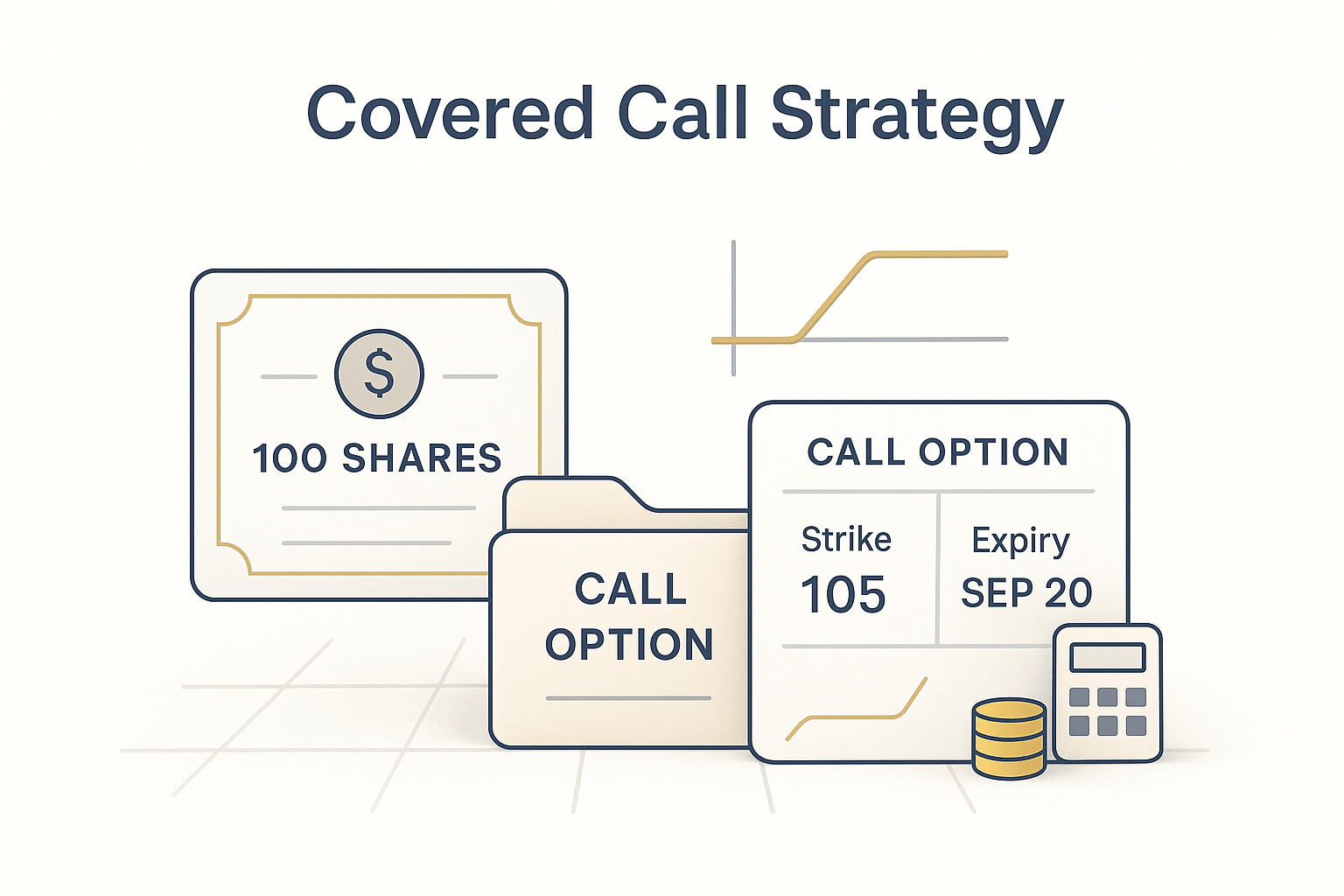
A covered call is a simple, rules-based way to generate extra income from stocks you already own. You hold the shares and sell a call option against them, collecting premium in exchange for capping some upside. This guide explains setup, payoffs, Greeks, risks, and a checklist you can apply today.
What Is a Covered Call?
You own 100 shares of a stock (or ETF) and sell (write) one call option on the same ticker and expiry. The premium you receive adds income and a small cushion against declines. If price rises above the strike at expiration, your upside is capped and you may be assigned (shares sold at the strike).
- Goal: Earn option income on owned shares
- Best fit: Neutral to moderately bullish outlook
- Position size: 100 shares per call contract
How It Works (Step by Step)
- Own or buy 100 shares of the underlying per contract.
- Sell an out-of-the-money (OTM) call—often 1–8 weeks out.
- Collect premium → this lowers your cost basis.
- At expiry:
- If price ≤ strike: call expires worthless → keep shares + premium.
- If price > strike: likely assignment → shares sold at strike; keep premium.
Payoff at Expiration (Per Share)
| Underlying at Expiry | Position P/L | Comment |
|---|---|---|
| Below breakeven (Stock Price ≤ Entry − Premium) | Loss, reduced by premium | Premium cushions downside but does not remove it |
| Between breakeven and Strike | Profit grows with stock | Keep premium and shares |
| At or above Strike | Capped profit = (Strike − Entry) + Premium | Likely assigned; upside limited |
Numerical Example
You own 100 shares at ₹1,000. You sell a 1-month 1,060 call for ₹20. Outcomes at expiry:
| Spot at Expiry | Result | P/L per Share |
|---|---|---|
| ₹950 | Option expires; keep shares | −₹50 + ₹20 = −₹30 |
| ₹1,040 | Expires; keep shares | ₹40 + ₹20 = ₹60 |
| ₹1,080 | Assigned at ₹1,060 | (₹1,060 − ₹1,000) + ₹20 = ₹80 (max) |
Greeks You Actually Need
- Delta (≈ +0.25 to +0.35 OTM): Sets probability of assignment and premium size.
- Theta (> 0 to you): Time decay works in your favor; faster close to expiry.
- Vega (< 0): Premium shrinks if volatility falls; rises if volatility spikes.
- Gamma: Low for covered calls vs naked calls; risk mostly from the stock you own.
Why Use It
- Earn income while holding quality shares
- Small buffer against declines (premium)
- Behavioral benefit: rules reduce impulse trades
Key Trade-offs
- Upside is capped above the strike
- Stock risk remains on the downside
- Possible early assignment near ex-div dates
When a Covered Call Makes Sense
- You’re neutral to moderately bullish for the next 2–8 weeks.
- You’re happy to sell the stock at the strike (set target exits).
- Implied volatility is fair to rich vs its 6–12-month history.
- You prefer steady income over chasing full upside.
Construction Rules (Practical)
| Element | Guideline | Why |
|---|---|---|
| Strike selection | OTM call with delta ≈ 0.25–0.35 | Balanced income vs assignment risk |
| Expiry | 2–6 weeks | Good theta capture; manageable roll cadence |
| Roll plan | Buy back at ~75–85% of max profit or 7–10 days to expiry | Locks gains; reduces gap risk |
| Position size | Start small; match lots of 100 shares | Controls risk and slippage |
Operational Risks to Watch
- Assignment: Be prepared to deliver shares; set alerts near strike.
- Ex-dividend: Early exercise risk increases if call is ITM and dividend exceeds time value.
- Gap moves: Overnight news can jump price through the strike—have a roll/close rule.
- Liquidity: Prefer tight spreads and active options chains.
- Taxes: Premiums and stock sales may be taxed differently; consult a professional.
Covered Call Checklist (Apply Today)
Open checklist
Disclaimer
Education only—this is not investment, tax, or legal advice. Options involve risk and are not suitable for all investors.