
Climate Innovation, Energy Transition, and Commodity Market Volatility
Climate innovation is accelerating, and the energy transition is no longer a niche theme discussed only in policy circles. It is now a capital allocation story that touches everything from infrastructure spending and industrial policy to supply chains, inflation, and commodity price cycles. In 2026, the market’s focus is likely to sharpen around a central tension: clean-energy optimism is expanding demand for critical materials, yet the supply response remains constrained, uneven, and politically sensitive. This mismatch is one of the clearest pathways to commodity market volatility and inflationary pressure.
The energy transition is often presented as a smooth technological upgrade, where renewables, storage, and electrification gradually replace fossil fuels. In reality, the transition behaves more like an overlapping handoff. Old systems remain essential longer than expected, while new systems require an upfront surge in metals, mining capacity, grid upgrades, and manufacturing scale. This overlap creates conditions where commodities can swing sharply, not only because of demand growth, but because markets are continually repricing the speed, cost, and feasibility of the transition.
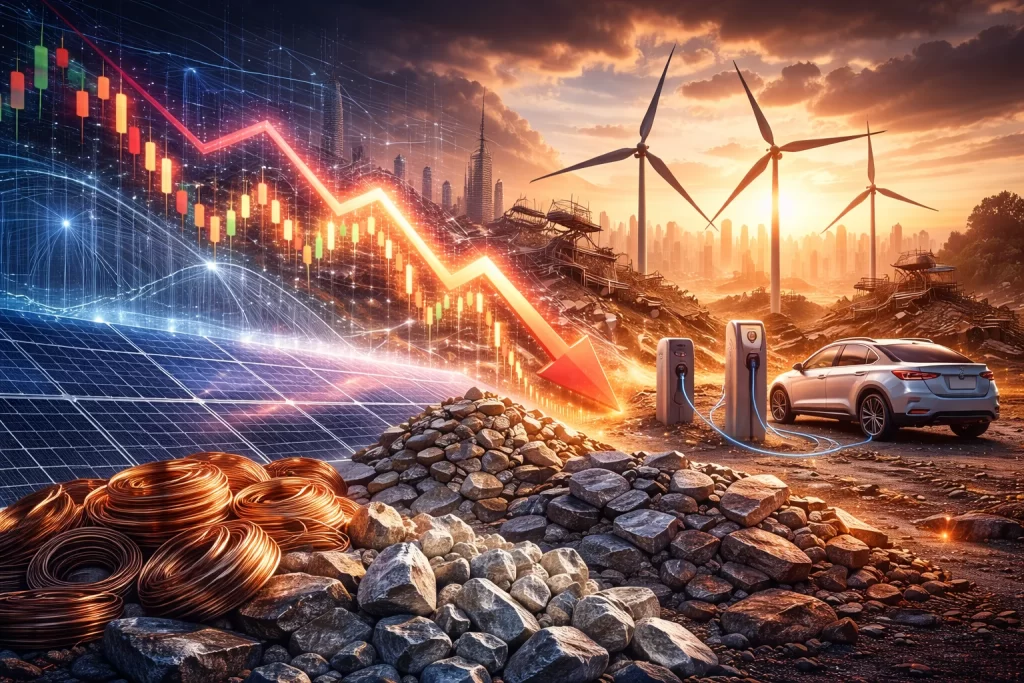
The Transition Is a Materials Story Before It Is a Power Story
At the heart of climate innovation sits a physical reality: electrification is metals-intensive. Grid expansion, transmission upgrades, electric vehicles, charging networks, energy storage, and renewable infrastructure require substantial quantities of industrial metals. Even when technological efficiency improves, the scale of deployment can keep total demand elevated. This is why the energy transition is not only an energy narrative. It is a commodity narrative with inflation consequences.
In 2026, clean-energy investment themes may continue to attract capital, but commodity markets will increasingly ask harder questions. Can mining supply expand fast enough. Can permitting timelines be reduced without political backlash. Can refining capacity and processing bottlenecks be solved. Can geopolitical disruptions be absorbed without price spikes. These questions matter because commodities are priced at the margin, and the marginal ton becomes expensive when inventories are tight and supply is slow to respond.
Metals Demand, Bottlenecks, and the Reality of Supply Constraints
Metals markets are particularly vulnerable to structural constraints because new supply takes time. Commodity cycles are often misunderstood as simple demand fluctuations. In critical transition metals, supply is constrained by long development timelines, regulatory approvals, infrastructure gaps, and increasingly complex political and environmental negotiations. This creates a setup where even moderate demand surprises can cause sharp price moves.
Copper is a useful lens because it sits at the center of electrification. It is essential for transmission lines, motors, transformers, and industrial electrification. Demand growth can be persistent, while large new copper projects face long lead times. If 2026 brings a renewed infrastructure push, stronger grid spending, or faster EV adoption in key regions, copper pricing could become a volatility driver for broader industrial input costs.
Aluminium, nickel, lithium, and other battery and industrial inputs add further layers. Even when one metal cools due to temporary oversupply or sentiment shifts, the system remains fragile because bottlenecks can migrate. A surplus in one segment does not eliminate the transition’s material intensity. It simply shifts stress to the next chokepoint, whether in processing, refining, shipping, or geopolitical availability.
Capital Discipline in a Resource-Constrained Transition
As climate innovation accelerates, a growing tension is emerging between ambition and feasibility. Markets often assume that capital availability alone can solve resource bottlenecks, yet history shows that capital without discipline can worsen volatility rather than reduce it. In 2026, this dynamic may become more visible as investment flows into clean energy intersect with finite resources, long construction timelines, and regulatory friction. When capital floods into transition themes, expectations rise quickly. However, the physical world does not scale at the same speed as financial markets.
Clean-Energy Optimism and the Commodity Cycle Problem
Optimism can be a catalyst for investment, but in commodities it often leads to cycles of overshoot and correction. When clean-energy optimism rises, markets price aggressive demand growth. That pushes commodity prices higher, which encourages new supply investment. Yet new supply arrives slowly, and by the time it materializes, demand expectations may have shifted, policy incentives may have changed, or financing conditions may have tightened. This is how commodity cycles are created. They are not only about demand. They are about timing mismatches between investment decisions and real-world delivery.
In 2026, this cycle risk is especially relevant because commodity pricing is intersecting with macro uncertainty. If growth slows in major economies, or if financial conditions tighten again, demand expectations can cool quickly. That can create sharp downward corrections in commodity prices even while the long-term transition remains intact. Investors must separate the structural trend from the cyclical path, because markets can punish those who treat a long-term theme as a straight-line trade.
Inflationary Pressures and the Cost of Transition
A major reason commodity volatility matters in 2026 is inflation. Energy transition investment can reduce long-term energy costs, but the buildout phase can be inflationary. When demand for metals and industrial inputs rises faster than supply, input costs increase across manufacturing, construction, and infrastructure. These costs can filter through to consumer prices, corporate margins, and interest-rate expectations.
This dynamic becomes more pronounced when commodity price spikes coincide with fragile supply chains or geopolitical disruption. Inflation then becomes harder to control because it is not simply demand-driven. It is supply-driven, and central banks have limited tools to fix supply constraints quickly. If 2026 experiences new waves of commodity-driven inflation, markets may see renewed volatility in bonds as investors reprice rate expectations and fiscal sensitivity.
The Inflation Feedback Loop
Commodity volatility tied to the energy transition has broader implications beyond raw materials. Rising prices for metals and energy inputs feed directly into producer costs, infrastructure budgets, and consumer prices. This creates an inflation feedback loop that markets must constantly reassess. In 2026, this loop may play a central role in shaping monetary policy expectations and market sentiment.
Inflation driven by supply constraints is particularly challenging. Central banks can slow demand, but they cannot quickly expand supply. As a result, policy responses may feel blunt, increasing the risk of economic slowdown while commodity prices remain elevated. Markets caught between inflation risk and growth risk tend to exhibit heightened volatility, especially in interest-rate-sensitive assets.
Corporate earnings forecasts are increasingly exposed to energy and commodity price assumptions. Companies involved in construction, manufacturing, transportation, and utilities face rising uncertainty around input costs. Even firms positioned as beneficiaries of the transition may struggle with margin pressure if material costs rise faster than revenues.
Fossil Fuels, Underinvestment, and the Transition Overlap
Another source of volatility is the overlap between old and new energy systems. Fossil fuels remain a major part of the energy mix, yet capital investment in traditional supply has become more constrained due to policy pressure, investor preferences, and ESG mandates. If underinvestment in conventional energy supply collides with strong demand, energy prices can spike, pushing inflation higher and stressing consumers and governments.
This creates a paradox. The transition aims to reduce fossil fuel dependence, but the transition period can increase vulnerability to energy price shocks if the old system is weakened faster than the new system can fully replace it. In 2026, this overlap risk can express itself through oil and gas volatility, which then feeds into inflation expectations and broad market sentiment. Even clean-energy-focused portfolios can be affected indirectly through the macro channel.
Policy Risk, Subsidies, and the Market’s Changing Expectations
Climate innovation is tightly linked to policy. Subsidies, tax credits, carbon pricing, and industrial policy shape the economics of clean-energy deployment. Markets tend to price these policies as stable, but political cycles can alter implementation, funding levels, or timelines. When policy expectations shift, commodity demand projections can shift with them, producing abrupt repricing in both materials and clean-energy equities.
In 2026, investors should expect policy headlines to remain a volatility source. The market can swing between confidence in accelerated deployment and concern about delays, budget constraints, or changing priorities. Commodities respond quickly to these shifts because pricing reflects future expectations as much as current conditions.
Geopolitics, Strategic Minerals, and Supply Security
Critical minerals are increasingly viewed through a national security lens. Concentrated production, refining dominance, and fragile trade relationships can turn commodity markets into geopolitical battlegrounds. Export controls, sanctions, permitting restrictions, and strategic stockpiles can all influence price dynamics. This adds a layer of non-economic volatility to commodity cycles.
When supply security becomes a priority, governments may intervene directly through stockpiling, incentives for domestic production, or restrictions on exports. These actions can amplify short-term volatility even if they improve long-term resilience. For 2026, this means commodity markets may react not only to industrial demand, but also to political decisions that change flow patterns overnight.
Commodity Volatility and Market Leadership in 2026
Commodity price swings often reshape equity leadership. When input costs rise, margin pressure increases in manufacturing and consumer sectors. Meanwhile, producers and upstream industries can benefit. However, leadership does not remain stable because policy, demand, and prices can change quickly.
If 2026 sees renewed commodity inflation, markets may rotate toward real assets, miners, energy producers, and inflation-protected segments. If commodity prices correct sharply due to demand concerns, leadership may swing back toward growth and rate-sensitive sectors. This is why understanding the commodity cycle is essential for navigating broader market leadership shifts tied to the energy transition.
A Practical Investment Lens for This Theme
The energy transition is a durable multi-year transformation, but the path is cyclical and volatile. A disciplined approach recognizes that commodity markets will overshoot in both directions. Prices can spike on supply fear, then collapse on demand fear, often within the same year. The goal is not to predict every move. The goal is to remain aware of where the market is in the cycle, how crowded the narrative has become, and whether supply constraints are tightening or easing.
In 2026, the most important mistake investors can make is confusing structural inevitability with immediate market timing. Climate innovation may define the future, but valuation, sentiment, and liquidity still determine returns in the present. Prepared investors treat commodity volatility as a signal, not a surprise, and they position with realism about the transition’s costs and bottlenecks.
Annual Letter 2026 – Strategic Outlook for Investors
Markets are entering a phase where innovation, geopolitics, and capital cycles are intersecting with unusual intensity. The Annual Letter 2026 is designed to help investors and traders interpret these shifts with clarity and discipline. It offers a structured view of global market cycles, leadership transitions, and risk phases expected during the year, supported by long-term cycle analysis and timing frameworks.
This research publication goes beyond headlines and short-term noise. It connects innovation-driven optimism with valuation risk, capital concentration, and sector rotation, helping readers understand where leadership may strengthen and where caution is warranted. The letter also examines how global macro trends and policy decisions could influence equities, commodities, and currencies as markets move through critical inflection points.

Financial Markets, Commodities, and the Cost Curve of Decarbonization
As the energy transition advances, markets are being forced to confront a reality that is often underappreciated in optimistic narratives: decarbonization has a cost curve, and that cost curve is not linear. Early stages of transition tend to be capital intensive, resource heavy, and vulnerable to inefficiencies. In 2026, this cost curve is likely to play a more visible role in shaping commodity prices and broader financial market behavior.
Decarbonization requires rebuilding large portions of the global energy and industrial system while the existing system continues to operate. This duplication effect places sustained pressure on commodities because demand is not merely shifting, it is stacking. Traditional energy infrastructure still requires maintenance and fuel, while new infrastructure simultaneously demands metals, components, and raw materials. Markets that underestimate this overlap risk may be surprised by persistent commodity tightness even during periods of slower economic growth.
Energy Transition and the Repricing of Industrial Inputs
Commodity markets do not move in isolation. Rising input costs affect corporate earnings, government budgets, and consumer behavior. In 2026, energy transition–driven demand for industrial inputs may increasingly influence earnings guidance and margin expectations across sectors. Manufacturers, construction firms, utilities, and transportation companies all face cost exposure tied to metals, energy, and logistics.
When commodity prices rise sharply, markets often respond by compressing valuation multiples in downstream sectors. This repricing does not imply a collapse in demand, but it reflects uncertainty about how quickly costs can be passed on. Inflation-sensitive periods amplify this effect because central banks may be less tolerant of price pressures, increasing the sensitivity of equities and bonds to commodity movements.
Transition Volatility and Bond Market Sensitivity
Commodity-driven inflation is particularly relevant for bond markets. If clean-energy investment coincides with supply constraints and energy price volatility, inflation expectations can become unstable. This instability affects yield curves, sovereign borrowing costs, and fiscal sustainability, especially in economies with large infrastructure commitments.
In 2026, bond markets may respond more quickly to commodity shocks than equity markets. Rising yields can then feed back into equity valuations, particularly in capital-intensive sectors associated with the transition. This feedback loop underscores why the energy transition should be analyzed as a macro-financial theme, not just an environmental or technological one.
Meet Our Team
Get to know our dedicated team of experts. With a diverse range of skills and years of experience, we’re committed to providing you with the best market analysis and investment guidance.

Mr. Rajeev Prakash Agarwal
Founder
Expert in financial & personal astrology for 20 years+. Rajeev is a well-known astrologer based in central India who has a deep understanding of both personal and mundane astrology.

Mr. Shashi Prakash Agarwal
Technical Head
Shashi is a technology leader with a strong background in global business.He holds a B. Tech in Computer Science & MBA in Finance from Narsee Monjee Institute of Management Studies, one of the top B-Schools in India.
Emerging Markets and Resource Concentration
Many critical commodities are sourced from emerging markets, where political stability, infrastructure quality, and regulatory consistency vary widely. As demand for transition-related materials grows, these regions may experience both opportunity and stress. Export revenues can rise, but so can domestic inflation, currency volatility, and social pressure if resource development is perceived as uneven or environmentally harmful.
In 2026, commodity volatility tied to the energy transition may spill into emerging-market assets through exchange rates, sovereign debt spreads, and equity performance. Markets may reward countries with stable governance and clear resource policy while penalizing those where supply risk appears elevated. This differentiation can occur rapidly, reinforcing volatility at the regional level.
Technological Efficiency Versus Physical Constraints
Innovation is often expected to reduce material intensity over time. While efficiency gains are real, they do not eliminate physical constraints in the near term. Scaling new technologies requires raw materials, manufacturing capacity, and infrastructure. Efficiency improvements often lag deployment, meaning initial phases of transition remain resource intensive.
Markets sometimes price future efficiency gains prematurely, assuming that material constraints will ease faster than they realistically can. When these assumptions fail to materialize on schedule, commodity prices adjust upward, and optimism-driven valuations recalibrate. This pattern is likely to repeat in 2026 as enthusiasm for innovation encounters the limits of physical supply.
Why Choose Us ?
Astrodunia guides you through the market’s ups and downs with the help of planetary science. Our team of experts in financial astrology provide valuable insights and predictions to assist you in market wise investment decisions and navigate the global market with ease.

Market Forecasting
Experience the advantage of enhanced market predictions. Our unique approach combines traditional analysis with astrological insights for more accurate predictions and better investment opportunities.

Decades of Market Timing Expertise
For over 20 years, we’ve honed our skills in market timing within the stock market. Our extensive experience allows us to navigate market trends with precision and confidence.

Trusted by Discerning Investors
Our clients choose us for our proven track record of success and our commitment to providing them with the most reliable market insights. Join the ranks of satisfied investors who trust our expertise
Speculation, Hedging, and Financialized Commodity Markets
Commodity markets today are deeply financialized. Futures, options, and structured products allow capital to move quickly in response to narratives. During periods of clean-energy enthusiasm, speculative positioning can amplify price moves beyond what fundamentals alone would justify. Conversely, when sentiment shifts, liquidations can drive sharp reversals.
In 2026, increased hedging activity by manufacturers and utilities may also influence price dynamics. As volatility rises, companies seek protection against input cost swings, adding another layer of demand in derivatives markets. This financial behavior can reinforce cycles, making commodity prices more reactive to sentiment and policy headlines.
Long-Term Transition, Short-Term Instability
The central tension of the energy transition in markets is the contrast between long-term clarity and short-term instability. The direction of travel is broadly understood, but the path is uneven. Markets must constantly update assumptions about cost, speed, policy support, and social acceptance. Each update introduces volatility.
For investors, the challenge is not to question whether the transition will occur, but to recognize that its market expression will be cyclical. Periods of calm may be followed by abrupt repricing when supply constraints tighten or policy expectations shift. Treating volatility as a feature rather than a flaw allows for more realistic positioning.
Testimonials
Discover what our satisfied customers have to say about their experience with us. Read our testimonials from people just like who have benefited from our services.
Market singals have helped me to make quick and informed decisions for trades in stock market. resulting in significant profits for my portfolio. The team is highly professsional and always available to answer your questions and provide the best customer service.
SK Jhunjhunwala
Investor based in Mumbai
I have been using the astrodunia’s services for over 4+ years now and have been extremely impressed with level of experties and precions they bring to the table. Their live market signals have helped me make quick and informed decisions.
N. Patel
Pennsylvania , US
Excellent service. This is undoubtedly the best market forecast newsletter that i have ever subscribed. None of the other newsletter are anywhere close to this terms of accuracy. Please continue with the good work !
Withheld
Fixed income trader with a required foreign bank in asia
i am an entrepreneur based in Australia and have been subscriber of astrodunia services from the past two years.i have found their NewsLetter , Live Signals and Annual Letter to be incredibly valueable.
Z. Irani
Australia
Strategic Patience in a Volatile Transition
Navigating climate innovation and commodity volatility in 2026 requires strategic patience. Chasing price spikes driven by fear of scarcity can be as risky as dismissing long-term structural demand. A disciplined approach focuses on understanding where the market sits within the cycle and how much optimism or pessimism is already embedded in prices.
This patience is especially important when inflation narratives dominate headlines. Commodity-driven inflation can reverse quickly if growth slows or policy changes. Investors who overreact to short-term price moves may find themselves misaligned with the broader trend.
Closing Perspective
Climate innovation and the energy transition are reshaping global capital flows, but they are also reshaping commodity markets in ways that can amplify volatility and inflation pressures during 2026. Metals demand, supply constraints, policy risk, and geopolitical supply security combine to create a landscape where price swings are likely to be frequent and consequential.
The transition remains a long-term opportunity, yet markets often price that opportunity unevenly. Commodity cycles will continue to test investor discipline, not only in materials and energy, but across equities and bonds through the inflation channel. In an era where the future is being built in real time, the key advantage is not optimism. It is preparedness, timing awareness, and respect for cycles.
Whether you’re a seasoned investor or just starting out, our financial astrology tools can be tailored to your specific investment goals. Gain valuable insights to achieve your financial aspirations.
Address
1301, 13th Floor, Skye Corporate Park, Near Satya Sai Square, AB Road, Indore 452010
+91 9669919000
© All Rights Reserved by RajeevPrakash.com (Managed by AstroQ AI Private Limited) – 2025