
Market downturns rarely arrive without emotional signals. Long before headlines announce a recession, crash, correction, or bear market, investors often sense a change in market behavior. Volatility rises. Leadership narrows. Safe-haven assets begin to attract attention. Speculative stocks lose momentum. News that once supported bullish sentiment starts to produce weaker reactions. This is where many serious market observers ask an important question: can financial astrology warn investors before market downturns?
The answer depends on how financial astrology is used. It should not be treated as a magic system that guarantees exact market tops or bottoms. Markets are influenced by liquidity, interest rates, earnings, geopolitics, central banks, investor positioning, debt cycles, and technology trends. However, financial astrology can act as a timing and sentiment layer. It can help investors study periods when fear, greed, uncertainty, speculation, and mass psychology may shift. When combined with technical analysis, macroeconomic research, valuation study, and disciplined risk management, financial astrology can become a useful early-warning framework.
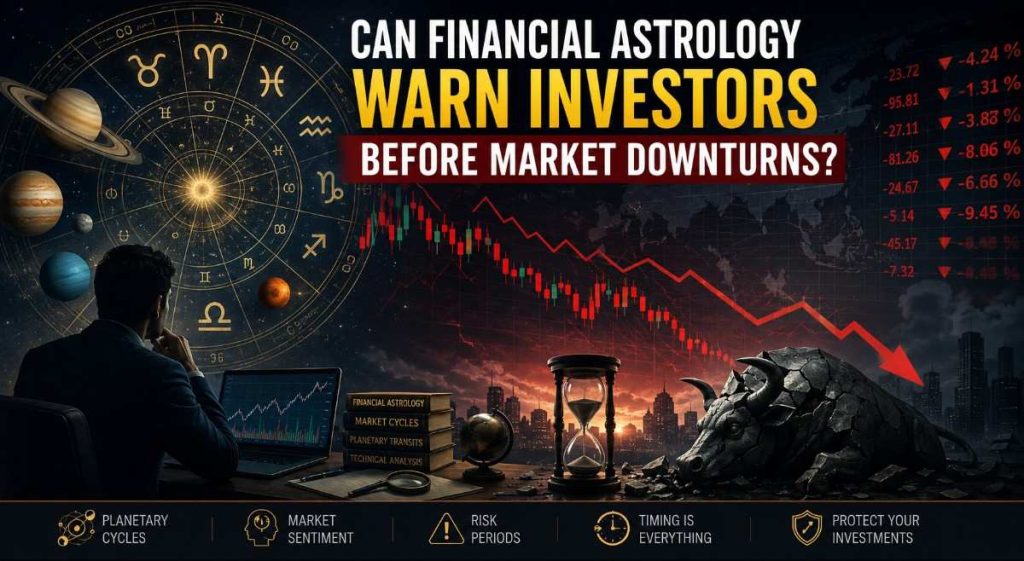
For investors, the real value is not in predicting every market decline perfectly. The value is in recognizing vulnerable periods before they become obvious. A downturn is often not a single event. It is a process. Financial astrology studies time cycles, planetary stress periods, eclipses, retrogrades, lunar phases, and historical market behavior to identify windows when market psychology may become unstable. In that sense, it can help investors prepare before panic spreads.
Why Market Downturns Are Often Psychological Before They Are Financial
A market downturn begins in the mind before it appears fully on the chart. Prices may remain near highs while confidence quietly weakens. Investors may still sound optimistic while insiders reduce exposure. Analysts may continue raising targets while volume patterns become defensive. In many cases, the market gives subtle warnings before the larger decline begins.
Traditional finance recognizes risk through valuation, leverage, liquidity, and economic stress. The Federal Reserve’s financial stability work, for example, reviews vulnerabilities such as valuation pressures, borrowing by businesses and households, financial-sector leverage, and funding risks. These are not always short-term predictions, but they show where pressure can build before instability appears.
Financial astrology approaches the same problem from a different angle. Instead of looking only at financial data, it studies the rhythm of collective behavior. It asks whether certain planetary periods correspond with heightened optimism, fear, confusion, aggression, or withdrawal. Markets are human systems. Even algorithmic trading models are built by humans and respond to human-created data. Therefore, any method that studies cycles of human emotion can offer insight into risk.
When markets rise for a long time, investors often forget risk. They start to believe that liquidity will always remain available, central banks will always support asset prices, and every dip will recover quickly. This is the emotional phase where financial astrology becomes especially interesting. It can highlight periods when excess confidence may face reality.
Can Financial Astrology Warn Investors Before Market Downturns?
Explore the most common questions investors ask about financial astrology, market downturns, risk windows, planetary cycles, and how astrology can support better timing decisions.
Financial astrology can help investors identify possible risk windows before a market downturn, but it should not be treated as a guaranteed prediction system. It studies planetary cycles, eclipses, retrogrades, and market sentiment patterns to highlight periods when volatility, fear, or uncertainty may rise. Investors can use these signals alongside technical analysis, macroeconomic data, valuation study, and proper risk management.
Financial astrology identifies risk windows by studying important planetary transits, stressful aspects, eclipse periods, retrogrades, and lunar cycles. When several difficult planetary patterns align with weak market breadth, high valuations, rising volatility, or fragile investor sentiment, the probability of a market correction may increase.
Astrology should not be used as a standalone tool to predict exact stock market crashes. However, financial astrology may help investors recognize periods when the market is more vulnerable to panic, correction, or sudden trend reversal. It works best as a timing and risk-awareness layer, not as a replacement for financial research.
Saturn, Uranus, Neptune, Pluto, Mars, Rahu, and Ketu are often studied in financial astrology for market downturns. Saturn may indicate restriction, debt pressure, and fear. Uranus may bring sudden shocks and volatility. Neptune may show illusion or confusion. Pluto may indicate deep structural change, while Rahu and Ketu can show speculation, detachment, and sudden sentiment shifts.
Yes, financial astrology can be useful for long-term investors when used carefully. It can help investors understand periods of possible instability, avoid emotional buying near euphoric tops, and prepare cash or hedging strategies before volatile phases. Long-term investors can use it to improve timing, but they should still focus on fundamentals, asset quality, and diversification.
Technical analysis studies price, volume, trends, support, resistance, and momentum. Financial astrology studies time cycles, planetary patterns, and collective market psychology. Technical analysis shows what price is doing, while financial astrology attempts to show when sentiment may shift. The two methods can work together when used with discipline.
Financial astrology can support risk reduction by helping investors become more cautious during sensitive time windows. It may encourage investors to review leverage, rebalance portfolios, protect profits, tighten stop losses, or avoid aggressive entries during unstable periods. However, it should always be combined with practical financial planning and risk controls.
Eclipses are often viewed as periods of revelation, uncertainty, and sudden change. In financial astrology, eclipse seasons may coincide with market narrative shifts, unexpected news, or volatility. An eclipse alone does not guarantee a downturn, but when it occurs near other stressful planetary patterns and weak market signals, investors may watch the market more carefully.
Mercury retrograde is associated with communication issues, delays, data confusion, trading errors, and revisions. In markets, this period may increase the chance of misinterpretation, false breakouts, or sudden changes in sentiment. It does not always create a downturn, but it can add confusion during already unstable periods.
No, investors should not make decisions only through financial astrology. It should be used as one layer within a broader decision-making framework. Strong investing requires technical analysis, fundamental research, macroeconomic awareness, diversification, position sizing, and risk management. Astrology can improve timing awareness, but it should not replace financial discipline.
Investors can use financial astrology as a market timing calendar. They can watch for high-risk planetary periods, compare them with price charts, review portfolio exposure, and prepare defensive strategies if market weakness appears. The most practical use is not fear-based prediction but calm preparation before volatility rises.
Financial astrology can be useful for family offices and institutions as a supplementary timing layer. Large portfolios already use macro research, quantitative models, sentiment indicators, and risk frameworks. Financial astrology adds another dimension by studying time cycles and investor psychology. It can support better preparation during volatile windows.
Want Better Market Timing Insights?
Explore how Rajeev Prakash uses financial astrology, planetary cycles, and market timing research to help investors understand risk windows before they become obvious.
Explore RajeevPrakash.comHow Financial Astrology Studies Downturn Risk
Financial astrology studies planetary movements and their possible relationship with market cycles. It looks at slow-moving planets, faster lunar cycles, retrograde periods, eclipses, planetary aspects, and ingress points where planets enter new zodiac signs. These movements are then compared with historical market behavior.
For example, Saturn is often associated with restriction, discipline, fear, debt pressure, regulation, and reality checks. When Saturn forms difficult aspects or becomes prominent in market-related charts, financial astrologers may watch for tightening conditions, lower risk appetite, and pressure on overvalued assets.
Jupiter is often linked with expansion, optimism, liquidity, growth, and confidence. Strong Jupiter periods may coincide with bullish sentiment, but excessive Jupiter influence may also create overconfidence. When Jupiter optimism clashes with Saturn restriction, markets may move from hope to caution.
Uranus is connected with shocks, disruption, sudden reversals, technology, rebellion, and unexpected events. In financial markets, Uranus periods may align with sharp volatility, sudden breakouts, or abrupt corrections. This influence is especially relevant in technology stocks, crypto assets, and speculative sectors.
Neptune can reflect confusion, illusion, euphoria, liquidity dreams, fraud risk, and unclear valuation. During strong Neptune periods, investors may chase stories more than fundamentals. Later, when the illusion weakens, markets can experience disappointment.
Pluto is associated with deep transformation, power, leverage, hidden forces, and structural breakdown. In market terms, Pluto periods may coincide with major resets, debt destruction, banking stress, or long-term changes in financial leadership.
Rahu and Ketu, in Vedic astrology, add another important layer. Rahu often reflects obsession, speculation, foreign influence, technology mania, and the hunger for rapid gains. Ketu reflects detachment, sudden exits, loss of interest, and separation from previous narratives. In speculative markets, Rahu may inflate enthusiasm while Ketu may mark the cooling phase.
Financial astrology does not claim that one planetary transit alone causes a crash. Instead, it studies clusters. A warning becomes more meaningful when several stress indicators appear together, especially when they align with weak technical structure, high valuations, excessive leverage, or macroeconomic pressure.
Can Astrology Predict a Crash?
The word “predict” can mislead investors. A market crash is not only an astrological event. It is a financial, economic, political, and psychological event. Astrology may warn that a certain time window carries higher instability, but it cannot replace data-based analysis.
A better question is whether astrology can identify risk windows. In that sense, financial astrology can be useful. It may not say that the S&P 500 will fall by a fixed percentage on a fixed date. However, it may suggest that a period is more vulnerable to fear, reversal, liquidity stress, or sudden sentiment shifts.
This is similar to how professional risk managers operate. They do not know every future event with certainty. Instead, they study vulnerabilities, stress scenarios, and exposure. SEBI’s investor education material also emphasizes that investors should understand their goals, risk appetite, and the risk-return profile before investing in securities markets.
Financial astrology should be used in that same disciplined spirit. It is not a substitute for risk management. It is a timing tool that can help investors ask better questions. Is market sentiment too euphoric? Are investors ignoring risk? Are planetary cycles entering a historically unstable phase? Are technical indicators confirming weakness? Are macro conditions becoming fragile?
When the answer to several of these questions is yes, investors may choose to reduce leverage, rebalance portfolios, tighten stop losses, raise cash, hedge exposure, or avoid new speculative positions.
Why Financial Astrology May Warn Before News Confirms the Downturn
Markets often turn before the news changes. By the time the general public reads about a downturn, the first phase of decline may already be complete. Professional investors know that price usually discounts future expectations. Financial astrology adds another layer by studying time periods when those expectations may shift.
During bullish markets, bad news is often ignored. During bearish markets, even good news may fail to lift prices. This change in interpretation is a psychological shift. Astrology is valuable because it focuses heavily on timing psychological changes.
For example, a difficult Saturn period may not immediately produce a crash. Instead, it may gradually reduce confidence. Investors may become more selective. Weak companies may stop rising. Debt-heavy sectors may underperform. Eventually, the broader index may follow.
Similarly, an eclipse season may not always create a sharp fall, but it may coincide with sudden changes in narrative. Eclipses are often viewed as periods of concealment and revelation. In market language, this can mean hidden risks becoming visible, leadership changes, or sudden surprises.
Retrograde periods can also matter. Mercury retrograde is often associated with communication problems, confusion, data revisions, trading errors, and delays. Venus retrograde may influence valuation, luxury, consumer behavior, and sentiment around assets. Mars retrograde may affect aggression, energy, conflict, and momentum. When these periods occur near important market highs, investors may watch carefully for trend exhaustion.
The Role of Lunar Cycles in Market Downturn Warnings
The Moon moves quickly, so it is not usually the cause of major bear markets. However, lunar cycles can help traders study short-term emotional rhythm. New moons, full moons, and important lunar aspects may coincide with turning points, volatility bursts, or changes in intraday sentiment.
In Vedic astrology, the Moon also connects with the mind, public mood, liquidity, and emotional response. Because markets are driven by crowd behavior, lunar cycles can be useful for short-term timing. When the Moon passes through sensitive signs, nakshatras, or aspects during a broader planetary stress period, traders may become more alert.
A lunar signal alone should not trigger an investment decision. However, if the market is already overbought, breadth is weakening, volatility is rising, and a difficult lunar window arrives within a larger Saturn, Rahu, Uranus, or eclipse pattern, the warning becomes stronger.
This layered approach is essential. Financial astrology works best when it does not isolate one factor. A downturn warning becomes more useful when astrology, price action, liquidity, sentiment, and macro data point in the same direction.
Historical Market Downturns and the Cycle Mindset
Many famous downturns were preceded by excessive confidence. Before the 2000 dot-com crash, investors believed internet companies could rise without traditional earnings support. Before the 2008 financial crisis, housing and credit markets carried hidden leverage. Before the 2020 crash, global markets were vulnerable to an external shock that quickly became a liquidity crisis.
Each period had a different trigger, but the emotional pattern was similar. Confidence became crowded. Risk was underestimated. Then sentiment shifted quickly. Financial astrology tries to study the timing of such shifts.
This does not mean every downturn can be forecast with perfect accuracy. It means the market often moves through recognizable emotional stages. Hope turns into excitement. Excitement turns into greed. Greed turns into denial. Denial turns into fear. Fear turns into panic. Panic eventually turns into exhaustion. Financial astrology attempts to map these emotional phases through planetary cycles.
For long-term investors, this can be helpful because downturns are not only threats. They are also opportunities. Investors who prepare before a decline may avoid forced selling. They may also have capital ready when high-quality assets become attractive again.
Financial Astrology and Risk Management for Investors
The practical use of financial astrology is not to sell everything whenever a difficult transit appears. That would be reckless. Markets can rise during difficult astrology and fall during supportive astrology. The better use is to adjust risk posture.
When financial astrology signals a possible downturn window, investors can review portfolio concentration. They can check whether they hold too much exposure to speculative stocks, crypto assets, leveraged ETFs, or highly cyclical sectors. They can study whether their stop losses are clear. They can examine whether their investment horizon matches their risk.
Regulators and investor education bodies often emphasize diversification because no single investment approach removes risk. The SEC explains that diversification helps investors spread exposure so that one weak investment does not damage the entire portfolio.
Financial astrology can support diversification decisions by highlighting when certain sectors may face more pressure. For instance, a Saturn-heavy period may affect debt-sensitive sectors, real estate, banks, and companies dependent on cheap financing. Uranus stress may affect technology, innovation stocks, electric vehicles, crypto, and high-beta assets. Mars periods may affect energy, defense, metals, and volatility. Venus periods may influence luxury, consumer goods, art, beauty, and valuation sentiment.
When investors study these planetary themes with financial data, they can create a more flexible risk plan.
Why Investors Should Avoid Blind Faith
The biggest mistake is using financial astrology as a replacement for financial discipline. No responsible astrologer should tell investors to ignore earnings, debt, cash flow, valuation, interest rates, or portfolio risk. Astrology is a timing lens. It is not a license to gamble.
Investors should also avoid exaggerated claims. No method can guarantee perfect protection before every downturn. Even professional economists, central banks, hedge funds, and research firms miss major turning points. Markets are complex adaptive systems. They respond to new information, policy decisions, human behavior, and unexpected shocks.
Therefore, financial astrology should be probability-based. It should say that a certain period appears more sensitive, more volatile, or more vulnerable. It should not promise guaranteed profits. This professional approach builds trust because it respects uncertainty.
The best investors do not seek certainty. They seek better preparation. A warning system does not need to be perfect to be useful. A weather forecast does not need to predict every raindrop to help someone carry an umbrella. In the same way, financial astrology does not need to predict every tick to help investors prepare for rougher market weather.
How Financial Astrology Works With Technical Analysis
Technical analysis and financial astrology can work together because both study timing. Technical analysis studies price, volume, trend, support, resistance, momentum, and market structure. Financial astrology studies time cycles and sentiment windows.
When both methods agree, the signal becomes more meaningful. For example, if a major index forms bearish divergence while a difficult planetary window is approaching, investors may become more defensive. If price breaks below a key moving average during an eclipse period, the move may deserve closer attention. If volatility rises during a Saturn or Uranus stress window, it may confirm that investors are becoming nervous.
On the other hand, if astrology suggests risk but price remains strong, breadth remains healthy, and liquidity conditions remain supportive, investors may avoid overreacting. This is why confirmation matters. Astrology can warn, but price must confirm.
This balanced method helps investors avoid emotional decisions. It also prevents the misuse of astrology as a standalone trading trigger.
How Financial Astrology Works With Fundamental Analysis
Fundamental analysis studies the real value of businesses, economies, and assets. It examines earnings, margins, debt, management quality, competitive advantage, cash flow, and valuation. Financial astrology does not replace this work. Instead, it may help investors decide when market perception of fundamentals could change.
A stock may be fundamentally strong, but if the broader market enters a risk-off phase, even strong stocks can decline. A company may report good earnings, but if investors are already overexposed and sentiment is fragile, the stock may sell off. This is where timing becomes important.
Financial astrology can help investors avoid buying excellent assets at emotionally dangerous moments. It can also help identify periods when fear may create long-term opportunities. For patient investors, this is valuable because buying quality during panic can produce strong future returns. However, it requires discipline, cash planning, and emotional control.
What a Financial Astrology Downturn Warning May Look Like
A serious financial astrology warning does not rely on one dramatic statement. It usually combines multiple observations. The astrologer may note that slow-moving planets are forming difficult aspects. An eclipse season may be near. Mercury or Venus retrograde may affect communication or valuation. Mars may increase aggression or conflict. Rahu may inflate speculation, while Ketu may suggest sudden detachment. At the same time, technical charts may show weakening breadth, rising volatility, or loss of leadership.
In such a period, the message to investors should be practical. It may suggest reducing excessive leverage, avoiding emotional buying, reviewing stop losses, hedging concentrated exposure, raising some cash, or waiting for better entries. It may also suggest watching specific sectors that are more vulnerable.
This is not fear-based forecasting. It is preparation-based forecasting. The goal is not to scare investors. The goal is to improve timing awareness.
Why Institutions and Family Offices May Use Astrology as a Timing Layer
Institutional investors and family offices already use many forms of analysis. They study macro data, liquidity, rates, valuation, geopolitics, sector rotation, quantitative models, and sentiment. Financial astrology can add a different dimension by focusing on time and collective behavior.
Large portfolios do not need astrology to replace research. They need tools that help them avoid crowded risk, improve entry timing, and prepare for volatility. If financial astrology can identify periods of higher emotional instability, it may help decision-makers become more alert before stress appears in headlines.
For a family office, this may mean reviewing equity exposure before a volatile window. For a fund, it may mean delaying aggressive deployment until confirmation improves. For a trader, it may mean avoiding overleveraged positions during unstable transits. For a long-term investor, it may mean preparing a buy list before panic creates opportunity.
The Right Way to Use Financial Astrology Before Downturns
Financial astrology works best when investors treat it as a risk calendar. A risk calendar does not tell investors to panic. It tells them when to pay attention. It identifies time windows when markets may become more sensitive to news, liquidity shifts, earnings disappointments, policy surprises, or geopolitical developments.
This approach can improve discipline. Instead of reacting emotionally after a market fall, investors can prepare in advance. They can decide how much risk they want to carry, where they will reduce exposure, where they will hedge, and where they will buy if prices become attractive.
The most professional use of financial astrology is calm, structured, and evidence-aware. It respects both planetary cycles and market data. It does not promise certainty. It encourages preparation.
Final Thoughts
So, can financial astrology warn investors before market downturns? It can warn of periods when market psychology, volatility, and risk may become more sensitive. It can highlight timing windows when optimism may weaken, hidden risks may surface, or speculative enthusiasm may cool. However, it should never be used alone.
The strongest approach combines financial astrology with technical analysis, macro research, valuation discipline, diversification, and risk management. Investors should use astrology as an early-warning system, not as a guaranteed prediction machine. It is most useful when it helps investors prepare before fear becomes obvious.
Markets move through cycles of confidence and caution. Financial astrology studies those cycles through the language of planetary timing. When used wisely, it can help investors ask better questions, protect capital during vulnerable periods, and stay ready for opportunities that appear after downturns.