
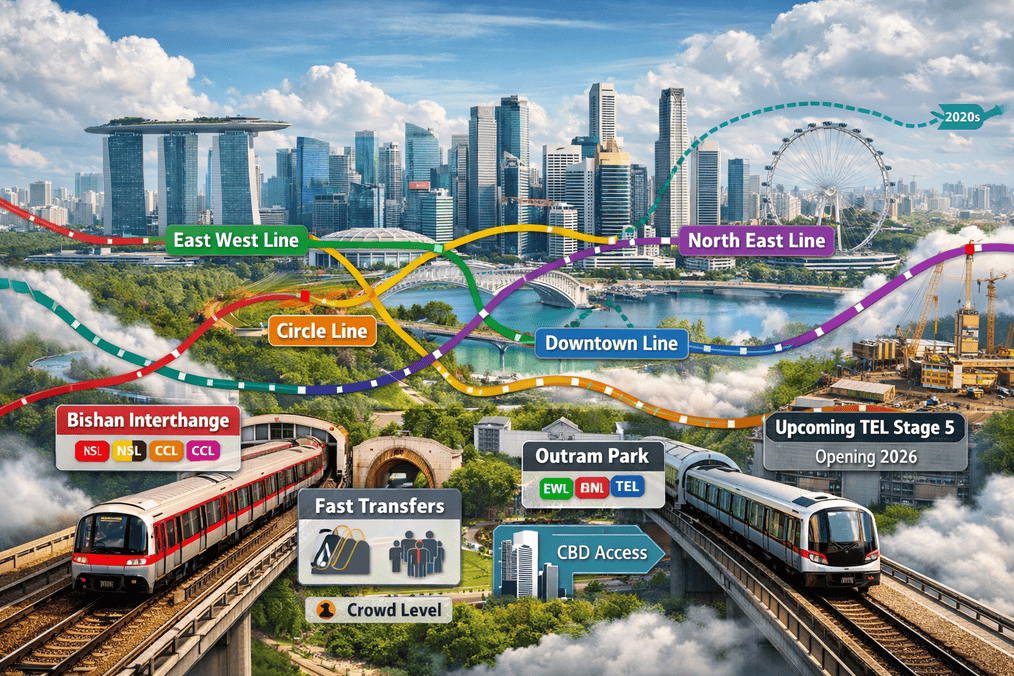
Why “best” depends on your commute, not just the map
In Singapore, the “best” MRT line is usually the one that reduces your total door-to-door time, keeps transfers painless, and gives you predictable crowding. A line that feels perfect for an office commuter heading into the CBD can feel slow and packed for someone who travels cross-island at peak hour, or for a family that needs easy lift access and short platform walks. So instead of ranking lines like a popularity contest, this guide focuses on what commuters actually care about: fastest practical routes, the easiest transfer stations, where crowds concentrate, and how upcoming expansions may change which lines are smartest to live near.
How to judge a commuter-friendly MRT line
Speed is not only about how fast trains run. It is about how many stops you take, how long you wait, whether you can avoid a transfer, and how long your transfer walk is when you cannot avoid one. Reliability and line resilience matter too, because an alternative route can save your morning when something goes wrong. Finally, station design matters more than people expect. Some interchanges feel like a short corridor. Others require long walks, multiple escalators, or navigation through busy concourses that add friction every day.
North South Line (NSL): the classic spine for north to city commuters
The North South Line remains one of the most important commuter backbones because it connects major residential clusters in the north and central areas to Orchard and the CBD belt. For many people, NSL is the default “straight shot” into town, especially when the origin and destination both sit on the line. The upside is simplicity and a familiar set of interchanges that connect you to almost everywhere else. The trade-off is that NSL can feel crowded at peak periods on the city-bound direction, and disruptions ripple widely because of how many people depend on it.
For commuters, NSL becomes far more powerful when paired with good interchange choices. Bishan is a key option if you need Circle Line connectivity without diving into the densest downtown interchanges. Orchard is significant for shoppers and office workers and it links with the Thomson–East Coast Line, offering an alternative north-to-city corridor. Marina Bay also provides a multi-line interchange environment that can help you reroute if you are heading to the downtown core, especially if your final stop is close to the Circle Line or the Thomson–East Coast Line.
East West Line (EWL): Singapore’s busiest workhorse for the widest corridor
The East West Line is the long-haul commuter workhorse: it spans large residential areas, major job nodes, and crucial interchange points. If you regularly travel between the west and the city, or between the east and the city, EWL often provides the most direct path with fewer transfers. EWL’s greatest commuter advantage is how many important interchanges sit on or connect to it. That advantage is also why crowding can feel intense during peak hours, because EWL absorbs commuting demand from multiple directions.
City Hall and Raffles Place are the classic central interchanges because they connect EWL with NSL, giving you two parallel station choices in the heart of the CBD. Outram Park is another high-value station because it links EWL with both the North East Line and the Thomson–East Coast Line, making it one of the most reroute-friendly hubs in the system. Jurong East is a powerful west-side interchange for people who transfer to NSL, and it becomes even more strategic when you consider the west’s future rail growth. Paya Lebar also matters because it connects EWL and Circle Line and often offers a less congested way to reach certain city-fringe destinations compared with changing trains deep in the downtown core.
North East Line (NEL): fast access to the city with a strong interchange chain
NEL is a highly commuter-friendly line for people living in the north-east corridor because it provides a relatively direct path toward central Singapore and key activity areas. HarbourFront at one end is a major destination station for retail and leisure, while the line’s interchange stations make it unusually flexible for cross-network movement.
Serangoon is one of the most valuable commuter interchanges because it connects NEL to Circle Line, enabling efficient movement toward the one-north area, the east, and other orbital destinations without first going into the CBD. Outram Park, as mentioned earlier, is a powerhouse because it connects NEL with EWL and Thomson–East Coast Line, which means a north-east commuter can reach large parts of Singapore with one well-chosen transfer. Dhoby Ghaut is another key node linking NEL to NSL and Circle Line, though it can be very busy and involves substantial station navigation, especially at peak times.
Circle Line (CCL): the orbital line that saves time by avoiding downtown
For many commuters, Circle Line is the “time-saver line” because it lets you bypass the city core when your trip is between city-fringe nodes, business parks, universities, and residential clusters that sit around the circle. If you commute between places like one-north, Buona Vista, Paya Lebar, Bishan, or Dhoby Ghaut, CCL is often the difference between a single smooth transfer and a frustrating downtown detour.
Buona Vista is a commuter favorite because it connects Circle Line to East West Line and gives direct access to one-north, research clusters, and office zones. Botanic Gardens is another commuter-friendly interchange because it connects Circle Line with Downtown Line and tends to be a clean, logical transfer for reaching the city or cutting across to the east. Bishan offers a central transfer between Circle Line and North South Line that can be easier than switching at the downtown-heavy nodes. Promenade and Bayfront matter for commuters whose jobs sit near Marina Bay or the downtown waterfront area because they connect Circle Line to Downtown Line, and Bayfront also links to the Thomson–East Coast Line.
Downtown Line (DTL): the commuter line for CBD access and east-side connectivity
Downtown Line is extremely strong for commuters who need consistent access to the downtown core. It also provides a fast-feeling alternative for certain east-to-city journeys, especially when your destination is closer to DTL’s stations than to the NSL or EWL core stops. DTL’s interchange stations are what make it a serious commuter tool rather than only a city line.
Bugis connects DTL to EWL and is a practical gateway into the city, especially if you want to avoid the very densest downtown interchanges. Chinatown connects DTL to NEL, offering a very useful cross-network link that can cut travel times for some north-east to city routes. Newton connects DTL to NSL and can be valuable for riders whose trips involve Orchard or the central spine. Botanic Gardens, as mentioned, is a particularly commuter-friendly DTL-CCL connection that helps you reach one-north and other orbital destinations with fewer steps.
DTL’s next major commuter boost is the planned connection at Sungei Bedok, because it will interchange with the Thomson–East Coast Line when TEL Stage 5 opens in the second half of 2026, creating a new transfer bridge between these two important lines.
Thomson–East Coast Line (TEL): the rising star for north-to-city alternatives and East Coast access
Thomson–East Coast Line is increasingly commuter-relevant because it offers an alternative north-to-city corridor and provides new rail coverage along the East Coast. TEL Stage 4 opened for passenger service on 23 June 2024, expanding TEL’s usefulness for daily travel. The line is designed to provide more alternative travel routes and improve connectivity, particularly for residents along the corridor it serves.
For commuters, TEL’s best feature is how it links several high-value interchange stations. Caldecott connects TEL with Circle Line, which is a powerful combination for orbital movement without entering the downtown core. Stevens connects TEL with Downtown Line, which can be a smooth way to reach the city core or cross to the east. Orchard connects TEL with NSL, which makes it an easy switch for people whose daily routine touches the Orchard belt or who need redundancy against delays. Outram Park is a major TEL interchange with EWL and NEL, turning it into one of the most flexible commuter hubs in Singapore.
Looking ahead, TEL Stage 5 is scheduled to open in the second half of 2026, extending service to Bedok South and Sungei Bedok, and strengthening East Coast connectivity while enabling an interchange with Downtown Line at Sungei Bedok. For commuters living in the east or traveling along the coast, that connection can reshape which line is fastest depending on where the final destination sits.
Fastest route thinking by commuter pattern
If your daily travel is a straight corridor commute, your fastest route is usually the line that gives you the fewest transfers even if it is slightly longer on the map. North residents heading to Orchard or Marina Bay often benefit from a direct NSL ride or a strategic switch to TEL at Orchard if it shortens the last-mile walk. West-to-city commuters often do best by staying on EWL into the core, unless the destination is closer to an orbital station that makes a CCL transfer worthwhile. North-east commuters usually win by staying on NEL and choosing an interchange based on where the office sits, often Serangoon for orbital access or Outram Park for cross-network reach.
If your commute is cross-island, speed is frequently about avoiding the downtown bottleneck and using Circle Line as the “bridge.” For example, if you need to move between the west and the east without actually working in the CBD, an EWL to CCL transfer at Buona Vista or Paya Lebar can be faster and less mentally exhausting than heading into City Hall or Raffles Place and switching there.
Transfer ease: the stations commuters tend to love and the ones they brace for
Transfer ease is a combination of walking distance, clarity, and crowd flow. Stations like Buona Vista, Botanic Gardens, and Bishan often feel commuter-friendly because the interchange logic is straightforward and the orbital connections are valuable. Outram Park is extremely useful because it links three major lines, though it can be busy, and its value grows when you are planning for redundancy.
On the other hand, Dhoby Ghaut, City Hall, and Raffles Place are incredibly powerful but can feel more intense during peak hour because they concentrate commuter flows in tight central spaces. They are not “bad” stations, but they require better timing, faster walking, and more patience, especially if you have a strict arrival time.
Crowd levels: where peak-hour pressure usually concentrates
Crowding is highly time dependent, but certain patterns repeat. City-bound stretches of NSL and EWL typically feel most compressed during the morning peak, while the reverse direction becomes more crowded in the evening. The central interchanges experience persistent pressure because they combine through-passengers with transferring passengers. Stations at major employment nodes and large mall clusters also attract surges at lunch and after work.
If you want a calmer daily experience, one practical strategy is to choose interchanges that are one step away from the absolute core, such as transferring at Paya Lebar instead of changing at City Hall for some east-side trips, or using Bishan or Caldecott instead of Dhoby Ghaut when your route allows it. The travel time difference can be small while the comfort difference can be noticeable.
Future expansions that could change “best lines” for commuters
The biggest long-term network change is the Cross Island Line. LTA states that construction for Cross Island Line Phase 1 has commenced and is targeted to be completed by 2030, and it will link to existing lines at Pasir Ris on EWL, Hougang on NEL, Ang Mo Kio on NSL, and Bright Hill on TEL. This is commuter-significant because it creates a true cross-island spine that can reduce reliance on downtown transfers for many trip types. LTA also notes that the CRL–Punggol Extension has commenced construction and is targeted to be completed by 2032, improving connections between parts of the east and the north-east.
In the west, the Jurong Region Line is expected to reshape commuting inside Jurong and its surrounding areas by connecting multiple west-side nodes and offering new transfer options into the broader MRT network. Public sources commonly describe the JRL as opening progressively in stages from 2027 to 2029. Even if timelines shift, the commuter takeaway is stable: west-side connectivity and alternative routing options are set to improve substantially over the next few years.
Closer in time, TEL Stage 5 in the second half of 2026, along with the new interchange at Sungei Bedok connecting TEL and DTL, is one of the most commuter-relevant near-term upgrades because it creates a new east-side transfer spine and improves route choices for people traveling between the north-to-city corridor and the east coast corridor.
Stations that tend to be commuter “sweet spots” for living near
From a commuter lens, the best stations to live near are not always the most central. They are often strong interchanges slightly outside the core, where you can choose multiple routes without paying the “downtown crowd tax” every day. Serangoon is a prime example because it links NEL and CCL and supports both city-bound trips and orbital movement. Buona Vista is another, because it connects EWL and CCL and gives flexibility into one-north and city directions. Bishan works similarly for NSL and CCL commuters. Caldecott is rising in commuter value because it links TEL and CCL, and TEL itself is becoming a strong alternative corridor for north-to-city travel.
If your daily destination is the CBD, the traditional central interchanges remain unbeatable for direct access, but many commuters prefer living near a station that gives them two good ways to get downtown rather than one, so that small disruptions do not derail the day.
Practical commuter takeaway
If you want the simplest commute, pick a home station and work station that are on the same line and avoid transfers. If you want the most resilient commute, choose a home station near a high-quality interchange like Serangoon, Buona Vista, Bishan, Outram Park, or Botanic Gardens so you can swap routes when crowding or delays hit. If you want a “future-proof” commute, keep an eye on the Cross Island Line interchanges and the east-side TEL and DTL connection at Sungei Bedok in the second half of 2026, because these expansions can change what “fastest route” means for entire corridors.