
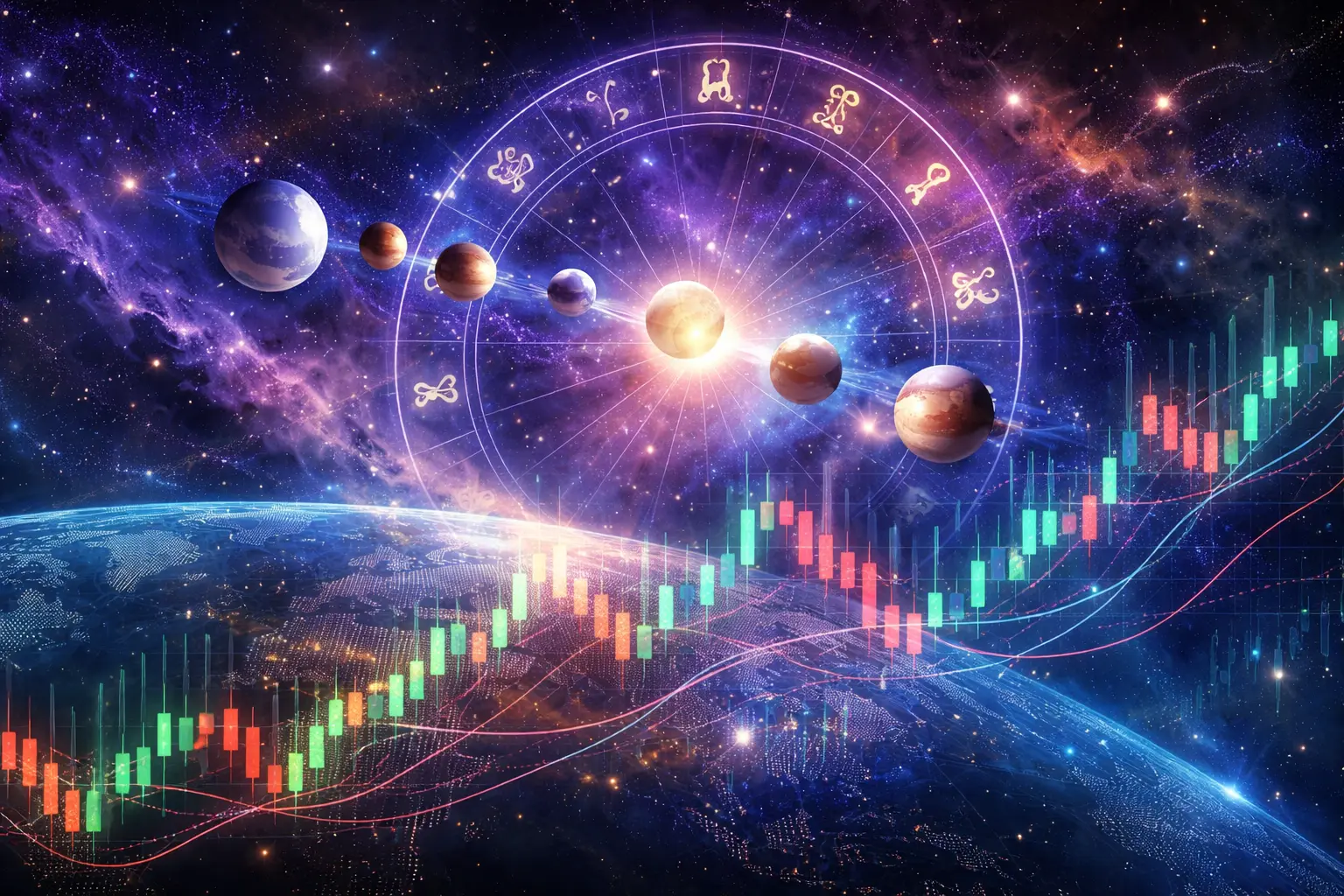
Astrology trading integrates celestial phenomena with financial analysis to forecast market trends and enhance trading strategies. This approach combines traditional technical analysis with astrological insights to gain a competitive edge in financial markets.
Astrological Technical Analysis
Astrological technical analysis utilizes planetary movements and aspects to interpret market behavior. By studying how planets in transit affect financial indicators, traders can predict potential price movements and identify optimal entry and exit points.
Planets in Transit: Influence on Market Dynamics
Understanding planetary transits is crucial for astrology trading. Each planet’s movement and alignment with key financial indicators can signal shifts in market sentiment and investor psychology. For instance, Jupiter’s transit may signify periods of optimism and growth, influencing bullish market trends.
Planetary Aspects: Analyzing Market Volatility
Planetary aspects, such as conjunctions and oppositions, impact market volatility and stability. Traders analyze these aspects to gauge potential market fluctuations and adjust their trading strategies accordingly. For example, a Mars-Uranus square might indicate sudden market disruptions.
Lunar Cycles: Timing Market Movements
Lunar cycles play a significant role in astrology trading, affecting market sentiment and investor behavior. Traders observe new moons and full moons to anticipate market reversals or heightened volatility, integrating lunar phases into their trading strategies.
Support and Resistance in Astrology: Aligning with Planetary Forces
In astrology trading, support and resistance levels are interpreted through planetary alignments. These levels signify price barriers influenced by planetary energies, guiding traders in identifying key levels for buying or selling.
Combining Technical Analysis with Astrology
Integrating technical analysis with astrology enhances trading precision. Traders use astrological insights to validate technical signals and improve decision-making, optimizing trading strategies for better risk management and profitability.
Trading Psychology and Astrology: Embracing Emotional Intelligence
Astrology trading emphasizes trading psychology, helping traders manage emotions and psychological biases. Understanding planetary influences on human behavior enhances emotional intelligence in trading, promoting disciplined and informed decision-making.
Day Trading and Swing Trading Astrology
Astrology can be applied to both day trading and swing trading strategies. Day traders might look at shorter planetary cycles and lunar phases to make quick, informed decisions. Swing traders, on the other hand, may focus on longer-term planetary transits and aspects to plan their trades over days or weeks.
Best Astrological Indicators for Trading
Identifying the best astrological indicators for trading involves understanding the nuances of planetary influences. Important indicators include retrogrades, eclipses, and major planetary aspects. Retrogrades, particularly of Mercury, can signify periods of market confusion, while eclipses often herald significant turning points.
Financial Astrology in Cryptocurrency Trading
The principles of financial astrology can also be applied to cryptocurrency trading. As digital currencies operate 24/7, the influence of planetary movements can be continuously observed. Traders can leverage astrological insights to navigate the volatile crypto markets, using the same strategies as with traditional assets.
Criticisms and Validation of Astrology Trading
While astrology trading has its critics, who argue that it lacks scientific basis, there are successful traders who attest to its effectiveness. The key is to use astrology as one of many tools in a comprehensive trading strategy. Combining astrological insights with technical and fundamental analysis can provide a well-rounded approach to market speculation.
How Each Planet Influences Trader Behavior
Astrology isn’t just about predicting market movement—it’s also about understanding your own trading psychology. Each planet influences how you perceive risk, manage money, and respond emotionally during trades.
Sun – Confidence, ego, leadership. Traders with strong Sun placements may take bold positions and enjoy being contrarian.
Moon – Emotion, instinct, rhythm. A strong Moon enhances intuition but can also lead to overreactions.
Mercury – Analysis, logic, execution. Dominant Mercury makes you detail-oriented, perfect for scalping or data-based strategies.
Mars – Drive, aggression, energy. Strong Mars can make one impulsive—good for momentum trades, risky for long holds.
Jupiter – Optimism, expansion, overconfidence. Great for long-term trends but can lead to greed.
Saturn – Discipline, delay, structure. A steady hand in volatile markets—best for slow but sure traders.
Types of Traders Based on Zodiac Signs
Aries: Bold risk-takers, love fast markets. Thrive in high-volatility trades.
Taurus: Patient investors. Prefer blue-chip stocks, slow and steady growth.
Gemini: Multi-tasking scalpers. Perfect for intraday or news-based trading.
Cancer: Emotionally aware. May need support to avoid panic-selling.
Leo: Confident swing traders. Often build their own systems.
Virgo: Data-driven and analytical. Use backtesting and indicators heavily.
Libra: Balance-seekers. Prefer diversified portfolios and trend confirmation.
Scorpio: Strategic and secretive. Excel in options or crypto.
Sagittarius: Macro traders. Think globally and trade long-term trends.
Capricorn: Disciplined planners. Ideal for long-term equity investing.
Aquarius: Futuristic and innovative. Drawn to tech and blockchain.
Pisces: Intuitive and idealistic. May follow astrology, lunar phases, or gut feel.
Historical Market Events Explained Through Astrology
One powerful way to strengthen astrology trading content is by connecting planetary cycles with well-known historical market events. When traders see how past crashes, rallies, or regime changes aligned with major planetary transits, astrology becomes more tangible and less abstract. This section can explore how Saturn cycles have coincided with credit tightening, how eclipses aligned with sharp market reversals, or how Jupiter transits marked expansion phases in equities. By grounding astrology in real market history, readers gain confidence in its practical relevance.
Astrology-Based Market Cycles and Long-Term Trends
Markets move in cycles, and astrology provides a framework to understand why certain phases repeat over decades. Long-term planetary cycles such as Saturn returns, Jupiter-Saturn conjunctions, and nodal shifts often align with economic restructuring, policy shifts, and changes in risk appetite. This section can explain how traders can use these cycles to identify secular bull markets, long consolidation phases, or structural downturns. It helps readers move beyond short-term trades into strategic positioning.
Sectoral Astrology: Which Planets Influence Which Markets
Different sectors respond differently to planetary energy. This section can map planets to industries and asset classes. For example, Mercury often aligns with technology, communications, and trading volume. Venus connects with luxury goods, fashion, and consumer sentiment. Mars is linked to energy, defense, and commodities, while Saturn governs banking, infrastructure, and regulation-heavy sectors. This perspective allows traders to rotate capital intelligently rather than applying one strategy across all markets.
Astrology-Based Risk Management and Capital Allocation
Most trading failures occur due to poor risk management rather than poor entry signals. Astrology can be used to adjust position sizing, leverage, and exposure during high-risk planetary periods. This section can explain how eclipses, retrogrades, or hard Saturn aspects may call for reduced risk, tighter stop-losses, or staying in cash. Conversely, supportive transits may justify higher conviction trades. This reframes astrology as a risk filter, not just a timing tool.
Using Personal Birth Charts for Trading Alignment
A powerful addition is the concept of aligning trades with the trader’s own natal chart. Different individuals respond differently to the same market conditions because of psychological wiring shown in their horoscope. This section can explain how traders can identify their natural strengths and weaknesses through their birth chart, such as impatience, overconfidence, or fear of loss. Trading in harmony with one’s astrological profile improves consistency and emotional stability.
Conclusion: The Future of Astrology in Trading
Astrology trading continues to evolve as traders recognize its potential in navigating complex financial landscapes. By leveraging celestial insights alongside technical analysis, traders can gain a deeper understanding of market dynamics and potentially improve their trading performance. The integration of astrology into trading strategies offers a unique perspective that blends ancient wisdom with modern financial acumen.
Astrology Trading FAQs
Explore common questions about astrology trading, planetary timing, eclipses, market sentiment, and how traders can use astrology as an additional timing layer.
Astrology trading is a method that combines financial market analysis with planetary movements, lunar cycles, and astrological timing. Traders use it as an additional layer alongside technical and fundamental analysis to understand market sentiment, volatility, and possible turning points.
Astrology helps traders study timing, sentiment, and emotional cycles in the market. Planetary transits, retrogrades, eclipses, and lunar phases may indicate periods of volatility, caution, optimism, or reversal. It does not replace charts or market data, but it can support better timing and risk awareness.
Astrology can highlight potential market windows, but it should not be treated as a guaranteed prediction system. It works best when used with technical analysis, price action, volume, macro data, and proper risk management. The goal is to improve probability, not promise certainty.
Eclipses are considered important turning points in astrology. In financial astrology, eclipses may signal sudden shifts, trend changes, or periods of heightened uncertainty. Traders often use eclipse windows as caution zones rather than direct buy or sell signals.
Yes, a personal birth chart can show emotional patterns, risk appetite, discipline, patience, and decision-making style. For example, strong Mars energy may create bold but impulsive trading behavior, while strong Saturn may support patience and long-term discipline.