
Why Astrology and Trading Are Being Reconnected
Astrology and trading might sound like two different worlds. One belongs to charts of the sky, the other to charts of price. Yet, when you look closely at market history, you repeatedly see the same curiosity. Turning points in stocks, commodities, indices, and even crypto often seem to cluster around powerful planetary cycles.
This is why the idea of astrology and trading has regained attention among serious traders, especially those who understand that markets are not just numbers but human behavior and collective psychology expressed in price. As global liquidity, central bank policy, and algorithms shape intraday volatility, many traders are searching for an additional layer of timing and context. That is where the study of astrology–trading market patterns comes in.
In this guide, you will explore how astrological cycles can help you understand recurring market patterns, how to combine astrology and trading in a practical, disciplined way, and how to avoid the common traps of blind faith or over-confidence. The objective is not to replace technical or fundamental analysis, but to add a timing and sentiment layer that may give you an edge in volatile conditions.
Understanding the Core Idea Behind Astrology and Trading
At the heart of astrology and trading lies a simple but powerful assumption. Human behavior is cyclical, and those cycles tend to synchronize with planetary rhythms. Financial markets are nothing more than a collective expression of human behavior, fear, greed, and expectations.
Astrology observes how specific configurations in the sky appear to correlate with repetitive patterns on Earth. When you bring this lens into the markets, you start to observe that certain planetary aspects, retrogrades, and cycles often coincide with volatility bursts, reversals, or shifts in trend. You do not have to believe in astrology as a “cause” to appreciate that these correlations can sometimes be useful as trading signals or filters.
This perspective treats astrology and trading as a partnership. Markets remain governed by liquidity, macro data, corporate earnings, and policy. Astrology does not cancel any of that. Instead, it proposes that the timing of strong moves, false breakouts, and sudden reversals may follow recognizable cosmic rhythms. If you can map those rhythms into your strategy, you might anticipate risk windows and opportunity windows more clearly.
The Planetary Architecture Behind Market Patterns
To use astrology and trading intelligently, you need to understand the main celestial players and how they tend to show up in market patterns. Different planets have different tempos and signatures, and markets respond differently to each of them.
The Sun represents vitality, focus, and the dominant tone of a period. In market terms, solar aspects often highlight the prevailing narrative and the overall mood. New Moons and Full Moons, which involve the Sun and Moon, are often associated with key emotional inflection points, particularly for retail-driven markets and short-term trading.
The Moon symbolizes emotion, sentiment, and the crowd’s instinctive reactions. Its fast cycle through the zodiac means that intraday and short-term turns often track lunar phases and sign changes. Many traders who are serious about astrology and trading use lunar cycles to mark potential reversal days or days of exaggerated volatility.
Mercury rules communication, data, and information flow. In markets, Mercury is linked with news, rumors, and the constant stream of updates that move prices. Mercury retrograde phases have a reputation for confusion, technical glitches, re-pricing, and false moves. For traders, this can translate into whipsaws, failed breakouts, or re-tests of previous levels.
Venus connects with value, money, and preferences. In trading, Venus cycles sometimes align with rotations between sectors, shifts in risk appetite, and changes in how investors perceive valuation. When you look at astrology and trading from a Venus perspective, you often find that certain Venus cycles link to major lows or highs in equity indices or specific sectors such as luxury, consumer, or financials.
Mars is the planet of action, aggression, and urgency. In markets, Mars often correlates with strong moves, panic selling, sharp rallies, and volatility spikes. Mars aspects, especially to outer planets like Saturn, Uranus, Neptune, or Pluto, can create market environments filled with decisiveness, conflict, or sudden risk events.
The outer planets represent deeper background trends. Jupiter signifies expansion, growth, optimism, and risk-taking. Saturn brings discipline, restriction, and reality checks. Uranus is associated with shocks, disruption, and sudden changes. Neptune clouds things with illusion, liquidity distortions, and bubbles. Pluto symbolizes transformation, power struggles, and intense re-pricing.
When traders combine astrology and trading, they are essentially mapping how these planetary energies interact through aspects and cycles, and then observing how markets tend to behave under similar configurations across history.
Aspects and Cycles: The Building Blocks of Astrology–Trading Market Patterns
Aspects are the angular relationships between planets. Certain aspects appear again and again around major market highs, lows, or trend transitions. Over time, traders can build their own database of how specific aspects behave in different markets.
Conjunctions occur when two planets align in the same zodiac degree. In astrology and trading analysis, conjunctions often mark fresh cycle beginnings. They can coincide with major policy shifts, new speculative themes, or resets in trend. For example, a conjunction between Jupiter and Saturn has traditionally been seen as restructuring the economic and social order over long cycles.
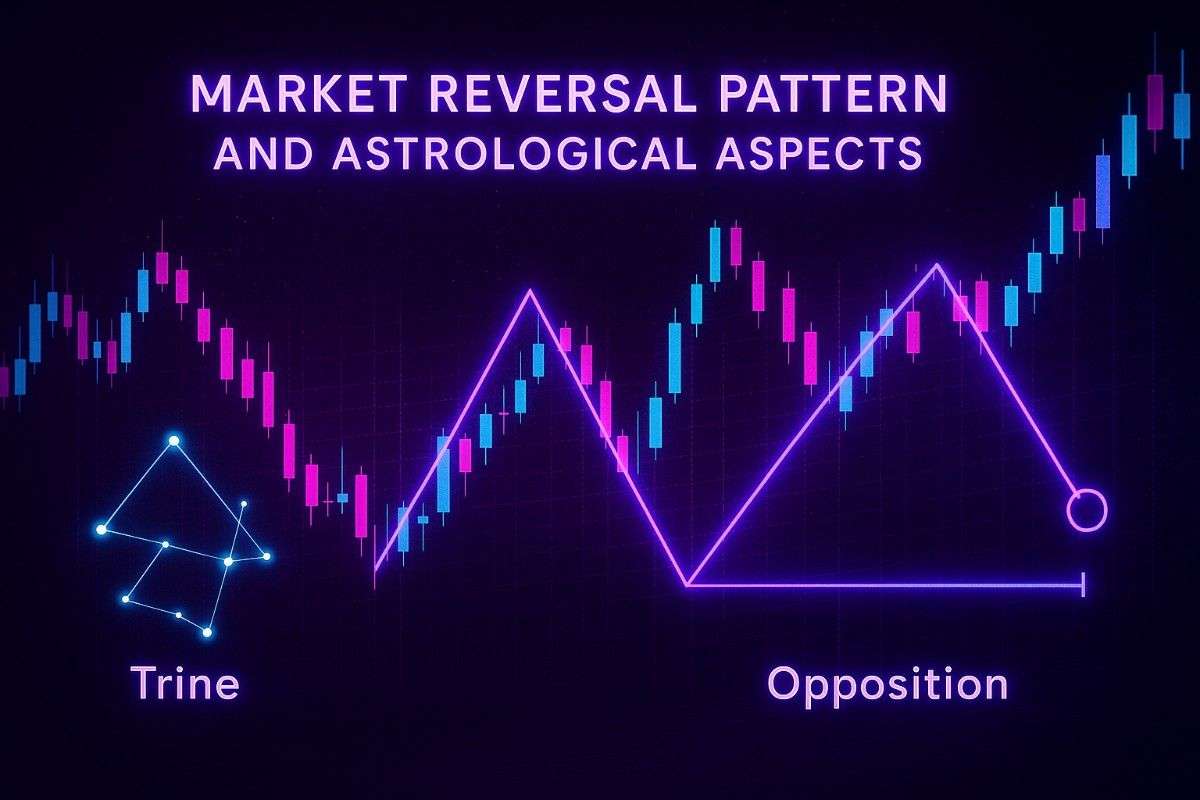
Oppositions represent tension between two poles. In markets, oppositions often manifest as strong push-and-pull between bulls and bears, resulting in volatility and possible trend reversals or accelerations. The classic pattern is that sentiment stretches to extremes as the opposition perfects, creating conditions for a reaction move.
Squares bring friction and challenge. In astrology and trading, square aspects between market-sensitive planets often align with stress, uncertainty, and sharp moves. They might represent key battle zones where markets decide whether to break out or fail.
Trines and sextiles are easier, flowing aspects. In market terms, they can correspond to trending environments where price moves more cleanly in one direction, often with lower resistance, especially when aligned with supportive macro data.
Beyond aspects, cycles matter. Each planet has a cycle length, and turning points within these cycles can serve as timing anchors. For instance, a Jupiter cycle through the zodiac takes roughly 12 years, Saturn around 29 years. When you overlay long-term price charts with these cycles, certain recurring themes often emerge around specific degrees or signs.
The study of astrology and trading market patterns involves tracking these aspects and cycles across multiple time frames and linking them with price behavior, volatility regimes, and macro conditions.
The Role of Signs and Elements in Market Behavior
Zodiac signs and their elements add another dimension to astrology and trading. Signs are grouped into fire, earth, air, and water, each with a distinct psychological tone that shows up in market behavior.
Fire signs, such as Aries, Leo, and Sagittarius, are associated with enthusiasm, risk-taking, and bold moves. Periods with strong fire sign emphasis can coincide with speculative rallies, aggressive breakouts, or new themes capturing traders’ imagination.
Earth signs, such as Taurus, Virgo, and Capricorn, tend to emphasize practicality, value, and stability. During strong earth periods, markets may favor defensive sectors, quality assets, or earnings strength. Fake euphoria often gets challenged by reality.
Air signs, such as Gemini, Libra, and Aquarius, highlight communication, networks, and ideas. In these phases, markets may be driven by narratives, tech themes, social sentiment, or rapid information flows. Airy climates can be fantastic for growth stories but also prone to over-reaction to news.
Water signs, such as Cancer, Scorpio, and Pisces, emphasize emotion, intuition, and the subconscious. Market behavior in these periods can be more driven by fear, hope, and hidden information. Water-heavy skies may coincide with liquidity distortions, crisis narratives, or deep re-pricing events.
By combining signs, elements, and aspects, astrology and trading practitioners attempt to anticipate not only when markets are likely to move, but also the quality of those moves. Are they likely to be emotional and overdone, rational and measured, speculative and fast, or grinding and structural.
How Astrology–Trading Market Patterns Show Up on Price Charts
The practical bridge between astrology and trading is the price chart. All theories ultimately need to prove themselves in how price behaves.
Many traders using astrology–trading market patterns work in layers. First, they identify key dates based on planetary aspects, lunations, retrogrades, or ingress events into important signs. Then they check whether these dates cluster around existing technical levels, such as major support or resistance, moving averages, Fibonacci retracements, or long-standing trend lines.
If astrological timing and technical levels converge, the date becomes a “high probability window” rather than a guaranteed turn. Within that window, traders watch for classic price action signals such as reversal candles, volume surges, failed breakouts, or divergences in momentum indicators.
One common approach is to mark calendars for New Moons and Full Moons, particularly those that make tight aspects to key market-sensitive planets. Short-term traders often observe how indices or key stocks behave around those dates. Some markets show a habit of reversing, while others tend to accelerate existing trends. The goal is not to assume that every lunar event will create a reversal, but to be extra alert to what price is telling you.
Another practical technique in astrology and trading is to overlay long-term planetary cycles, such as Saturn or Jupiter transits, on monthly or weekly charts. Major highs and lows often appear to repeat when these planets revisit sensitive degrees or aspects. Traders then pay special attention when price reaches those zones again under similar astrological conditions.
Integrating Astrology and Trading With Risk Management
No matter how convincing astrology–trading market patterns may look in hindsight, risk management remains essential. Markets can behave differently under the same sky due to new macro forces, policy surprises, or simply the complex nature of human behavior.
A disciplined trading plan should define position size, entry criteria, stop-loss levels, and exit rules before executing. Astrology should not replace those mechanics; it should enhance them. For instance, when a significant planetary aspect suggests elevated volatility, a trader might choose smaller position sizes, wider stops, or more selective entries. When a more supportive cycle is unfolding, the trader may scale up carefully as technical confirmation appears.
Many practitioners of astrology and trading use astrological windows for timing, but rely on price action to validate their entries. They never enter purely because a date looks important astrologically. Instead, they treat astrology as a timing radar, not a trading signal by itself. This attitude protects them from over-confidence and allows them to treat astrology as one more tool in their arsenal.
Psychological Benefits of Understanding Astrology and Trading
Beyond predictions, astrology and trading work together in another subtle but important way. Markets often feel random and overwhelming. Traders can become fearful, impatient, or overconfident. Recognizing that markets move in cycles can restore a sense of structure and patience.
Astrological calendars remind traders that not every day is equal. Some periods naturally favor waiting, others favor careful engagement. This helps reduce the urge to overtrade. When you know a key planetary cluster or aspect is approaching, you may choose to observe more closely rather than forcing trades in low-probability conditions.
Moreover, astrology and trading together encourage self-awareness. Your own natal chart, if you choose to work with it, may reveal how you react to risk, drawdowns, and uncertainty. Some traders discover that they are more impulsive or more fearful during certain transits. Recognizing these tendencies in advance can help them stick to their rules more effectively.
Common Mistakes When Applying Astrology–Trading Market Patterns
As with any powerful tool, astrology and trading can be misused. One of the most common mistakes is treating astrology as a guarantee rather than a probability enhancer. Markets are multi-causal. Even the most precise astrological configuration can be overridden by unexpected news, central bank announcements, or geopolitical events.
Another trap is data mining without discipline. It is easy to cherry-pick historical instances that support a favorite pattern while ignoring the times it did not work. Serious practitioners of astrology and trading build detailed logs of dates, configurations, and actual market outcomes. Over time, they refine their understanding, identify which patterns are reliable in which markets, and eliminate those that are too inconsistent.
A third issue is ignoring traditional analysis. Some traders become so fascinated by astrology that they neglect fundamentals, macro context, or technical structure. This usually ends badly. The most robust approach treats astrology as an additional dimension, not a substitute. A planetary signature that suggests risk must still be interpreted in light of trend, liquidity, positioning, and sentiment.
Finally, some people underestimate the psychological bias that can creep in. If you decide in advance that a specific aspect must cause a crash or a rally, you may filter information and price action to fit that narrative. This is dangerous. The most effective use of astrology and trading involves curiosity, flexibility, and a willingness to accept when a pattern is not playing out as expected.
Building a Structured Astrology–Trading Workflow
To turn astrology and trading into a reliable workflow, you need structure and repetition. A simple approach involves three layers: calendar, chart, and journal.
First comes the calendar. At the start of each month or quarter, you identify the key planetary events that tend to move markets. This may include major aspects between outer planets, lunations that activate important degrees, retrograde stations, and sign ingresses of market-sensitive planets. You note these dates as potential windows of change or volatility.
Second comes the chart. For each instrument you trade, you analyze the bigger picture trend using your usual technical tools. You mark supports, resistances, key moving averages, and any relevant patterns. Then you overlay your astrological dates and see where they intersect with key price zones. These intersections become your priority watch areas.
Third comes the journal. As each date approaches and then passes, you document what actually happened in the market. Did price reverse, accelerate, or stay flat. Was volatility higher than usual. Did any major news hit. Over months and years, this journal becomes your personalized database of astrology and trading correlations. You will see which patterns consistently work for you and which ones are noise.
By repeating this three-layer process, you turn an abstract concept into a concrete trading edge grounded in your own observation, rather than in theory alone.
Time Frames: Short-Term, Swing, and Position Trading With Astrology
Astrology and trading can be blended on multiple time horizons. Short-term traders, such as day traders and scalpers, may focus more on lunar cycles, intraday aspects, and the fast-moving Moon. They may watch how certain hours or days respond to Moon sign changes, planetary hours, or tight intraday aspects.
Swing traders typically combine weekly planetary calendars with daily technical charts. They look for multi-day to multi-week moves and treat major aspects or lunations as pivot windows. When a key aspect aligns with an overbought or oversold technical condition, the swing trader becomes more attentive to reversal patterns.
Position traders and investors, who hold for months or years, work more with long-term cycles. For them, astrology and trading is about identifying major accumulation phases, distribution phases, or secular turning points. They may study Saturn, Jupiter, Uranus, Neptune, and Pluto cycles in relation to indices, sectors, and macro data. These big cycles can help them understand when to be aggressively exposed, cautiously allocated, or heavily hedged.
The methods differ by time frame, but the principle remains identical. Astrology shapes your sense of timing and context, while price confirms your decisions.
Sector Rotation and Thematic Trades Through an Astrological Lens
Astrology and trading can also be applied to sector rotation and thematic risk. Different planets and signs resonate with different industries. For example, technology and innovation often correlate with Uranus and air signs. Banking and traditional finance resonate with Saturn and earth signs. Energy and raw materials have strong associations with Mars, Pluto, and certain fire or earth configurations.
When a particular planet becomes prominent through transits or aspects, sectors aligned with its symbolism may move into focus. Traders who follow astrology–trading market patterns sometimes position for these rotations by watching exchange traded funds, key sector leaders, or relative strength charts.
For example, if a major Uranus transit is culminating, traders may expect heightened volatility in technology, disruption-themed stocks, and high-beta growth names. If Saturn is asserting itself strongly, value-oriented, defensive, or income sectors might outperform while speculative areas compress. These broad tendencies are not rigid rules, but they provide a framework for thinking about where risk is likely to concentrate.
Crypto, Commodities, and Forex: Different Markets, Different Responses
One of the most fascinating aspects of astrology and trading is that different asset classes appear to respond differently to the same sky.
Crypto markets, heavily driven by sentiment, innovation narratives, and retail speculation, often appear highly sensitive to lunar cycles and outer-planet shocks. Sudden rallies and crashes can cluster around Full Moons, eclipses, or disruptive aspects involving Uranus. Traders who specialize in crypto sometimes use these windows to adjust leverage, hedge, or tighten risk.
Commodities such as gold, silver, and crude oil have their own rhythms tied not only to macro data but also to specific planetary signatures. For example, gold’s behavior has historically shown sensitivity to Jupiter, Neptune, and certain lunar configurations. Crude oil may respond strongly to Mars and Pluto aspects, especially when geopolitics is involved.
Forex and indices, being deeply linked to macro policy, interest rates, and capital flows, appear more tied to longer-term planetary cycles involving Jupiter, Saturn, and sometimes Uranus or Pluto. For forex traders, astrology and trading becomes a way to anticipate changes in risk sentiment, carry trade appetites, and central bank tone shifts.
The key for any trader is to specialize. You do not have to apply every astrological pattern to every market. Instead, you focus on one or two markets, track how they respond to the sky over time, and build your own statistically informed impressions.
Ethical and Practical Limits of Astrology in Trading
It is essential to recognize the limits and responsibilities that come with using astrology and trading together. Astrological analysis can tempt you to believe that you have access to hidden knowledge that others do not. This can be dangerous if it leads to over-leverage, disregard for risk, or a lack of humility.
From an ethical perspective, you should also be clear about how you use astrology if you share analysis with others. Presenting astrological views as probabilities and scenarios, rather than absolute guarantees, is both accurate and responsible. Transparent communication about risk, uncertainty, and the role of traditional analysis maintains trust.
Practically, there will be times when astrology and trading signals conflict with technical or fundamental evidence. You must decide in advance how to handle those conflicts. Some traders will always prioritize price. Others may reduce position sizes or stand aside rather than betting against a strong astrological risk window. What matters is that your rules are clear and consistent.
Future of Astrology–Trading Market Patterns in a Data-Driven World
In a world of machine learning, high-frequency trading, and algorithmic execution, it might seem strange to talk about astrology and trading. Yet data-driven methods can actually support or refute astrological hypotheses. By tagging historical price data with astrological variables, researchers can test whether certain patterns are statistically significant or simply random.
As computing power and data analysis tools improve, serious practitioners of astrology and trading will likely adopt more quantitative approaches. They might build models that incorporate planetary cycles as features alongside volatility metrics, macro indicators, and sentiment measures. The objective is not to create mystical black boxes, but to test whether planetary timing genuinely contributes incremental predictive power.
In parallel, human traders may continue to value the psychological and cyclical insights that astrology offers. Even if algorithms dominate execution, human decisions about strategy, risk, and time horizon are still influenced by emotion and narrative. Astrology remains a powerful way to frame those narratives and to remind traders that markets move in waves, not straight lines.
Conclusion: Using Astrology and Trading as a Strategic Edge, Not a Shortcut
Astrology–trading market patterns bring together two ancient observations. First, the sky moves in rhythms. Second, human behavior and collective emotion also move in rhythms. Financial markets are one of the purest expressions of that behavior. By carefully studying how planetary cycles align with market cycles, traders can potentially gain a fresh edge in timing, risk awareness, and psychological balance.
However, the key word is “carefully.” Astrology and trading must be approached with discipline, openness, and respect for risk. The most successful practitioners treat astrology as a sophisticated timing and context framework, not as a magic formula. They test their ideas, keep detailed records, and combine astrological insights with technical, fundamental, and macro analysis.
If you integrate astrology and trading in this balanced way, you do not abandon logic. Instead, you expand your toolkit. You acknowledge that markets are not just machines but living ecosystems of human fear, hope, and expectation. Under that lens, planetary cycles become one more map of crowd behavior, one more way to recognize when markets are stretched, vulnerable, or ready for a new phase.
Used wisely, astrology–trading market patterns can help you trade with greater awareness, patience, and precision. They encourage you to think in cycles rather than straight lines, to prepare for volatility windows instead of being surprised by them, and to connect your trading decisions with a broader view of time. That combination of structure and perspective is what turns astrology and trading into a genuine strategic ally on your path to becoming a more consistent and thoughtful market participant.