
Last Updated: October 8, 2026 | Stock: Tesla, Inc. (NASDAQ: TSLA) | Forecast Period: 2027–2030
Tesla stock price prediction 2030 has become an important topic for investors trying to understand the future of electric vehicles, artificial intelligence, autonomous driving and clean energy. Tesla, Inc. (NASDAQ: TSLA) is no longer evaluated only as an electric vehicle manufacturer. Its long-term stock valuation increasingly depends on whether the company can turn advanced technologies such as Robotaxi, Full Self-Driving (FSD), Optimus humanoid robots and battery storage into profitable businesses.
As of October 7, 2026, Tesla shares closed at approximately $377.81. Investors are now asking whether TSLA could reach $500, $700 or even $1,000 by 2030, particularly if Tesla successfully expands its autonomous mobility and robotics operations.
The answer depends on several factors, including revenue growth, profit margins, competitive pressure, global interest rates and the commercialization of Tesla’s emerging technologies.
This Tesla stock forecast for 2030 examines three possible outcomes, the key business developments investors should monitor, and the financial assumptions that could support different valuations.
Tesla Stock Price Prediction 2030: Key Takeaways
The future of Tesla stock depends on how successfully the company transforms its technological ambitions into sustainable earnings.
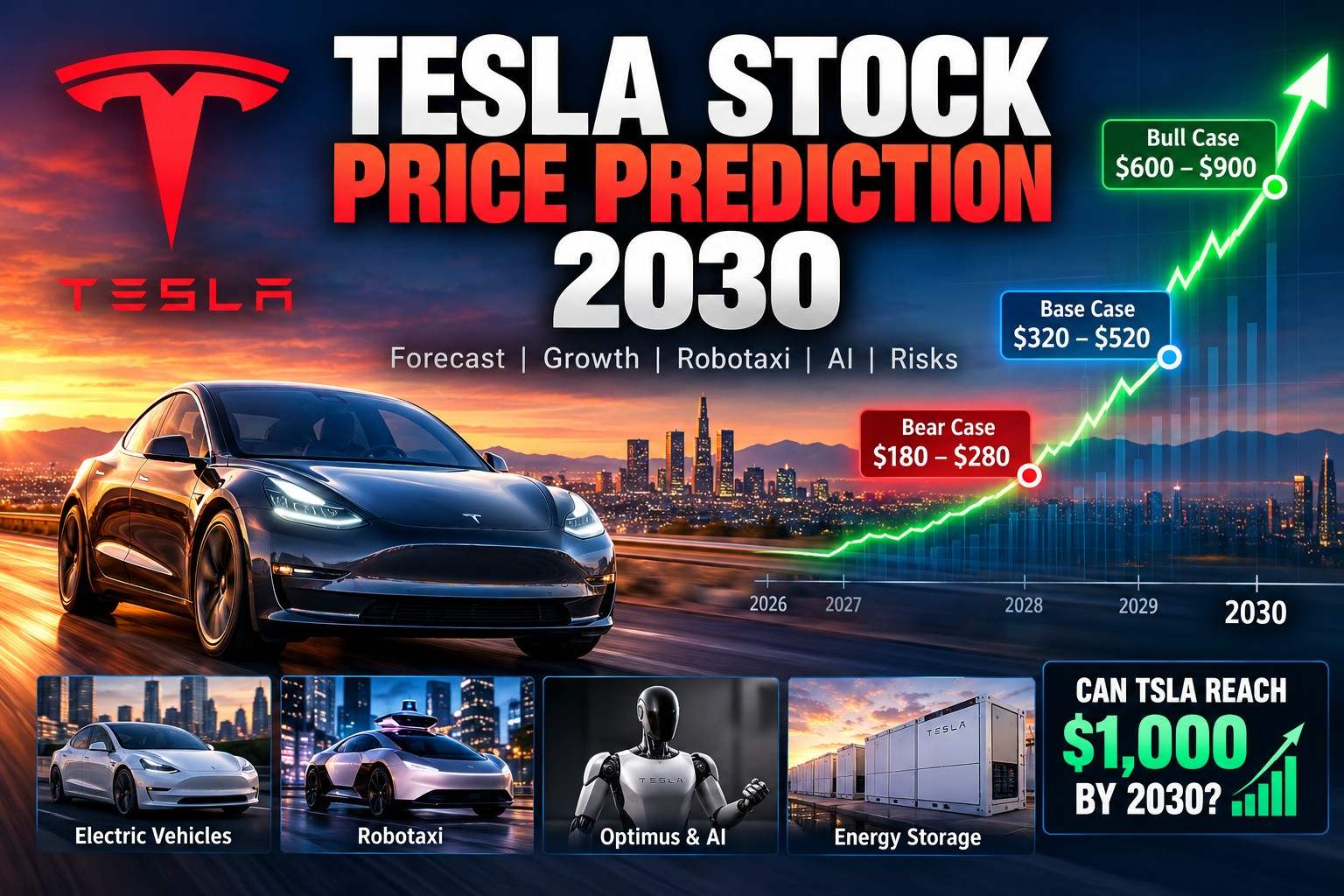
For a structured long-term analysis, investors can examine three illustrative outcomes.
| Scenario | Illustrative 2030 TSLA Price | Main Assumption |
|---|---|---|
| Bearish | $180–$280 | Weak automotive margins and disappointing technology monetization |
| Base case | $320–$520 | Moderate EV growth, expanding energy business and gradual software commercialization |
| Bullish | $600–$900 | Strong earnings growth supported by autonomy, software and robotics |
Important: These are independently constructed hypothetical valuation scenarios, not Wall Street consensus targets, guaranteed outcomes or statistically assigned probabilities. They assume no additional stock split and use simplified future earnings assumptions. They should be reassessed after each earnings release.
A sustained rise toward the upper end of these ranges would require Tesla to generate substantially more profits than its traditional vehicle manufacturing business alone might support.
Tesla Stock Price Today: Where Does TSLA Stand in 2026?
Tesla has experienced major changes in its competitive and financial position over recent years. The company helped establish the modern electric vehicle industry, but competition has intensified as global manufacturers introduce more affordable electric models.
As of the October 7, 2026 close, Tesla stock traded at $377.81. This historical reference provides a starting point for evaluating its potential performance through 2030.
The most recent delivery figures also provide useful context.
Tesla reported 480,126 vehicle deliveries during the second quarter of 2026, alongside 13.5 GWh of energy storage deployments. Third-quarter deliveries subsequently reached 486,532 vehicles, beating market expectations reported by Reuters.
These results suggest that Tesla continues to attract substantial demand, although vehicle deliveries alone cannot determine the company’s profitability.
Investors should also examine selling prices, automotive gross margins, operating expenses, capital expenditure and cash flow. A company may increase deliveries without improving earnings if it relies on heavy discounts or incurs additional production costs.
Tesla’s business now needs to be evaluated across several segments: electric vehicles, energy generation and storage, automotive software, autonomous transportation and emerging robotics applications.
Sources: Tesla Investor Relations | Reuters: Tesla Q3 2026 Deliveries
Tesla Stock Price Prediction 2027 to 2030
Long-term stock forecasts are most useful when investors understand how changes in revenue, earnings and valuation influence the eventual share price.
Rather than assuming Tesla will appreciate every year, investors should evaluate its progress through measurable business milestones.
Tesla Stock Price Prediction 2027
The year 2027 could be an important period for assessing Tesla’s ability to balance its automotive business with newer technology investments.
Investors will likely concentrate on whether vehicle deliveries grow profitably, whether energy storage becomes a larger contributor to operating income, and whether autonomous driving generates meaningful recurring revenue.
An improvement in automotive margins could support investor confidence. However, sustained capital expenditure on new technologies may limit free cash flow even if revenue continues increasing.
Tesla’s share price during 2027 may also be influenced by changes in Federal Reserve policy, Treasury yields and investor demand for growth stocks.
Tesla Stock Price Prediction 2028
By 2028, financial markets may have more evidence about the commercial potential of Tesla’s autonomous transportation initiatives.
The key question will not simply be whether Robotaxi technology functions successfully. Investors will want to know whether the service operates at sufficient scale, with acceptable safety outcomes and attractive economics.
Expansion into additional geographic markets could be positive, but commercialization costs, insurance requirements and regulatory approvals may affect profitability.
Tesla’s energy storage business could also become increasingly important if demand for grid-scale battery systems continues expanding.
Tesla Stock Price Prediction 2029
Tesla’s 2029 valuation could depend heavily on the percentage of company earnings generated outside traditional vehicle sales.
Recurring software revenue, vehicle-related services and energy storage contracts may receive different valuation multiples from automotive manufacturing profits.
A diversified earnings structure could potentially reduce Tesla’s dependence on vehicle deliveries, although it would not eliminate competition, regulatory or execution risks.
Investors should assess whether earnings growth is keeping pace with the market valuation.
Tesla Stock Price Prediction 2030
By 2030, Tesla’s stock performance will likely reflect whether it has become a consistently profitable, diversified technology and energy company or remains predominantly an automaker with ambitious growth plans.
In a weaker outcome, the market could assign Tesla a more traditional automotive valuation. In a favorable outcome, meaningful earnings from software, autonomous mobility and energy could justify a higher valuation.
However, even strong operational performance does not guarantee rising share prices. When investors have already priced in substantial growth, a business may perform well while its stock delivers disappointing returns.
Tesla Stock Forecast 2030: Bull, Base and Bear Cases
The following valuation framework illustrates how different combinations of earnings and investor expectations might affect Tesla’s share price.
A simplified valuation equation is:
Estimated Stock Price = Forecast Earnings per Share × Price-to-Earnings Multiple
This approach is not a complete discounted cash flow analysis. Nevertheless, it offers a transparent way to show what must happen for a particular forecast to become plausible.
Bearish Scenario: Tesla Stock at $180–$280
In the bearish case, Tesla experiences pressure from competition, lower vehicle margins and delayed commercialization of its emerging technologies.
The automotive business continues operating, but earnings do not increase enough to justify a substantial premium valuation.
A hypothetical earnings-per-share range of approximately $4–$5 combined with valuation multiples around 45–56 could support prices in the broad neighborhood of $180–$280.
This scenario assumes that investors still assign Tesla a growth premium. A more severe deterioration in earnings or valuation could produce outcomes below this range.
Possible bearish drivers include lower EV pricing, weaker market share, higher battery costs, slow Robotaxi expansion and unexpectedly large technology investments.
Base Scenario: Tesla Stock at $320–$520
The base scenario assumes Tesla maintains a substantial position in electric vehicles, improves its energy storage profitability and gradually monetizes software services.
In this case, the company grows earnings without achieving every ambitious technology target.
Hypothetical earnings per share of $8–$10, combined with valuation multiples around 40–52, could produce share values around $320–$520.
Such earnings would still require meaningful business improvement. This is not a forecast that Tesla will automatically achieve those results.
The base case would become more credible if investors observe improving operating margins, steady free cash flow and growing recurring revenue.
Bullish Scenario: Tesla Stock at $600–$900
A bullish outcome assumes Tesla successfully scales profitable technology-based businesses alongside its existing automotive and energy operations.
Autonomous transportation could contribute to a larger recurring revenue base, while energy storage expands and robotics begins demonstrating measurable commercial potential.
Illustrative earnings per share of $12–$15, combined with valuation multiples around 50–60, could support prices between $600 and $900.
These assumptions are demanding. They require strong earnings execution and sustained investor willingness to pay a significant premium.
This scenario should not be treated as the most likely outcome merely because Tesla operates in high-growth industries.
Can Tesla Stock Reach $1,000 by 2030?
One of the most searched questions regarding Tesla’s long-term outlook is whether TSLA can reach $1,000 per share.
The possibility cannot be dismissed, but a $1,000 valuation would require exceptionally strong fundamentals or unusually optimistic market pricing.
Using the simplified earnings valuation model, Tesla would need approximately $20 in annual earnings per share at a price-to-earnings multiple of 50 to support a $1,000 valuation.
Alternatively, it would need roughly $12.50 in earnings per share at a multiple of 80.
The second outcome depends considerably more on sustained investor optimism, making it vulnerable to changes in interest rates, earnings growth or market sentiment.
A move to $1,000 from the October 7, 2026 closing price of $377.81 would represent an increase of approximately 165%.
Investors should therefore focus on the earnings and business developments required to justify such a valuation, rather than treating a round-number price target as a prediction.
Five Factors That Could Influence Tesla Stock Price by 2030
1. Global Electric Vehicle Adoption
Electric vehicles remain a central component of Tesla’s business model. Long-term demand will depend on affordability, charging infrastructure, government policy and competition.
Tesla has advantages in brand recognition, manufacturing expertise and charging infrastructure. However, global automakers continue investing in electric models, while manufacturers in China and other markets are expanding their offerings.
Future market share is not guaranteed.
Investors should monitor deliveries, regional market share, average selling prices and automotive gross margins.
For Tesla shareholders, profitable growth is more important than delivery growth alone.
2. Tesla Robotaxi and Autonomous Driving
Autonomous transportation represents one of Tesla’s most closely watched long-term opportunities.
A successful Robotaxi business could potentially generate recurring revenue from transportation services rather than depending entirely on vehicle sales.
However, the commercial outcome depends on safety, reliability, regulatory approvals, insurance costs, fleet utilization and operating expenses.
The distinction between advanced driver-assistance systems and fully autonomous operations is especially important.
Investors should avoid assuming that software demonstrations automatically translate into profitable transportation networks.
Evidence of sustainable unit economics would be a much stronger indicator of long-term value.
3. Tesla Optimus and Artificial Intelligence
Tesla’s humanoid robotics initiative has attracted attention because robots could eventually support industrial tasks, manufacturing and other applications.
If practical humanoid robots become economical to deploy at scale, the commercial market could be substantial.
Nevertheless, robotics remains an uncertain contributor to Tesla’s long-term earnings.
Development costs, production complexity, safety requirements and competition could slow adoption.
For a credible Tesla stock price prediction for 2030, analysts should distinguish potential market size from revenue that Tesla can realistically capture.
Until commercial adoption and profitability are established, robotics assumptions should remain conservative.
4. Tesla Energy Storage and Battery Technology
Energy generation and storage is another important area of potential growth.
Tesla’s Megapack and Powerwall products address demand for utility-scale storage, renewable energy integration and distributed electricity systems.
Growing electricity demand, grid modernization and renewable energy expansion may create favorable long-term conditions for storage providers.
However, future profits will depend on manufacturing capacity, battery costs, competition, pricing and project execution.
Investors should follow energy storage deployment volumes alongside segment revenue and gross profit.
Storage installations may grow rapidly while their contribution to total company earnings develops at a different pace.
5. Interest Rates, Inflation and Market Sentiment
Tesla shares are also influenced by economic conditions beyond the company’s control.
Higher Treasury yields can reduce the present value investors assign to distant future earnings. Inflation can affect manufacturing costs and consumer purchasing power.
Consumer financing rates may influence electric vehicle affordability, while changes in government incentives can affect demand.
A favorable economic environment could support growth-stock valuations. Conversely, tighter financial conditions may compress valuation multiples even if Tesla’s revenue grows.
This makes broader market analysis important when evaluating long-term TSLA forecasts.
Tesla Valuation: Why Revenue Growth Alone Is Not Enough
Tesla is frequently discussed in terms of total addressable market, technological innovation and future revenue opportunities.
However, investors ultimately need to consider how much of that growth converts into earnings and free cash flow.
For example, a company generating $200 billion in annual revenue at a 5% net margin would earn approximately $10 billion in net income.
The same revenue at a 15% net margin would generate approximately $30 billion.
That difference illustrates why profit margins matter as much as business expansion.
Share count is also important. Earnings per share depend on both net income and the number of shares outstanding.
Stock-based compensation, capital raises, repurchases and stock splits can change per-share calculations.
Investors should regularly update valuation assumptions using Tesla’s financial statements rather than relying on old price targets.
A robust long-term model should include automotive revenue, energy revenue, services revenue, operating margins, capital expenditure, tax assumptions, outstanding shares and a reasonable valuation range.
Tesla Stock Technical Analysis: Signals to Monitor
Although a 2030 forecast is primarily fundamental, technical analysis can help investors understand intermediate-term momentum and potential entry risks.
The 50-day moving average provides a view of shorter-term trends, while the 200-day moving average is commonly used to assess broader direction.
When Tesla trades above a rising 200-day moving average, investors may interpret this as a constructive trend signal. Sustained trading below a declining 200-day average can indicate weakness.
The Relative Strength Index (RSI) can help identify whether recent price movements appear unusually strong or weak.
However, an RSI reading above 70 does not guarantee an immediate decline, and a reading below 30 does not guarantee a recovery.
Volume, market structure and support or resistance levels should be evaluated together.
Long-term investors should avoid using technical indicators as substitutes for business analysis. A strong chart pattern cannot compensate for deteriorating earnings indefinitely.
Tesla Stock Prediction Using Financial Astrology
Financial astrology is an alternative market-timing framework that examines potential relationships between planetary cycles and financial market behavior.
For Tesla, practitioners may study planetary transits, retrograde periods and longer-term cycles alongside historical price movements.
In a research setting, dates associated with Jupiter, Saturn, Mars and Mercury can be compared with changes in volatility, market momentum or trend direction.
However, planetary configurations should not be interpreted as scientifically established causes of stock-price movements.
Any proposed relationship requires transparent historical testing, including unsuccessful signals, transaction costs and comparisons with conventional market indicators.
For investors evaluating TSLA, financial astrology may be explored as a supplementary timing hypothesis rather than a substitute for valuation, company financial statements or risk management.
At RajeevPrakash.com, financial astrology research can be considered alongside market trends, technical indicators and cross-asset analysis.
Readers interested in this approach can explore the Financial Astrology Terminal for additional market analysis and timing-related research.
Major Risks That Could Change the Tesla 2030 Forecast
A credible Tesla stock forecast must consider the possibility that optimistic assumptions do not materialize.
One significant risk is rising competition from established automotive companies and lower-cost EV manufacturers.
Another concern is the cost of developing autonomous driving and robotics technologies. These initiatives may require substantial investment before they produce meaningful earnings.
Regulatory approvals remain important, particularly for technologies involving autonomous transportation and advanced driver assistance.
Political decisions affecting electric vehicle incentives, import tariffs and international trade can also influence production costs and consumer demand.
Tesla also faces potential challenges involving supply chains, raw materials, brand perception, executive leadership and global economic conditions.
Finally, valuation risk should not be overlooked.
A business can be financially successful yet deliver weak shareholder returns if investors initially paid too much for expected future growth.
Is Tesla Stock a Good Long-Term Investment Until 2030?
Tesla may remain attractive to investors who believe the company can generate profitable growth across several industries.
However, the investment case depends on how much of that potential is already reflected in its share price.
Investors should evaluate Tesla’s financial strength, revenue diversification, competitive advantages and future earnings alongside the company’s market valuation.
Those with a long-term horizon may prefer to follow quarterly financial results and revise their assumptions as new information becomes available.
Diversification is also important because individual growth stocks can experience significant volatility.
Instead of relying on a single optimistic target, investors can compare multiple scenarios and decide whether the potential return adequately compensates for the risks.
Frequently Asked Questions About Tesla Stock Price Prediction 2030
What is the Tesla stock price prediction for 2030?
Our illustrative scenario framework places Tesla between $180 and $280 in a bearish outcome, $320 and $520 in a base outcome, and $600 and $900 in a bullish outcome. These are valuation exercises based on hypothetical earnings and multiples, not guaranteed targets or verified market consensus.
Can Tesla stock reach $1,000 by 2030?
Tesla could theoretically reach $1,000, but this would require substantial earnings growth, a high valuation multiple, or a combination of both. The share price would depend heavily on successful technology commercialization and market conditions.
What will Tesla stock be worth in 2027?
There is no reliable fixed price for Tesla stock in 2027. Its valuation will depend on automotive profitability, energy storage growth, developments in autonomous driving and broader equity market conditions.
Will Tesla stock rise after 2026?
Tesla shares may appreciate if the company’s earnings outlook improves and investors remain confident in its long-term opportunities. However, declining profit margins, delays in technology initiatives or broader market weakness could result in falling share prices.
How could Tesla Robotaxi affect the stock price?
A profitable Robotaxi network could create a new recurring revenue stream. Its potential valuation impact would depend on commercial scale, operating costs, regulatory approvals and actual profitability rather than announcements alone.
Is Tesla stock risky for long-term investors?
Yes. Tesla remains exposed to automotive competition, high valuation expectations, regulatory uncertainty, technological execution and market volatility. Long-term holding periods do not eliminate investment risk.
What is the biggest factor affecting Tesla stock by 2030?
The most important factor may be Tesla’s ability to translate its investments into sustainable earnings and free cash flow. Vehicle demand, energy storage, software revenue, robotics and autonomous transportation all contribute to that question.
Can financial astrology predict Tesla stock movements?
Financial astrology offers hypotheses about market timing, but it has not been established as a reliable standalone method for predicting stock prices. Any use should involve transparent historical testing and conventional financial risk analysis.
Conclusion: Tesla Stock Price Prediction 2030 and Future Outlook
Tesla’s future stock performance will depend on whether the company can convert innovation into sustainable financial results.
Electric vehicle manufacturing remains central to its operations, while battery storage, artificial intelligence, autonomous transportation and robotics provide additional potential growth opportunities.
Our Tesla stock price prediction for 2030 uses a range of outcomes rather than a single definitive price target. The bearish scenario reflects weak profitability and limited technology monetization, while the bullish scenario requires substantial earnings growth and successful expansion beyond traditional vehicle manufacturing.
For investors, the most useful approach is to monitor quarterly financial results, compare valuation assumptions with actual business performance and update expectations as conditions change.
A long-term forecast should evolve with new evidence rather than remain anchored to an outdated price prediction.
Explore More Market Research
For additional US equity forecasts, institutional market analysis and financial astrology research, visit RajeevPrakash.com and explore the Financial Astrology Terminal.