
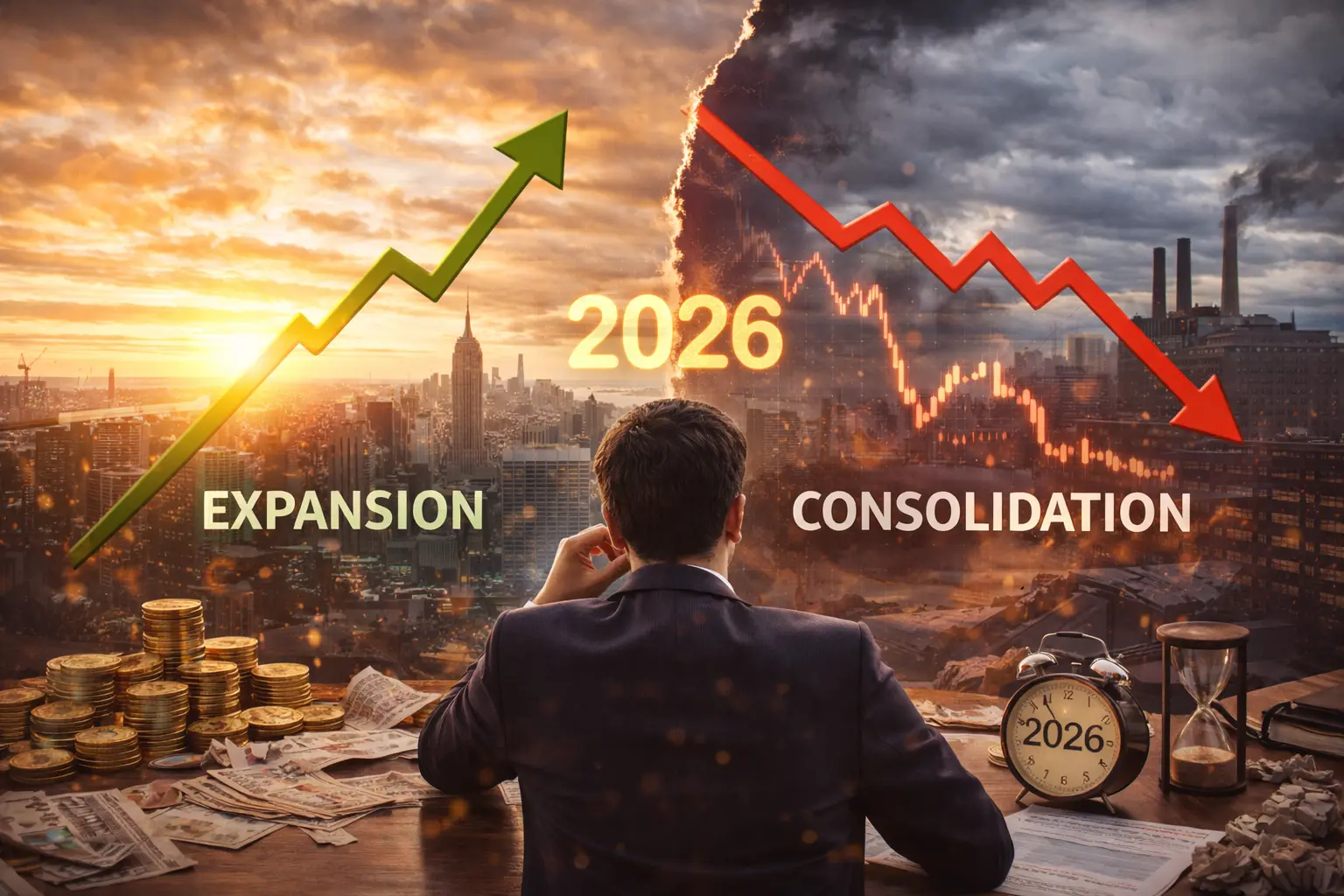
Market cycles are rarely symmetrical. Long periods of expansion are often followed not by immediate collapse, but by phases of consolidation where excess is absorbed, expectations reset, and capital becomes more selective. The year 2026 stands out as a point where many of the conditions that supported prolonged expansion are fading, while the forces that encourage consolidation are becoming more dominant. This transition does not necessarily imply a crisis. It implies a change in how growth, risk, and opportunity are expressed across markets.
Understanding this shift is critical for investors because strategies that thrive during expansion often struggle during consolidation. Recognising the transition early allows portfolios to adapt rather than react.
The Nature of Expansion Versus Consolidation Cycles
Expansion cycles are characterised by rising liquidity, broad participation, and optimism about future growth. Capital flows freely, valuations expand, and risk-taking is rewarded. Consolidation cycles are different. They are periods of digestion rather than acceleration. Growth continues, but unevenly. Markets focus more on quality, sustainability, and balance sheet strength.
In consolidation phases, returns become more selective and volatility often increases. Instead of broad upward momentum, markets move sideways with sharp rotations beneath the surface. This environment challenges investors who rely on momentum or passive exposure alone.
The shift from expansion to consolidation is subtle at first, which is why many investors miss it.
Why the Drivers of Expansion Are Losing Momentum
The expansion that dominated the previous cycle was supported by extraordinary liquidity, low capital costs, and policy flexibility. By 2026, these drivers no longer operate with the same intensity. Capital has become more expensive, inflation sensitivity remains elevated, and policy responses are more constrained by trade-offs.
This does not eliminate growth, but it changes its character. Growth becomes harder-earned, less evenly distributed, and more dependent on execution rather than narrative. Markets become less forgiving of inefficiency and excess.
As these supports weaken, consolidation naturally follows.
Liquidity Tightening and Its Consolidation Effects
Liquidity is a powerful force behind expansion. When liquidity tightens, even modestly, markets shift behavior. In 2026, liquidity conditions are more variable, with periods of calm punctuated by sudden tightening.
This variability encourages consolidation. Assets reprice, weaker participants are pressured, and capital rotates toward stability. Markets spend more time consolidating past gains rather than extending them.
Liquidity-driven consolidation is not always dramatic, but it is persistent, reshaping market structure over time.
Valuation Compression After Years of Expansion
Extended expansion cycles often leave behind stretched valuations. Consolidation phases address this imbalance through time rather than price alone. Markets may move sideways for extended periods while earnings catch up.
In 2026, valuation compression is more likely to occur unevenly. High-quality assets may hold value while speculative assets correct more deeply. This divergence reflects a market focused on durability rather than growth at any cost.
Understanding valuation dynamics helps investors avoid frustration during periods of limited headline progress.
Shifts in Market Leadership
One of the clearest signs of a transition to consolidation is a change in market leadership. Assets and sectors that dominated during expansion often lose momentum, while previously overlooked areas begin to outperform.
In consolidation cycles, leadership tends to favor cash flow generation, pricing power, and capital discipline. Growth remains relevant, but it is evaluated through a stricter lens.
This shift requires investors to reassess assumptions about what constitutes “strength” in the market.
Volatility as a Feature of Consolidation
Consolidation cycles are rarely quiet. Volatility increases as markets test boundaries and reassess value. In 2026, volatility reflects uncertainty about the path forward rather than panic.
This volatility serves a function. It redistributes capital, reveals weak positioning, and discourages complacency. Investors who interpret volatility solely as risk may miss its role in resetting conditions for future growth.
In consolidation phases, volatility becomes a diagnostic tool rather than a threat.
The Role of Time in Market Consolidation
Consolidation is as much about time as it is about price. Markets often require extended periods to absorb the effects of prior expansion. In 2026, this time-based consolidation may frustrate those expecting rapid returns.
However, time allows fundamentals to reassert themselves. Earnings grow into valuations, balance sheets strengthen, and expectations become more realistic. This process creates a healthier foundation for the next expansion.
Patience becomes a strategic asset during such periods.
Investor Psychology During Transition Phases
Transitions from expansion to consolidation challenge investor psychology. Optimism from the prior cycle lingers, creating resistance to the idea that conditions have changed. At the same time, the absence of easy gains leads to disappointment and overtrading.
In 2026, successful investors will recognise that consolidation is not failure. It is a necessary phase in the market’s evolution. Adjusting expectations reduces emotional decision-making and supports disciplined strategy.
Psychological adaptation is often more important than analytical precision during transitions.
Why Passive Strategies Face New Challenges
During broad expansion, passive exposure performs well because rising tides lift most assets. Consolidation cycles are less forgiving. Returns become uneven, and passive strategies may experience long periods of stagnation.
This does not render passive investing obsolete, but it does require recalibration. Selectivity, risk management, and active decision-making regain importance in a consolidating environment.
Investors who understand this shift can adapt without abandoning core principles.
Consolidation as Preparation, Not Decline
It is important to view consolidation as preparation rather than decline. Markets that consolidate effectively emerge stronger and more sustainable. The process clears excess, improves capital allocation, and restores balance.
In 2026, consolidation provides an opportunity for disciplined investors to position for the next phase. Those who preserve capital and maintain flexibility can take advantage of mispricings that arise during this period.
Consolidation lays the groundwork for future expansion, even if it feels uncomfortable in the moment.
Adapting Portfolio Strategy for Consolidation Cycles
Recognising the transition to consolidation encourages a shift in portfolio strategy. Emphasis moves toward resilience, income stability, and selective growth. Risk is managed more actively, and patience is rewarded.
This adaptation does not require abandoning growth entirely. It requires aligning exposure with the realities of the cycle rather than the memories of the past.
Portfolios designed for consolidation are better positioned to endure uncertainty and benefit when expansion eventually resumes.
Annual Letter 2026 by Rajeev Prakash Agarwal
Markets are entering a phase where easy assumptions no longer work. Liquidity is selective, volatility is structural, and capital is rewarded only when it is positioned with clarity and discipline. In such an environment, reacting to headlines is not enough. What matters is having a forward-looking framework that helps you anticipate change rather than chase it.
The Annual Letter 2026 by Rajeev Prakash Agarwal offers a comprehensive investment outlook designed for this new market regime. It blends long-term macro analysis, market psychology, and planetary cycles that have historically aligned with major shifts in global capital flows. The focus is on understanding cycles, identifying high-probability phases, and protecting capital during periods of uncertainty.

Understanding 2026 as a Turning Phase
The significance of 2026 lies not in a single event, but in the accumulation of signals pointing toward consolidation. Liquidity, valuations, leadership, and psychology are all evolving.
Investors who recognise this transition early gain an advantage. They avoid forcing expansion-era strategies into a consolidating environment and reduce the risk of disappointment.
By understanding why 2026 signals a shift from expansion to consolidation cycles, investors can navigate the year with greater clarity, discipline, and resilience, positioning themselves not just for survival, but for long-term opportunity beyond the current phase.
How Capital Allocation Changes During Consolidation Cycles
One of the most important yet subtle changes during a transition from expansion to consolidation is how capital is allocated. In expansion phases, capital chases growth aggressively, often tolerating inefficiency, leverage, and long payback periods. In consolidation cycles, capital becomes more demanding. It seeks clarity, durability, and visible returns rather than distant promises.
In 2026, this shift is evident in how markets reward certainty over ambition. Businesses and assets that can demonstrate stable cash generation, disciplined reinvestment, and balance sheet strength attract capital even when broader markets stagnate. Capital becomes selective rather than abundant, and allocation decisions carry greater consequences.
This change reshapes market behavior at every level, from equity leadership to credit conditions.
Consolidation Cycles Reveal True Competitive Advantages
Expansion phases often blur distinctions between strong and weak business models. Easy capital allows many participants to survive simultaneously. Consolidation cycles remove that protection. Competitive advantages that were theoretical during expansion must now prove themselves in real operating conditions.
In 2026, consolidation exposes which companies and assets can maintain margins, defend market share, and adapt to changing input costs. Those without genuine advantages struggle to justify valuations or access capital on favorable terms.
For investors, this environment rewards deeper analysis and patience. Superficial growth metrics give way to a focus on sustainability.
The Slowing of Narrative Velocity
During expansion, narratives travel faster than fundamentals. Stories about disruption, innovation, or transformation can drive valuations ahead of evidence. Consolidation slows narrative velocity. Markets demand confirmation before repricing assets higher.
In 2026, this slowdown means that even strong themes take longer to express themselves in prices. Progress is incremental rather than explosive. Investors accustomed to rapid narrative-driven rallies may feel disoriented.
Understanding this change helps set realistic expectations and reduces the temptation to abandon sound positions prematurely.
Why Sideways Markets Are Mentally Difficult but Structurally Healthy
Sideways markets are a hallmark of consolidation. They are mentally challenging because effort does not translate into immediate reward. However, structurally, they serve an essential purpose.
In 2026, sideways movement allows excess optimism to dissipate without catastrophic decline. It gives time for earnings to grow, debt to be managed, and capital allocation to improve. Markets that skip this process often face sharper corrections later.
Recognising the health of sideways consolidation helps investors stay engaged rather than disengaged.
Credit Conditions as a Silent Enforcer of Consolidation
Credit plays a crucial role in reinforcing consolidation cycles. When credit is cheap and accessible, expansion accelerates. When credit becomes selective, consolidation takes hold.
In 2026, tighter lending standards and higher refinancing costs act as a silent discipline mechanism. Projects that once made sense under low-cost capital are reconsidered. This filtering process reduces excess and improves long-term efficiency, but it also slows visible growth.
Investors who track credit conditions gain early insight into how deep and prolonged consolidation may become.
Consolidation Does Not Mean Uniform Weakness
A common misconception is that consolidation implies broad underperformance. In reality, consolidation increases dispersion. While indices may move sideways, individual assets and sectors can experience meaningful gains or losses.
In 2026, this dispersion favors those who focus on relative strength, balance sheet resilience, and alignment with structural demand. It punishes broad assumptions and passive expectations.
Consolidation rewards discernment rather than optimism.
The Reset of Risk Premiums
Expansion cycles compress risk premiums. Investors demand less compensation for uncertainty because conditions feel forgiving. Consolidation cycles reverse this trend. Risk premiums widen, even if gradually.
In 2026, this reset affects equities, credit, and alternative assets. Returns may not look attractive until prices adjust or fundamentals strengthen. This repricing can take time, reinforcing the sideways nature of markets.
Understanding risk premium dynamics prevents frustration and misinterpretation of subdued returns.
Time as the Primary Adjustment Mechanism
Not all imbalances resolve through sharp price moves. Often, they resolve through time. Consolidation cycles use time to realign expectations with reality.
In 2026, many assets may experience long periods of limited progress rather than dramatic decline. This time-based adjustment is easy to misread as stagnation, but it is a normal part of the cycle.
Investors who respect time as a mechanism avoid unnecessary repositioning and preserve capital for future opportunity.
Behavioral Shifts During Prolonged Consolidation
As consolidation persists, investor behavior changes. Participation narrows, attention shifts away from markets, and enthusiasm fades. This behavioral cooling is part of the consolidation process.
In 2026, declining excitement and reduced trading volume may coexist with underlying stability. These conditions often precede the emergence of more durable opportunities, as excess speculation has been worked off.
Recognising behavioral fatigue as a signal rather than a warning helps investors maintain perspective.
Consolidation and the Return of Strategy Discipline
Expansion cycles reward speed and exposure. Consolidation cycles reward discipline and process. In 2026, disciplined investors who manage risk, size positions appropriately, and remain selective are more likely to achieve consistent outcomes.
This discipline includes knowing when to act and when to wait. Consolidation does not reward constant activity. It rewards thoughtful engagement.
Strategy discipline becomes a competitive advantage when momentum fades.