
Commodities as Signals: Inflation, Growth, Liquidity and Risk Across Long Cycles
Agricultural markets, metals, and energy prices reveal far more than short-term supply and demand imbalances. Over long horizons, they act as signals about inflation, economic growth, liquidity conditions, and shifting risk appetite. These signals unfold slowly, often over years, rather than weeks.
This piece is written as a framework, not a forecast. Its purpose is to help investors read commodity markets the way a disciplined long-term allocator might: patiently, probabilistically, and in relation to broader macro forces. Commodities are treated here as indicators of economic regimes, not vehicles for tactical speculation.
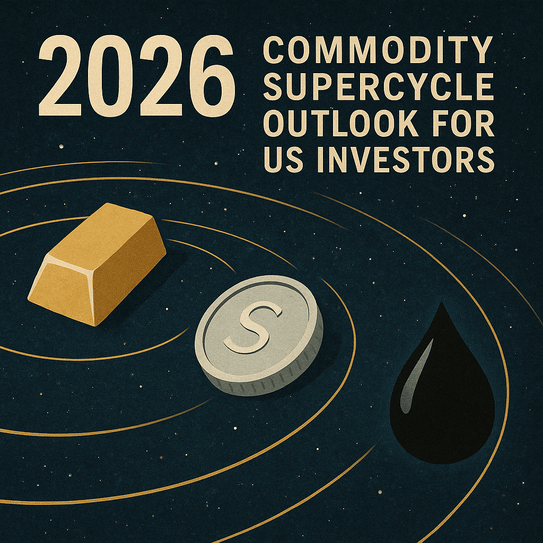
The illustration guideline you selected, showing gold, silver, and oil placed along a cosmic timeline, captures this idea well. Time, cycles, and market forces move together in patterns that are never perfectly predictable. Even so, they often express recurring rhythms that reward patient observation.
In the sections that follow, the emphasis stays on how commodities can be used to interpret inflation and risk cycles. Specific price targets are deliberately avoided. This approach makes the content durable, educational, and well suited to WordPress readers who want to deepen their macro understanding without being drawn into short-term trading narratives..
Why Commodities Matter When Thinking About Inflation
Inflation is not an abstract statistic for US investors. It shapes real returns, compresses or expands valuation multiples, and influences decisions across equities, bonds, and cash. Commodities sit close to the source of inflation because they represent the inputs that flow through production, transportation, and distribution systems.
Short-term commodity rallies often reflect normal cyclical dynamics. Persistent strength over multiple years suggests something deeper. Structural drivers may include fiscal deficits, capacity constraints, labour shortages, geopolitical fragmentation, or sustained shifts in global demand.
Observing commodity markets offers several advantages. One benefit is visibility into cost pressure building within the production pipeline. Another is insight into how central banks may respond, not through precise policy actions, but through broader financial conditions. Commodities also highlight where global growth originates, since demand surges frequently begin outside the US and feed back into domestic inflation and earnings.
When commodities are treated as information rather than speculation, inflation risk becomes easier to contextualise. This mindset aligns well with a Buffett-style philosophy that prioritises long-term economic reality over short-term noise.
Metals as Indicators of Wealth, Credit and Risk Sentiment
Metals occupy a unique position within the commodity complex. Gold and silver sit at the intersection of monetary history and investor psychology. Base metals, such as copper and aluminium, reflect real-world industrial activity.
Gold has long been viewed as a store of value. Periods of low or negative real interest rates often coincide with renewed interest in wealth preservation. The most useful signal, however, lies in gold’s behaviour relative to other assets. Strength during equity stress and bond market instability often points to defensive positioning rather than speculation.
Silver introduces additional nuance. Its dual role as both a monetary and industrial metal allows it to respond to different forces at different times. When growth expectations rise and investment accelerates, silver’s industrial demand can become more prominent. Changes in the gold-to-silver ratio often reflect whether fear or optimism is dominating investor behaviour.
Base metals provide a clearer read on economic momentum. Copper, often described as a diagnostic indicator of global growth, responds to construction activity, electrification trends, and capital expenditure. Coordinated strength across base metals usually signals expanding credit availability and rising confidence in future demand.
From a 2026 perspective, the relationship between precious and industrial metals matters more than any single price level. Defensive strength in gold alongside weak base metals may suggest anxiety and risk aversion. Broad-based strength across metals may indicate inflationary growth, where nominal gains look attractive but real returns remain uncertain.

Metals as Barometers of Wealth, Credit, and Risk Sentiment
Metals, especially gold and silver, occupy a special place in the commodity complex. They sit at the intersection of monetary history, investor psychology, and macro risk. For centuries, gold has acted as a store of value and a reference point for currencies. Silver, often more volatile, carries both monetary and industrial characteristics. Base metals such as copper and aluminium, meanwhile, tell you about real-world industrial activity.
When real interest rates are low or negative and investors worry about currency debasement, gold tends to attract attention as a wealth preservation asset. However, the deeper signal is not in any single price move. It lies in how gold behaves relative to other assets. If gold is firm while equities are struggling and bond yields are unstable, it often reflects a search for safety and a desire to hold assets perceived as outside the financial system.
Silver, with its dual role, can sometimes amplify these signals. In phases where investors expect growth and structural investment in new technologies, silver’s industrial use in electronics and solar applications becomes more prominent. Its ratio to gold can hint at how much of the precious metals rally is driven by pure fear versus optimism about future activity.
Base metals are more directly linked to economic expansion. Copper, famously nicknamed “Dr Copper” for its ability to diagnose the global economy, tends to respond to construction activity, electrification trends, and broader industrial demand. When base metals strengthen in a coordinated way, it frequently suggests that growth expectations, credit availability, and capex plans are on an upswing.
In a 2026 framework, US investors can use metals to understand which forces are dominating. Strong precious metals with weak base metals may reflect anxiety and defensive positioning. Broad strength across both groups may indicate that inflation and growth are rising together, possibly pointing to an environment where nominal returns look high but real returns are harder to secure. The point is not to predict where gold or silver will trade, but to read their behaviour as part of an integrated narrative about wealth protection, credit trends and risk appetite.
Energy Markets and the Rhythm of Global Growth
Energy commodities reflect the pulse of the global economy. Oil and natural gas influence inflation readings, corporate margins, and household expenses. They also sit at the centre of geopolitical strategy and the long-term energy transition.
Rising energy prices driven by strong demand and constrained supply often indicate an economy running near capacity. Transportation networks tighten, refineries operate at high utilisation, and bottlenecks become visible. In the short term, these dynamics are inflationary. Over longer horizons, the critical question is whether producers invest enough to expand capacity.
Natural gas adds a regional dimension. Infrastructure limits, weather patterns, and political tensions can all disrupt supply. Even when domestic markets appear stable, global dislocations can alter trade flows and influence prices indirectly.
Discussions about an energy supercycle frequently focus on underinvestment, regulatory pressures, and emerging demand from data centres, electrification, and developing economies. For US investors, the goal is not to predict prices but to assess whether the balance between supply discipline and demand growth is tightening or easing.
Viewed through this lens, energy markets help clarify whether inflation pressure is likely to persist or fade. They also highlight potential stress points within the global growth engine
Agricultural Commodities and Everyday Inflation Pressure
Agricultural markets connect directly to consumer experience. Food prices shape household sentiment, political pressure, and spending behaviour. For investors, these markets provide insight into the resilience of consumer demand and the stability of social and economic systems.
Grains, soft commodities, and livestock each respond to distinct drivers. Weather variability, input costs, biofuel policies, and dietary shifts all play roles. Taken together, agricultural price trends reveal whether food inflation is broad-based or isolated.
Structural themes in agriculture include population growth, climate variability, technological innovation, and land use changes. High energy and fertiliser costs can push prices higher even during strong harvests. Technological improvements and favourable conditions, by contrast, can temporarily relieve pressure.
For long-term investors, agricultural commodities function less as tradable assets and more as indicators. Persistent food inflation can erode real incomes and reduce discretionary spending. These effects eventually surface in earnings and policy decisions

If you are a long term investor
As a long-horizon investor, rely on the Annual Letter 2026 to position yourself for major macro cycles and sector shifts, aligning with multi-month themes in global markets instead of chasing every short-term fluctuation.
Cross-Asset Signals: Commodities, Equities, Bonds and the Dollar
Commodity signals gain meaning when placed alongside equities, bonds, and currencies. Rising commodities accompanied by strong equities and stable credit often suggest a reflationary environment. Growth and inflation rise together, favouring cyclical sectors and real assets.
A different picture emerges when commodities rise while equities struggle and bond yields spike. In such cases, inflation fear may be overwhelming growth optimism. Financial conditions tighten, and volatility increases.
The US dollar adds another layer. Strong commodity prices alongside a firm dollar imply robust demand or tight supply. A weaker dollar, on the other hand, can amplify commodity strength and shift attention toward foreign and real assets.
Recognising these configurations helps investors identify regimes rather than chase individual moves. Over time, this awareness builds confidence in interpreting macro signals calmly.
Integrating Cycles and a Non-Predictive View of 2026
Although this framework references 2026, its value lies in scenario thinking rather than prediction. Commodities respond differently across inflation and growth regimes. High inflation combined with strong growth produces different outcomes than inflation paired with stagnation.
Cycle-oriented investors often map these regimes across time. Structural forces, liquidity conditions, and sentiment tend to align in waves. The cosmic timeline metaphor is useful because it emphasises rhythm over precision.
Documenting how commodities behaved during past regime shifts provides context. Comparing current conditions with earlier periods refines expectations about volatility and sector leadership. This approach treats 2026 as part of a longer research arc rather than a single decisive moment.
A Buffett-Style Perspective on Commodities
A Buffett-style mindset avoids short-term forecasting while remaining deeply engaged with economic fundamentals. Commodities, viewed through this lens, become tools for understanding business economics rather than speculative opportunities.
The central question is not whether gold or oil will outperform in a given year. Instead, it is whether the prevailing commodity regime supports or undermines the economics of quality businesses. Persistent input cost pressure favours firms with pricing power and structural advantages. Easing pressure benefits capital-light franchises with stable demand.
Repeatability matters. Investors who develop a consistent process for reading commodity signals can apply it across cycles. Over time, the framework itself becomes an asset.
Positioning Annual Letter 2026 Within This Framework
Annual Letter 2026 can use this commodity framework without making explicit forecasts. The letter can position commodities as one of several lenses through which investors interpret evolving macro conditions.
By examining historical interactions between commodities, inflation, and asset performance, the letter can outline scenarios rather than predictions. It can explain how different commodity regimes influence sector leadership, correlations, and risk management decisions.
This approach reinforces credibility. Investors are offered a disciplined way to think, not a list of price targets. Commodities become part of a broader language of cycles, time, and capital allocation.
Framed this way, Annual Letter 2026 stands apart. It teaches investors how to read the landscape calmly and intelligently, using commodities as signals rather than temptations. That is what makes the framework durable, educational, and genuinely useful.